The best way to plan rest stops on a long drive is to decide them before you turn the key: break your trip into roughly two-hour driving legs, pick one stop per leg, and give each stop a length that matches what you actually need there. Plan it on paper or in a map app the night before and you will never be hunting for a place to pull over at the exact moment your eyes start to droop.
Below is the method I actually use, plus what veteran drivers on forums like r/roadtrip and iRV2 get right about fatigue. It takes maybe 30 minutes of planning for a full day of driving.
- The rule: stop for at least 15 minutes every 2 hours of driving.
- The ceiling: fatigue can set in after about 6 hours of continuous freeway driving.
- The longer break: give yourself 20 minutes or more around the 4-hour mark, and a real meal stop every 4 to 5 hours.
- The overnight rule: if the whole drive exceeds 8 to 10 hours, book a night somewhere. Do not plan to push through.
Table of Contents
- What You Need
- Step-by-Step: How to Plan Rest Stops on a Long Drive
- Estimate Your Total Driving Time
- Set Rest Stops by Time, Not Distance Alone
- Choose Stops That Match the Break
- Build a Flexible Route Plan
- Common Mistakes
- Frequently Asked Questions
- How often should I stop on a long drive?
- What is the best length for a rest stop?
- Can I safely sleep in my car at a highway rest area?
- What should I do if every rest area along my route is closed or full?
- How do I plan rest stops when driving with children or passengers who need frequent breaks?
- Conclusion
What You Need
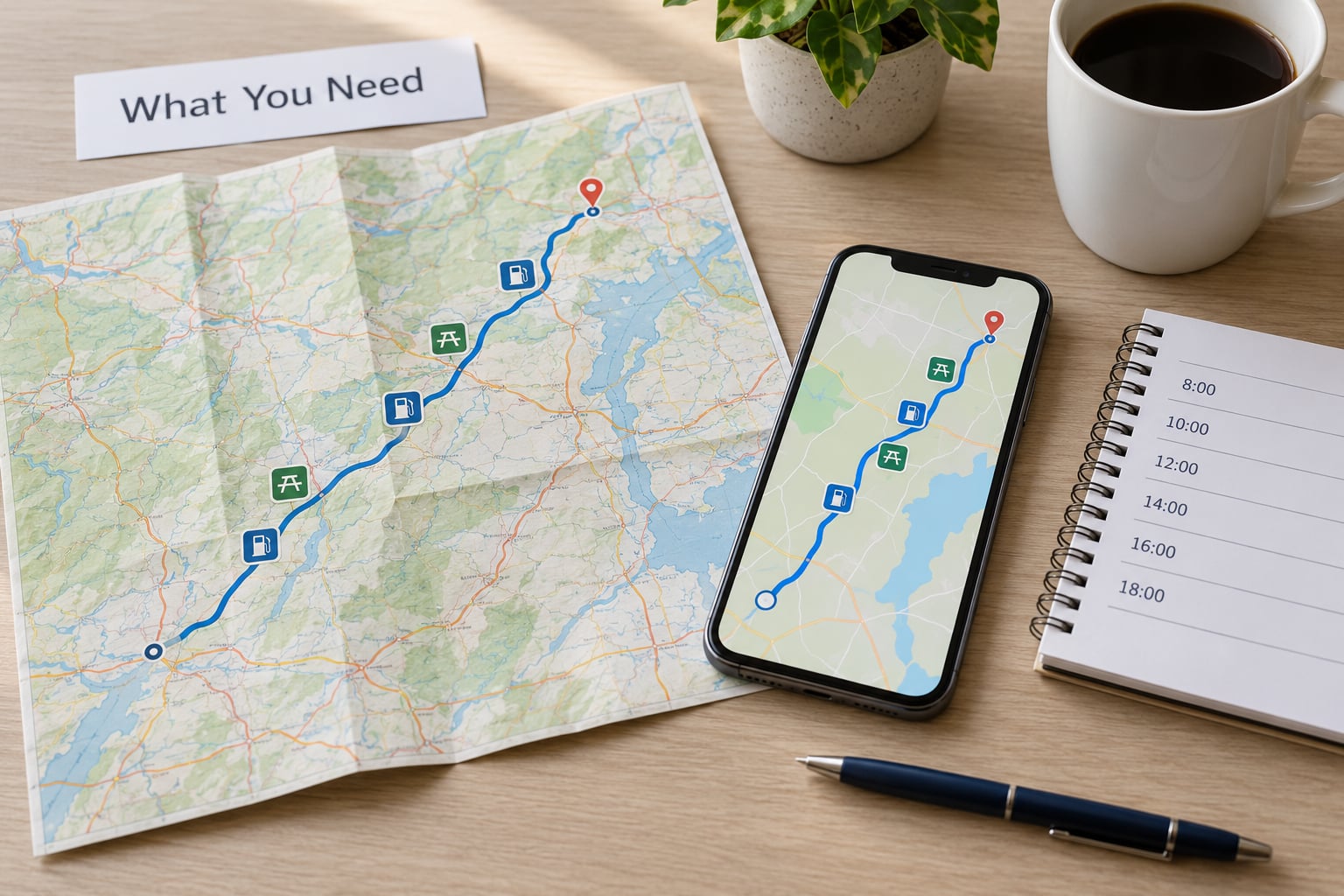
You need four things before you can build a schedule, and none of them cost money or take more than an evening.
Route facts. Start and end point, total distance, and roughly how much of that distance is freeway. Freeway miles matter far more than total miles, because monotonous high-speed driving is what wears a driver out.
A timing source. A map app with live traffic is enough. Google Maps, Waze and Roadtrippers all work; they differ mostly in how many stops they let you add before the interface gets annoying.
Vehicle and supply checks. Fuel level, tyre pressure, oil, and a working phone charger. Veteran road trippers on r/roadtrip carry a small kit of a cooler, a first aid kit, a tyre plug kit, water, snacks, a blanket, and a spare toothbrush and toothpaste.
Passenger needs. If anyone is coming along, find out now whether they need a toilet every hour, whether a child will nap midday, and whether anyone has to be somewhere at a fixed time. A stop plan built for the driver alone fails on trips with kids.
One more thing worth checking before departure: whether you are crossing a time zone. Gaining an hour west of the Mississippi can quietly eat your afternoon, and losing one heading east can push your last rest stop into the middle of the night.
Step-by-Step: How to Plan Rest Stops on a Long Drive
Estimate Your Total Driving Time
Start with driving time only. Strip sightseeing, waiting for the kids to finish, and the hour you will lose to lunch out of the estimate, because none of those hours need a rest stop attached to them.
Then add realistic padding. A congested metro approach can add 45 minutes to a leg that maps at two hours. Mountain passes in winter, border crossings, toll queues and a single lane closure in the wrong place all do the same thing. If your map says eight hours, plan for nine and a half.
Next, find your longest continuous stretch of driving. This is the number that matters, not the total for the day. A trip of four hours broken into two short hops with a long stop in the middle is easier than a trip of four hours done as one block.
That figure also tells you whether an overnight stop belongs in the plan at all. Past roughly 8 to 10 hours of total driving, a night stop is not a luxury. It is the difference between arriving functional and arriving asleep at the wheel.
Set Rest Stops by Time, Not Distance Alone
Distance alone is a poor ruler. Sixty miles on a back road at 40 mph is nothing; sixty miles of straight interstate at 75 mph is a two-hour attention drain. Set your stops by minutes behind the wheel instead. Getting this rhythm right is the part of how to plan rest stops on a long drive that actually keeps you safe.
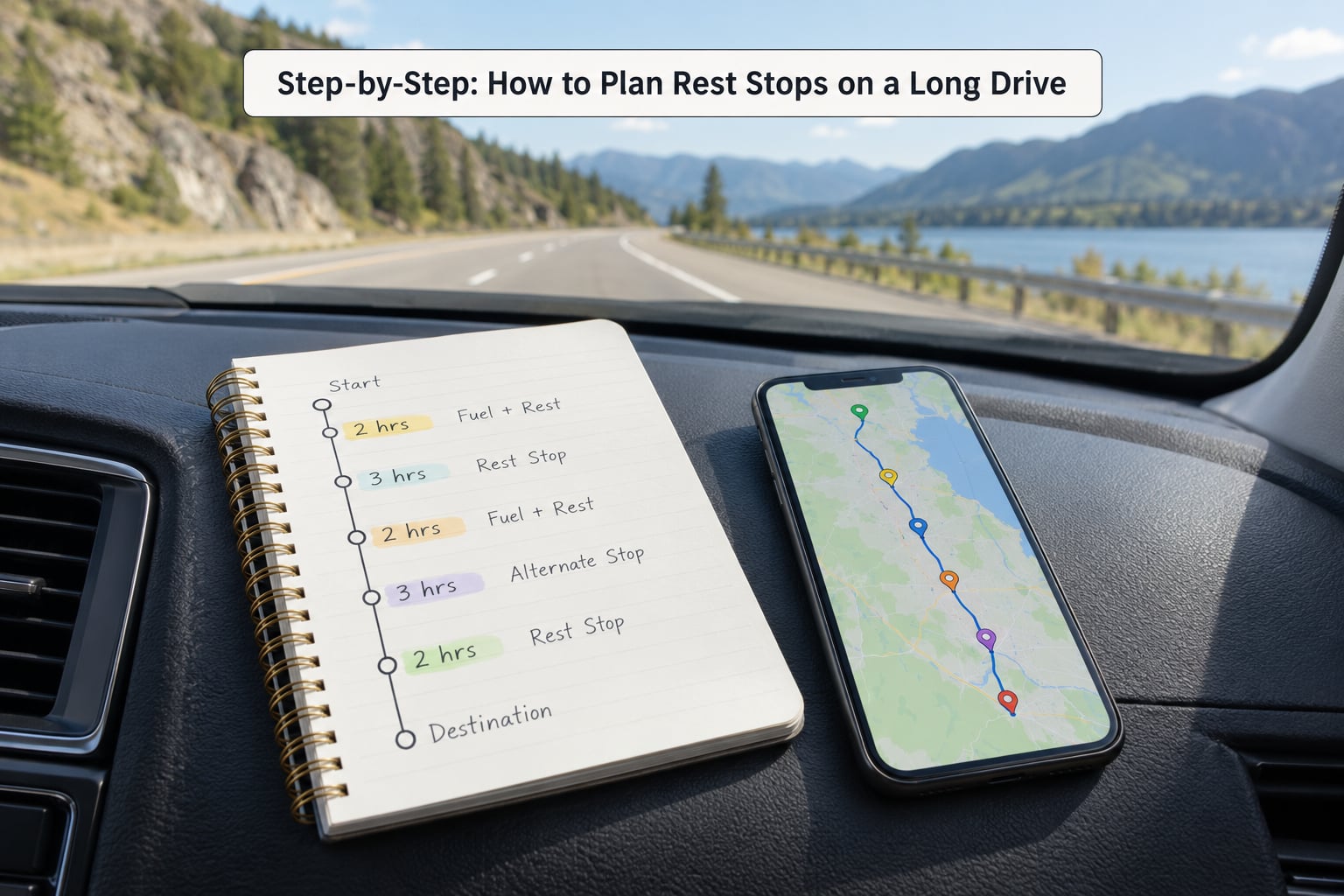
The working cadence is simple: a 15 to 20 minute break every 2 hours, a longer break of 20 minutes or more near the 4-hour mark, a proper meal stop every 4 to 5 hours, and a night stop once the day passes 8 to 10 hours. If two of those land in the same place, merge them and give yourself the full meal.
Layer the local clock on top too. The worst window for fatigue is roughly 3am to 5am, when your body is deepest into its natural sleep rhythm. If your schedule puts you behind the wheel then, move the start time, share the driving, or plan a 20-minute nap into the leg just before it.
Watch for the early signs rather than waiting for the feeling. Physical signs: frequent blinking, yawning, heavy eyelids, eyes going out of focus. Mental signs: wandering thoughts, drifting off mentally mid-sentence, not being able to recall the last stretch of road. Driving mistakes: drifting toward a lane edge, missing a sign or an exit you normally would not, braking later than usual, slowing down without meaning to.
The moment you notice two or more of those, stop at the next safe place regardless of what the schedule says. A veteran RV driver on the iRV2 forums put it plainly: fatigue sets in at about six hours of freeway driving, so they stop roughly every two hours to stretch and walk around. That rule is the single most useful thing in this whole guide.
Choose Stops That Match the Break
Not every stop needs to be a picnic table under a tree. Match the stop to what you actually need at that point in the drive.
Quick comfort stop (5 to 10 minutes). A toilet and a stretch. Useful mid-leg, but be honest about what it restores. EV drivers on r/rav4prime make exactly this point: a bathroom-only break is too short to actually rest, and you get back behind the wheel still tired.
Fuel-and-food stop (15 to 30 minutes). A gas station or service area where you can refuel, use a restroom, and grab something to eat. This is the workhorse stop for most itineraries.
Restorative break (20 to 40 minutes). A walk, a short nap of 20 minutes or less, some daylight. This is the stop that actually resets alertness, and it is the one most often skipped.
Overnight stop. A hotel, motel, campground or, in some states, a rest area. Book it before you go.
| Stop type | Restrooms | Food | Fuel | Overnight use | Best for |
|---|---|---|---|---|---|
| Public rest area | Usually | Vending at best | No | Varies by state | Quick comfort stop and short walks |
| Service area | Yes | Yes | Yes | Generally no | The main fuel-and-food stop |
| Travel information center | Yes | Sometimes | No | No | Touring at the start or end of a leg |
| Gas station | Yes, quality varies | Snacks | Yes | No | Backup when a planned stop fails |
| Coffee shop | Usually | Yes | No | No | Quick reset on a short leg |
| Truck stop | Yes, usually cleanest | Yes | Yes | Sometimes | Longer, better-equipped stops |
| Hotel or motel | Yes | Off-site | No | Yes | Any drive past 8 hours |
| Campground | Varies | You bring it | No | Yes | Camper vans and car camping |
A few practical criteria decide between them. Look for working restrooms first, then shade or shelter, then somewhere to walk a loop, then food. If you are travelling alone at night, pick busier, well-lit places. The most-repeated advice given to a solo woman driver on r/roadtrip was exactly that: stop at busier rest stops and gas stations rather than the deserted ones.
On overnight stops, the rules genuinely differ by state and by facility. Some states allow sleeping in a parked car at a rest area and some do not, and time limits may apply. Check your state DOT rest area page before you plan on it, and treat a rest area as an emergency option rather than a booking.
Build a Flexible Route Plan
A schedule with no backup is a schedule that will fail. Build two stops into every long leg: one primary stop and one you are happy to use instead.
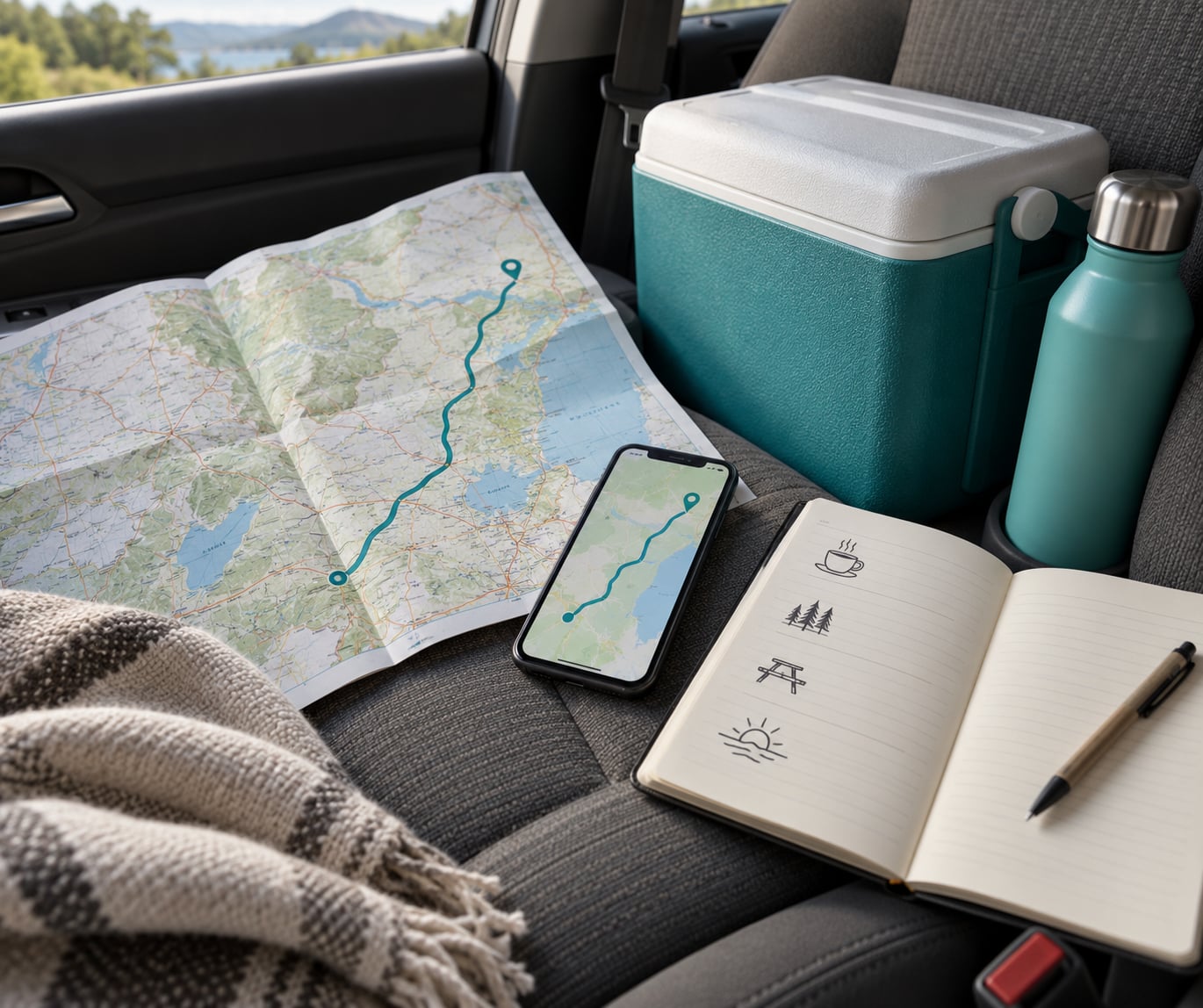
Adding the stops takes a few minutes. In Google Maps, search your destination, then use Add a stop to drop in each rest area in sequence; on mobile it is under the three-dot menu on the route. The trick long-distance drivers mention most often is dragging the blue route line: as you drag it, each segment shows its hours, which tells you exactly how far you can go before each break. Roadtrippers does the same job with explicit waypoints and is easier to keep as a shared list.
Then cross-check what the map claims. State DOT pages list public rest areas with their facilities, and on US interstates the gaps between them are uneven. Two drivers will not get the same spacing on the same route, so know where your backup options sit before the exit passes rather than after.
Save the plan offline before you leave, and share it with a passenger. Screens die, signal drops out in canyons, and a paper list in the glovebox works in every condition. If you are running two drivers, put the changeovers in the plan as fixed events at the stops rather than as a vague “swap when tired”.
When a planned stop fails, here is the order I use. Pull into the nearest fuel stop and use the restroom there. Then reassess: if you are only slightly behind, drop the stop and absorb the delay in the buffer. If you are genuinely tired, take the 20 minutes anyway and push the arrival time. Arriving late is a small problem. Arriving having fought sleep for an hour is not.
Common Mistakes
Overplanning every minute. A schedule with nothing but tight legs leaves no room for the one delay that matters. Build in 15 to 20 percent slack and stop treating the plan as a contract.
Waiting until you feel tired. By the time fatigue is obvious, it has already affected your reaction time and judgement. This is why the 2-hour cadence exists as a fixed rule rather than a feeling-based one.
Relying on one stop per day. One fallback is enough. Two is where the plan gets flexible.
Treating a restroom stop as a real break. Five minutes off the road is not a break. If you have 20 minutes available, walk, get daylight, and drink water.
Skipping food and water. Dehydration and a blood sugar dip feel almost exactly like tiredness. Eat a real meal every 4 to 5 hours and keep water in the car rather than in the trunk. On r/costarica the standard workaround people actually use is to use the restroom whenever you stop to eat, so the stop covers both needs at once.
Ignoring passengers. A plan built around the driver’s alertness can leave a child or a motion-sensitive adult miserable for hours. Build their needs in as stops too.
Not checking access and rules. Overnight parking, restroom closures and seasonal facility shutdowns all vary. Two minutes on the state DOT page saves a bad surprise at 2am.
Confusing a rest stop with a fuel stop. Public rest areas generally have no fuel. If your tank is low, your stop is a service area or a gas station, and you should pick it on that basis rather than hoping.
A final habit from the forums that is worth stealing: put the stop times in writing and treat them as appointments. Drivers who plan and drivers who react arrive in a very different condition after ten hours.
Frequently Asked Questions
How often should I stop on a long drive?
Stop for at least 15 minutes every 2 hours of driving. Most drivers hold focus for roughly 2 hours before attention starts to drift, and fatigue can set in after about 6 hours of continuous freeway driving. Add a longer break of 20 minutes or more near the 4-hour mark, and stop sooner than the schedule if you notice fatigue signs.
What is the best length for a rest stop?
Fifteen minutes is the minimum, and 20 minutes is the practical target because it is long enough to walk a loop, use the restroom, and get daylight. Save longer breaks of 40 minutes or so for meals and for a nap of 20 minutes or less, which is long enough to refresh you without leaving you groggy when you get back in the car.
Can I safely sleep in my car at a highway rest area?
It depends entirely on the state and the facility. Some states permit overnight sleeping in a parked car at a rest area, others restrict or prohibit it, and some apply time limits. Check your state DOT rest area page before you rely on it, choose a well-lit and reasonably busy location, and treat it as a last resort rather than a booked option.
What should I do if every rest area along my route is closed or full?
Use the nearest fuel stop or service area instead, since most sell restrooms and food. Then decide honestly whether to absorb the delay in your buffer or to take the full break anyway. Public rest areas can also close seasonally or for maintenance, which is why every long leg in a good plan carries at least one backup stop you have not visited.
How do I plan rest stops when driving with children or passengers who need frequent breaks?
Plan more often than the 2-hour rule suggests, usually every 90 minutes to 2 hours, and favour stops with playgrounds, picnic tables, and easy restroom access. Build the driver’s restorative break into the same stop rather than adding separate ones, since a stop everyone uses at once is easier to manage than two stops close together.
Conclusion
How to plan rest stops on a long drive comes down to four numbers: 2 hours of driving, 15 minutes minimum away from the wheel, a longer break near the 4-hour mark, and an overnight stop once the day passes 8 to 10 hours. Everything else is detail, and the detail is what makes the plan survive a bad day of traffic.
Start with the longest driving stretch in your trip, not the whole itinerary. Find the two-hour mark inside it, pick a stop there, then pick a second one you would be happy to use instead. Add both to your map app, print a copy, and put the fixed stop times somewhere you will see them. That half hour of planning is the difference between a long drive and an exhausting one.