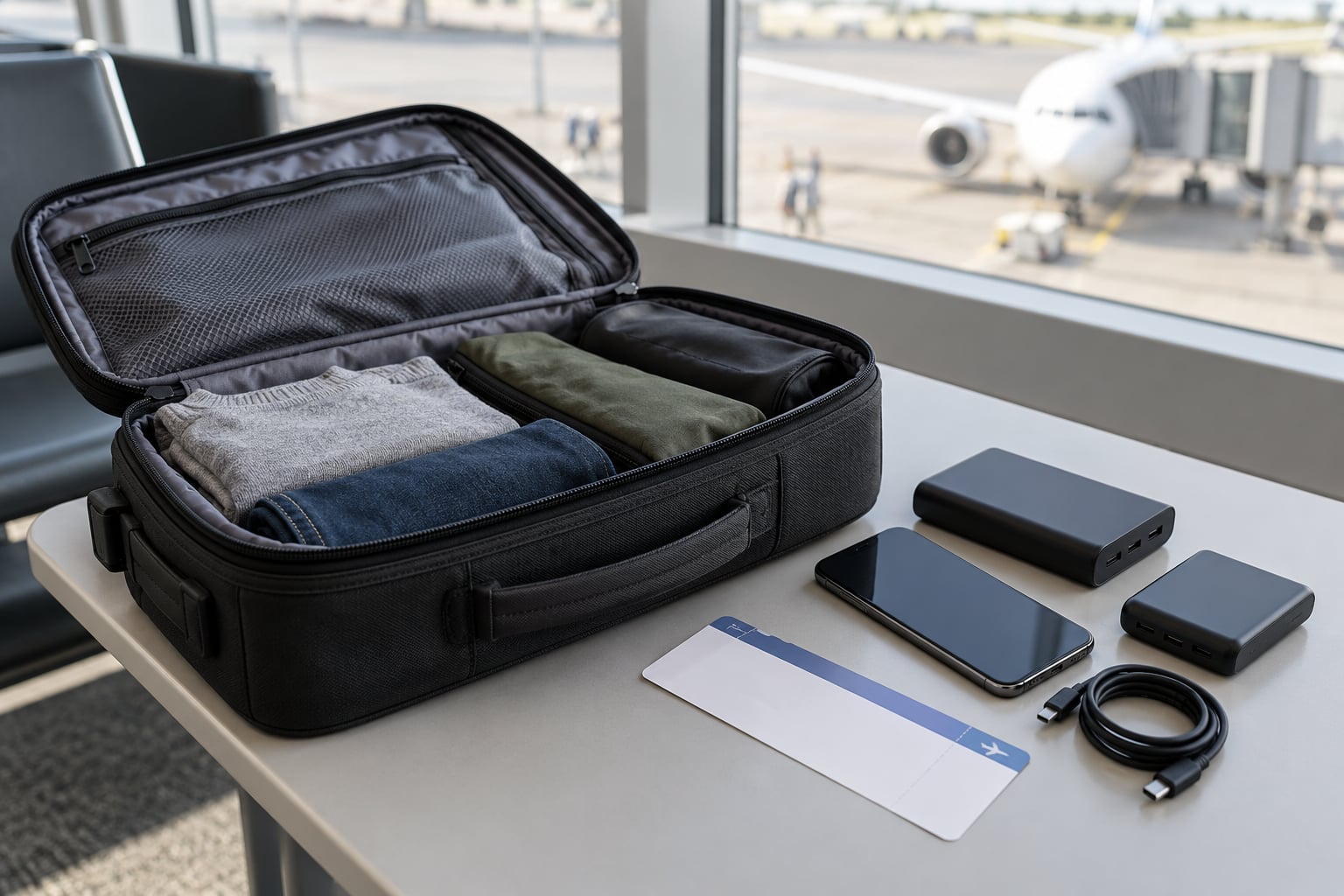
If you’re flying in the United States, the answer to how many power banks you can bring on a plane is two, each rated at 100 watt-hours (Wh) or less, carried in your cabin bag and never in checked luggage. Above 100 Wh the airline has to approve it in advance and the count stays at two; above 160 Wh you cannot fly with it at all. Some carriers, including Southwest and Emirates, allow only one.
Table of Contents
- How Many Power Banks Can You Bring on a Plane?
- What Are the FAA Power Bank Limits?
- How many power banks does the FAA actually allow?
- Can You Put Power Banks in Checked Luggage?
- What if your carry-on gets gate-checked?
- How Do Airlines Count and Approve Power Banks?
- How to Calculate a Power Bank’s Watt-Hours
- How Do Airport Screening Rules Affect Power Banks?
- What About Power Banks on International Flights?
- How to Pack and Use Power Banks Safely During a Flight
- Frequently Asked Questions
- Can I bring three power banks on a plane?
- Can I bring a 20,000mAh power bank on a plane?
- Can you fly with a 30,000mAh power bank?
- What is the maximum mAh for a power bank on a plane?
- Can you use a power bank on a plane?
- Do power banks count toward your personal item allowance?
- Conclusion
How Many Power Banks Can You Bring on a Plane?
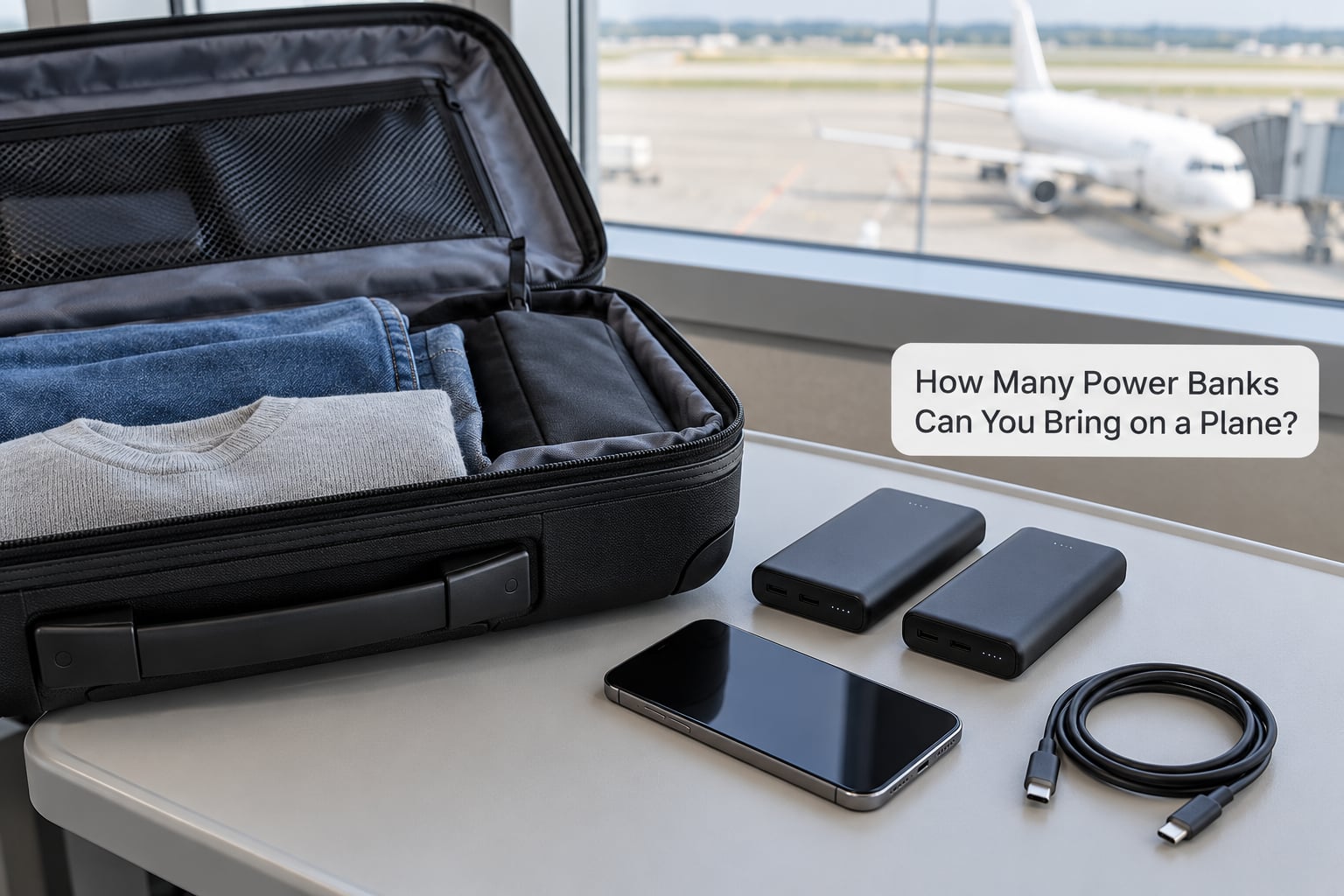
Here is the short version, broken into the three capacity bands that every aviation authority uses:
| Capacity | Typical size at 3.7 V | How many | Approval needed | Where it goes |
|---|---|---|---|---|
| Under 100 Wh | Up to about 27,000 mAh | Two | No | Carry-on only |
| 101–160 Wh | About 27,000–43,000 mAh | Two | Yes, from your airline in advance | Carry-on only |
| Over 160 Wh | Above about 43,000 mAh | Zero | Not permitted | Nowhere |
One thing to clear up first, because it’s where most of the confusion comes from: U.S. security screening does not set a quantity cap on power banks under 100 Wh. TSA checks the watt-hour rating, not how many you have. The two-power-bank limit you’re reading about comes from IATA guidance that airlines adopt as policy, and from individual carriers that went further.
That’s why you’ll find “no limit under 100 Wh” on some pages and “a maximum of two” on others. Both are describing a different rulemaker. Plan for two and you won’t argue with anyone at the gate.
What Are the FAA Power Bank Limits?
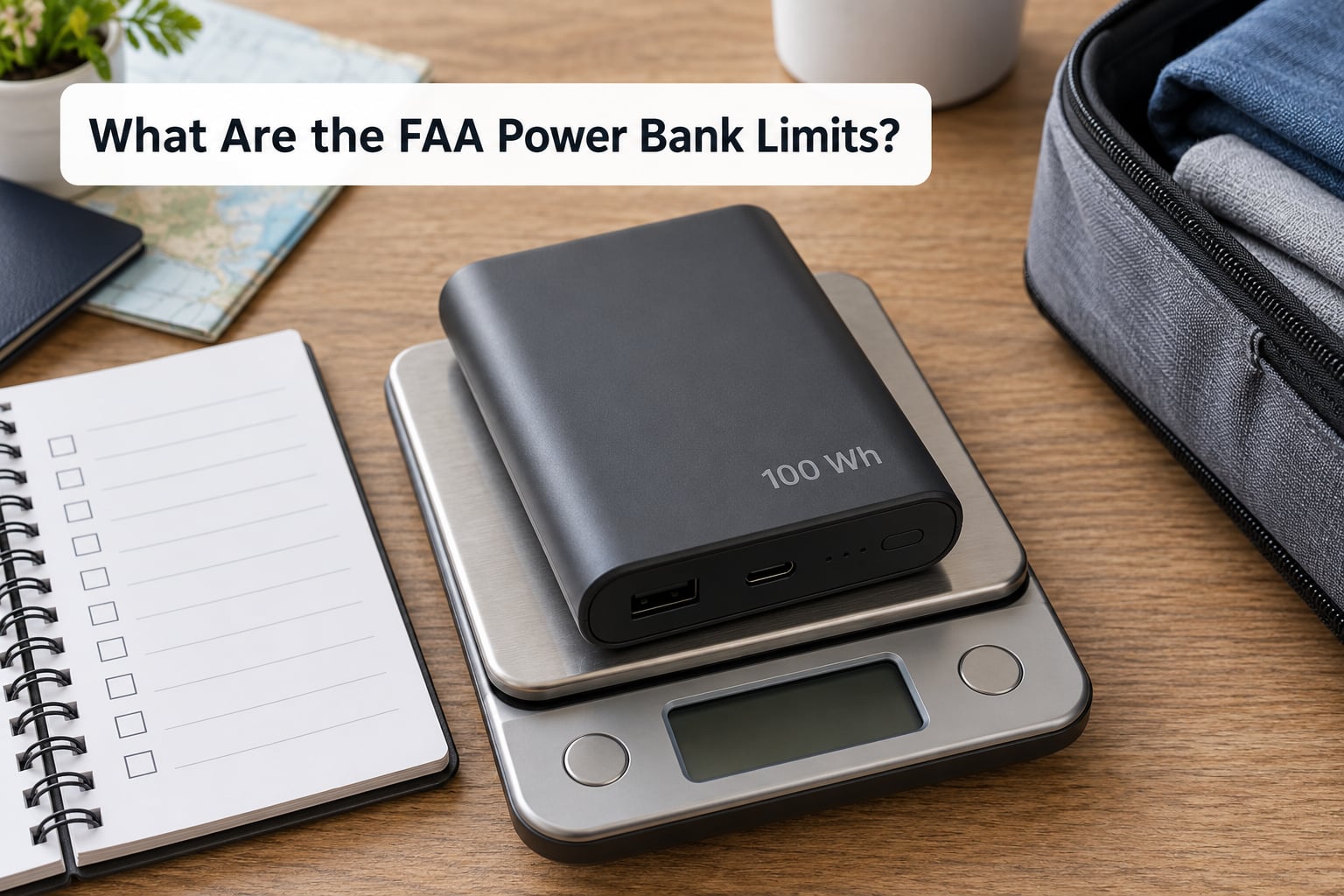
The Federal Aviation Administration caps spare lithium batteries in the cabin at 100 Wh without approval. A pack between 101 Wh and 160 Wh can travel in the cabin if the airline approves it beforehand, still capped at two spare batteries per passenger. Anything past 160 Wh is banned from passenger aircraft entirely.
How many power banks does the FAA actually allow?
The FAA frames the rule around batteries rather than chargers. Under 100 Wh, the ceiling is ten spare batteries per passenger, not a limit of ten chargers. The practical number that reaches you as a traveler is two power banks, because that’s the IATA figure most carriers copy into their baggage pages.
Damaged, swollen or recalled batteries are prohibited in the cabin, and so are packs with exposed terminals you can’t cover. If a unit has been through a hard drop or looks puffy at the edges, leave it at home rather than trying to argue it’s fine.
One detail worth understanding: regulators use watt-hours because the number combines capacity and voltage. Milliamp-hours only tell you how much charge a pack holds, and two packs with the same mAh can have very different energy ratings.
Can You Put Power Banks in Checked Luggage?
No. Power banks and spare lithium batteries have been carry-on only for years, and the rule is not a technicality. A lithium-ion cell can enter thermal runaway, and the cargo hold is unpressurized and unmonitored, so a failure in there has no one nearby to respond.
The distinction that catches people: a battery installed inside a device is a different category from a spare. A phone, tablet or laptop with its battery in place can generally travel in checked luggage if it’s fully powered off and protected against activation, while loose spares and power banks cannot.
What if your carry-on gets gate-checked?
Take the power bank out before the bag goes into the hold. If the bag is forced down at the last moment and you don’t have time to strip it, tell the gate agent, and ask whether they want you to carry the pack in your personal item instead. A power bank discovered in the hold is treated as a prohibited item, and you usually have no claim to it afterward.
How Do Airlines Count and Approve Power Banks?
Airlines are allowed to be stricter than the FAA minimum, and plenty are. Current published limits look roughly like this, and they change more often than most travel guides admit:
| Carrier | Power banks allowed | Capacity ceiling | Onboard use | Storage rule |
|---|---|---|---|---|
| Southwest Airlines | One | 100 Wh | Allowed | Cabin only |
| Emirates | One | 100 Wh | Not allowed | Seat pocket |
| American Airlines | Two | 100 Wh | Allowed | Visible and reachable, not overhead bins |
| EVA Air, Cathay Pacific, Singapore Airlines, Thai Airways | Two | 100 Wh | Not allowed | Seat pocket |
| IATA guidance from January 1, 2027 | Two | 100 Wh without approval | Not allowed | Seat pocket |
Two things trip people up here. First, on a codeshare or multi-city itinerary, the operating carrier’s policy governs, not the airline you booked. Second, “approval” for a 101–160 Wh pack means contacting the airline before you travel, in writing, and getting a yes. Showing up at check-in with an oversized pack and asking nicely is not the same thing.
American Airlines also bans large portable power stations outright, naming brands including Jackery, EcoFlow, Bluetti, Vevor and 4Patriots. If you’re hauling a home-generator-sized battery for a road trip, that’s a different category of object and it’s being rejected at the gate by multiple carriers.
How to Calculate a Power Bank’s Watt-Hours
The formula is simple: watt-hours = mAh × volts ÷ 1,000. Consumer power banks are almost always built around single-cell lithium-ion at a nominal 3.7 V, even though the USB output reads 5 V. Use the nominal cell voltage, not the charging output voltage.
| Capacity on the label | Watt-hours at 3.7 V | Status |
|---|---|---|
| 5,000 mAh | 18.5 Wh | No approval needed |
| 10,000 mAh | 37 Wh | No approval needed |
| 20,000 mAh | 74 Wh | No approval needed |
| 27,000 mAh | 100 Wh | Right at the limit |
| 30,000 mAh | 111 Wh | Needs airline approval |
That table also explains why you see two different answers for the biggest pack you can carry without permission. U.S.-derived sources say 27,000 mAh, while EASA and UK-facing airline pages say roughly 25,000 mAh. Both are doing the same math with a different assumed nominal voltage. If a pack is marketed at 5 V instead of 3.7 V, its real watt-hour figure is higher than the label implies, and that is exactly the kind of thing that gets a pack held at the checkpoint.
How Do Airport Screening Rules Affect Power Banks?
TSA officers screen against watt-hours, and they don’t measure capacity with a meter. They read the label, look at the pack, and decide. A clearly labelled 74 Wh bank sails through. A large unmarked brick with a capacity you can’t read gets a closer look, and you may be asked to remove it, open it, or leave it behind.
The thing nobody warns you about is discretion rather than rules. Travelers on travel forums describe carrying two compliant packs and worrying that the second one draws attention, especially at a checkpoint that has been processing slow lines. Nobody is going to confiscate a sub-100 Wh bank for having two of them, but keeping both in the same labeled pocket of your bag is calmer than splitting them across side pockets like you’re trying to hide something.
If a pack is confiscated, there’s no appeal and no compensation. Some officers will suggest shipping it home instead. Assume you’re willing to lose whatever they take.
What About Power Banks on International Flights?
Outside the U.S., the framework is similar but the enforcement varies. The UK and EU follow EASA guidance closely: 100 Wh without approval, up to 160 Wh with airline permission, and no onboard use. Australia mirrors that. China applies the 100 Wh ceiling more rigidly and can require pre-approval on some routes.
Your transit country can matter as much as your destination. A connection in a third jurisdiction adds another set of rules, and the operating carrier’s policy still applies to every segment. If a route is non-U.S. at any point, check the airline page for that carrier rather than relying on what the booking site showed you.
How to Pack and Use Power Banks Safely During a Flight
Before you leave: read the watt-hour rating printed on the case, look for swelling or a cracked shell, check your carrier’s quantity and usage policy, and confirm the pack is in your carry-on rather than a bag you might check at the gate.
Each pack should be protected against short circuits, either in its own case or with terminals covered. Don’t tape a MagSafe pack straight onto the back of your phone for the whole flight and forget about it, either. Keep it in a pocket you can reach.
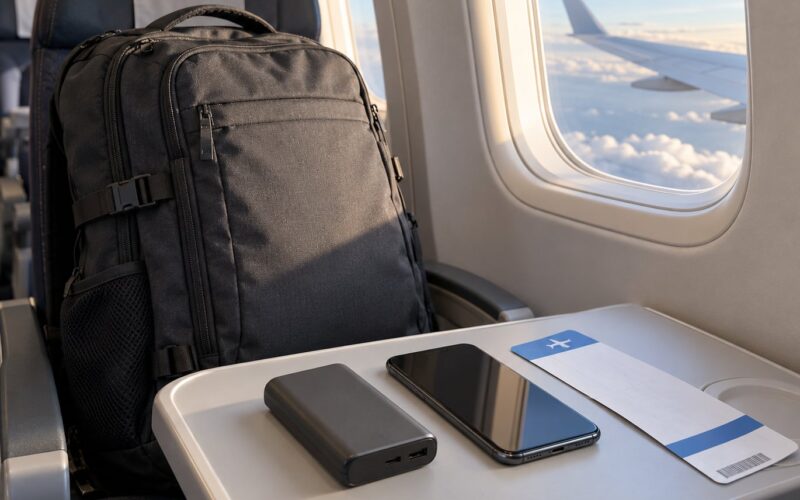
Onboard, American and most IATA-aligned carriers now want the pack visible and accessible, typically in the seatback pocket, not buried in an overhead bin. If a pack gets unusually hot, stop using it, unplug it, and tell a flight attendant rather than trying to cool it yourself.
From January 1, 2027, IATA guidance closes the loophole entirely: two power banks, no charging your devices from them in flight, and no recharging the pack from the seat outlet either. The reasoning is in the incident record. The FAA has logged a rising number of verified lithium-battery incidents on U.S. passenger flights over the last few years, and most of them involve phones rather than power banks.
Frequently Asked Questions
Can I bring three power banks on a plane?
Nothing at security stops you, because TSA sets no quantity cap under 100 Wh. The limit comes from airlines and from IATA guidance capping carry-on power banks at two from January 1, 2027. Three is a gamble: it can be refused at the gate and you get no compensation. Two is the number that works everywhere.
Can I bring a 20,000mAh power bank on a plane?
Yes, in your carry-on. At the standard 3.7 V nominal cell voltage, 20,000 mAh works out to 74 Wh, comfortably under the 100 Wh threshold, so no approval is required. It is not allowed in checked luggage. Forum travelers note that packs this size sometimes draw extra attention from screening officers even though they are compliant.
Can you fly with a 30,000mAh power bank?
Only with prior airline approval. At 3.7 V, a 30,000 mAh pack is roughly 111 Wh, which sits in the 101–160 Wh band where the airline must agree in advance and the total stays at two. Anything above 160 Wh is prohibited on passenger aircraft entirely, and large power station generators in that range are banned outright by several carriers.
What is the maximum mAh for a power bank on a plane?
About 27,000 mAh at 3.7 V nominal is the practical ceiling for the no-approval tier, since that equals 100 Wh. UK and EU sources often quote roughly 25,000 mAh because they assume a different nominal voltage. If your pack is marketed at a 5 V cell rather than 3.7 V, work out the real watt-hours yourself before you fly.
Can you use a power bank on a plane?
It depends on the carrier, and it is getting stricter. Emirates, EVA Air, Cathay Pacific, Singapore Airlines and Thai Airways already bar onboard use, and IATA guidance from January 1, 2027 bans both charging devices from a pack and recharging the pack from a seat outlet. Where use is permitted, the pack must stay visible in the seatback pocket.
Do power banks count toward your personal item allowance?
They travel inside your carry-on or personal item, and that bag still has to meet the airline’s size and weight rules. A power bank does not get its own separate allowance. Each traveler gets their own allowance too, so two adults each carrying two compliant packs is four packs in the cabin, and no sharing arrangements change that.
Conclusion
Two power banks, each at or under 100 Wh, carried in your cabin bag and never in checked luggage. That’s the answer that holds up in 2026 and after the IATA changes land in 2027. Check your carrier’s quantity and usage policy for your specific route, read the watt-hour label on the pack, and skip anything swollen or recalled.