Choosing a power bank for flights comes down to four checks: it must sit at or under 100 watt-hours, which works out to roughly 27,000mAh at a 3.7 volt cell voltage; it must travel in your carry-on and never in checked baggage; the watt-hour rating must be printed on the device itself; and on domestic flights inside China it also needs 3C certification. Get those right and the rest is personal preference.
Regulations change, so this guide reflects the rules as checked in 2026, and your operating carrier’s own page always wins over anything written on a shopping site. That last point is the one every traveller learns the expensive way, so it is worth two minutes of reading before you shop.
Table of Contents
- What You Need
- Step-by-Step
- How to choose a power bank for flights by checking capacity and airline limits
- How to choose a power bank for flights by checking ports and charging speed
- How to choose a power bank for flights by checking size, safety, and battery type
- How to choose a power bank for flights for your itinerary
- Common Mistakes
- Trusting the printed milliampere number
- Packing the battery in checked luggage
- Buying two large banks and hoping nobody counts
- Purchasing from an unbranded marketplace listing
- Leaving the terminals exposed
- Testing nothing before departure
- Frequently Asked Questions
- Can I bring a 20000mAh power bank on a flight?
- Is a 20000mAh power bank allowed in flight TSA?
- Is a 160Wh power bank TSA approved?
- Should I get a 10000mAh or 20000mAh power bank?
- Do power banks need to be in carry-on rather than checked baggage?
- Can I use a power bank on a plane during the flight?
- Conclusion
What You Need
Before you compare anything, gather five things. Without them, capacity advice turns into guesswork, and you end up carrying a battery that is either too small for the trip or too large for the rules.
- The operating carrier’s current power bank page. Airlines publish their own thresholds, quantity caps and storage instructions, and those override the general guidance below.
- Your device battery sizes. A recent phone typically holds 3,000 to 5,000mAh, a small tablet around 8,000 to 11,000mAh, and a laptop far more, depending on the model.
- Hours without power. Count the flight itself, any layover, the walk to the gate, and the first few hours after landing before the next outlet opportunity.
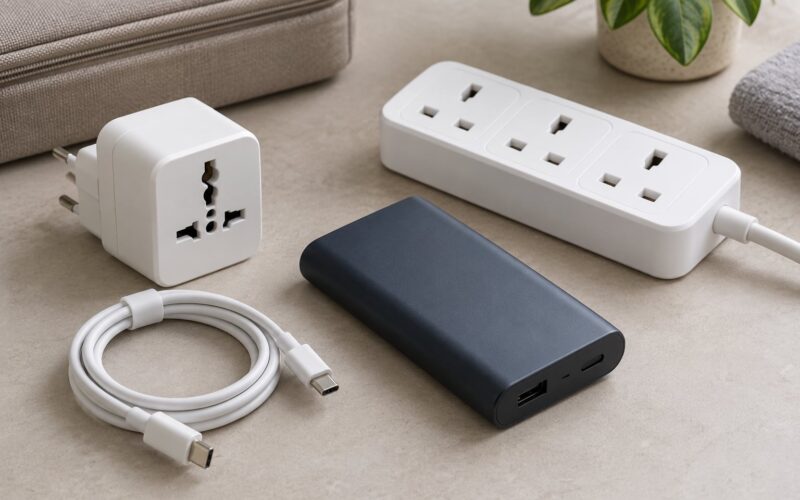
- Your destination’s plug type and voltage. If you plan to refill the bank from a wall abroad, note whether the sockets are Type A and B, Type C and F, or Type G.
- A protective case, pouch or even a roll of tape so the terminals are covered or inaccessible during screening.
Step-by-Step
Work through these four checks in order. Each one eliminates a category of problem at the security checkpoint, where a rejected battery is usually confiscated rather than returned.
How to choose a power bank for flights by checking capacity and airline limits
Capacity is marketed in milliampere-hours but regulated in watt-hours, and only the second number matters to the airline. The conversion is simple: watt-hours equals milliampere-hours multiplied by the cell’s nominal voltage, divided by 1,000.
| Rated capacity | Nominal voltage | Watt-hours | Carry-on status |
|---|---|---|---|
| 5,000mAh | 3.7V | 18.5Wh | Allowed without approval |
| 10,000mAh | 3.7V | 37Wh | Allowed without approval |
| 20,000mAh | 3.7V | 74Wh | Allowed without approval |
| 25,000mAh | 3.6V | 90Wh | Allowed, but staff may question it |
| 27,000mAh | 3.7V | 99.9Wh | Allowed, right at the ceiling |
| 30,000mAh | 3.7V | 111Wh | Above 100Wh, needs airline approval |
| 40,000mAh | 3.7V | 148Wh | Approval band, maximum two per person |
Three things follow from that table. A printed milliampere figure on the box tells you nothing on its own, because two banks labelled 20,000mAh can carry 74Wh or 88Wh depending on their cells. And the 101Wh to 160Wh band exists as an option, though it requires prior airline approval and a maximum of two batteries per passenger, with anything above 160Wh prohibited entirely.
Roughly a quarter of what the label claims never reaches your phone. Conversion losses in the circuitry mean a 27,000mAh bank typically delivers around 20,000mAh of usable charge, which is why a bank that looks generous on paper still runs out sooner than the arithmetic promises.
Look for the watt-hour figure printed on the casing itself, usually near the port bank. If only milliampere-hours appear anywhere, assume the bank will be treated cautiously at the checkpoint and expect a conversation with an officer.
How to choose a power bank for flights by checking ports and charging speed
USB-C has become the standard on modern phones, tablets and laptops, and a bank with only USB-A will leave you hunting for a legacy cable that may no longer be in your bag. USB Power Delivery is what makes laptops viable at all, since those need far more wattage than a basic output provides.
For phones, any reputable USB-C output handles a full charge in an hour or two. For a laptop, look for 65W as a workable minimum and 100W or more if you charge a larger machine, since below that you can charge slowly or not at all while the laptop is running.
Count your ports too. Two outputs let you share with a companion, and pass-through charging lets you top up the bank from a wall while your phone draws from it at the same time, which matters on long layovers with sparse outlets. Finally, remember to pack the cable itself, since a bank with no built-in or retractable lead is useless without one.
How to choose a power bank for flights by checking size, safety, and battery type
Power banks are regulated as spare lithium batteries, usually under the UN 3480 classification, and the reason is failure mode. A damaged cell can enter thermal runaway and vent burning gas, so aircraft cargo holds ban them outright and cabins do not, where crew can respond to smoke.
Most travel banks use lithium-ion or lithium-polymer cells, which are lighter and thinner than older nickel chemistries. What actually matters is the protection circuitry: short circuit, overcharge, over-discharge and temperature cut-offs. A casing with visible vent channels and a solid, non-flexing body is a better signal than any sticker.
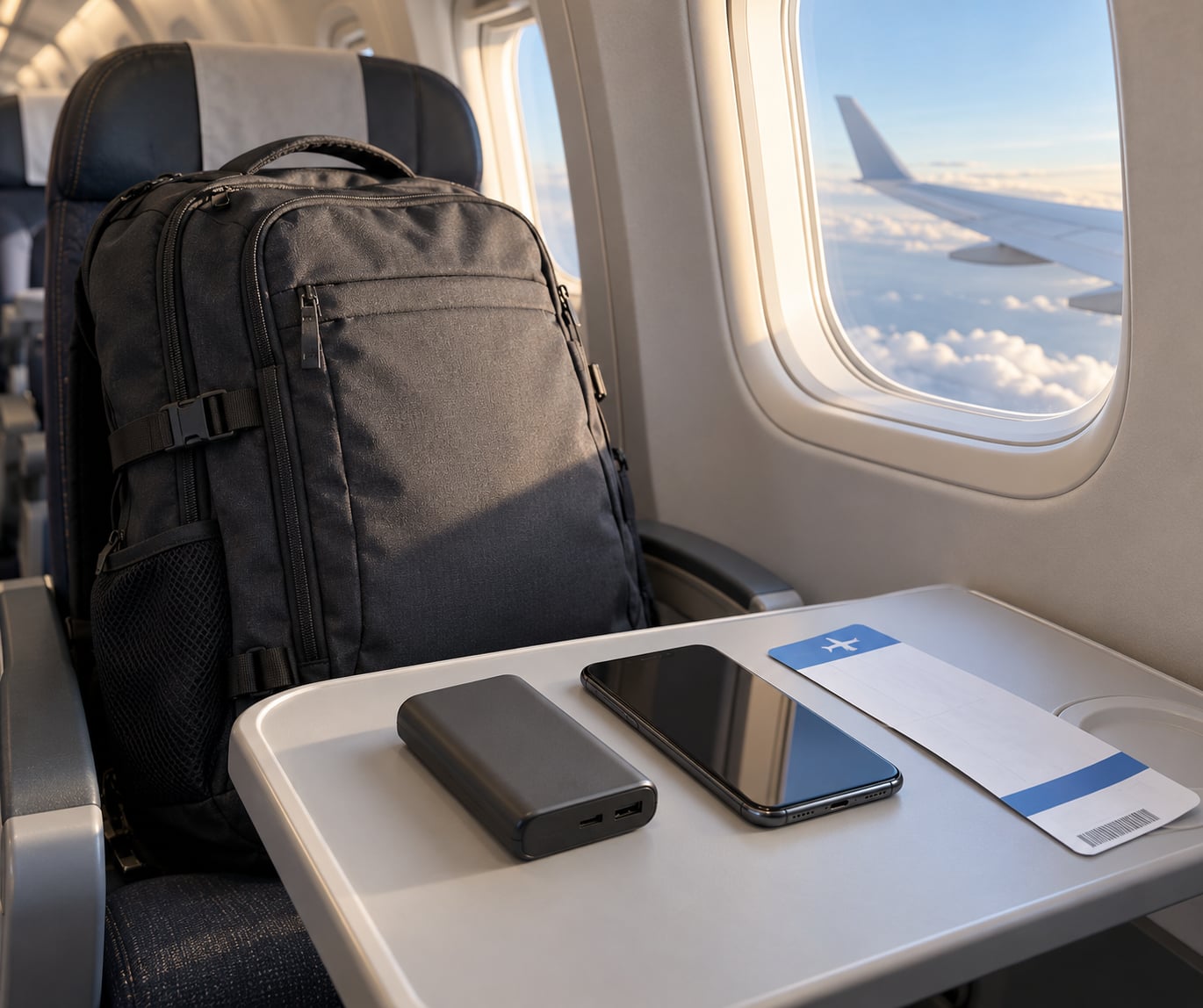
Look for recognised marks printed on the device, such as UL, CE, FCC, PSE in Japan or KC in Korea, and the CCC mark with its QR code if you fly domestically in China. Reject any bank that is swollen, cracked, dented, corroded at the contacts, or that has lost a protective film. Never pack one in checked luggage, and keep it in your personal item rather than an overhead bin, since a loose battery rolling around a bin is the situation regulators warn about.
How to choose a power bank for flights for your itinerary
Match capacity to the hours you spend away from an outlet, then divide by your device count. Everything beyond that is weight in your pocket.
| Tier | Trip length | Phone charges | Airline headroom | Approx. carried weight |
|---|---|---|---|---|
| 5,000mAh | Day trip, under 6 hours | About one | Wide margin | 150g or so |
| 10,000mAh | Single overnight flight plus layover | Two | Wide margin | Around 200g |
| 20,000mAh | Two to three days, two devices | Three to four | Comfortable margin at 74Wh | Around 350g |
| 27,000mAh | Long-haul, laptop plus phone | Four to five, or a partial laptop charge | Right at the 100Wh limit | Around 480g |
Ten thousand milliampere-hours is the size most one-bag travellers settle on, because it packs small and covers the common case of one long flight plus airport time. If your itinerary includes a laptop or two people charging together, twenty thousand is the more honest purchase. Save the twenty-seven thousand tier for cases where weight genuinely does not matter, since it leaves no margin for a miscalculated voltage.
One more trip-level detail: if you will refill the bank from a wall abroad, check that its input accepts the local voltage, usually 100 to 240V, and pack a plug adapter for your destination. No power bank ever needs a heavy voltage converter, because USB charging output is fixed low voltage.
Common Mistakes
Almost every confiscated battery traces back to one of a handful of avoidable errors.
Trusting the printed milliampere number
The label says 27,000mAh; the casing says 110Wh. Officers read the casing. Convert before you buy, and treat any bank with no watt-hour marking as a gamble.
Packing the battery in checked luggage
This is the one rule with no exception and no approval pathway. The prohibition applies to every lithium battery above 100Wh and to all power banks in general, so keep it in your personal item from the moment you leave home.
Buying two large banks and hoping nobody counts
Most carriers cap you at two spare batteries above 100Wh, and several cap total power banks per passenger at two as well. Three banks of any size invites a secondary inspection and a very long explanation.
Purchasing from an unbranded marketplace listing
Exaggerated capacity is the most common complaint in travel forums, and a bank that overstates its rating is usually one with no real protection circuit. Recognisable marks, a stated warranty and a printed watt-hour figure all cost you little and remove most of the risk.
Leaving the terminals exposed
Travellers repeatedly recommend taping the contacts, keeping the bank in its original packaging, or sliding it into a hard case. It is free insurance against a short against loose metal in a bag.
Testing nothing before departure
Charge the bank fully the night before, confirm the cable you intend to pack actually moves charge, and read the watt-hour label once yourself. A two-minute check at your kitchen table is cheaper than buying a replacement in a foreign airport.
Frequently Asked Questions
Can I bring a 20000mAh power bank on a flight?
Yes, in almost every case. A 20,000mAh bank rated at 3.7V works out to 74 watt-hours, which sits comfortably under the 100Wh ceiling, so it needs no airline approval. It must travel in your carry-on or personal item, never in checked baggage, and the watt-hour rating should be printed on the device. Check your carrier’s page anyway, since a few impose stricter limits.
Is a 20000mAh power bank allowed in flight TSA?
The TSA sets the placement rule, the FAA sets the capacity rule. TSA requires lithium-ion power banks to stay in carry-on bags and forbids them from checked luggage. The FAA caps permitted spare batteries at 100 watt-hours for passenger aircraft without approval. A 20,000mAh bank at 3.7V is 74Wh, so it passes both. Note that airline staff, not TSA officers, apply the stricter of the two rules at the gate.
Is a 160Wh power bank TSA approved?
No one approves a 160Wh power bank through the TSA. Batteries between 101Wh and 160Wh require prior approval from your airline, with a maximum of two such batteries per passenger, and anything above 160Wh is prohibited entirely. Approval usually means contacting the carrier in advance by email or phone and keeping the confirmation. For most itineraries a bank at or under 100Wh avoids the process entirely.
Should I get a 10000mAh or 20000mAh power bank?
Ten thousand milliampere-hours covers one overnight flight plus airport time and packs small, which is why it is the most common recommendation in one-bag travel forums. Twenty thousand covers two to three days, two devices, or a partial laptop charge, and at 74Wh still leaves comfortable margin under the airline limit. Choose ten thousand for short trips where weight matters and twenty thousand for long-haul or multi-device itineraries.
Do power banks need to be in carry-on rather than checked baggage?
Yes, power banks are never permitted in checked luggage on any airline, because a damaged lithium cell in an unpressurised cargo hold can start a fire that cannot be reached. This rule applies regardless of capacity, so even a small 5,000mAh bank belongs in your cabin bag. Keep it in your personal item rather than an overhead bin, with terminals covered, and stop using it during takeoff and landing if your carrier instructs you to.
Can I use a power bank on a plane during the flight?
Usually yes, once the aircraft is at cruising altitude. Most carriers forbid charging devices from a power bank during takeoff and landing, and some ask you to stow it away entirely for those phases. Individual airline pages spell this out, and cabin crew can repeat it on board. A modest top-up in the air is a normal expectation; what is not permitted is a damaged or unlabelled battery in the cabin at all.
Conclusion
Start by opening your operating carrier’s current power bank policy and reading the watt-hour figure, not the marketing capacity. Once you know the ceiling for your route, pick a bank at or under 100Wh with the watt-hour rating printed on the casing, a recognised safety mark, ports that match your devices, and terminals you can cover.
Ten thousand milliampere-hours covers most single overnight itineraries, twenty thousand handles long-haul and multi-device trips, and anything on a China domestic flight also needs the CCC mark and its QR code. Do that and a checkpoint conversation becomes an inconvenience rather than a lost battery.