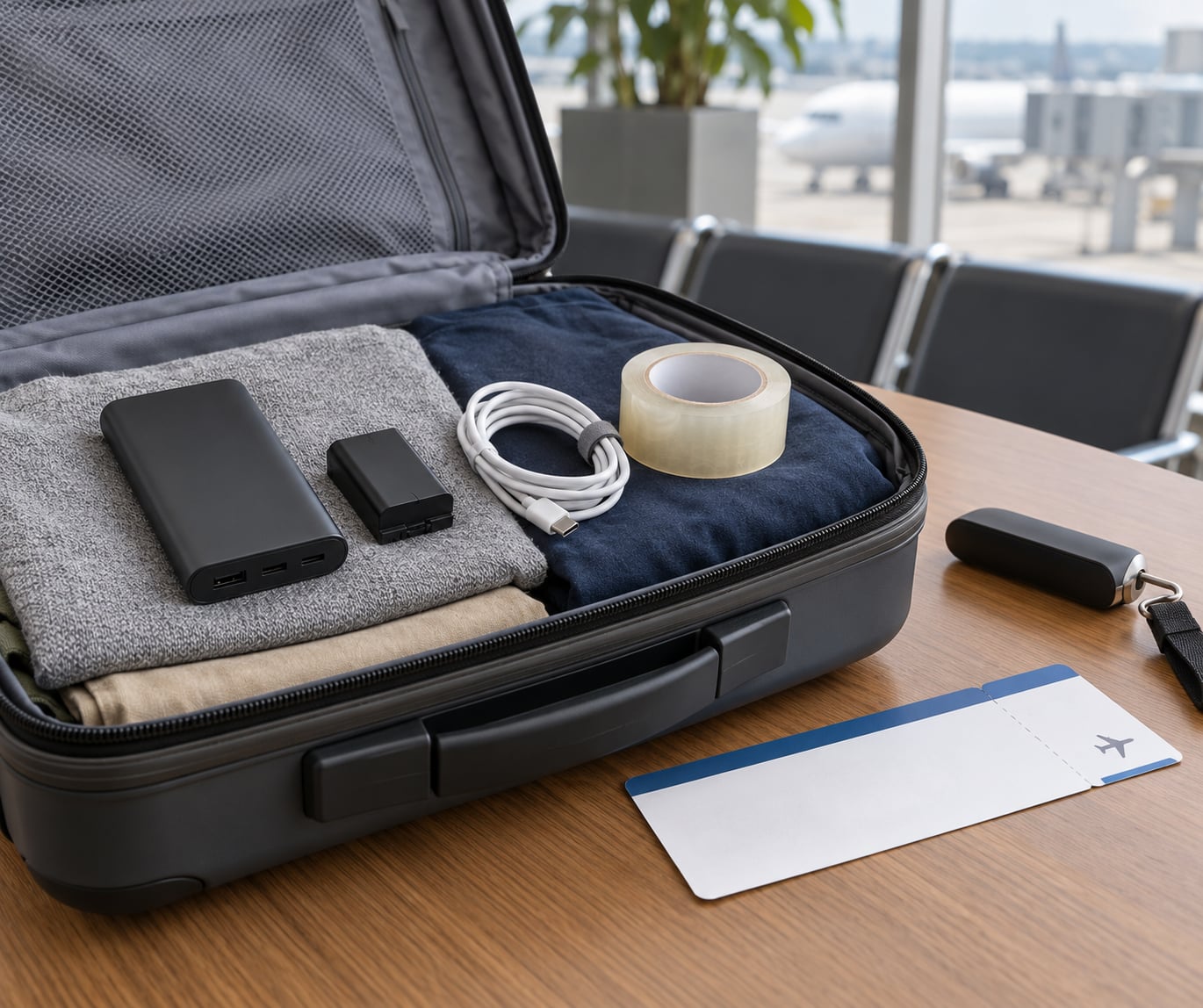
Airline rules for lithium batteries all come down to one number: watt-hours. Batteries under 100 Wh normally travel in your cabin bag, batteries between 100 Wh and 160 Wh need airline approval before you fly, and anything above 160 Wh is not allowed on a passenger aircraft at all. Spare batteries and power banks are cabin-only, with the terminals covered.
It sounds rigid, and for the most part it is, because these rules were written after a long string of in-flight fires. What trips people up is not the rule itself but the gaps between sources: the TSA site says one thing, the airline page says another, and the airport you connect through may add a third layer. This guide pulls the pieces together so you can pack once and stop worrying.
Table of Contents
- Why Airlines Restrict Lithium Batteries
- How Airline Rules for Lithium Batteries Work
- How airline rules for lithium batteries work in three watt-hour tiers
- What Can You Carry in Your Cabin Bag?
- How Airline Rules for Lithium Batteries Apply to Checked Bags
- Which Lithium Batteries Have Special Rules?
- How to Pack Lithium Batteries Safely
- What to Do When a Battery Is Damaged, Swollen, or Overheated
- Why Airline Rules Can Change Between Tickets
- Frequently Asked Questions
- Can you put a lithium battery in your luggage or carry-on?
- Can I bring a 30000mAh power bank on a plane?
- Which lithium batteries are not allowed on a plane?
- What happens if you have a lithium battery in checked luggage?
- Do camera and drone batteries count toward the spare battery limit?
- Can I take lithium ion batteries on a plane internationally?
- The Rule to Remember Before You Fly
Why Airlines Restrict Lithium Batteries
A lithium battery that is crushed, punctured, overheated or short-circuited can enter what is called thermal runaway. It gets hot, it cannot cool itself down, and it produces its own oxygen as it reacts. The result is a fire that burns hot enough to melt surrounding material.
Cargo holds make this worse. Baggage compartments on passenger aircraft are not usually pressurised or heated the way the cabin is, and a fire down there is very hard to reach. Crew can respond to a problem seat in seconds; nobody can reach a burning suitcase in the belly of a 787 quickly enough. That single fact is why airlines allow lithium batteries to fly but insist they fly where a human can see them.
It also explains why the rules split three ways. Passengers get the most freedom, because the cabin crew can spot and handle a problem. Baggage and cargo shipments get tighter restrictions, because nobody is watching them. And damaged or recalled batteries are treated as dangerous goods rather than normal luggage.
IATA, which sets the international guidance airlines build their own policies from, has documented well over 300 lithium battery incidents on aircraft since 2006. Smoke and flame reports are the most common, and the overwhelming majority involve portable electronics rather than aircraft systems.
How Airline Rules for Lithium Batteries Work
Every lithium battery rule starts with classifying the battery by energy content, measured in watt-hours, or Wh. The Wh number is printed on the battery or power bank itself, usually near the capacity label.
| Capacity | Cabin bag | Checked bag | Approval needed |
|---|---|---|---|
| Under 100 Wh | Allowed, subject to the spare battery count limit | Not allowed as a spare | No |
| 101 to 160 Wh | Up to two spares per person | Not allowed | Yes, airline approval before travel |
| Over 160 Wh | Not allowed on passenger flights | Not allowed | No approval route exists |
The limit applies to each battery individually, not to the combined total of everything in your bag. Four 60 Wh camera batteries are four batteries under the threshold, not one 240 Wh problem. Airports screen for this because screening systems flag dense battery-like objects in checked luggage, which is why a power bank buried under clothes tends to get a bag pulled aside.
There is a second scale for lithium metal batteries, which are the non-rechargeable kind used in some cameras, key fobs and old laptops. Those are measured by grams of lithium content, usually 2 to 8 grams per passenger.
How airline rules for lithium batteries work in three watt-hour tiers
Tier one, under 100 Wh, is the easy one. Phones, laptops, most camera batteries, most power banks and every e-cigarette you own sit here. These travel in your cabin bag with no permission needed, provided the terminals are protected.
Tier two, 101 to 160 Wh, is the approval tier. A single 110 Wh battery needs written or documented clearance from the airline before you travel, and no more than two are permitted per person. Many airlines will approve a large camera battery or a drone battery but refuse a power bank above 100 Wh outright, so ask early rather than at the gate.
Tier three, over 160 Wh, is closed to passengers. These batteries fly as cargo, or they do not fly. If a device needs one, the airline’s dangerous goods desk handles it separately.
How do you convert the mAh figure printed on a power bank into watt-hours? Use the label voltage, which is normally 3.7 volts for a single-cell power bank.
| Power bank capacity | Watt-hours at 3.7 V | Where it lands |
|---|---|---|
| 10000 mAh | 37 Wh | Cabin bag, no approval |
| 20000 mAh | 74 Wh | Cabin bag, no approval |
| 27000 mAh | 99.9 Wh | Just under the limit |
| 30000 mAh | 111 Wh | Approval tier, and often refused |
That last row matters. A 30000 mAh power bank is over the threshold even though the number on the box looks modest next to a laptop battery, and many carriers simply do not approve portable chargers in that range.
What Can You Carry in Your Cabin Bag?
Installed batteries are the easy case. A phone, tablet, laptop, camera, handheld gaming console or electric toothbrush all travel normally, because the battery is built into the device and protected by its housing.
Loose lithium batteries are treated differently. Camera spares, drone batteries, laptop replacement packs and vape cells must be carried in your cabin bag or on your person, never in checked luggage, and the terminals must be protected against short circuit.
Power banks and portable chargers follow the same cabin-only rule. In addition, most airlines ask you to keep them visible during the flight and to use them only for charging small personal devices, not for laptops or anything else that draws heavy power.
Medical batteries sit in their own category. Spare lithium batteries for insulin pumps, ventilators, CPAP machines and similar equipment are accepted in the cabin bag in reasonable numbers, and the equipment itself is usually treated as a permitted assistive device. Tell the airline in advance so they can note it on your booking.
Do camera and drone batteries count toward your spare battery limit? They do. They are lithium batteries, and a photographer travelling with four camera spares is using four of the spares their airline allows. Airline limits differ widely here, from a handful on some carriers to twenty or more on others, which is why the airline’s own page is the last word.
How Airline Rules for Lithium Batteries Apply to Checked Bags
Spare batteries and power banks are prohibited in checked baggage. There is no exception for a full flight or for connecting baggage, and this is the rule people break most often without realising it.
Installed batteries are treated differently. A laptop with its battery fitted, or a camera with its battery inside, can go in checked luggage as part of the device. Switch the device off before you pack it, and if it has a removable battery that you could easily pull out, removing it and carrying it in your cabin bag removes any ambiguity.
Here is the routine that prevents almost every problem. Before you check a bag, open it and look for anything with a battery that is not bolted into a device: power banks, headphone cases with built-in cells, camera spares, vape devices, spare tool packs, smart luggage. Pull them out and put them in your cabin bag. It takes thirty seconds and it is the whole difference between flying and standing at the belt watching your bag get opened.
Gate-checking is the other trap. If your cabin bag is too large and gets gate-checked at the last minute, loose batteries and power banks must come out with you. Removing a 20000 mAh power bank at the gate, in front of a boarding queue, is not a good time to discover you left your spare camera batteries in the side pocket too.
Which Lithium Batteries Have Special Rules?
Mobility aids such as powered wheelchairs and scooters are permitted, with the battery in place, because the aid is necessary for the passenger’s mobility. Spare lithium batteries for these devices usually need airline approval in advance, and spillable batteries have their own separate rules.
E-bikes, hoverboards and self-balancing scooters are normally not accepted in passenger baggage at all, whether they ride with the terminals or not. They can often be transported as cargo instead.
Power tool batteries travel in the cabin bag as spare lithium batteries, within the normal count and watt-hour limits. There is no separate category for professional tools, though airline rules usually assume personal use rather than a commercial kit, and a full tool case can exceed the spare limit.
Smart luggage with a removable battery is usually accepted if the battery comes out and goes into your cabin bag. Smart luggage with a non-removable built-in battery is frequently refused by both the airline and the airport, so check before you buy, not at the counter.
Vapes and e-cigarettes are permitted in carry-on bags but banned in checked luggage. Keep the device and any spare cells in your pocket, switched off, and mind the rules of the country you are landing in, some of which restrict them entirely.
If any of this is unusual for you, contact the airline’s special assistance or dangerous goods desk before you book. An email exchange takes a day and removes the risk of losing expensive gear at the gate.
How to Pack Lithium Batteries Safely
Terminal protection is the requirement that confuses people most, because no authority explains it in plain words. It means the positive and negative contacts of a loose battery must not be able to touch each other, or anything metal that conducts, at any point in the journey.
- Check whether the battery has terminals, a raised button, or a removable pack. Button-top cells and camera packs are the ones that need attention.
- Cover the terminals with clear packing tape, insulating tape, or a strip of tape over the contacts. Cover both the positive and negative ends for a battery with two posts.
- Put the taped battery in its original packaging, a purpose-made battery case, or a separate zip bag. A hard case is better than a soft bag if it will be knocked around.
- Pack batteries so they cannot shift and rub against each other. Fill the gaps with clothing or a padded insert.
- Keep them in your cabin bag, not in a checked bag or a separate bag you hand over at the belt.
- After security, do not put a loose battery straight back into a hot car or leave it charging in a bag while you walk around. Heat is what starts trouble.
A clear travel case with two power banks and a few taped cells is the simplest version of this and takes about a minute to assemble at home. Do it before packing, not at the gate.
What to Do When a Battery Is Damaged, Swollen, or Overheated
A swollen battery, one that looks dented, rusted, torn or has a damaged wrapper, is not luggage. It is a fire risk, and you should not put it in a bag or board with it.
Signs to look for: a bulging or puffed surface, a soft or spongy feel, a chemical smell, heat coming from the device while it sits unused, a screen that lifts away from the body, or any physical damage to the casing. If a device got wet in salt water, treat it the same way, since saltwater is exceptionally aggressive on lithium cells.
If a battery is hot, smoking or hissing, move people away first and tell the nearest airline or airport staff member immediately. Do not carry a smoking battery through a terminal, and do not put water on it, because lithium fires are not extinguished the way a normal fire is.
If the damage is not actively dangerous but the cell is clearly compromised, the usual outcome is that it cannot travel at all. Damaged and recalled batteries are excluded from passenger carriage under most rules. Take it to a battery recycling point instead of hoping nobody notices.
Tell the airline before you travel rather than at the terminal. If a device with a damaged battery is something you need for health reasons, the airline’s medical assistance desk can tell you whether it can fly at all, and what documentation you need.
Why Airline Rules Can Change Between Tickets
Rules can differ between two tickets, even tickets on the same route, because the operating carrier sets them. When you book through an agent or a comparison site, the airline shown first in the booking code is often not the airline you fly.
Codeshares are the usual trap. Check the airline operating your flight, and then check the marketing airline’s rules for every segment, because the airline you fly may be more restrictive than the one you booked with. With two carriers on one itinerary, the stricter rule is the one that ends up mattering.
Transit countries add another layer. Your rules can change again at each connection, because each country sets its own conditions for lithium batteries entering or leaving its territory. Flying between two countries you know is not the same as flying a route with three stops across different regulatory regimes.
The practical habit is simple. Look up the operating carrier for each segment on the airline’s website, read the lithium battery page rather than the generic baggage page, and contact them in advance if you are travelling with anything between 100 Wh and 160 Wh or anything unusual. Do not rely on the booking site alone, since its baggage summaries are frequently a simplified version of the real policy.
Frequently Asked Questions
Can you put a lithium battery in your luggage or carry-on?
A battery installed in a phone, laptop or camera can travel in either, provided you switch the device off. A loose battery, a spare pack or a power bank can only travel in your cabin bag or on your person. Checked bags and cargo holds are closed to them, including when you are connecting, since a fire there cannot be reached quickly.
Can I bring a 30000mAh power bank on a plane?
A 30000 mAh power bank at 3.7 volts works out to roughly 111 Wh, which sits in the 101 to 160 Wh band. That band needs airline approval before you travel and is limited to two batteries per person, and many carriers refuse power banks above 100 Wh altogether. Check your airline before you leave, or bring a smaller bank.
Which lithium batteries are not allowed on a plane?
Anything over 160 Wh is not allowed in passenger baggage, on any airline, in either your cabin bag or a checked bag. Damaged, swollen or recalled batteries are also excluded. Smart luggage with a non-removable battery and e-bikes or hoverboards are commonly refused as well, and spare batteries over 100 Wh need advance airline approval.
What happens if you have a lithium battery in checked luggage?
Screening systems flag dense battery-shaped objects, so staff will usually pull the bag and open it. A power bank or spare battery will be removed and you will be asked to carry it in your cabin bag instead. If you are already boarded, it may mean leaving it behind. Some carriers also refuse boarding entirely, so pack your bag before you travel.
Do camera and drone batteries count toward the spare battery limit?
Yes. Every spare lithium battery counts, whatever the device is for, so four camera batteries use four of the spares your airline allows. Drone batteries are the usual reason a working traveller hits the limit, since a single aircraft can carry three or four of them. Airline allowances differ, from a handful on some carriers to twenty on others.
Can I take lithium ion batteries on a plane internationally?
Yes, under the same watt-hour tiers that apply domestically, but every country you fly into or through can set its own conditions and each airline operating your flight applies its own policy. Long haul carriers are usually stricter than regional ones. If your route includes several countries, contact each airline before you travel and keep your approvals with you.
The Rule to Remember Before You Fly
Read the watt-hour figure on each battery, keep anything loose or removable in your cabin bag with the terminals taped, and check the operating airline’s own lithium battery page rather than the booking summary. Everything else follows from those three steps.
If you are travelling with anything unusual, such as a large camera rig, several drone batteries, medical equipment or smart luggage, one message to the airline’s special assistance desk a week before departure will do more than any amount of forum research.