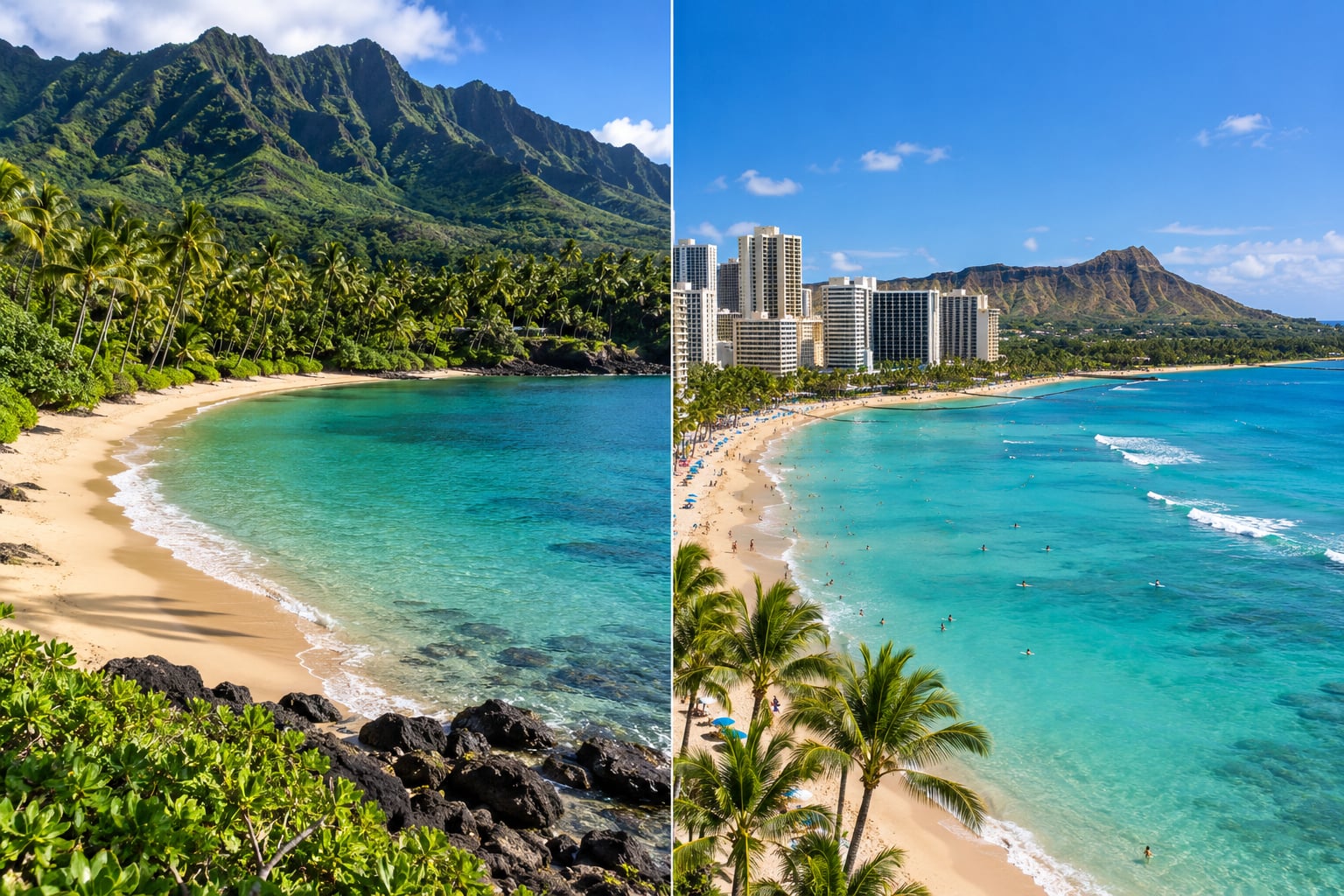
If this is your first Hawaii trip, pick Oahu for variety, history, dining and the easiest island to get around without a car. Pick Maui for scenery, slower days and a strong resort-and-outdoors feel. Most first-timers do better with one island for five to seven days than with two rushed ones.
That is the short version of the oahu vs maui for first time visitors question, and almost everyone asking it has the same worry underneath: pick wrong and you will spend five days doing the wrong things in paradise. The good news is that neither island is a bad choice. They are just built for different weeks.
Oahu is the island where the list of things to do is longer than the days you have. Waikiki puts a beach, a shopping strip and a hundred restaurants within walking distance of most hotel towers. Pearl Harbor, Iolani Palace, Diamond Head, the Polynesian Cultural Center and the North Shore drive all fit into the same week, and the bus system actually gets you between them.
Maui is the island where the list is shorter and the days are longer. West Maui beaches, the upcountry drive and Haleakala give you scenery that takes an entire morning to absorb, and most of what you want to see is spread out on two-lane roads rather than clustered in one neighborhood. You will drive more and plan more, and you will end the week with sand in places you never expected.
I have watched first-timers agonize over this choice for years, and the pattern is consistent: regret almost never comes from choosing the wrong island. It comes from trying to see two islands in a week, from skipping the advance reservations, and from booking a rental car on Oahu when the bus would have done the job. Let’s take the comparison apart piece by piece.
Table of Contents
- Oahu vs Maui for First Time Visitors at a Glance
- Which Island Suits Your Vacation Style?
- What a structured island trip feels like
- Beaches and Swimming: Which Island Is Better?
- Snorkeling and swimming: Oahu vs Maui for first time visitors
- The honest verdict on beaches
- Scenery and Nature: Waikiki Views or Maui’s Road to Hana?
- Activities and Attractions: More Choice or a Stronger Sense of Place?
- Getting Around: Public Transport, Rental Cars, and Road Trips
- Can you do Oahu without a rental car?
- Food, Shopping, and Nightlife
- Crowds, Costs, and Trip Planning
- Which Should You Choose?
- By traveler type
- Frequently Asked Questions
- Can first-time visitors see both Oahu and Maui on one Hawaii trip?
- Is Oahu or Maui better for a first visit?
- Is Maui more romantic or family-friendly than Oahu?
- Can you get around Oahu without a rental car?
- How many days are enough for Oahu or Maui?
- Which island is easier for beginners planning a road trip?
- Conclusion
Oahu vs Maui for First Time Visitors at a Glance

| Criterion | Oahu | Maui |
|---|---|---|
| First impression | Busier, more urban, more choices per hour | Slower, quieter, more spread out |
| Beaches | Waikiki and resort beaches, plus rougher North Shore surf | Longer stretches of sand, calmer resort coves |
| Scenery | Cliffs, valleys, city skyline, developed coastline | Volcanic slopes, crater, waterfalls, open road |
| Activities | Many landmarks, museums, shows and rainy-day backups | Drives, beaches, outdoor trips, whale season |
| Getting around | Bus, rail, rideshare and walking all work | Rental car is close to essential |
| Pace of a day | Busy, scheduled, easy to fill | Relaxed, unstructured, easy to empty |
| Crowds | Concentrated around Waikiki and major sights | Spread along the coast and the Road to Hana |
| Costs | Generally the cheaper of the two across the board | Resort areas and popular drives push costs higher |
| Best for | First timers who want landmarks, food and nightlife | Scenery, rest, snorkeling and outdoor time |
| Weakest point | Traffic and the constant hum of a busy island | Car dependence and thin public transport |
Read that table as a description of two different weeks, not a scoreboard. A row where Oahu wins on one line and Maui wins on the next is normal, and it is usually about what you want a day to feel like rather than how good it is.
Two quick notes on the last three rows. Costs on Oahu run lower on almost every line, mostly because the hotel inventory is far larger and stretches from inexpensive Waikiki rooms to Ko Olina resorts, while Maui’s guest beds skew toward the expensive end. Crowds on Maui are real but differently shaped: a busy Maui beach is a busy parking lot, whereas a busy Oahu beach has a whole district around it.
Which Island Suits Your Vacation Style?
The central trade-off is structure versus scenery. Oahu rewards a trip built from a list, because everything on that list is close to everything else and easy to move between. Maui rewards a trip without much of a list, because the scenery is the activity and you need time to sit with it.
Think about how you like to travel. If you prefer to wake up and decide what happens today, Oahu gives you thirty options at nine in the morning and lets you walk to lunch. If you prefer to have one plan and see it through, Maui suits you better, because the drive to a trailhead or a beach is part of the day rather than wasted time in it.
What a structured island trip feels like
A structured Oahu week has a rhythm. You might do a historic morning at Pearl Harbor, an afternoon at a beach park, dinner in a particular neighborhood you picked on the map the night before. Every day has two or three anchors, and the space between them is short.
A relaxed Maui week has a different rhythm. You drive to the beach, you stay four hours, you eat wherever the line is shortest. You might spend a whole morning on a single overlook. Nothing feels wasted, because there is no schedule being missed.
Neither pace is superior. The mistake first-timers make is booking a Maui villa with a full Oahu-style itinerary, then spending two hours of each day in a rental car to get between commitments that did not need to exist. Or booking a busy Oahu hotel and then feeling mildly disappointed that the beach is across a parking lot instead of down a road. Pick the rhythm, not just the island.
Beaches and Swimming: Which Island Is Better?
There is no universal answer, because Hawaii beaches do not fit one template. Oahu gives you the widest range of beach types within driving distance, and Maui gives you the most consistently beautiful resort sand. The swimming conditions matter more than the photographs.
Snorkeling and swimming: Oahu vs Maui for first time visitors
Maui has the stronger case for snorkeling. Calm visibility around the sheltered resort coves and the channel between islands is why so many first-time snorkelers put Maui at the top of their list. Molokini Crater trips out of Maalaea, several long stretches of West Maui shoreline and good conditions at Wailea make it easy to see reef fish on a beginner-friendly trip.
Oahu gives you more variety in one day. Waikiki is a swimming and paddling beach in the classic sense, protected by the reef, with a wall of high-rises behind it. Ko Olina’s man-made lagoons are the calmest family option on either island, sheltered enough for small children. Hanauma Bay is a different thing entirely, a curved reef-protected cove with a marine life conservation program that requires advance booking and a short briefing.
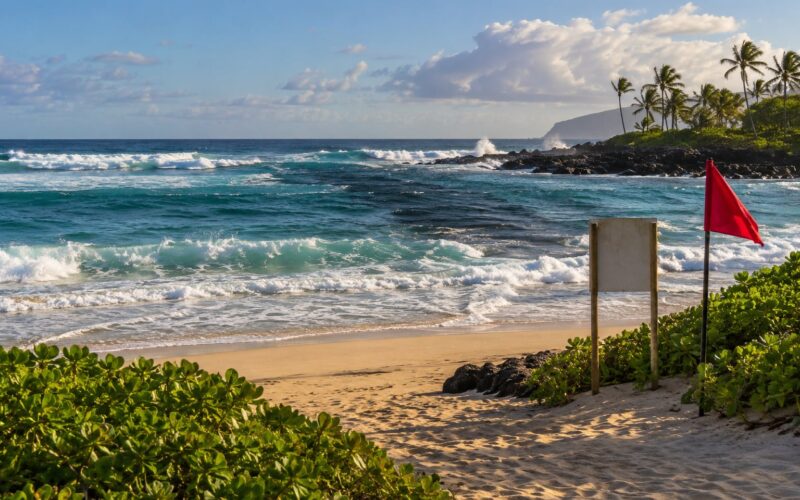
Two condition warnings belong in any honest comparison. North Shore Oahu beaches such as Waimea Bay, Sunset Beach and the Pipeline area are exposed and powerful when there is a north swell, and that swell arrives with the winter months. Visitors who treat a posted warning as decorative get swept off. On Maui, reef and shallow entries limit where waves can break, which is good for families and bad for surfers looking for a proper break.
Private property shapes access on both islands. Much of Maui’s best shoreline sits behind resort gates, condominium complexes and agricultural parcels, so a beach can be visible and unreachable from the highway. On Oahu, military installations, ranches and neighborhood associations hold long stretches of coastline. A ten-minute detour frequently gets you to an open beach that a fifteen-minute detour on a different island cannot.
The honest verdict on beaches
For calm, reliably swimmable water with sand underfoot and no lifeguard-sized decisions, Maui and Ko Olina on Oahu are the strongest picks. For reef-protected drama, a cove with hundreds of fish, or surf you can actually watch, Maui again. For variety within a short drive and a beach you can walk to from a city block, Oahu wins clearly.
If your idea of a beach day involves a long walk on sand with nobody else on it, aim west and south on Maui between Kahoolawe and the resort areas, and expect sand under your towel. The trade for that empty sand is a car and a longer drive from wherever you are staying.
Scenery and Nature: Waikiki Views or Maui’s Road to Hana?
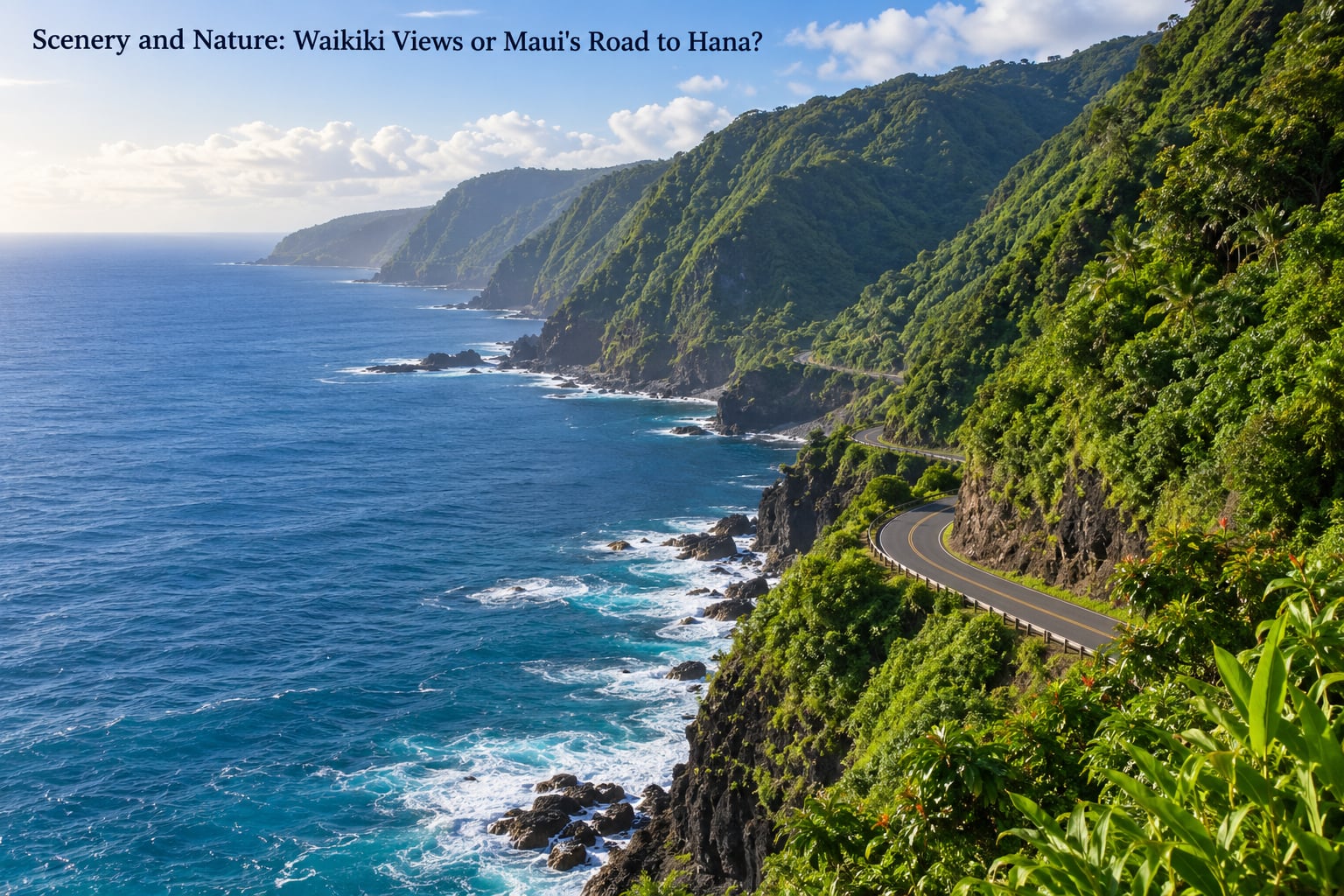
Maui is the more scenic island for almost every type of visitor, and Oahu is more scenic in a smaller, sharper way. Maui has the volcano, the crater at its summit, the raw coast on its eastern side and a road that crosses waterfalls and bridges all day. Oahu has cliffs you can reach from a city street, a harbor skyline worth photographing, and valleys that go green within minutes of a highway stop.
Haleakala National Park is the headline on Maui, and the sunrise summit is the single most requested thing on the island. That means a very early alarm, a low temperature at the top, and a reservation system for the popular sunrise window. Do it once. Bring layers, because the summit is genuinely cold even when the coast is warm.
The Road to Hana is the other headline, and it deserves honest expectations. It is a full-day drive of roughly sixty miles of winding two-lane road, with dozens of legitimate stops: waterfalls, lookouts, a bamboo grove, a black sand beach at Waianapanapa State Park, roadside stands selling fruit and banana bread. Travel time varies enormously with traffic and rain, and the road is not a place to rush.
Families with young children often regret attempting Hana as a day trip with tired kids in the back. A guided tour, or splitting the drive across two days, is the fix people recommend after the fact. Check current conditions and reservation requirements before you commit, because access rules at state parks have changed more than once since the fires.
Oahu’s scenery concentrates rather than sprawls. The Pali lookout gives you a view of the windward coastline from a parking area off a highway. Makapuu lighthouse trail runs along a ridge with the ocean on one side, and it is a flat, easy, no-reservation walk. Hoomaluhia Botanical Garden and the botanical gardens on the leeward side give you a very different kind of green, with less driving involved.
Which one is better depends on whether you drive to see scenery or walk to it. If you are content to stop at five lookouts between your hotel and dinner, Oahu delivers. If you want a day to consist almost entirely of scenery, Maui gives you more of it.
Activities and Attractions: More Choice or a Stronger Sense of Place?
Oahu has more attractions per square mile, and that is not a marketing line. On any given day you can fit Pearl Harbor with its visitor center museums and submarine tour, Iolani Palace, the Bishop Museum, a shopping stop and a luau, then still have the evening free. That density is why so much first-time advice points Oahu this way, and the density is real.
Rain is not a wasted day on Oahu. When a tropical shower moves through in the afternoon, the options are indoor: an aquarium, a museum, a shopping center, a luau, a long lunch. On Maui, a rainy afternoon competes with driving and ocean conditions, and many travelers end up reading on a lounge chair instead. If your group includes people who will be unhappy outdoors in wet conditions, that difference matters.
Maui’s activities are fewer and more spread out. Whale watching from December through April is the standout seasonal draw, with humpbacks visible from the shore around the channel and from tour boats. Snorkel trips to Molokini Crater run through the warmer months. Upcountry drives, farm tours and a scattering of small towns give the island a character that feels less like a resort and more like a place where people live.
Here is where the trade-off bites. A first visit to Maui takes planning to feel full, and planning takes time you would rather spend on the beach. A first visit to Oahu fills itself. If you are the kind of traveler who books one big experience and then wanders, Maui rewards you. If you want to see the most possible in a short trip, Oahu does.
Getting Around: Public Transport, Rental Cars, and Road Trips
This is the biggest practical difference between the two islands, and it affects everything from your daily budget to how much you can see in a day. Oahu has real public transport and useful rail. Maui has beautiful roads and almost nothing else.
Oahu’s system includes a commuter rail line running along the south shore and connecting to the airport, a city bus network that reaches Waikiki, the east and west shores and the North Shore, plus abundant rideshare and standard rental cars. Travelers on visitor forums regularly call the bus system surprisingly capable of tourist-level trips, particularly the express routes between Waikiki and major attractions. Check current routes and service notes before you plan around a specific line.
What Oahu will cost you in logistics instead of fares is time. Waikiki traffic can turn a fifteen-minute hop into forty minutes, parking near beaches and shopping areas runs from awkward to difficult, and the bus stops are not always a five-minute walk from where you want to be.
Maui depends on the car in a way that is not really negotiable for most visitors. There is no useful rail and only a limited bus network between the main towns, which means the resort beaches, Haleakala, upcountry and the Road to Hana all require a vehicle or an organized tour. Budget for the rental, factor in parking at trailheads and beaches, and expect to fill out a tank more than once a day on a Hana drive.
Can you do Oahu without a rental car?
Yes, and for Waikiki-based trips it is the sensible default. The bus reaches most of the major sights, rail covers the airport and the southwest coast, and rideshare fills the gaps late at night or when you have had one too many mai tais. Book a hotel near a bus route and walk to dinner. Rent a car only for the days you specifically need the North Shore, a beach with no parking nearby, or a supermarket run.
The same question on Maui has a different answer for nearly everyone. Without a car you are limited to a resort area, its immediate beaches and whatever tours you book. That is a fine week if you want to do nothing, and a frustrating one if you want to see the island.
Inter-island flights are worth factoring into a longer trip. Flights between Honolulu and Kahului take roughly half an hour in the air, plus check-in and ground time. Booking an open-jaw ticket into one island and out of the other avoids a backtrack, but note that you would rent a car on each island. You cannot drive a rental car between them, and you would not want to.
Food, Shopping, and Nightlife
Oahu eats better than Maui, and for a first trip that difference shows up immediately. Honolulu has a far larger concentration of restaurants across price points and cuisines, from plate lunch spots and food trucks to serious dining rooms, with neighborhoods like Kakaako, Chinatown, Ala Moana and the Waikiki strip each with their own character. Shopping runs from the big mall at Ala Moana to small local boutiques.
Nightlife is another Oahu advantage. Honolulu has bars, clubs, live music and luau venues that run well past dinner, and the Waikiki area means most hotels are a short walk from something happening. Maui has excellent restaurants and a livelier food scene than visitors expect, but evening options center on the resort areas and wind down earlier.
Maui’s food identity is different rather than thinner. Upcountry towns around Kula and Makawao serve produce-driven restaurants and counter spots, resort areas handle the big celebrations, and farm tours let you see what is actually growing. You will eat well. You will just eat fewer distinct cuisines in a single evening.
Two practical notes. Restaurant reservations matter on both islands, and popular places on Maui fill up fastest because there are fewer of them. And recommendations from a few years ago go stale quickly on both islands. Confirm current openings and hours before you build an evening around a specific restaurant.
Crowds, Costs, and Trip Planning
Oahu is usually the more affordable of the two, and usually for structural reasons rather than bargains. More hotel rooms, a broader mix of neighborhoods from inexpensive Waikiki properties to higher-end Ko Olina resorts, more competing restaurants and cheaper rental options all pull the average down. Maui carries a heavier resort weighting, and its popular drives draw visitors who are spending on a car, fuel and tours.
Compare costs directionally rather than by exact figures. Expect lodging to run higher on Maui on average, dining to be more expensive on average at resort areas on Maui, activities to cost more on Maui if you book guided boat or sunrise tours, and transportation to cost more on Maui because the car is mandatory rather than optional. On Oahu, expect the reverse on every line, with the trade-off being congestion and higher density.
Crowds are distributed differently. Waikiki has an unmistakable concentration of visitors, and major sights like Pearl Harbor and Diamond Head have their own peak hours that reward an early start. Maui crowds cluster at specific places at specific times: the Road to Hana, popular snorkel departure points in the morning, the summit at sunrise. Both islands are busy. One is busy everywhere, the other is busy at the highlights.
Reservation lead time is the part first-timers most regret. If you are visiting in 2026, check the current rules early for the summit sunrise window at Haleakala, entry reservations at Hanauma Bay, out-of-state parking reservations at Diamond Head, Waianapanapa State Park, and any shuttle or commercial tour requirements on the Road to Hana. Rules and fee structures have shifted more than once, so treat last year’s information as unreliable.
A few planning habits smooth the trip. Booking lodging and any car before you fly is the least reversible part, so do it first. Waikiki and Kaanapali and Wailea fill early in high season. Booking a rental car on Maui ahead of your trip is easier than walking up. Arriving the day before a Haleakala sunrise means you do not lose the whole first day to jet lag.
One more thing, said plainly: Maui is still rebuilding in places, and Lahaina in particular is recovering on its own timeline. Most of the rest of the island is open and welcoming, and locals generally appreciate visitors who come to enjoy rather than to photograph the damage. If a specific area or experience matters to your trip, check its current status directly before you build a day around it.
Which Should You Choose?
Choose Oahu for your first visit if you want landmarks you can name, a working bus, a wide choice of restaurants, evening entertainment and the comfort of having backup plans when the weather turns. Choose Maui if you want scenery to be the point, days that stretch, better snorkeling and fewer urban distractions.
By traveler type
Couples and honeymooners: Maui wins for a quiet, scenery-heavy week, especially outside resort areas. Oahu wins if you want dinners, shows and things to do at night after the beach.
Families with young children: Oahu has the edge for variety and the bus, with Ko Olina lagoons, aquarium and museum days and easy meals. Maui has the edge for space, resort pools and calm beaches close to the room.
Families with teenagers: Maui suits them if they surf, snorkel or want unstructured pool time. Oahu suits them if they will be bored by the pool and want activities, shopping and nightlife within reach.
Road-trippers: Maui, without much argument. Its two-lane highways through upcountry and along the coast are the reason to bring a car. Oahu rewards a car on one or two days, not the whole week.
Budget-conscious travelers: Oahu. More rooms at lower rates, cheaper meals, no car needed for most days. On Maui the rental car alone can decide the question.
Short stays of three or four days: Oahu. You can see the major sights without living in a car. Maui needs five days minimum to feel worth the drive time.
Long stays of ten days or more: Either island fully satisfies a long trip. If it is ten days plus, consider splitting them, but give each island at least five rather than doing three and three.
Solo travelers: Both work. Oahu is easier on foot and in public; Maui is easier if you drive and are comfortable with quiet evenings alone.
Travelers with limited mobility: Oahu, clearly. Waikiki’s hotels, shopping and dining are largely walkable or ride-shareable, and the rail and bus cover major areas. Maui without a car limits you severely.
Frequently Asked Questions
Can first-time visitors see both Oahu and Maui on one Hawaii trip?
You can, and plenty of people do, but the pattern that works is four or five nights on each island with a flight between them, not three days apiece. Forum advice converges on this: under ten days total, trying both feels rushed and you spend your time in airports and rental counters. If you have ten days or more and a booked open-jaw ticket, splitting the trip is a real option.
Is Oahu or Maui better for a first visit?
Oahu is better for a first visit if you want variety, landmarks, dining, nightlife and the easiest island to navigate without a car. Maui is better if you want scenery, slower days, strong snorkeling and outdoor time. First-timers most often regret not picking one island and committing to it rather than making the wrong choice between two good ones.
Is Maui more romantic or family-friendly than Oahu?
Maui leans romantic: quieter beaches, long drives, sunset dinners away from crowds. Oahu leans family-friendly: more attractions, reliable public transport, sheltered lagoons, and meals everyone can agree on. That said, Maui resorts are excellent with kids, and Oahu couples can have a lovely week. The difference is about default atmosphere rather than capability.
Can you get around Oahu without a rental car?
Yes, if you stay near Waikiki. Rail, the city bus network and rideshare reach the major sights, and locals and forum regulars consider the bus genuinely usable for visitors. Expect longer ride times than driving and bus stops that are not always a short walk. Rent a car for the days you want the North Shore, a remote beach or a supermarket run.
How many days are enough for Oahu or Maui?
Three to four days is workable for Oahu. Maui needs five as a minimum, and seven is where it stops feeling rushed. If you have five to seven days total, choose one island. If you have ten or more, split them. Adding a second island means a flight day, two car rentals and less time on the ground than the calendar suggests.
Which island is easier for beginners planning a road trip?
Maui is more satisfying for a road trip because the scenery is the destination: upcountry roads, the coast highway, the drive to Hana. It is also harder on a beginner driver, with narrow winding sections, no shoulder and limited services. Oahu driving is simpler with wider highways, but the scenery is largely roadside and you will spend more time in traffic.
Conclusion
If you have five to seven days for your first Hawaii trip and you want to see the most while doing the least planning, book Oahu. Stay near Waikiki, use the bus, and save the rental car for one or two specific days. You will come back with a photo of Diamond Head, a visit to Pearl Harbor and a list of restaurants you actually ate at.
If you have the same week and you would rather spend it looking at ocean and green volcanic slopes, book Maui and rent the car early. Give it at least five days, make the reservations that require them, and accept that some days will be mostly driving and scenery. That is the trade: less variety, more calm. Decide your priorities, your ideal pace and how much you enjoy planning before you book, and this choice makes itself.