If you are asking how to prove onward travel at the border, the honest answer is simpler than most guides make it sound: you need one credible document showing you are leaving the country before your permitted stay ends, plus the ability to explain where you are going. A confirmed flight out, an international bus or train ticket, a ferry booking or an award-seat confirmation usually does it. Requirements differ by destination and by your passport, so check the official rule before you book anything.
Entry rules change often. Verify the current requirement for your nationality on the destination’s official immigration or embassy site, or check the IATA Travel Centre, before you fly.
This guide covers what evidence border and airline staff actually look at, how to prepare it so it still works when airport Wi-Fi fails, and what to do in the ten minutes after you are turned away at the desk.
Table of Contents
- What You Need
- Documents that work most often
- Regional rules at a glance
- Step-by-Step: Prepare Before You Travel
- Step 1: Check your destination’s rules for proof of onward travel
- Step 2: Choose a realistic itinerary
- Step 3: Carry proof you can access offline
- Step 4: Prepare answers about your plans
- Step 5: Present the evidence clearly
- Common Mistakes and How to Fix Them
- If you are refused at check-in
- Frequently Asked Questions
- What is considered proof of onward travel?
- Does the onward ticket have to be a flight back to my home country?
- Can I show a bus or train ticket as proof of exit?
- Why did the airline ask for onward travel when immigration did not?
- What happens if I buy a round-trip ticket and only use one way?
- Is editing or forging an itinerary illegal?
- Conclusion
What You Need
Proof of onward travel is any credible document showing you intend to leave a country before your permitted stay ends. A confirmed flight or bus, train or ferry ticket out of the country counts. So does an open-jaw or third-country itinerary, and in some countries proof of funds, an accommodation record or a sponsorship letter is accepted instead.
Two different people check this, and they are not asking the same question.
| Check | Who does it | When | What they are testing | If you fail |
|---|---|---|---|---|
| Carrier check | Check-in agent or boarding gate staff | At departure from your origin country | Whether you are admissible at your destination | Denied boarding before the flight leaves |
| Border check | Immigration or border officer | On arrival | Whether you are a genuine visitor who will leave | Refused entry, questioning, secondary inspection |
Airlines are strict because they pay when a passenger they carried is refused entry. That carrier liability is the whole reason check-in is where trips actually stop, and it is why people are stopped at a desk in a country where immigration would never have asked. A poster in a Fodor’s Central America thread described an airline’s information desk insisting on proof of onward travel out of Colombia while neither the gate staff nor Colombian immigration ever raised it.
Documents that work most often
- Confirmed return ticket to any country, not only your home country. A third-country ticket usually satisfies the requirement, and you still need whatever entry permission that country demands.
- One-way ticket out of the country you are entering, bought as a real, ticketed reservation.
- Open-jaw itinerary that shows you arriving and leaving on a coherent route.
- International bus or cross-border train ticket. Overland proof is accepted far more often than travellers expect, and forum reports regularly mention cheap, legitimate ground tickets working where a flight was refused.
- Ferry or cruise booking. One traveller was stopped at Heathrow and saved by an unused ferry ticket sitting in his wallet.
- Award ticket or points confirmation that shows a seat is held and the route is real.
- Proof of sufficient funds, accommodation record or sponsorship letter, where the destination’s rules allow these in place of a ticket.
Regional rules at a glance
Requirements shift with your nationality, so treat this as orientation and then verify your own case officially.
| Region | Typically asked for | Often accepted | Watch for |
|---|---|---|---|
| Southeast Asia | Onward ticket with visa exemption or visa on arrival | Flight, bus, train or ferry out | Stay length changes frequently; check the official site |
| Central America | Varies sharply by border and by country | Cross-border bus tickets | Costa Rica is reported as the strictest land enforcer; the CA-4 union between Guatemala, Honduras, El Salvador and Nicaragua has minimal formalities |
| UK and Schengen | Officer asks about onward travel under the genuine visitor standard | Any credible exit plan, accommodation, funds | Entry is a judgement call, not a document checklist |
| US and Canada | Return or onward ticket plus funds evidence | Confirmed itinerary in another country | A fake or edited ticket is treated as a serious offence |
| New Zealand | Funds and onward arrangements | Accommodation record, ticket, invitation | Sufficient funds carry more weight than a low-value booking |
Named operators come up constantly in traveller reports for Central America, including TicaBus, TransNica, ADO, Pullmantur, Hedman Alas and ETN. Routes and schedules change, so confirm what actually runs on your date before you rely on it.
Step-by-Step: Prepare Before You Travel
Step 1: Check your destination’s rules for proof of onward travel
Some countries legally require an onward ticket. Some only recommend it. Many never ask at all. Find out which category your destination falls into before you spend anything, using the official immigration or embassy page for your passport, or the IATA Travel Centre. Airlines check their own systems too, and IATA Timatic is what flags an onward-travel requirement for your nationality and route behind the check-in desk.
Step 2: Choose a realistic itinerary
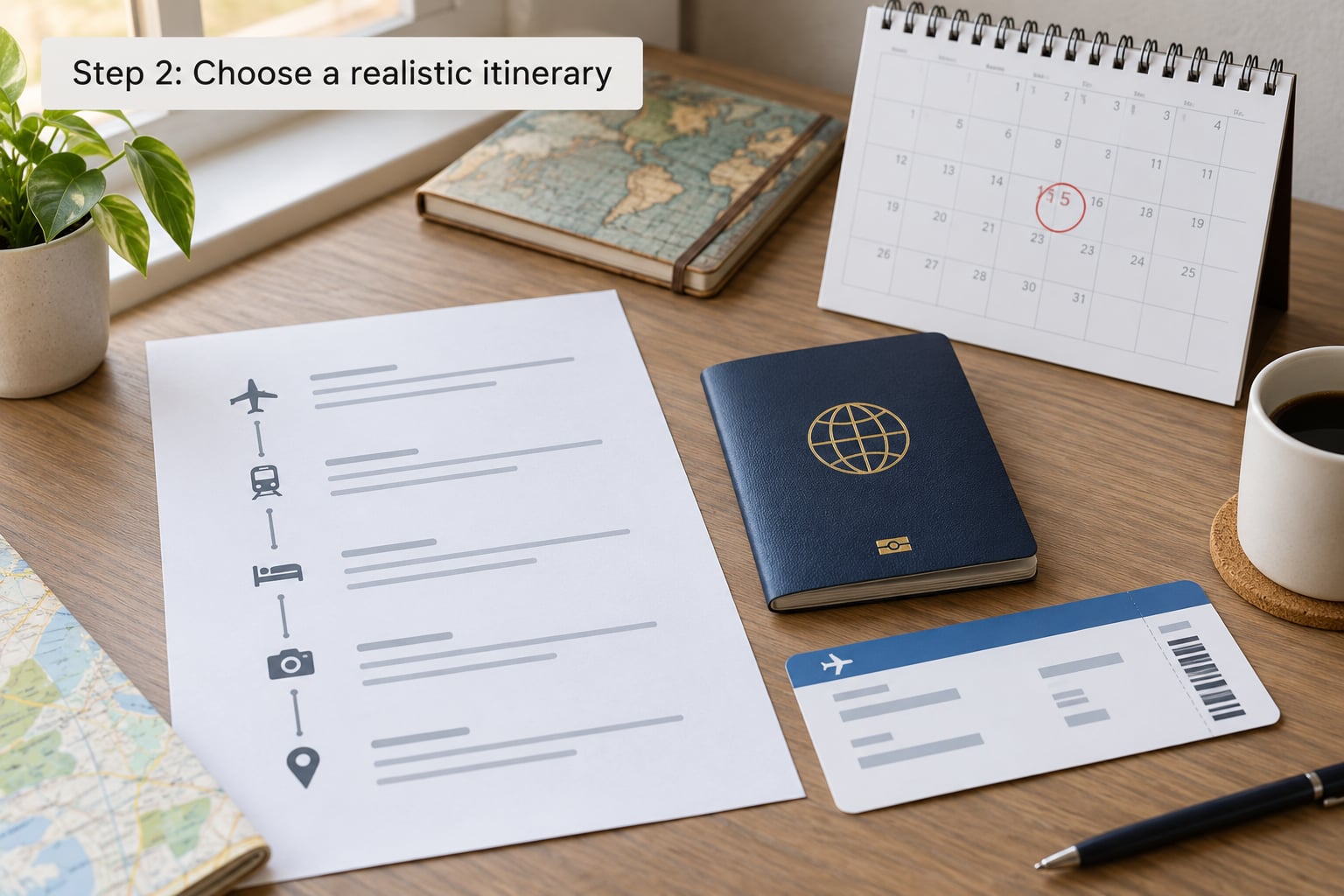
Pick a departure date, a destination and a transport mode that make sense for the trip you are actually taking. A ticket to a city you have no plan to reach, or one dated far outside your intended stay, reads as evidence against you rather than for you.
This is the single most avoidable mistake in the whole process. One travel forum poster reported losing real money on a flight between two South American cities that was never needed. If your exit ticket is dated past the end of your permitted stay, you are handing an officer a contradiction.
Step 3: Carry proof you can access offline
Download every confirmation to your phone and keep a printed copy in your carry-on. Airport connectivity fails often enough that travellers plan around it, and a screenshot of a PDF is not the same as a document an agent can pull up.
Know the booking reference for each reservation. Confirm each booking is properly ticketed rather than merely held: a reservation reference without an issued ticket number is the gap that gets temporary reservations rejected at the desk.
Step 4: Prepare answers about your plans
Be ready to say, in plain sentences, where you are heading, how you will travel onward, where you are staying and what you intend to do. Consistency matters more than polish. If your ticket says a departure date and your answer says something else, expect to be questioned until the two agree.
Know why you chose that onward destination. Showing a ticket out proves you are allowed to enter where it goes, so if that country requires a visa you do not hold, the ticket does not help you.
Step 5: Present the evidence clearly
Have the document open before you reach the desk rather than searching through your bag while a queue builds. Hand it over with a short explanation: the destination, the date and the transport mode. Answer the question that was asked and stop there.
There is no prize for winning an argument with a check-in agent. You can absolutely ask for clarification, or for a supervisor, while staying truthful and calm. Do not argue, do not embellish, and do not offer a story that your documents do not support.
Common Mistakes and How to Fix Them
- Contradictory bookings. A return date past your permitted stay, or a route that skips a country you claim to be visiting. Fix: make one itinerary match your answers, and discard the rest.
- Unverifiable reservations. A held booking with no issued ticket number, often sold as a temporary or rented itinerary. Fix: check for a real ticket number, and be aware that some agents will not accept anything else.
- Screenshots only. Fix: save the file offline and print a copy. Both.
- Proof that goes nowhere. A flight out of a country you cannot enter without a visa, or a route you have no intention of taking. Fix: pick a destination you could genuinely reach.
- Edited or forged documents. Changing a date in a PDF to match your story is fraud. It has ended trips and triggered bans, and in some countries prosecution. There is no version of this that is worth it.
- Overpacking irrelevant paperwork. Twenty documents and none of them loadable. Fix: one clear ticket, one accommodation record, references written down.
- Trusting an old thread. Advice from a forum written years ago describes different visa rules. Fix: check the current official page on the day you book.
- Assuming nobody will ask. Enforcement varies by airport, airline, shift and agent. Travellers who were never stopped often are, on the next trip.
If you are refused at check-in
Stay calm and work through this in order. Ask the agent exactly what they need, because the requirement is often a specific document rather than a ticket at any price. If a ground ticket satisfies them, buy a legitimate one for the next day or two from the terminal or a reputable operator. Contact your airline immediately, because a self-transfer itinerary needs to be re-timed correctly rather than improvised. If your booking was made within the US 24-hour cancellation window, ask about a refund or a hold, noting that the rule applies to bookings made at least seven days before departure and airlines may offer a hold instead of a refund. Finally, ask for a supervisor if the agent is applying a rule that does not match the destination’s published requirement, and keep your written evidence for any later claim about denied boarding.
Frequently Asked Questions
What is considered proof of onward travel?
A confirmed flight, bus, train or ferry ticket out of the country is the most common answer, and an open-jaw or third-country itinerary works too. Some destinations accept proof of sufficient funds, an accommodation record or a sponsorship letter in place of a ticket. What matters is that the document is genuinely ticketed, internally consistent, and matches what you tell the officer.
Does the onward ticket have to be a flight back to my home country?
No. Most destinations accept a one-way ticket to any third country you are allowed to enter. A cheap onward flight to a nearby hub has satisfied the requirement for many travellers. The exception is your onward destination’s own entry rules: showing a ticket to a country whose visa you do not hold proves very little.
Can I show a bus or train ticket as proof of exit?
Yes, on most routes. International bus and cross-border train tickets are regularly accepted, and traveller reports from Central America describe ground tickets working where agents had refused other options. Confirm that the service actually runs on your date, since some routes are seasonal or have suspended, and keep the confirmation accessible offline.
Why did the airline ask for onward travel when immigration did not?
Because the airline carries the financial risk. If you are refused entry at your destination, the carrier may face a fine and repatriation costs, so check-in staff enforce the destination’s rules before handing you a boarding pass. Border officers apply a separate, discretionary test on arrival. That gap is why travellers are stopped at desks in countries where nobody asked at the border.
What happens if I buy a round-trip ticket and only use one way?
Nothing automatic happens, but the unused return leg is your weakest piece of evidence. Officers read tickets as statements of intent, so an unused leg sitting on a ticket while you say you have no fixed return date is a contradiction. Either use the ticket as written, or plan a coherent exit and be ready to explain the change plainly.
Is editing or forging an itinerary illegal?
Yes. Altering a date or route in a ticket to make it fit your story is document fraud, and it has led to refused entry, bans and prosecution in several countries. Border authorities treat a forged onward ticket as evidence of deception rather than a harmless shortcut. The legal way through is a real ticket you can actually use.
Conclusion
Start with the official rule for your passport and destination, then assemble one coherent evidence set that matches the trip you are really taking: a genuine ticket out, saved offline and printed, with dates that make sense. One document that holds up beats a folder of papers that contradict each other.