
How long can Americans stay in Europe without a visa? U.S. citizens with a valid passport can normally visit most of Europe visa-free for up to 90 days within any rolling 180-day period, and a handful of countries outside that zone allow much longer. The exact limit depends on where you are going and why.
The U.S. Department of State puts it plainly: with a valid U.S. passport, you can stay up to 90 days during any 180-day period. That sentence covers the Schengen Area, which is the great majority of European destinations for American travelers. It does not cover London, Dublin, or Istanbul, and it does not cover what happens if you want to stay longer than a season.
Here is the short version before the detail:
- The rule: 90 days in the Schengen Area in any rolling 180-day period, counted across all Schengen countries combined.
- Resetting: nothing resets it. A weekend out of the Schengen Area does not clear your days.
- Tracking: the EU Entry/Exit System records biometrics at the border, so an unstamped passport no longer means an untracked stay.
- Different limits: the United Kingdom allows up to 180 days, Ireland operates its own 90-day right, and Georgia offers a much longer visa-free stay for Americans.
- Caution: the France-U.S. bilateral agreement of 1949 permits longer stays in metropolitan France, but not unlimited travel.
Table of Contents
- How Long Can Americans Stay in Europe Without a Visa?
- What Is the Schengen 90/180 Rule?
- How Does the 90/180 Rule Actually Work?
- A single 30-day trip uses 30 of your 90 days
- Three long weekends use far less than three trips would suggest
- A split trip across countries is still one continuous stay
- Old days fall out one at a time
- Which European Countries Are in the Schengen Area?
- Does Every Trip to Europe Use the Same 90-Day Limit?
- Does a U.S. Visa Exemption Equal a Visa?
- Do Americans Need ETIAS or a European Travel Authorization?
- What If 90 Days Is Not Enough?
- How Can Travelers Avoid an Overstay?
- Frequently Asked Questions
- Can an American stay in Europe for 180 days without a visa?
- Is the 90-day limit separate for each Schengen country?
- Does the 90/180 period restart whenever I leave Europe?
- Is the day I arrive in Europe counted as a full day?
- Can an American work or study in Europe on a 90-day visa-free visit?
- Conclusion: Check the Rule Before Every European Trip
How Long Can Americans Stay in Europe Without a Visa?
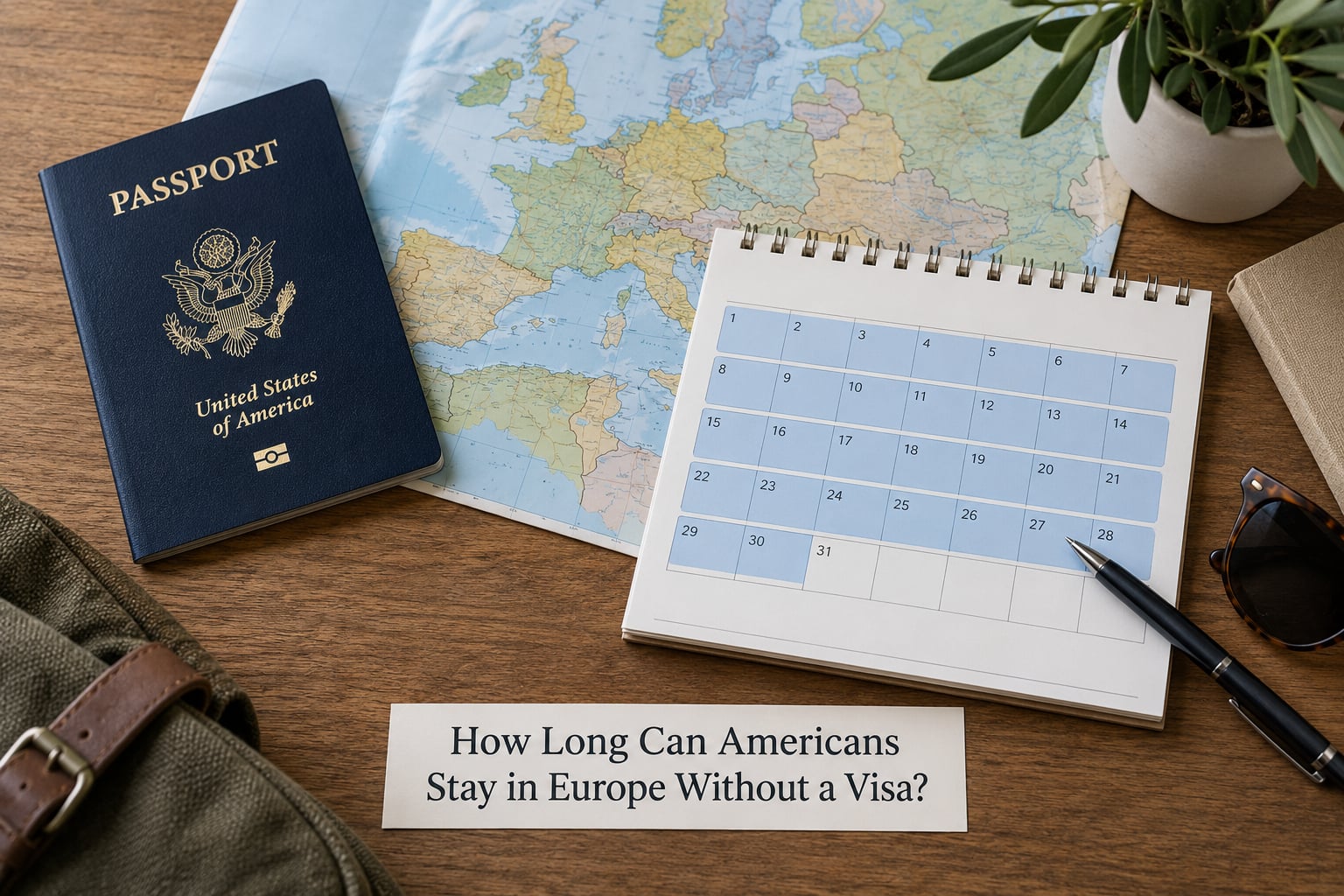
Ninety days. That is the headline number for a U.S. passport holder visiting the 29 Schengen countries, and it applies to the whole zone rather than to each country separately.
The 90 days are not a per-trip allowance you can spend again next month. They are an average running rate across a six-month window, so one 90-day visit uses the entire budget until older days fall out of the calculation.
Traveling to a country outside the Schengen Area gives you a separate allowance. A trip to London or Dublin does not consume a single Schengen day, which is why so many long European itineraries are built around them.
What Is the Schengen 90/180 Rule?
The Schengen Area is treated as one border zone for immigration purposes. Twenty-nine countries share an external border and a common immigration rule, so a border officer in Slovenia and one in Portugal apply the same test to your passport.
The test is a rolling look-back. Every time you cross into the zone, officials count how many of the previous 180 days you have already spent inside it. If that total is 90 or more, you are at or over the allowance. If it is 89, you are inside it.
Because the window moves, days stop counting eventually without you doing anything. Spend 60 days in Italy in March, and those 60 days are still being tallied through September, dropping out one by one from mid-September onward.
How Does the 90/180 Rule Actually Work?
Most confusion comes from treating the rule like a bucket that refills. It is better to think of it as a sliding window. Here is how four common itineraries land.
A single 30-day trip uses 30 of your 90 days
Fly into Madrid on 1 April, stay 30 days, fly home on 30 April. On departure, the system looks back 180 days and finds 30 days used. You can return for another 60 days within the same window.
Three long weekends use far less than three trips would suggest
Say you spend four days in Paris in February, five in Rome in April, and four in Berlin in June. That totals 13 days across the whole zone, not 13 days per country. Plenty of room remains.
A split trip across countries is still one continuous stay
Ten days in Spain followed by ten in Italy followed by ten in Greece is 30 Schengen days. Moving from Madrid to Rome does not start a new allowance, and a flight over a non-Schengen country without landing does not stop the count either.
Old days fall out one at a time
After a 60-day stay finishing 1 June, your earliest days drop out of the window starting 1 September. Each day after that frees up another day. This is why travelers describe waiting a period and then re-entering.
One nuance worth knowing: a small number of countries, Spain among them, have historically calculated the period on a 90-in-185 basis rather than 90-in-180. The practical effect is a handful of extra days. Leave a buffer instead of planning to the final day.
Which European Countries Are in the Schengen Area?
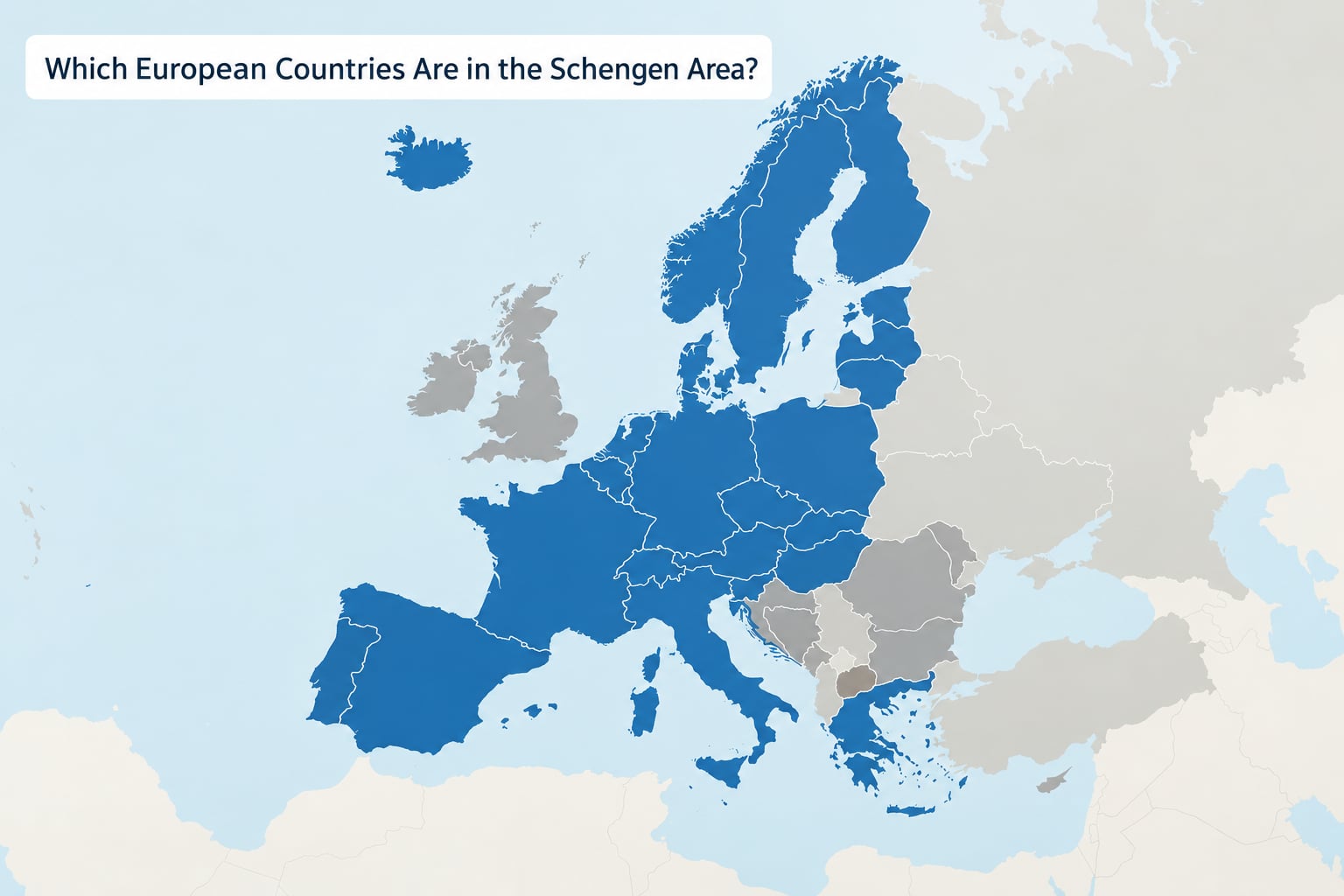
The Schengen Area currently covers 29 countries: Austria, Belgium, Bulgaria, Croatia, Czechia, Denmark, Estonia, Finland, France, Germany, Greece, Hungary, Iceland, Italy, Latvia, Liechtenstein, Lithuania, Luxembourg, Malta, the Netherlands, Norway, Poland, Portugal, Romania, Slovakia, Slovenia, Spain, Sweden, and Switzerland.
Membership, application dates, and government checks move over time, so confirm the current list with an official EU source before booking. The table below groups the destinations American visitors ask about most.
| Destination | Zone | Visa-free stay for Americans | Notes |
|---|---|---|---|
| France | Schengen | 90 days, with extra time available in metropolitan France under the 1949 U.S.-France agreement | Overlap rules differ from the standard Schengen allowance |
| Spain, Italy, Germany, Portugal, Greece and the rest of the 29 | Schengen | 90 days in any rolling 180-day period, zone-wide | One shared allowance, not one per country |
| Ireland | Non-Schengen (EU member) | 90 days under its own common travel area arrangement | Does not draw on your Schengen days |
| United Kingdom | Non-Schengen | Up to 180 days | Separate permission, separate counting |
| Cyprus | Non-Schengen (EU member) | Short stays for tourism and business | Rules set by Cypriot authorities |
| Turkey | Non-Schengen | Up to 90 days for tourism | An e-visa or sticker visa can allow longer stays |
| Serbia, Montenegro, North Macedonia, Albania, Kosovo | Non-Schengen (Western Balkans) | Generally 90 days for U.S. passport holders | Some allow longer for specific purposes |
| Georgia | Non-Schengen | Visa-free stay of up to a year for Americans | A genuine long-stay option outside the Schengen zone |
| Armenia, Moldova, Ukraine | Non-Schengen | Short visa-free visits for U.S. citizens | Confirm current conditions before travel |
| Russia, Belarus | Non-Schengen | Visa required for Americans | Not covered by any Schengen arrangement |
Does Every Trip to Europe Use the Same 90-Day Limit?
No. The permitted length depends on both the destination and the reason for your visit, and the distinction matters more than most itineraries assume.
Tourism and visiting friends are the standard categories. Short business meetings, medical treatment that has been pre-arranged, and transit through the zone are also generally accepted. Each Schengen state also offers its own long-stay route for people studying, working, or joining family, and those permissions are applied for before arrival rather than requested at the counter.
Paid work is the line that catches people. A tourist entry does not authorize employment, and the tolerance for remote work on a laptop varies by country and by how local your tax position becomes.
France is the notable exception Americans rarely know about. Under a bilateral agreement dating to 1949, a U.S. citizen can be granted a longer stay in metropolitan France than the standard Schengen allowance when a French authority issues the permission. It applies to metropolitan France, not to the overseas territories, and it is a separate authorization rather than a general extension of the Schengen clock. Ask a French consulate before you rely on it.
Does a U.S. Visa Exemption Equal a Visa?
It does not. Visa exemption means no visa was required in advance. It says nothing about whether you will be admitted on arrival.
The usual short-visit requirements include a passport valid for at least three months beyond your planned departure, issued within the previous ten years, with a blank page. Border officers also look at the purpose of your visit, where you are staying, how you are getting home, and whether you can support yourself without working.
Travel insurance is often requested by consulates and recommended by carriers. Proof of accommodation for the first nights and a return or onward ticket carry more weight with an officer than any amount of sightseeing plans.
A refusal at the desk is always possible even with a perfect document. That is why an exemption should be treated as permission to ask, not a guarantee.
Do Americans Need ETIAS or a European Travel Authorization?
ETIAS is the European Travel Information and Authorization System, a pre-travel authorization for visa-exempt visitors heading to the Schengen Area. It is not a visa, and holding one does not grant the right to enter.
As of the latest official information available, ETIAS has not yet entered full operation, and the start date has moved more than once. Verify the current launch date and any requirements on the official EU ETIAS pages rather than a third-party application site, many of which charge a handling fee for something you may be able to complete directly at no cost.
When it is running, an ETIAS costs 20 euro, is valid for three years or until your passport expires, and covers multiple trips. Fee waivers are available for some travelers under 18 and over 70.
EES is separate and more consequential. The EU Entry/Exit System registers the fingerprints and facial image of travelers crossing the external border and replaces the old rubber stamps. That is the mechanism making the 90-day count accurate, and it is why an unstamped passport is no longer evidence of anything.
What If 90 Days Is Not Enough?
You cannot extend a Schengen stay at the border. Officers do not grant extra time on the spot, and asking informally rarely helps. A different kind of permission has to exist before you travel.
The main routes for longer stays are a Schengen short-stay visa with a justified reason, a national long-stay visa such as a digital nomad, retirement, or family permit, or a regular route to permanent residence. Several of these have income thresholds, health-insurance requirements, and appointment backlogs that take months to work through, so start well before the trip you have in mind.
Alternating between the Schengen zone and countries outside it is a real strategy, and plenty of travelers run multi-country itineraries on it. It is also not unlimited. Living in one country while popping in and out to reset counters can draw questions about your real intentions, and tax residency is a separate clock with its own 183-day threshold.
How Can Travelers Avoid an Overstay?
Counting your days by hand takes about five minutes once you know the method.
- List every day you were inside the Schengen Area across the last 180 days, including every country in the zone and transit stops where you passed through immigration.
- Group them into trips with arrival and departure dates, so overlapping or miscounted stretches are obvious.
- Add up the total. If it is 89 or more, plan to leave or go to a non-Schengen country before you cross back in.
- Mark the date your earliest days roll off — 180 days after your first day in the zone — so you know when capacity returns.
- Recheck after every crossing, because EES now records your movements whether or not anyone stamps the passport.
Before departure, check these too:
- Passport valid three months past your return date, with a blank page.
- Every itinerary day classified as Schengen or non-Schengen, including layovers where you clear immigration.
- Return or onward travel booked, accommodation confirmed for the first nights.
- Medical insurance covering the full stay and any activity you plan.
- Two to three spare days at the end of the trip so a delayed flight does not become an overstay.
- Current ETIAS and EES status checked on an official EU site, plus the destination country’s own entry rules.
Frequently Asked Questions
Can an American stay in Europe for 180 days without a visa?
Not in the Schengen Area. Americans get 90 days there in any rolling 180-day period, and moving between countries does not create a fresh allowance. Longer stays are possible outside the zone: the United Kingdom permits up to 180 days, and Georgia offers visa-free stays of up to a year for U.S. citizens. If 180 days in Europe is the goal, build the itinerary around non-Schengen countries.
Is the 90-day limit separate for each Schengen country?
No. All 29 Schengen countries share a single allowance, and border officers can see your full history through the Entry/Exit System. Ten days in Spain, ten in Italy and ten in Greece equal 30 days against the same 90. The one complication is France, where a bilateral agreement with the United States can allow a longer stay in metropolitan France when granted by a French authority.
Does the 90/180 period restart whenever I leave Europe?
No. The window is a rolling look-back of 180 days rather than a period that resets on departure. Leaving for a weekend in London or Dublin does not clear your Schengen days, because those countries sit outside the zone. Your oldest days do eventually drop out, one per day, once they pass 180 days from the date you entered the Schengen Area.
Is the day I arrive in Europe counted as a full day?
Yes. The day you cross the external Schengen border counts as a full day, as does the day you leave. An arrival on 1 April and departure on 30 April uses 30 days. This is one reason travelers aim to be out by day 89 rather than day 90: a mistimed flight on the last day turns a legal stay into an overstay, and overstays can mean fines or an entry ban.
Can an American work or study in Europe on a 90-day visa-free visit?
Paid employment is not permitted on a tourist entry, and taking local work is treated as an immigration violation even when the stay itself was within the 90-day limit. Studying requires a separate student permit, and most long-stay routes, including digital nomad and retirement visas, must be secured before departure. Remote work on a tourist status sits in a grey area whose tolerance differs by country.
Conclusion: Check the Rule Before Every European Trip
The baseline is simple: 90 days in the Schengen Area in any rolling 180-day period, counted across all member countries at once, with nothing resetting when you leave. Start by checking the current rules for every destination on your list and adding up every day you have already spent in the zone.
Rules shift, membership changes, and ETIAS timing has moved repeatedly, so confirm details with official government and consular sources before you book. Leave a buffer of two or three days so a delayed flight does not turn a legal trip into an overstay.