To protect coral reefs with reef safe sunscreen, choose a broad-spectrum formula built on zinc oxide or titanium dioxide with no chemical UV filters, apply it on land 15 to 20 minutes before you get wet, and wash it off ashore afterward. Add a rash guard and hands-off reef habits, and most of the damage never happens.
Hawaii makes this easier than anywhere else in the US. Since Act 104 took effect, you cannot buy a bottle containing oxybenzone or octinoxate in the state at all, so the shelf is already filtered for you. The rest is habit: how much you apply, when you apply it, and what you rinse off where.
It takes about ten minutes of prep and costs nothing extra. That is the whole trade.
Table of Contents
- What You Need
- Step-by-Step
- Choose a Sunscreen That Is Less Harmful to Reefs
- Apply It Before Entering the Water
- Reduce the Product You Bring Into the Ocean
- Use Physical Protection Whenever Possible
- Common Mistakes
- Frequently Asked Questions
- What type of sunscreen is safe for coral reefs?
- Does Hawaii Act 104 mean reef safe sunscreen?
- Is spray sunscreen bad for the environment?
- What are the downsides of mineral-based sunscreen?
- Should I rinse off sunscreen before entering the ocean?
- Is it okay to use old sunscreen?
- Conclusion
What You Need
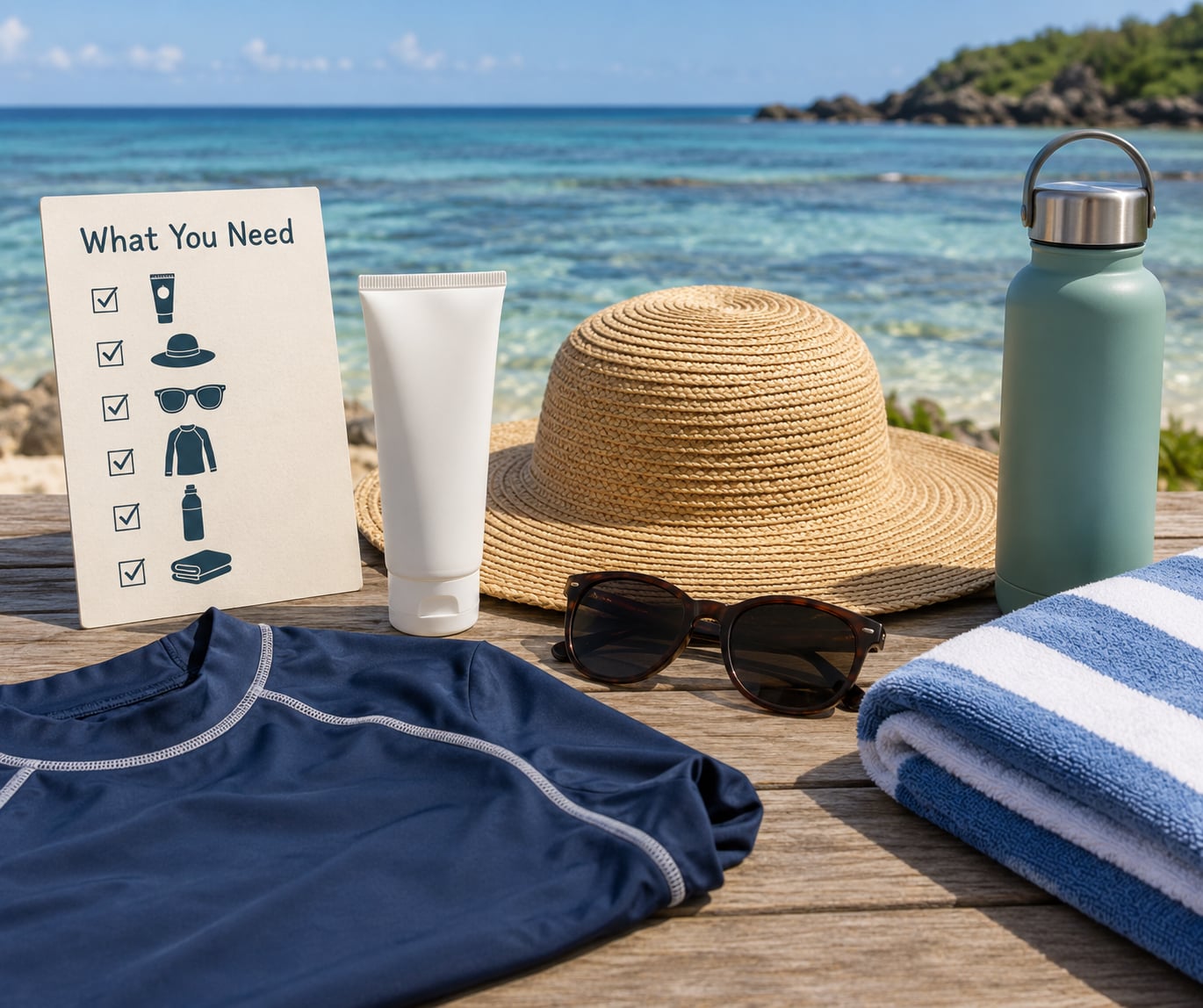
Pack these seven things and you have covered the whole job, sunscreen included.
- A broad-spectrum mineral sunscreen with zinc oxide or titanium dioxide as the active filter. Non-nano is the safer label to look for, and broad spectrum is what blocks UVA as well as UVB.
- A rash guard or UV swim shirt. This is the single most reef-protective item on the list, because it means less bare skin and less sunscreen going into the water.
- A wide-brimmed hat or a reef-safe sun hat with a chin strap. Hats fail when they blow into the water, so the strap is not optional.
- Sunglasses. Polarized if you will be looking at reef life for a while.
- A reusable water bottle. Single-use plastic is the other thing most reef trips generate in bulk.
- A fresh-water rinse plan. A camp shower, a hotel tap, or a soapy cloth in your bag. This is what lets you wash sunscreen off on land instead of in the lagoon.
- A behavior plan for the water. Hands off coral, fins parallel to the bottom, nothing fed to fish, no standing on reef in shallow water.
Leave the aerosol can at home. More on that in a minute.
Step-by-Step
Choose a Sunscreen That Is Less Harmful to Reefs
Start with the awkward part: reef safe is a marketing label with no legal definition and no certification behind it. Two companies can put it on bottles with completely different ingredients, and you are the only one doing the quality control. So read the active ingredient list rather than trusting the front of the pack.
Mineral filters sit on the surface of your skin and scatter or reflect UV back into the air. Chemical filters absorb UV into your skin instead, and that is what lets them leach into seawater when you swim or when you rinse off later.
Hawaii’s Act 104, signed in 2018 and enforced from 2021, prohibits selling or distributing sunscreen containing oxybenzone or octinoxate in the state. Maui added its own ordinance covering further ingredients, and Hawaii County did the same. None of these laws require a product to be reef safe, and none require non-nano mineral. The legal floor and the kind choice are not the same thing.
Ingredients to avoid, with the names that show up on labels:
- Oxybenzone (benzophenone-3)
- Octinoxate (ethylhexyl methoxycinnamate)
- Octocrylene
- Homosalate
- 4-MBC (4-methylbenzylidene camphor)
- PABA
- Parabens
- Triclosan
- Nano zinc oxide (particles under 100 nanometers)
- Nano titanium dioxide
- Microplastics and plastic beads used as scrubbers
Cheat sheet for where the rules are strictest:
| Destination | What is restricted |
|---|---|
| Hawaii (state) | Oxybenzone, octinoxate |
| Maui County | Adds octocrylene, homosalate, octisalate and others |
| Hawaii County (Big Island) | Adds further chemical filters by local ordinance |
| US Virgin Islands | Oxybenzone, octinoxate |
| Palau | Oxybenzone, octinoxate, plus microbeads banned outright |
| Bonaire | Oxybenzone, octinoxate |
| Aruba | Oxybenzone, octinoxate |
| Key West and Monroe County | Oxybenzone, octinoxate |
| Maldives | Prohibits products with chemical UV filters in resorts and guesthouses |
| Thailand (marine national parks) | No oxybenzone, octinoxate, octocrylene or butyl methoxychinolinone |
| Great Barrier Reef (Australia) | No oxybenzone or octinoxate sold in the marine park |
Non-nano simply means the mineral particles are larger than 100 nanometers, big enough that marine life is not expected to swallow them. The tradeoff is cosmetic: larger particles scatter more light, so you get a whiter cast that is hard to rub out. That is the honest deal, and it is still the better one for a reef.
You will know the choice worked if the active ingredients are minerals, the word non-nano appears somewhere on the label or the brand publishes particle data, and the finish takes a few extra seconds to blend. If it absorbs in a second and leaves no film, you are probably looking at a chemical formula with a leaf on the box.
Skip sprays entirely. Aerosol propels a share of the product into the air rather than onto your skin, and that drift lands on the water and on people behind you. A lotion or a stick does the same job with nothing in the air. It is the one rule in this topic that costs you nothing and takes no research at all.
Apply It Before Entering the Water
Apply on land, 15 to 20 minutes before you get in, and use enough to leave a faint visible film. Most people under-apply, and a thin coat that looks clear is usually thinner than the label assumes.
Rub it in fully, especially the backs of your hands, your ears and the back of your neck. Those are the spots snorkelers burn most often because they reach for a hat strap and assume they are covered.
Reapply after every swim and after every towel-off. A bottle labeled water resistant for 80 minutes is tested for immersion, not for a two-hour session with a reef stop, a mask adjustment, and a beach towel. Think of it as a starting clock rather than a promise.
One practical note from the water: mineral formulas are the better choice for a leaky mask. Chemical filters that migrate into your eyes from a bad seal sting badly, and zinc does not do that.
Reduce the Product You Bring Into the Ocean
This is the step almost everyone skips, and it is the one that changes the most. Rinse off with fresh water and a soapy cloth before you get in, not in the lagoon. You cannot stop sunscreen you are already wearing from washing off in the surf, but you can avoid adding a second deliberate rinse.
Wash off as soon as you are back on land, well before sunset. The idea is to make sure the rinse happens on sand or tile rather than over coral.
Sunscreen also reaches the ocean through shower drains, pool drains and storm runoff, not just from swimmers. That is why rinsing thoroughly at the campground tap still matters, and why a bottle of product should never go down a storm drain. If you want to be careful about the sunscreen already in your bathroom at home, finish using it onshore and keep it out of the water.
Old sunscreen is fine to use as long as it is not expired and has been stored somewhere cool. Sunburn is the bigger risk, and sunburn ruins a reef trip faster than any chemical does.
Use Physical Protection Whenever Possible
Clothing beats lotion because it does not dissolve. A long-sleeve rash guard or a UV swim shirt covers the areas that burn most and removes the need to apply sunscreen there at all. Sun gloves, leggings, a wide-brim hat and dive booties in shallow water complete the set.
Then use the two free protections people forget: shade and timing. An hour under a tree at midday does more than any SPF number, and going in before nine or after four shortens the exposure window without adding a single ingredient to the water.
On the reef itself, the behavior rules do more good than the bottle did. Keep your hands off coral, hover instead of touching, keep your fins parallel to the bottom, do not stand on reef in shallow lagoons where the water is calm enough to stand in, do not feed or chase fish, and use moorings rather than anchors where a buoy is available. If you do brush coral, move away gently and do not go back to inspect it. Snorkelers who never touch anything describe the reef as a forest, which is a decent mental image for the whole trip.
Common Mistakes
Assuming every reef-safe label means the same thing. It is unregulated marketing language, and two labels on the same shelf can hide completely different filters. Fix: read the active ingredients every time you buy.
Applying too little, too late. A thin coat applied in the parking lot burns. Fix: a visible film, applied 15 to 20 minutes before you get wet.
Treating 80 minutes of water resistance as a whole session. It is not. Fix: reapply after every swim and after any towel-off.
Trusting sprays. Aerosol drifts off-skin and onto the water. Fix: lotion or stick.
Rinsing off in the ocean. A deliberate rinse over a lagoon is a dose of product delivered directly to the reef. Fix: wash on land with fresh water.
Thinking sunscreen alone protects the reef. It is one item in a list. The rash guard, the hat, and keeping your hands off the coral do more for a reef than the bottle does.
Dropping a chemical sunscreen in the shower straight after snorkeling. It goes down the drain and eventually reaches the sea. Fix: rinse outdoors on sand or gravel where you can.
Frequently Asked Questions
What type of sunscreen is safe for coral reefs?
A broad-spectrum mineral sunscreen with zinc oxide or titanium dioxide as the only active filter, ideally labeled non-nano, is the least harmful option. Avoid chemical UV filters, especially oxybenzone and octinoxate, which lab studies have linked to coral bleaching and abnormal larval growth. No product is regulated or certified as reef safe, so read the active ingredient list rather than trusting the label.
Does Hawaii Act 104 mean reef safe sunscreen?
Not exactly. Act 104 bans the sale of sunscreen containing oxybenzone or octinoxate in Hawaii, enforced since 2021, and Maui and Hawaii County ordinances add more restricted ingredients. It sets a legal floor rather than requiring a product to be reef safe, and it does not require non-nano mineral particles. A product can be legal in Hawaii and still contain ingredients you would rather avoid.
Is spray sunscreen bad for the environment?
Aerosol sprays put a meaningful share of the product into the air rather than onto your skin, and that drift settles on the water and on bystanders. For a reef, a lotion or solid stick is the better choice for the same coverage. If a spray is all you have, apply it outdoors in the wind, well away from the water, and let it dry before you swim.
What are the downsides of mineral-based sunscreen?
The main complaints are the white cast, thicker texture, and a slower rub-in, all of which come from larger non-nano particles. Scents can also bother sensitive skin, and the formulas cost more than mass-market chemical ones. In exchange you get no chemical filters washing off you into the water, and zinc does not sting your eyes from a leaky mask.
Should I rinse off sunscreen before entering the ocean?
Yes, rinse or wipe it off with fresh water ashore rather than in the sea, and again as soon as you are back on land. You will still shed some product in the surf, but you avoid delivering a deliberate rinse directly over coral. Make sure the rinse goes onto sand or gravel outside rather than down a shower or storm drain.
Is it okay to use old sunscreen?
Yes, as long as it is not expired, the container has not been left in a hot car, and the texture and smell are normal. Expired sunscreen loses effectiveness, and sunburn ruins a reef trip far more than any ingredient does. A chemical sunscreen you already own is fine to finish using on land; just keep it out of the water and rinse outdoors.
Conclusion
Here is the order to do it in. Pick a broad-spectrum mineral sunscreen with non-nano zinc oxide or titanium dioxide and no oxybenzone or octinoxate. Apply it on land 15 to 20 minutes before you swim, in enough quantity to leave a faint film, and reapply after every session. Wear a rash guard so there is less bare skin to cover in the first place. Wash off with fresh water ashore instead of in the lagoon. And in the water, keep your hands off the coral, your fins off the bottom, and nothing fed to the fish.
None of this asks you to give up sun protection. It asks you to move the protection around, so the reef gets the least of it.