Filling out a customs declaration form takes about ten minutes once you know which form you have and what you are carrying. It asks who you are, where you are staying, what you are bringing or mailing, and what each item is worth, then you answer a set of yes or no questions, sign, and hand it over. Everything else is detail work.
The mistake almost everyone makes is treating the form like a tax bill to be minimized. It is not. It is a record of what is crossing the border so officials can decide whether the goods may enter and whether duty applies. Accurate answers, even expensive-looking ones, are what keep you moving through the line.
There is also a second thing worth clearing up right away. Travelers filling out CBP Form 6059B in the United States and people mailing a parcel through USPS are using two completely different documents, and the search results rarely tell you which one you need. Both are covered below.
Table of Contents
- What You Need
- Which form you actually need
- Step-by-Step: How to Fill Out a Customs Declaration Form
- How to fill out a customs declaration form for personal information
- How to list the country you are arriving from
- How to declare goods, money, and restricted items
- How to check and sign the completed form
- Common Mistakes and How to Fix Them
- Frequently Asked Questions
- Do I need to fill out a customs declaration form if I bought nothing?
- Do transit passengers need to fill out a customs declaration form?
- What happens after I hand in my customs declaration form?
- Do gifts have to be declared separately on the customs form?
- What value should I write for used or handmade items?
- What should I do if a customs form question is unclear or my answer does not fit?
- Final Checklist Before Submitting
What You Need
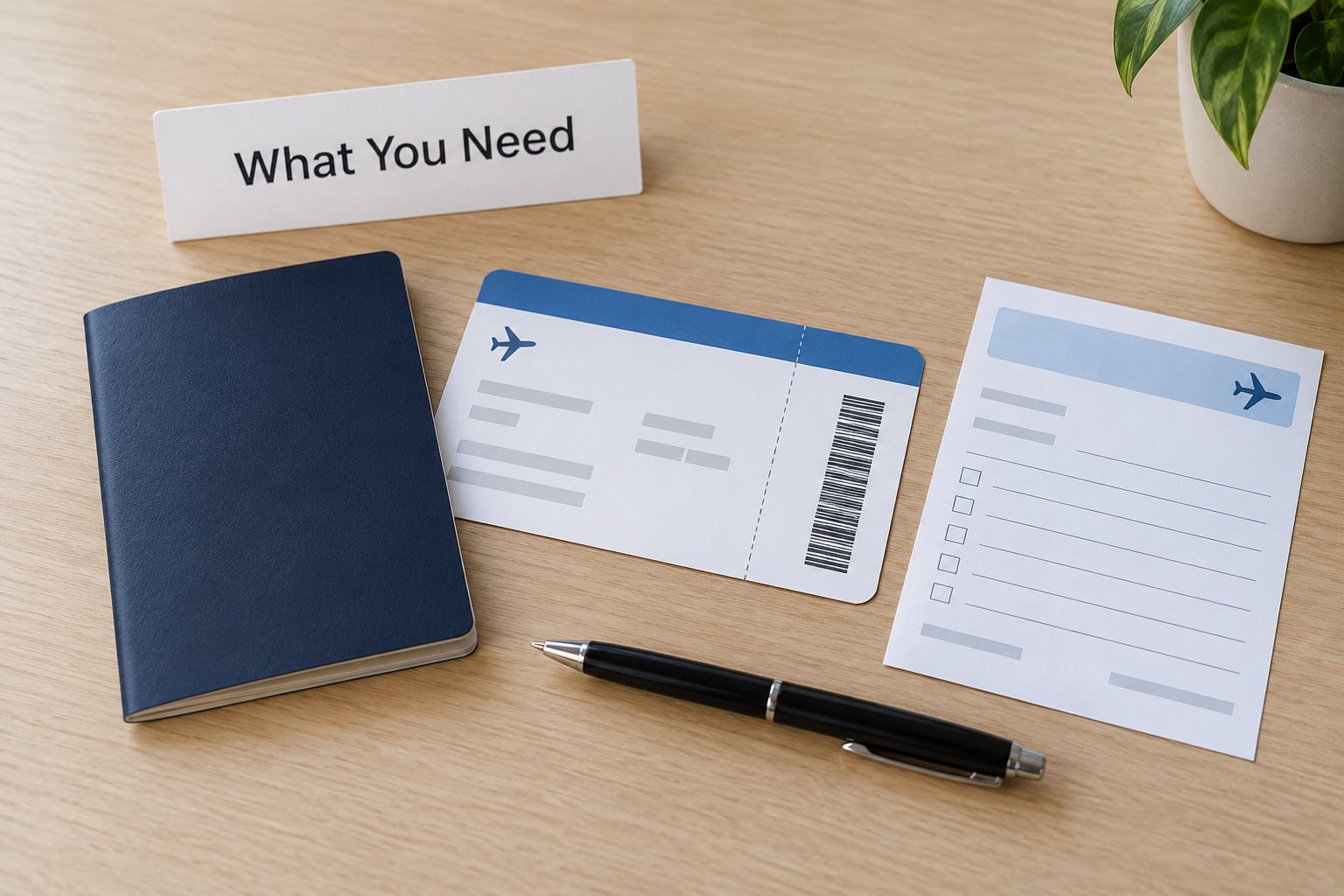
Gather these before you start, while you still have quiet time. Trying to fill a declaration in a customs queue with a phone at 15 percent battery is where the small errors come from.
- Your passport. The name, date of birth, passport number, and issuing country all come from the document itself, not from a booking or an app. Copy them exactly, including hyphens in the passport number.
- Your travel details. Airline and flight number or vessel name, the date of arrival, and the countries you passed through since your last trip outside the destination.
- A US address where you will stay if you are entering the United States. A hotel name plus room number is fine for a short trip. A friend or relative’s street address is fine too, as long as you know the city and state.
- Receipts or a note of what you bought. Not required, but it is the difference between a confident value and a guess you have to defend at a counter.
- A pen, or a device with the fillable PDF open if you are typing instead of writing.
- The instruction sheet that came with the form. The wording on it is what settles most of the confusing questions, particularly around transit stops.
Which form you actually need
Pick the row that matches your situation before you start writing anything.
| Situation | Form | Where it comes from |
|---|---|---|
| Arriving in the US by air, land, or sea | CBP Declaration Form 6059B, also called CF-6059 | Flight attendants hand it out on board; at land ports the officer gives it to you |
| Mailing a parcel abroad through USPS | PS 2976, CN22, or CP31 depending on contents and value | The clerk supplies it, or you can print the correct version |
| Sending documents only, with no commercial value | The green postal customs declaration or the electronic equivalent | USPS branch or online |
| Traveling through a country without passing through immigration | Usually nothing, but check the departure airport | Ask staff at the transfer desk before you fly |
A word on a search that confuses people: the paper 6059B is not gone. What has changed is that many ports now run a verbal declaration or a digital flow, where an officer asks the questions and enters the answers for you. Frequent flyer forum users on r/GlobalEntry note that at a growing number of ports you get a paper form only if the officer wants one. If you are offered a digital option, use it; if a form is handed to you, complete it.
Step-by-Step: How to Fill Out a Customs Declaration Form
How to fill out a customs declaration form for personal information
The personal section is the least creative part of the job. Everything comes off the passport or your itinerary, character for character.
Write your name as printed in your passport. Include middle names if the passport has them. Do not use a nickname, a maiden name, or the name on your ticket if it differs.
Give your date of birth as numbers, matching the machine-readable line of the passport where the format is printed that way.
Add passport details: the number exactly as printed including any letter or hyphen, the country that issued it, and your country of citizenship if the form asks for it separately.
List everyone traveling with you. On the 6059B there is a table of accompanying travelers where you add the first and last name of each adult and child in your group. One of the recurring questions on travel forums is whether each person needs their own form, and the short answer is that travelers arriving together commonly file one joint declaration, with each person listed. The currency threshold applies to the group total rather than to each traveler separately.
Write the US address where you will stay. Hotel, address of the home you are visiting, or a cruise ship name plus the port. If you have not booked anything yet, a reliable friend or host can give you the address over the phone before the plane lands.
Supply your contact details if the form has a phone or email field. This is the fastest way for an officer to reach you about a held bag.
Add the transport details: the airline and flight number, or the vessel name and voyage number if you arrived by sea, plus the port of entry where you are arriving.
The order of boxes matters more than people expect. The form is laid out in numbered parts, and some fields only make sense once the one above them is filled, so work top to bottom rather than jumping around.
How to list the country you are arriving from
The question that trips people up is which country counts as where you are arriving from. The instruction on the form asks for the last country or place you were outside the country you are entering, not where your flight started.
So if you fly London to Dubai to Los Angeles, you are arriving from the United Arab Emirates. Your origin for the field is the last country you were physically in before the destination, which is Dubai. Airlines print this on your itinerary as the last point of origin.
Transit stops do not count as arrival points when you never cleared immigration there, which is the normal situation for a connection through a third country. When in doubt, look for the route printed on your boarding pass rather than the ticket you bought. You can also record any intermediate countries the form separately asks for, such as countries visited on the trip within a set number of months.
How to declare goods, money, and restricted items
This is the section that decides whether your bags go straight through or onto a table. Accuracy here is worth far more than trying to shave an amount off a total.
List every item you are carrying that you bought, received, or are bringing for someone else. Each line needs four things: what the item is, how many, what it is worth in US dollars, and the country it came from. One line per kind of item, with the quantity grouped.
Write a real description. This is the single most repeated complaint from people whose parcels or bags got held. A useful description sounds like “men’s cotton button-down shirt, slim fit, one piece” rather than “men’s shirt” or “clothes”. Customs cannot classify “souvenir” or “stuff”, and an unreadable description produces a request for information, a hold, or a return to the sender.
Use the value you would pay for the item new in the destination country. For purchases that is your receipt price. For something you owned before you left, use what it would cost to replace today, which is often a fair bit more than what you originally paid. For handmade gifts, use what the work would fetch commercially.
Convert to US dollars at the rate you can support. The rate on the day you travel is the sensible basis, and a conversion from your card statement or bank works well. Whatever you use, be ready to say where the number came from.
Group similar items on one line rather than writing a new line for each of thirty small gifts. Three pieces of the same design at twenty-five dollars each is one line, quantity 3, total 75 dollars. Then note who they are for.
A reference for the fields people get wrong, in the order they appear on the form:
| Part or question | What it asks | Common mistake |
|---|---|---|
| Personal details | Name, date of birth, citizenship | Using a nickname or a name from a ticket |
| Passport information | Passport number, issuing country | Dropping a letter or misreading a digit |
| Family members | Others arriving in the same group | Leaving out children who hold no passport of their own |
| US address | Where you will stay | Writing only a city, or a hotel with no room number |
| Transportation | Airline and flight, or vessel and voyage | Filling the carrier name but not the flight number |
| Countries visited | Last country outside the destination | Answering with the first country on the ticket |
| Items accompanied | Description, quantity, value, country of origin | Blank value or a description of one word |
| Declarations | The yes or no questions | Leaving questions blank instead of answering |
| Signature and date | Declaration of truth | Forgetting the date, or signing before reading |
A useful shorthand for the goods table is: what it is, how many, what it is worth in US dollars, and where it came from. If a line has those four answers, it is complete.
What you are carrying decides where it goes on the form. This is the version I keep coming back to:
| What you have | Where it goes | Why |
|---|---|---|
| Clothing and personal items you already owned | Nothing to list; they are personal effects | Used belongings for the trip are not commercial goods |
| New purchases abroad | Items accompanied, with value and quantity | Counts toward the personal exemption if you qualify for it |
| Gifts for other people | Items accompanied, with a note of who they are for | A gift label does not remove duty from the item |
| Cash or negotiable instruments over 10,000 USD | The currency question, answered yes | Reporting threshold, counted for the group |
| Fresh food, plants, seeds, soil, meat | Question 11, answered yes | Restricted for agricultural reasons, no exemption applies |
| Goods for sale or as samples | Commercial merchandise question, plus more documentation | Commercial shipments need far more detail than personal luggage |
| Firearms, ammunition, many medicines | Restricted items question, answered yes | Rules differ sharply by item and by country |
Several yes or no questions follow the goods list. The rule from long-standing invasive species guidance, repeated by travelers on forums and by the Washington Invasive Species Council, is straightforward: if a question covers something you have, answer yes.
- Restricted agricultural items. Question 11 on the 6059B is the one people search for by number. Answer yes if you have any fresh fruit, vegetables, meat, dairy, seeds, plants, plant material, soil, or anything from a farm, and note the invasive species line that asks whether you have been on a farm or in close contact with livestock.
- Currency and monetary instruments over 10,000 USD. This is the reporting threshold for cash, traveler’s cheques, and negotiable instruments in your possession or being carried for someone else. Families traveling together count together.
- Commercial merchandise. Goods you are bringing to sell, trade, or give away as samples. Even items you plan to sell at a market are commercial, and the answer is yes.
- Goods bought duty-free or in bond, and any goods acquired for another person.
- Prohibited or restricted goods, which means firearms and ammunition, most fresh food, plants, soil, and many medicines, and anything counterfeit or stolen.
- Prior citations, a previous customs violation or a declaration you were found to have falsified.
- Non-immigrant status or student paperwork. If you are entering on a student or exchange visitor document, you need your I-20 or DS-2019 ready at the desk.
A yes answer is not an admission of wrongdoing. It routes you to an officer or a counter where the item is handled properly, which is far better than a bag search that finds it anyway.
It also helps to know what declaring is not. There is a personal exemption of 800 USD per returning resident for goods acquired abroad, alongside separate duty-free allowances for items like alcohol and tobacco, and goods acquired and consumed while you were on a trip in the country you are leaving can work under another exemption. Those exemptions reduce or eliminate duty on certain items, which is different from saying the item must be declared. If you have a large haul and a big number in the value column, an officer can apply the exemption after the goods are identified.
None of this applies to prohibited and restricted items, though. There is no allowance that makes unsealed soil or undeclared meat legal.
For parcels going out of the country rather than travelers coming in, the logic is the same with a different form. On PS 2976, CN22, or CP31 you give the full sender and recipient addresses including contact details, tick the category that fits the contents, describe each item precisely, give quantity and value in the currency requested, state the country of origin, and sign. The purpose of shipment matters: gift, personal belongings, sample, or merchandise. Post office staff will ask for a written description in your own words rather than a vague one, which is worth doing for the same reason travelers should be specific.
How to check and sign the completed form
Give the finished form two minutes before you hand it over. Read the name and passport number against the passport, the dates against your itinerary, and every value against your receipts.
Then check the two easy-to-skip items. Confirm that every yes or no question has an answer, since a blank box is treated as an incomplete declaration. Add the signature and the date in the signature block; an unsigned declaration is one of the most common reasons a traveler is sent back to a podium.
If you filed electronically or through an app, save the confirmation reference or screenshot on your phone before you close the tab, since officers may ask for it and the signal drops at the worst moment. After that, hand the form to the officer with your passport when you reach the customs desk.
Common Mistakes and How to Fix Them
Each of these is easy to prevent and awkward to sort out later.
- Transcribing passport details by memory. Fix: read every character off the document, including the letter prefix in the passport number.
- Using the flight origin instead of the last country outside the destination. Fix: use the last point of origin printed on the itinerary.
- Leaving value fields blank. A blank value reads as incomplete. Fix: put a real number, even a conservative one, and be ready to explain it.
- Writing vague descriptions. “Gifts” or “clothes” invites questions and delays. Fix: name the item, material, and quantity.
- Estimating values with no basis. Fix: use the receipt price, or the replacement value for something you already owned.
- Forgetting the yes or no questions entirely. Fix: treat them as mandatory, particularly the agricultural and currency questions.
- Skipping the signature and date. Fix: sign as you would a passport, in the block at the end.
- Assuming one form per parcel is enough when you are sending something commercial. Fix: check the shipper guidance for your contents and value, since the required form changes.
What happens when a declaration is wrong depends on the mistake. A clerical slip usually means a question at the counter. A mismatch between your bag and your answers can mean secondary inspection, an assessment of duty, or the officer holding your goods pending documents. A false statement, knowingly made, is treated far more seriously and can lead to fines and seizure of the goods involved.
For travelers who worry about being watched, customs has more tools than people expect. Bags are screened, flagged bags are opened and compared against your declaration, arriving manifests and passenger data are matched, and officers ask questions that only someone who packed the bag can answer. Declaring accurately is what stops that process from escalating.
If you realize you forgot an item after you have already left the customs area, do not walk away quietly. Tell an officer before you leave the secure area, because it is far easier to add an item to a declaration while you are still there than to resolve it weeks later. The same advice applies to food found in a checked bag on the way to the carousel.
Frequently Asked Questions
Do I need to fill out a customs declaration form if I bought nothing?
Usually yes, or you need to say the equivalent. Arriving travelers are commonly asked to declare even with nothing to declare, either in writing or verbally to an officer, and a signature of no goods to declare protects you if you carried something and forgot about it. The paper 6059B is no longer handed out at many ports, so a verbal declaration at the desk covers the same ground.
Do transit passengers need to fill out a customs declaration form?
Usually not. If you are connecting through a country and never clear immigration there, you normally do not file anything for that stop. You file for the country you actually enter. The exception is when you collect checked baggage at the connection, or when the transfer airport preclears passengers before an international departure, which happens in places like Canada, Ireland, the Bahamas, Aruba, the UAE and Mexico.
What happens after I hand in my customs declaration form?
An officer reviews it, usually with a glance and sometimes with questions. Most travelers with clear declarations pass straight through. If an answer needs explaining, or the officer wants to look at something, you may be directed to a secondary inspection area, which adds time. Goods that need duty or specific clearance can be held until you supply documents or pay what is owed.
Do gifts have to be declared separately on the customs form?
Declare them, and you can list several similar gifts on one line with the quantity and total value rather than a separate line each. Marking an item as a gift does not remove duty from it, which is a common misconception, though gifts do count toward the personal exemption calculations. Tell the officer who the gifts are for if it helps, and keep small gifts from different people grouped by type.
What value should I write for used or handmade items?
Use what the item would cost to buy new in the country you are entering, which is the replacement value rather than what you originally paid. For handmade goods, use what similar work sells for commercially. I-94 records and receipts from the country of purchase support your figure. Do not write zero for a service gift, and do not use the price you paid as a discount on new goods.
What should I do if a customs form question is unclear or my answer does not fit?
Ask the officer at the desk rather than guessing, and say plainly that you are unsure. A blank answer on a question you do not understand is treated as an incomplete declaration, which is worse than an honest question. You can also look for the official form and instructions published by the relevant border agency before you travel, and write your best understanding on the line so the officer can correct it in front of you.
Final Checklist Before Submitting
Compare every answer against your passport and your documents before you hand the form over. Name, passport number, dates, address, and each value are the fields that get checked first.
Then confirm the practical bits: every yes or no question answered, the arrival country right, goods described specifically, and the signature and date in place. If one answer is genuinely uncertain, ask the officer while you are still at the desk. It costs a minute there and saves a phone call about a held bag three weeks later.
Rules change by country and by port, so check the border agency form and instruction page for your destination before you pack. For US arrivals that is the CBP traveler entry form and its fillable PDF; for parcels, the USPS international customs forms page.