Flying a drone abroad is legal in most countries, but never automatically. To use a drone legally while traveling you have to clear three separate rule sets: the destination country’s aviation law, the airline and airport rules for carrying lithium batteries, and local airspace restrictions around airports, cities, national parks and coastlines. Clear all three and the aircraft is a normal part of the trip. Miss one and you risk a confiscated drone, a fine, or a place on a watch list.
Research is the whole job, and it takes longer than packing does. Expect an hour or two per destination, then repeat the airspace check within 30 days of departure because maps and temporary restrictions change. Every legal figure below is a general rule that varies by country and use, so treat the official civil aviation authority page as the final word, not this article.
Table of Contents
- What You Need to Fly a Drone Legally While Traveling
- Step-by-Step: How to Use a Drone Legally While Traveling
- 1. Check whether you may legally carry and fly the drone
- 2. Register the drone and obtain any required authorization
- 3. Check the destination’s airspace and local restrictions
- 4. Inspect and prepare the drone for travel
- 5. Create a flight plan and assess the site
- 6. Fly conservatively and preserve evidence of compliance
- 7. Follow customs, export and return rules
- Common Mistakes That Get Travelers in Trouble
- Frequently Asked Questions
- Can I carry a drone to Europe?
- What countries can you not bring a drone into?
- Are spare drone batteries allowed in carry-on?
- Can you get in trouble for flying a drone without a license?
- How do I check for no-fly zones before traveling?
- What is the 1:1 rule for drones?
- Start with the official rules for your exact flight location
What You Need to Fly a Drone Legally While Traveling
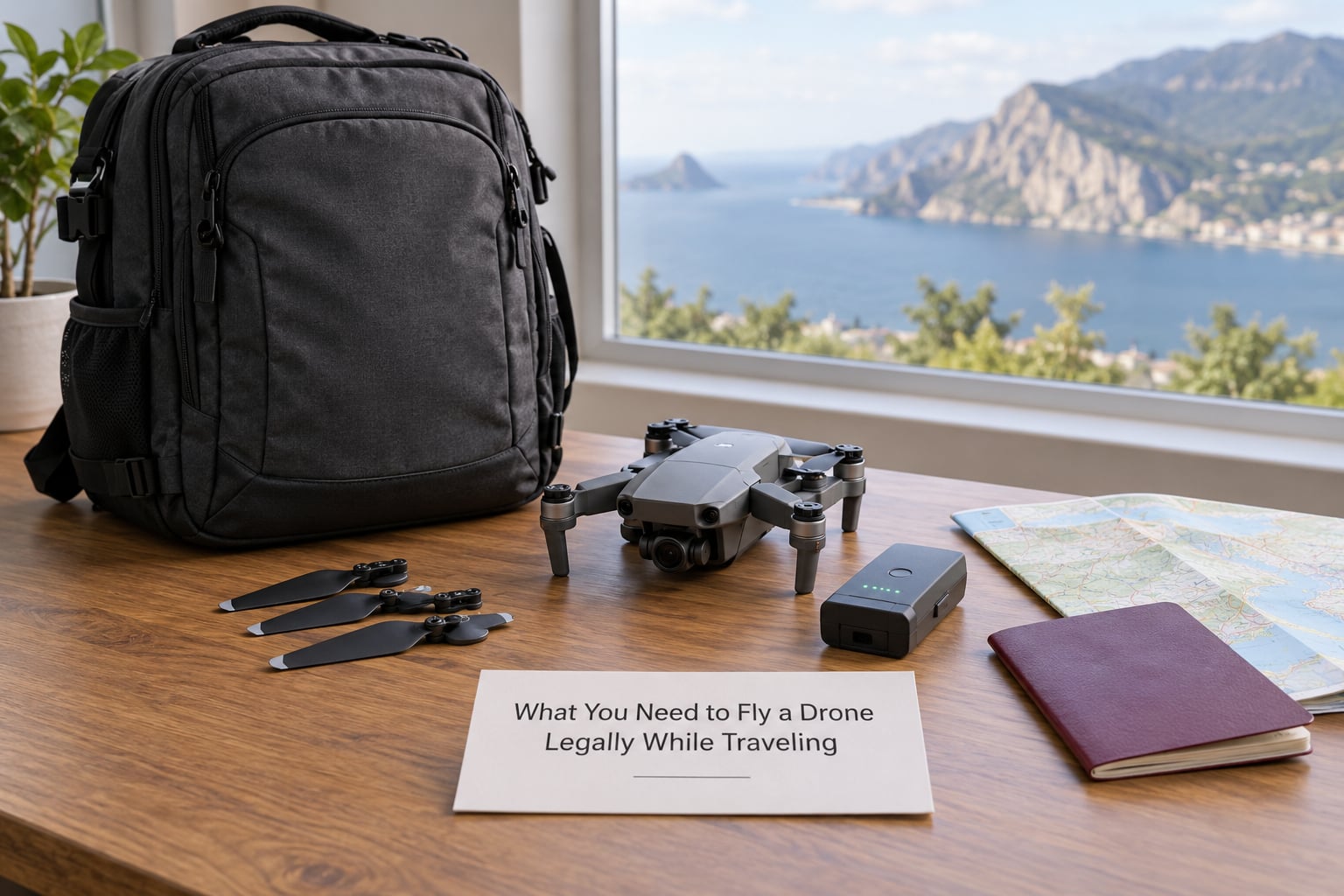
Start with paperwork, because paperwork is what gets you stopped. Keep every document offline on your phone and in a printed folder, since border officers and local pilots rarely want to wait for your signal.
- Drone registration proof. Your home-country registration certificate or remote ID, plus a photo of the aircraft label.
- Operator ID or remote pilot certificate. Some regions require you to carry an operator registration number or a competency certificate even as a visitor.
- Proof of purchase. An invoice or receipt showing the model, serial number and date.
- Liability insurance certificate. Third-party cover is mandatory in a few countries and sensible everywhere.
- Passport and any local permission. A photo ID, an authorization letter from the drone owner if it isn’t yours, or a permit for protected areas.
- Airspace references. The aviation authority website for each destination, an official map tool, and the flight restriction map for the country you fly in next.
- A safe flight plan. Location, altitude ceiling, launch point, emergency landing options and a backup site.
Gear matters less than people expect. A hard shell case, a couple of spare batteries with terminals protected, and a small supply of silica gel packets will do most of the work. Storage cards formatted before departure save you an evening somewhere with no reliable connection.
Step-by-Step: How to Use a Drone Legally While Traveling
1. Check whether you may legally carry and fly the drone
Start with the destination, then work backwards through every stop on the itinerary. A drone you never take off can still be seized at a border, and connecting flights multiply that risk, because your bag is checked on a connecting leg in a country you may have never heard of.
Search the destination country’s civil aviation authority site by name, plus the words drone, UAS and import. If you cannot find a clear answer, assume flying is not permitted until you hear otherwise from the authority, the embassy, or a local flying club that documents its own permissions.
Several countries are widely reported to ban drones outright or confiscate them on arrival, including Morocco, Egypt, Cuba, India and Iran. Thailand, the UAE and Japan are commonly described as permit-required rather than banned, which means the aircraft may enter but you may not fly it without approval. Treat both lists as a starting point for research, not a final answer, and confirm with the authority before you book. You can tell it worked when you have a page from the authority itself saved, not a forum post or a two-year-old blog.
2. Register the drone and obtain any required authorization
Registration depends on weight class and on what you are doing, and the thresholds are surprisingly specific. Most countries exempt very light aircraft from some paperwork, but expect to register far more than you think you will, and check whether the exemption removes only one requirement or all of them.
The numbers travel well, so learn these: 250 g is the most common exemption ceiling for small recreational drones, 900 g is a second tier used by several authorities, and 25 kg is a heavy-aircraft tier that brings commercial-grade requirements. In the United States, aircraft over 250 g must be registered for recreational and commercial use alike. In the EU and EEA, an aircraft in the mini or small class is usually exempt from aircraft registration, yet the operator generally still needs to register in the country of residence and display the operator ID on the airframe. The UK operates its own separate regime and is not part of the EASA system. Japan is commonly described as the strictest popular destination, with exams and registration needed even for visitors.
| Region | Registration trigger | Typical altitude ceiling | Watch out for |
|---|---|---|---|
| United States | Over 250 g, recreational included | 400 feet above ground level | Remote pilot certificate required for any non-recreational work |
| EU and EEA | Operator registration in country of residence; aircraft registration depends on class | 120 metres | Operator ID must be displayed on the aircraft |
| United Kingdom | Separate national system, not EASA | 120 metres | Different forms and different identification rules |
| Canada | Weight-based basic and advanced operations | 122 metres | Provincial parks and land rules on top |
| Australia and New Zealand | Recreational registration commonly required from 2 kg | 120 metres | State and national park bans |
| Japan | Registration and a proficiency exam for most flights | 150 metres | Strict urban and crowd limits |
One of the most common traveller mistakes is assuming that harmonised European rules mean no paperwork. They mean one registration serves you across the member states, not that you skip it. It also does not travel outside the region: a US certificate is a US document, and an EU operator ID is not recognised in Japan.
3. Check the destination’s airspace and local restrictions
Open the official map for the destination, not a generic one. You are looking for controlled airspace around airports, temporary restrictions near events and demonstrations, national parks and wildlife refuges, military and government land, city centres with heritage monuments, and any border or coastal zone with its own clearance process.
Your drone’s geofencing is not a legal reference. It reflects what the manufacturer wants you to avoid, which is narrower than what the authority has restricted, and it updates on the manufacturer’s schedule rather than the aviation authority’s. Flyers on r/drones and mavicpilots.com repeat the same point: the app saying no is not the same as the law saying no.
Parks are the classic trap. Wildlife disturbance rules exist in most countries and carry real penalties, so check the specific park or reserve rather than the general national rules. A site that looks empty at 8am can be a nesting site by noon. You can tell your check worked when you know the airspace classification for every site on your list and whether each one needs prior permission.
4. Inspect and prepare the drone for travel
Firmware, batteries and documentation come before the packing. Update the firmware and the flight app before you leave home, because the phone you need at a remote launch point will not want to install anything.
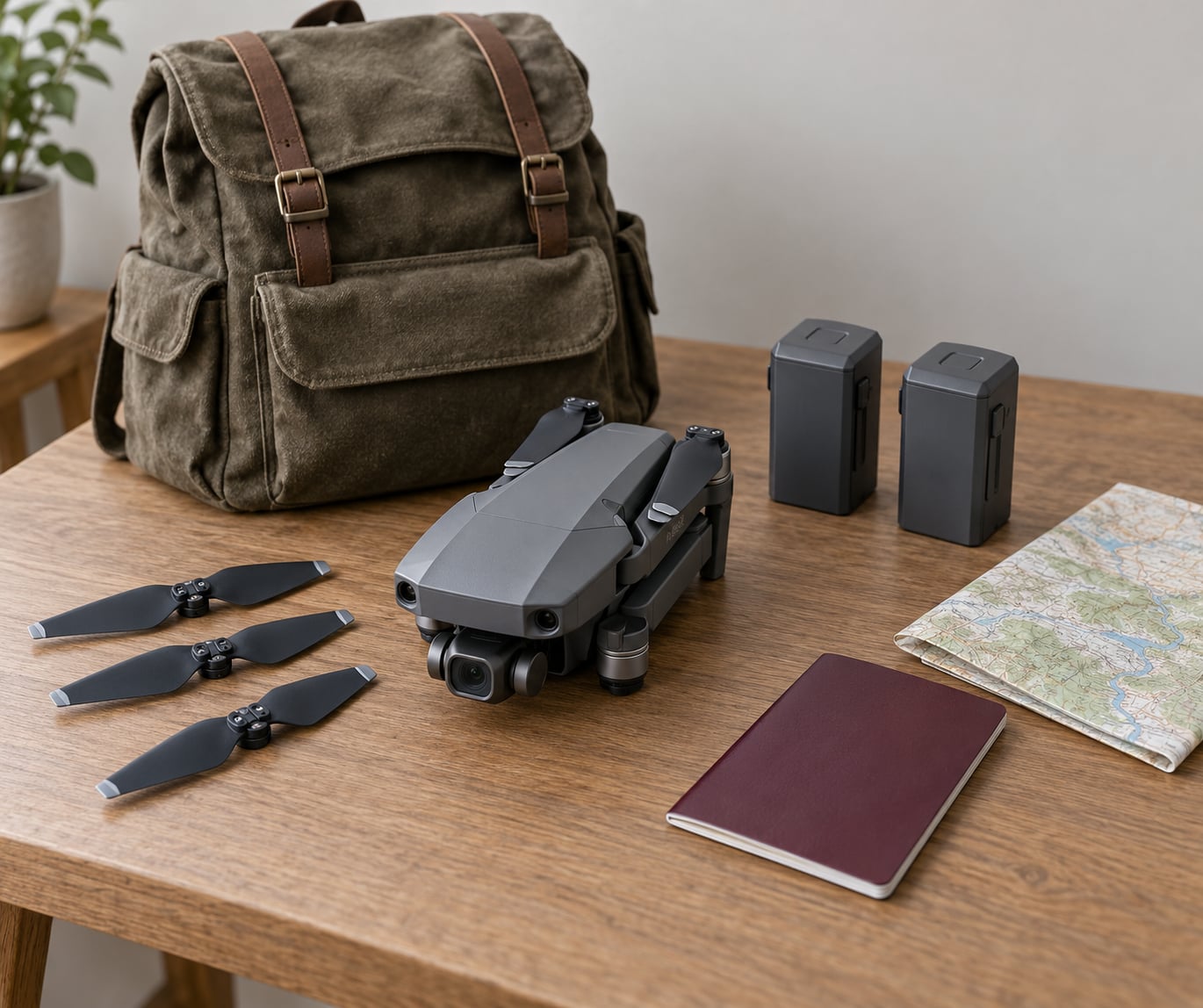
Batteries are the part travelers get wrong. Spare lithium batteries belong in carry-on baggage, never in a checked bag, and terminals should be covered with the factory caps or a battery-safe bag. Most airlines and aviation authorities use watt-hours as the limit: batteries up to 100 watt-hours are broadly permitted, and a higher limit often applies up to 160 watt-hours with airline approval, sometimes with a cap on the number of spares. Work out the watt-hour rating by multiplying volts by amp-hours on the battery label, and write the number down before you fly.
Pack the aircraft in a hard case with propellers removed, and never put loose foam around batteries, since foam insulates heat exactly the way you do not want. Travel with them at a partial storage charge rather than full or empty, and keep them out of a hot car. For the last check, the drone should arrive assembled, charged, with labels and documents in the same case.
5. Create a flight plan and assess the site
Write the plan down even for a two-minute flight. It takes less time than a coffee and it stops you from making decisions while the aircraft is airborne.
Walk the site on foot first. You are checking wind direction and gusts, where the sun sits, whether you have a clear line of sight to the aircraft at all times, whether there is anywhere safe to land if something fails, and how close the nearest people are. Launch points near paths, roads, roofs and water all have a higher chance of ending badly than an open field.
Also ask the practical question: would a local person watching this be annoyed? Beaches, cliffs and viewpoints often have rules from the town or the site operator that no aviation page mentions, and people on a busy trail outnumber the pilots in the air in most places on earth.
6. Fly conservatively and preserve evidence of compliance
Fly the way you would with no permission at all, because in practice that is the standard everyone expects. Stay within the altitude ceiling for that country, keep the aircraft within visual line of sight, and never fly over people, animals, moving vehicles or a crowd.
Some pilots work to a one-to-one ratio of one pilot per aircraft, with a dedicated visual observer. That habit came out of stricter proposed rules and good sense, and following it keeps you out of trouble when the law is ambiguous.
Turn back when anything changes: wind picks up, the battery drops faster than expected, the signal softens, or people gather. In a crowd, the aircraft and the person flying it become a hazard together. When you land, note the time, location and altitude you flew, keep any permission you had on your phone, and take a photo of the aircraft with its label visible. That record is what you show a local authority who has a different version of events.
7. Follow customs, export and return rules
Borders are the least advertised part of drone travel and the one most likely to cost you the aircraft. Every country has its own declaration rules, and many ask you to declare high-value electronics and any item that might be considered an import control item.
Fill the customs form honestly. Declare the drone, the batteries, the gimbal and the lenses, and give the values you actually paid. Know where you bought it and be ready to say you are a traveller using it recreationally and will take it home. If a country requires it, a temporary import permit or an ATA Carnet lets you move high-value gear through without duties, but you need to arrange it weeks ahead.
The return leg has its own rules. Batteries you can legally fly with outbound can face a different rule inbound, and customs treatment can change while you are away. Re-check your home country’s import position before you fly home, not on the airport floor.
Common Mistakes That Get Travelers in Trouble
- Trusting a generic map or old advice. Flyers on mavicpilots.com are blunt about this: guidance older than a few months is not worth much. Check the authority’s site and note the date you checked it.
- Assuming one permit covers a country. A national authorization almost never covers a national park, a nature reserve or a protected monument.
- Treating a geofence as clearance. The app’s restricted zone and the law’s restricted zone are different sets.
- Flying over people. Crowds at a festival, a beach or a tour group are the classic enforcement trigger. Move or do not fly.
- Ignoring privacy rules. Several countries have specific rules about filming private property and identifiable individuals, and a few have strict data and privacy expectations around footage you bring home.
- Packing batteries in checked baggage. Terminals covered, carry-on only, partial charge. This is the fastest way to end a trip early.
- Forgetting transit countries. A connection in a country where drones are banned is still an import. That is why travellers on r/drones sometimes ship the aircraft ahead instead of carrying it through.
- Over-describing your work at the border. Say you fly recreationally and are not being paid. Claiming commercial work invites permits you have not applied for.
- Renting without checking. A local rental operator may include insurance that covers damage and a licence that covers you. Ask what is included before you sign, and check whether the aircraft is above the limit your visitor registration covers.
Frequently Asked Questions
Can I carry a drone to Europe?
Yes, in most EU and EEA countries you can bring a drone as a visitor, but you normally register as an operator in your country of residence and display that operator ID on the aircraft. Aircraft in the mini or small class are usually exempt from aircraft registration, not from operator registration. The UK runs a separate system outside EASA. You also need to fly within 120 metres and keep the drone in visual line of sight.
What countries can you not bring a drone into?
Morocco, Egypt, Cuba, India and Iran are the countries most often reported as banning drones or confiscating them on arrival, while Thailand, the UAE and Japan are usually described as permit-required rather than banned. Rules change, and a connecting flight can add a country you never planned for. Check the civil aviation authority page for every stop on the itinerary before you book.
Are spare drone batteries allowed in carry-on?
Yes, and they should be. Spare lithium batteries belong in carry-on baggage with terminals protected, never in a checked bag. Limits are usually expressed in watt-hours: up to 100 Wh is broadly allowed, and many airlines permit up to 160 Wh with approval and a cap on the number of spares. Multiply volts by amp-hours on the battery label to get the rating before you fly.
Can you get in trouble for flying a drone without a license?
Yes, and penalties range from an on-the-spot fine to aircraft confiscation, a ban from flying in that country, or removal from a protected area for good. Flying over people, ignoring an airport exclusion zone or disturbing wildlife are the most commonly enforced offences. A traveller is reported to have been banned for life after being found flying in a South African national park, and US national park violations carry fines and prison time.
How do I check for no-fly zones before traveling?
Use the civil aviation authority’s official map tool for the destination and cross-check the airport, port and military exclusion zones. Then add the local layer: national parks, wildlife reserves, nature monuments and any city centre with monument or privacy rules. Your drone’s geofencing is not a legal reference, because it reflects the manufacturer’s restrictions rather than the authority’s. Re-check within 30 days of travel.
What is the 1:1 rule for drones?
The one-to-one rule means one pilot per aircraft, and for larger operations one dedicated visual observer in line of sight who does nothing else. It grew out of proposed regulation and it is now everyday good practice in many regions, even where it is not a strict legal requirement for small recreational flights. Following it keeps you compliant when a local rule and a practical judgement disagree.
Start with the official rules for your exact flight location
If you do one thing before booking anything, open the destination country’s civil aviation authority website and read its drone rules, then work through the same checklist for every transit country on the route. Confirm the aircraft rules for your weight class, carry the batteries in your hand luggage, and save the paperwork offline before you leave.
To use a drone legally while traveling, treat the authority’s page as the answer and every other source as a starting point. Check the rules again shortly before you fly, fly well inside the limits even where they are generous, and keep a record of each flight. Travelers on r/drones who fly regularly all say the same thing: the research takes a weekend, and the aircraft problems take one bad afternoon.