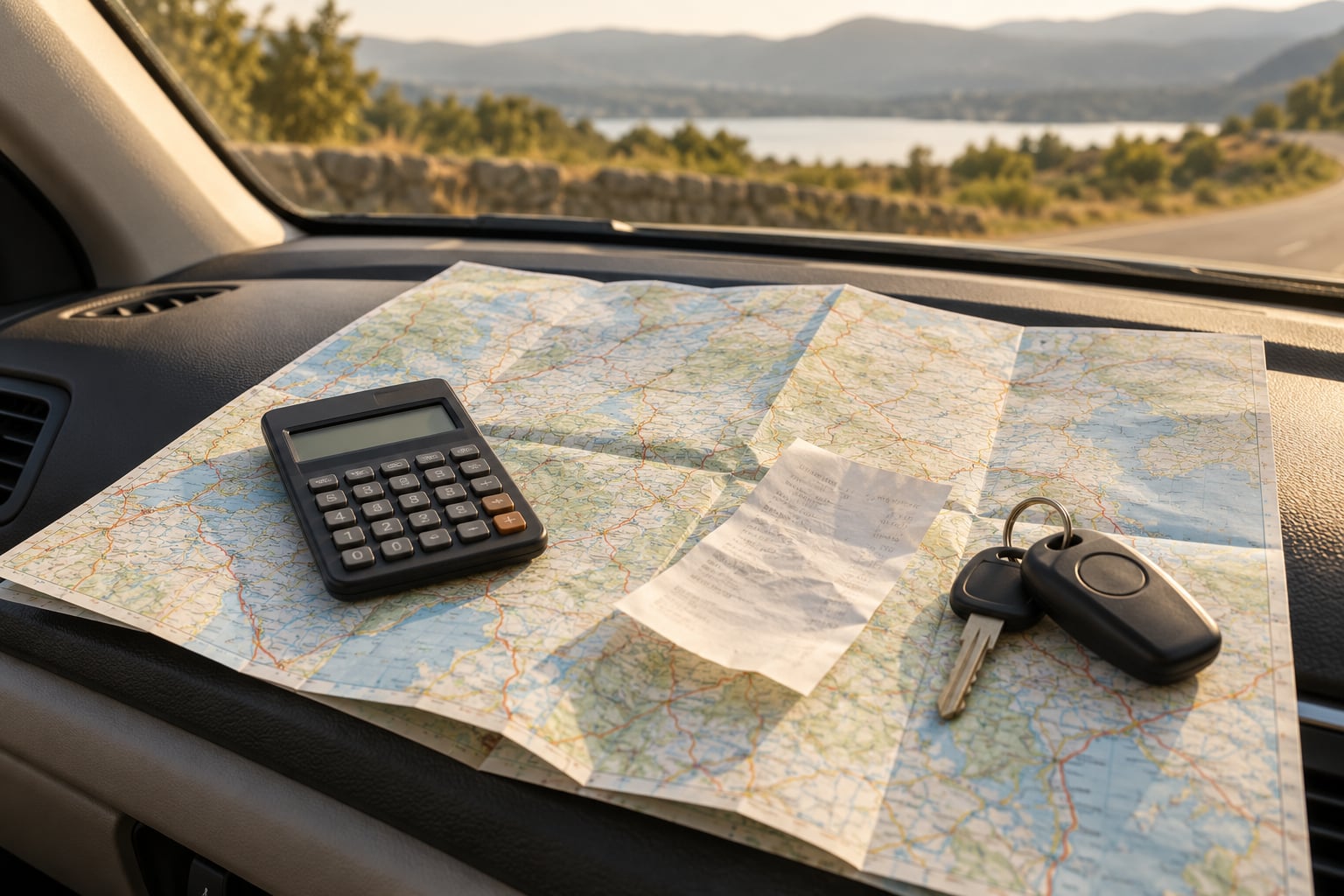
Learning how to calculate gas costs for a road trip takes about two minutes and three numbers: divide your total trip miles by your vehicle’s real-world highway MPG, then multiply the gallons that comes out to by the price per gallon along your route. That is the whole method.
Two of those three numbers are harder to get than they look. Most people use the EPA rating on the window sticker, which is a lab figure measured on a gentle cycle, not a figure for eight hours at 70 mph with four people and three coolers in the back. The second trap is assuming one price per gallon applies for 2,000 miles, when the cheapest station on your route is usually two exits behind you.
Get those two inputs right and the rest is arithmetic. Below is the process I use, including a worked six-leg example, the mistakes that blow up most fuel budgets, and a buffer that has saved me from being surprised at a rest stop in Nebraska.
Table of Contents
- What You Need
- Step-by-Step: How to Calculate Gas Costs for a Road Trip
- Estimate the Trip’s Total Distance
- Find Your Vehicle’s Real Highway MPG
- Check the Current Gas Price Along Your Route
- How to Calculate Gas Costs for Each Leg
- Build a Road-Trip Fuel Budget
- Common Mistakes
- Frequently Asked Questions
- How do I calculate gas costs for a round trip?
- Should I use highway MPG or city MPG for a road trip?
- How much extra should I budget for unexpected fuel costs?
- What is the best way to track gas used during a long road trip?
- Should rental-car fuel costs be calculated differently?
- Conclusion
What You Need
Four things, and you can assemble all of them before you book anything.
- Total trip distance in miles, from a route planner rather than a straight-line guess.
- Your vehicle’s real highway MPG, ideally from a full tank-to-tank measurement you have made yourself.
- The average price per gallon for the states you will cross.
- A calculator and a note, plus optionally a route planner and a fuel-tracking habit.
One note on units, since this matters outside the US. American drivers measure efficiency in miles per gallon, the number on the sticker. Most of the rest of the world uses litres per 100 kilometres, where a lower number is better, and prices fuel per litre. A 30 mpg car is about 7.8 L/100km, and one US gallon is 3.785 litres, so a 3.20-per-gallon price is roughly 0.85 per litre. If your trip crosses a border, convert before you budget.
Step-by-Step: How to Calculate Gas Costs for a Road Trip
Estimate the Trip’s Total Distance
Open a route planner, enter every stop you actually intend to make, and read the mileage for the whole itinerary. Include the pickup leg, because an airport rental adds miles that have nothing to do with your vacation.
Then decide one-way or round trip. This is the single most common arithmetic error in road-trip budgeting, and it halves or doubles your answer. A planner will happily show you 1,530 miles one way and say nothing about the 1,530 back, so if you are turning around at the same place, multiply.
Add extra for reality. A 5 percent allowance covers the grocery run, the scenic overlook you did not plan, and the hotel that turned out to be on the wrong side of town. Do not go higher than that, because padding distance twice will quietly push you into budgeting for a trip you are not taking.
Find Your Vehicle’s Real Highway MPG
The dashboard figure is a decent starting point but not a good budget number. Recalibration drifts, and it reacts instantly to speed, hills and air conditioning. Forums full of people measuring their own cars keep landing in the same place: a highway number 15 to 30 percent below the sticker. One owner on piloteers.org put it plainly, describing highway trips with cruise control at 70 to 75 mph returning 23 mpg at absolute best and 21 mpg on a bad day, against a rating that read considerably higher.
So measure it yourself if you can. Fill the tank to the top, note the odometer, drive a full tank, then refill and divide the miles by the gallons it took. Repeat across three fill-ups and average them. Forum regulars on insightcentral.net track high fills against low fills for exactly this reason, since dashboard readouts drift over a long trip. The manual tank-size method works as a cross-check: if your tank holds 15 gallons and you covered 350 miles on it, that is 23.3 mpg.
Then apply a buffer. Take your measured number, not the sticker, and shave 10 to 15 percent off for highway speed, terrain, roof boxes, passengers and hard braking in mountain traffic. That derated figure is the one you divide by.
| Vehicle type | Real-world combined MPG | Budget figure for a long highway drive |
|---|---|---|
| Compact car | 28-35 | 24-29 |
| Midsize sedan | 25-32 | 21-26 |
| Small or midsize SUV | 22-28 | 19-23 |
| Large SUV | 17-23 | 15-19 |
| Pickup truck | 16-22 | 14-18 |
| Minivan | 18-24 | 16-20 |
| Hybrid midsize sedan | 40-55 | 36-48 |
Check the Current Gas Price Along Your Route
Pull the price per gallon for each state on the itinerary, not one national figure. AAA Gas Prices gives a state and regional breakdown and updates daily. GasBuddy goes further, showing individual station prices and often which ones discount with a loyalty card, which is how you find the cheap spot near a highway exit.
Use regular grade unless your engine asks for something else, and price your whole tank in that grade. If the car is specified for premium, budget premium for the entire distance, not just the last tank.
Do not assume a posted price holds for three days. Holiday weekends reliably push prices up in resort states, and remote stretches of interstate can run well above the state average. When a leg has few stations, use the state high rather than the state average.
How to Calculate Gas Costs for Each Leg
Two operations per leg. Gallons equal miles divided by your buffer-adjusted MPG. Cost equals gallons multiplied by that leg’s price per gallon. Add the legs together and you have the trip.
Here is a full round trip from Denver to Buffalo and back, in a midsize SUV rated 27 mpg combined but budgeted at 24 for highway driving. Prices are illustrative and per gallon; check live numbers before you leave.
| Leg | Miles | Gallons | Price per gallon | Leg cost | Running total |
|---|---|---|---|---|---|
| Denver to Kansas City | 600 | 25.0 | 3.20 | 80.00 | 80.00 |
| Kansas City to St. Louis | 250 | 10.4 | 2.95 | 30.72 | 110.72 |
| St. Louis to Nashville | 310 | 12.9 | 2.90 | 37.46 | 148.18 |
| Nashville to Columbus | 570 | 23.8 | 2.88 | 68.40 | 216.58 |
| Columbus to Buffalo | 400 | 16.7 | 3.35 | 55.83 | 272.41 |
| Return journey, same legs | 2,130 | 88.8 | weighted 3.07 | 272.41 | 544.82 |
Checkpoints on that result. Gallons per leg times the miles-per-gallon figure should return the miles, and the weighted price times 88.8 gallons should give you 272.41 for the outbound half. Both hold, so the arithmetic is clean.
Now the useful part: run the same distance through the sticker number instead. 4,260 miles divided by 27 mpg is 157.8 gallons, which at the same 3.07 weighted price comes to about 484 dollars. The real figure is 545. One bad input assumption cost 61 dollars on a single trip, and on a 5,000-mile run the gap is much wider.
| Trip distance | 15 MPG | 20 MPG | 25 MPG | 30 MPG | 35 MPG | 40 MPG |
|---|---|---|---|---|---|---|
| 200 miles | 13.3 | 10.0 | 8.0 | 6.7 | 5.7 | 5.0 |
| 500 miles | 33.3 | 25.0 | 20.0 | 16.7 | 14.3 | 12.5 |
| 1,000 miles | 66.7 | 50.0 | 40.0 | 33.3 | 28.6 | 25.0 |
| 1,500 miles | 100.0 | 75.0 | 60.0 | 50.0 | 42.9 | 37.5 |
| 2,000 miles | 133.3 | 100.0 | 80.0 | 66.7 | 57.1 | 50.0 |
| 3,000 miles | 200.0 | 150.0 | 120.0 | 100.0 | 85.7 | 75.0 |
Multiply any cell by your local price to get a quick ballpark. A 1,500-mile trip in a 25 mpg car at 3.00 per gallon is 180 dollars, and in a 35 mpg car it is about 129. That gap is usually the whole argument for choosing one vehicle over another for a long drive.
Build a Road-Trip Fuel Budget
A precise estimate is not a budget. Take your trip total of 545 dollars and add 10 percent for two reasons: prices that moved between planning and departure, and driving that ran worse than your buffer. That is 600 dollars, and 600 is a number you can actually hand to someone.
Turn it into a plan by dividing across refuelling stops. With a 15-gallon tank at 24 mpg you have roughly 360 miles per fill, so a 2,130-mile outbound run is six or seven stops. Decide in advance which legs you will top off on rather than running the tank close to empty, since the last few gallons before a station are the expensive ones.
If two or more people share the drive, split fuel on miles driven rather than on who paid. It sidesteps the argument that comes up on every long trip and it is easy to verify from the odometer log.
Common Mistakes
Using the EPA rating instead of your real MPG. Fix: measure three full tank-to-tank cycles, then derate by 10 to 15 percent for highway conditions. Forum owners report highway results well below their ratings, sometimes by a quarter.
Forgetting to double the mileage. Fix: decide one-way or round trip before you open the calculator, and write the total distance down once. Every other number flows from that figure.
Using city MPG on a highway trip. Fix: budget the lower highway figure. City numbers are usually the better of the two and they flatter the budget.
Mixing up price per gallon and price per litre. Fix: divide a per-gallon price by 3.785 to get a per-litre price, and remember a lower L/100km figure is the better one, the reverse of MPG.
Applying one price to the whole route. Fix: price each leg or each state. A single state average across five states can be off by 10 to 20 percent in either direction.
Ignoring detours and airport pickup miles. Fix: add 5 percent to planned distance, then leave it there. Rental pickup alone can add 40 to 80 miles to a trip that felt short on paper.
Budgeting zero contingency. Fix: add 10 percent. It covers a price spike, a missed exit, or a headwind, and it costs you nothing when it goes unused.
A few habits that quietly lower the real number. Keep tire pressure at the door-jamb figure rather than the sidewall maximum, since the higher-looking sidewall reading is meant for load capacity, not economy. Hold a steady speed with cruise control on flat, straight highway miles, which is where it actually helps. Lighter loads help more than most people expect, and aerodynamic drag climbs fast above 70 mph, so dropping from 75 to 68 on a long interstate leg can be worth several percent of the whole fuel bill.
Route choice matters too. Toll roads are sometimes faster, and time is fuel. Compare a route’s extra miles against its extra hours before assuming the shorter line is cheaper. Tools like FuelEconomy.gov can project fuel cost for a list of cities with a highway-versus-city split, and GasBuddy and TollGuru handle route-aware price lookups that a plain distance-and-MPG calculator cannot.
Frequently Asked Questions
How do I calculate gas costs for a round trip?
Multiply the one-way distance by two before running the formula, then use your derated highway MPG. For a 1,000-mile one-way trip in a car budgeted at 25 MPG, the round trip needs 80 gallons, which at 3.00 per gallon is 240 dollars. Add 10 percent for price movement and worse-than-expected driving before you call it a budget.
Should I use highway MPG or city MPG for a road trip?
Use the highway figure, and then cut it further. The EPA highway rating is measured at a steady speed under ideal conditions, so a full day at 70 to 75 mph with passengers, luggage and air conditioning will land below it. Forum owners commonly report highway results 15 to 30 percent below the sticker number, which is why budgeting from the sticker under-counts fuel.
How much extra should I budget for unexpected fuel costs?
Ten percent is a reasonable default, and fifteen percent suits a long multi-state run with mountain terrain or winter weather. The buffer is not padding, it covers a price change between planning and departure, a missed exit, and a headwind. On a 545 dollar estimate, ten percent turns it into a round 600, which is far easier to plan around than a precise figure that may not hold.
What is the best way to track gas used during a long road trip?
Log every fill-up yourself: odometer reading, gallons, and total spent, entered in a phone note or a paper notebook. Divide miles between fills by gallons bought to get a true MPG for that segment, which reveals whether your planned buffer was generous or optimistic. A dashboard MPG readout drifts over a long trip, so treat it as a guide and keep your own record.
Should rental-car fuel costs be calculated differently?
The math is the same, but three inputs change. Use the rental car’s highway MPG rather than the vehicle you own, add the mileage from the airport or pickup branch to your destination, and check the contract for a fuel policy, since prepaid options and full-tank return rules set the price per gallon for you. Reserve your own refuelling time before the drop-off hour, not during it.
Conclusion
To calculate gas costs for a road trip, take your total trip miles, divide by a highway MPG you have measured and then cut by 10 to 15 percent, and multiply by the average price per gallon for the states you will cross. Confirm those three inputs, add a 10 percent contingency, and round the total to something you would not feel silly saying out loud.
For the six-leg example above, that turns a 545 dollar estimate into a 600 dollar plan, which is the difference between budgeting and hoping.