If your flight is delayed overnight, do two things first: get a confirmed seat on a specific later flight, and ask for a meal voucher and a hotel voucher before you leave the gate area. Everything else – receipts, insurance, compensation claims – depends on how cleanly you handle those first two steps.
An overnight delay means your departure has moved past midnight and you are either rebooked onto a later flight or stuck at the airport with no onward accommodation arranged. It is not an emergency, but it is a long night, and the difference between a comfortable one and a miserable one is decided in the first hour.
One word decides almost everything: the reason for the delay. Airlines publish their obligations in a customer service plan, and the split is between delays they control – maintenance, crew, fueling, baggage loading, cleaning – and delays they do not, like weather, air traffic control and security. For a delay the airline caused, major US carriers commit to a hotel, meals and ground transport. For a delay nobody controlled, US law requires no compensation at all, though a refund becomes available if you decline the rebooking and the wait crosses three hours domestic or six hours international.
Last reviewed and updated for 2026. Airline plans and passenger rights change by season and by jurisdiction, so verify anything time-sensitive against your airline’s own site before you rely on it.
Table of Contents
- What You Need
- Step-by-Step: What to Do If Your Flight Is Delayed Overnight
- What to do if your flight is delayed overnight: confirm the disruption
- Protect your booking and get the delay reason in writing
- Arrange food and shelter
- Prepare for the next flight and your onward plans
- Common Mistakes
- Buying your own replacement ticket before coverage is confirmed
- Leaving the terminal without an updated boarding pass
- Relying on a single power source
- Assuming every expense will be reimbursed
- Skipping the delay reason
- Forgetting your bag is not travelling with you
- Frequently Asked Questions
- Will the airline pay for a hotel if my flight is delayed overnight?
- Can I leave the airport to find a hotel and return before my new flight?
- Should I buy a new ticket if the airline cancels my flight?
- What happens to my checked luggage if I cannot board as planned?
- Am I entitled to compensation when a red-eye flight is delayed overnight?
- Conclusion
What You Need
Most of the useful preparation happens before the disruption. Ten minutes of setup turns an eight-hour night at the gate into a manageable one.
- Your booking reference and the airline app, logged in. Six letters or numbers get you further on a phone call than your name does, and the app shows your rebooking options faster than any agent will.
- A charged phone, a second power source, and a cable. One dead phone at 1am with no flight details in your head is the single most common way this goes wrong.
- Payment cards for meals and transport. Two different ones, ideally, because terminals and ride-share drivers sometimes decline the other network at 3am.
- Your passport or ID, plus any travel visas. If you leave the secure area for a hotel, you may need to clear security again, and some documents have to be shown at the desk even with a boarding pass.
- Essential medication, glasses, hearing aids and chargers in your carry-on. Checked bags may end up on a different aircraft, a different airport, or waiting on a belt somewhere you are not standing.
- Contacts who know you are rebooked. One message to family, one to work, one to whoever is expecting you at the destination. Disruption cascades faster than you think.
- A pen and paper, or a notes app. Written confirmation of your new flight number, date, time and gate is worth more than a screenshot that disappears with your battery.
- A change of clothes, toothbrush and any medication in hand luggage. Not for style. For the possibility that you are wearing the same outfit tomorrow morning.
- Travel insurance details or your credit card benefits hub login. Know the policy number now, because you will not want to dig for it at 4am.
Step-by-Step: What to Do If Your Flight Is Delayed Overnight
Work through these in order. The first hour is the most valuable hour of the whole night, because that is when agents still have authority and when hotels near the airport still have rooms.
What to do if your flight is delayed overnight: confirm the disruption
Check the airline app first, then the airport screens or boards, then your text or email alerts, then your boarding pass. Those four are the only sources that matter for a decision this consequential.
What you are looking for is not just that the flight is late. You are looking for four specific facts: whether it is delayed or cancelled, what the new departure time is, whether the gate has changed, and how many hours you have now been waiting. Screens in different terminals disagree more often than people expect, and the gate display inside your terminal is the one that gets updated last and most accurately.
Set a routine. Check every thirty minutes if the delay is under three hours, and every fifteen once it passes four. Airlines change estimates constantly, and a departure time that keeps sliding forward is itself information – it usually means there is no aircraft and no crew waiting behind you.
Do not trust crowd-sourced flight advice for anything you would act on. Forum threads and social posts are useful for anticipating a pattern at a specific airport, but they are frequently hours stale. Use them for morale, not for decisions.
Protect your booking and get the delay reason in writing
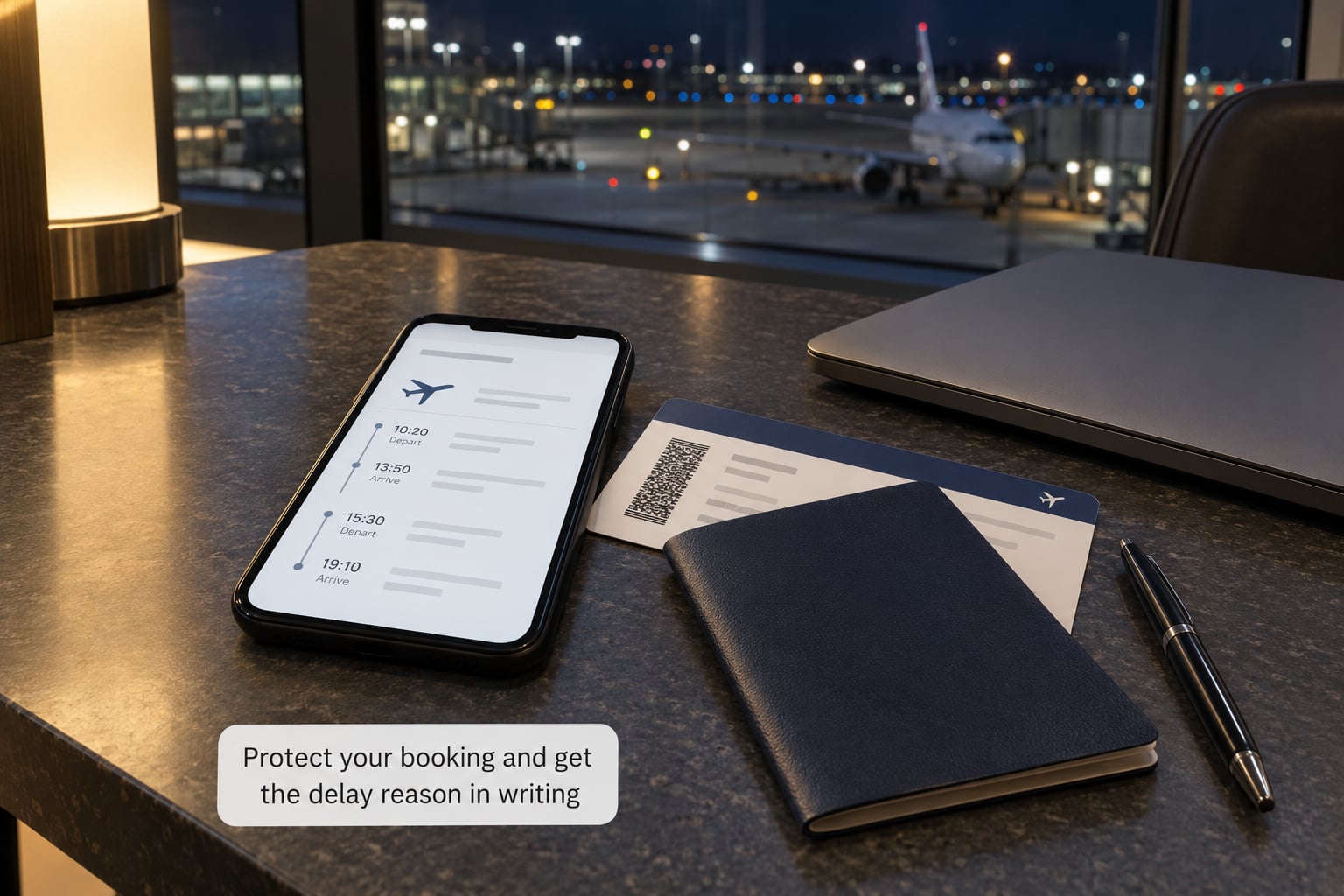
A delay and a cancellation are treated completely differently, and so is being rebooked versus being refunded. Confirm in writing which one you have.
Use four channels at the same time rather than one after another: the airline app, the phone line, a gate or service desk agent, and an airport kiosk. Apps rebook you fastest, phone agents negotiate best, and gate desks are the only people who can move you onto a partner carrier or a different airport. Run them in parallel and take whichever option arrives first.
Before you accept anything, ask three questions in this order:
- What is the exact flight number, date, departure time and seat assignment I now hold? Get it in writing, in the app, on a printed itinerary, or in a message you can screenshot. “We’ll text you later” fails at 4am more often than it should.
- What is the written reason for the delay? This is the reason code that appears on your booking record, and it is the single most decisive piece of evidence in any later claim. Ask for it before you leave the desk. Posters in airline forums say repeatedly that they did not know to ask, and that not knowing cost them the room.
- Is this delay one the airline controls? Maintenance, crew duty limits, fueling, baggage loading and cabin cleaning are controllable. Weather, air traffic control, security and infrastructure are not, and most airlines treat them differently.
Ask about your onward connection too. If you are booked to connect, ask specifically whether you are protected onto the next flight and whether that applies if the rebooking puts you on a different carrier. Passengers connecting on a through-ticket are generally protected; passengers on two separately ticketed flights are usually not, and that distinction is worth five seconds of thought before you accept a rebooking.
Keep documentation as you go. Photograph the delay screen, save the confirmation number, note the time of every conversation with an agent. This costs nothing in the moment and it is the difference between a claim that gets approved and one that gets politely declined.
Arrange food and shelter
Order of operations matters here: ask for the vouchers before you buy anything yourself. Asking specifically for a hotel, rather than accepting a general “what can I help you with”, is the single change passengers report making the biggest difference to the outcome.
On food, most US carriers commit to a meal voucher or meal cash once a delay passes roughly two hours, and several extend it to three. Ask for the exact form they use – a voucher for an airport restaurant, a meal credit loaded to your booking, or cash – because the three are not interchangeable and a voucher is often only valid at a named restaurant in a specific concourse.
On shelter, you have three real options and each suits a different person.
- An airline-booked hotel. Usually the airline’s preferred property, often with a shuttle, sometimes without breakfast and sometimes with a check-in cutoff. Ask what time you must arrive and whether ground transport is covered. Book it before you leave the terminal, not after, because the desk stops making calls at some point in the night.
- A hotel you book and claim back. Better choice if you have mobility needs, a pet, a child, or medical equipment the shuttle cannot handle. Pay yourself, take a detailed receipt, and file the claim before you leave the property, because claims filed weeks later are far harder to get approved.
- The terminal. Free and often unavoidable. Charged seating is limited after security, showers exist in some airports, and lounges sometimes open their doors to passengers with same-day boarding passes on rebooking vouchers. Check whether the terminal has a curfew or closes its holdrooms overnight, and whether you would need to re-clear security in the morning.
If the airport itself is closed or your flight is cancelled outright, the airline is more likely to cover accommodation, because you are no longer waiting – you are simply stranded until they can fly you.
Special cases deserve a conversation with an agent rather than a queue: an unaccompanied minor cannot be sent to a hotel alone, a traveler with reduced mobility may need ground-floor accessible rooms and a car rather than a shuttle, a service animal needs to be declared before you book anything, and anyone with time-critical medication should confirm pharmacy access at the destination airport.
One safety note worth stating plainly: if you leave the airport, take your phone charged and tell someone your hotel name and your new flight number. Long nights produce long, quiet walks to unfamiliar transport stops. If you would rather not leave, that is a completely reasonable decision and plenty of people make it.
Prepare for the next flight and your onward plans
Now work forwards. Check every booking the original trip depended on: the onward flight, the destination hotel, the rental car, the train, the dinner reservation, the conference session.
Confirm your onward segment is still attached to a confirmed ticket and that you have a new boarding pass for anything you board in the morning. A boarding pass for a cancelled flight can sit in your inbox looking perfectly valid, and boarding agents do not always catch it. Ask for the gate and check the terminal once your seat is confirmed, because a new aircraft often means a new concourse.
For checked bags, ask one question explicitly: will my bags transfer automatically to the new flight, or do I need to claim them at baggage claim and re-check them? On most domestic itineraries the bags move with you when you are rebooked onto a later flight. The exceptions are international itineraries with a different routing, cancelled flights, and anything going through a different airport. If you need to claim bags overnight, go to baggage services with your file tag before the terminal closes for the night, and ask about a delivery timeline. Domestic mishandled-bag claims typically have to be filed within 24 hours, with delivery expected inside a 12-hour window; international timelines are longer.
Onward costs cascade quietly. A hotel night you paid for and cannot use, a rental car reservation that starts while you are still stuck, an event ticket with a door time – none of these are usually reimbursed by a US airline, and forum posters make that point bluntly. What carriers typically cover is your hotel on the night of the disruption, meals during the wait, and transport between them. If you have a separate hotel booked at the destination, tell the airline in writing that you cannot use it, and ask for confirmation that they have noted it.
If you have travel insurance or a credit card with trip-delay coverage, this is the moment to open the file rather than at home three weeks later. Most policies want a written statement of the disruption from the airline plus itemised receipts. Photograph everything, including the hotel folio and any card charges, before you check out.
Common Mistakes
Every one of these is avoidable, and each one has shown up again and again in airline forum threads from passengers who were otherwise prepared.
Buying your own replacement ticket before coverage is confirmed
If you rebook before the airline commits, you may pay twice and get a ticket that is not protected. Let the airline make the first offer. If you want out and they will not help, ask for the cancellation of your original ticket in writing before you book anything else – and keep the record of what they offered you first.
Leaving the terminal without an updated boarding pass
A hotel trip is fine with a phone screenshot. A boarding attempt at 5am with an old pass is a wasted morning. Get the new pass, the new gate and the new terminal before you settle anywhere for the night.
Relying on a single power source
One dead phone means no itinerary, no voucher lookup, no ride. If you have a power bank, use it from the moment the delay is confirmed rather than saving it for the crisis.
Assuming every expense will be reimbursed
Meals, a hotel on the night of the disruption, and transport between them are the realistic coverage zone. Destination costs, missed events and onward bookings you chose not to cancel are usually not. Keep receipts anyway, because claims are assessed on what you can prove, not on what you hoped for.
Skipping the delay reason
Posters on airline subreddits report that knowing whether a delay is controllable is the deciding variable, and that almost nobody asks for it at the gate. Ask before you leave, write it down, and photograph the booking record.
Forgetting your bag is not travelling with you
Plenty of passengers discover at the hotel that their bag went through on the original aircraft or is riding a belt somewhere. Ask the transfer question out loud before the night starts, not at 7am in a foreign baggage hall.
Frequently Asked Questions
Will the airline pay for a hotel if my flight is delayed overnight?
Often yes, but it depends on the reason. When a delay is within the airline’s control, such as maintenance, crew or baggage issues, most major US carriers commit in their customer service plans to a hotel, meals and ground transport. For weather, air traffic control or security delays, no compensation is required and a hotel is discretionary. Ask specifically for the hotel, get the delay reason in writing, and keep every receipt. Policies vary by airline and by location.
Can I leave the airport to find a hotel and return before my new flight?
Yes, in most cases. If the airline books the hotel, they usually provide transport and tell you when to return. If you choose your own accommodation, you can generally re-enter the terminal with your boarding pass, though you may pass through security again and your gate may have changed. Leave only after you have a confirmed seat, a gate number and a new boarding pass. Keep your phone charged and tell someone your hotel name and flight number.
Should I buy a new ticket if the airline cancels my flight?
Usually not until the airline has refused to rebook you. If you decline the rebooking the airline offers and the delay crosses the threshold, three hours on a domestic flight or six hours on an international one, you can request a refund to the original form of payment rather than a travel credit. If you buy your own ticket first, you may lose the right to that refund. Ask for the cancellation and the refund in writing before you book anything else.
What happens to my checked luggage if I cannot board as planned?
It depends on the itinerary. When you are rebooked onto a later flight on a domestic route, bags usually transfer automatically. International routings, cancelled flights and anything involving a different airport often mean you must claim bags at baggage claim and re-check them. Ask the agent explicitly whether your bags will transfer, and if you must collect them overnight, go to the airline’s baggage desk before the terminal closes and photograph your file tag.
Am I entitled to compensation when a red-eye flight is delayed overnight?
A red-eye delay is treated like any other delay. US passengers have no general right to cash compensation for inconvenience, though refunds may be due if you decline rebooking and the delay passes three hours domestic or six hours international. EU and UK passengers may claim fixed cash compensation under EU261 and UK261 when a qualifying delay leaves them at the destination hours late. Vouchers, miles and hotel coverage come from airline policy, not from law. Rules vary by route and location.
Conclusion
Confirm the itinerary in writing first, including the new flight number, gate and boarding pass. Then ask the airline directly for the meal voucher, the hotel and the written reason for the delay. Photograph the screens and keep every receipt, including the hotel folio, because that is what any reimbursement or insurance claim will be built on. Arrange shelter while rooms still exist, then monitor the next boarding cycle rather than the departure estimate.
Nobody controls the weather or the crew roster. You do control the record you leave behind, and that is where the money usually comes from.