To beat jet lag coming home, get into natural daylight, eat your meals at normal home-time hours, and stay awake until your usual bedtime. Those three levers do more work than any supplement, and your body clock moves at roughly one day per time zone crossed. Add water instead of alcohol, movement instead of a day in bed, and naps capped at 20 minutes.
What makes the return trip different is that your schedule stops being yours. Flying out, you can sleep through whenever your body demands it. Landing at home, there is a commute, a shift, a school run and a bedtime that happens whether you are ready or not. That constraint shapes everything below, so this plan is timed around what you already have to do rather than around an imaginary week of doing nothing.
None of this is a cure. Jet lag is a temporary mismatch between your circadian rhythm and the local clock, and the plan is simply about feeding your brain home-time signals in the right order. It works fastest when you cross fewer zones, and slower as you get older. The whole thing takes about two minutes to set up before you land and some patience afterwards.
Updated for October 2026. This is general information, not individual medical advice. Talk to a doctor or pharmacist first if you take regular medication, have a health condition, are pregnant, or are travelling with a young child.
Table of Contents
- What You Need Before You Land
- How to Beat Jet Lag Coming Home: Step-by-Step
- Before You Land: Set Your Home-Time Plan
- During Arrival: How to Beat Jet Lag Coming Home in Your First 24 Hours
- How Long Does Jet Lag Usually Last Coming Home?
- Use Light, Caffeine and Food at the Right Times
- Protect Tonight’s Sleep
- Adjust Over the Next Few Days
- Common Mistakes That Make Coming Home Worse
- When Jet Lag Is More Than a Time-Zone Problem
- Frequently Asked Questions
- Why is jet lag worse when coming home?
- How long does jet lag last coming back?
- What is the hardest day of jet lag?
- Is it easier to recover from jet lag going east or west?
- Should I take melatonin on the flight home?
- When do jet lag symptoms need a doctor instead of a good night’s sleep?
- Conclusion
What You Need Before You Land
None of this is exotic. It is a short list of ordinary things, and having them ready in advance is what stops the first evening at home from turning into a scramble.
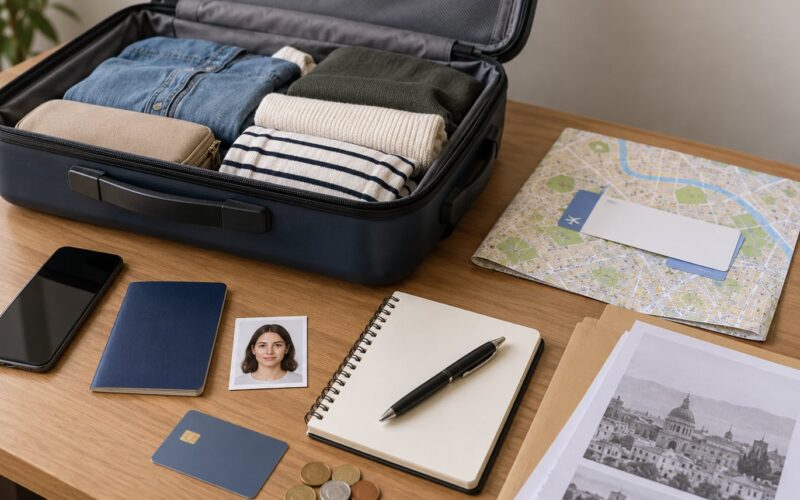
- Your real home-time schedule. When does the school run start, when is your first meeting, when does the household expect dinner, when do the children need to be in bed. Write the actual times down.
- One fixed target bedtime and one fixed wake time. Not an ideal one. The one you will actually keep, repeated every day including the weekend.
- Clothes for an ordinary evening. Not pyjamas-in-the-arrivals mood. Whatever you would normally wear on a Tuesday at home, because staying in travel mode is part of the problem.
- Water, and no alcohol for the first day. A bottle you can refill, and a plan for the evening that does not involve a drink.
- Something simple for your first home-time meal. Whatever is easy to cook when your appetite is unreliable and your family is hungry.
- An eye mask and earplugs. Useful on the flight and again on the first night if the house is noisy.
- A cool, dark bedroom. Blackout blinds or an eye mask, and a room that is not warm. Sleep quality matters more than the number of hours right now.
- A light therapy lamp rated around 10,000 lux if you land in autumn or winter, when outdoor daylight is too weak to do the job on its own.
- Optional: melatonin, low dose. Worth having decided about in advance rather than at 2am in an unfamiliar pharmacy queue.
- Day two, written down. The first day gets all the attention. The second day is where most people lose the plot.
If you only take two things from that list, take the fixed wake time and the plan for the first meal. They are free, and they are the two most commonly skipped.
How to Beat Jet Lag Coming Home: Step-by-Step
Work through it in order. The sequence matters because each step makes the next one easier, and the order people usually try things in is roughly the reverse.
Before You Land: Set Your Home-Time Plan
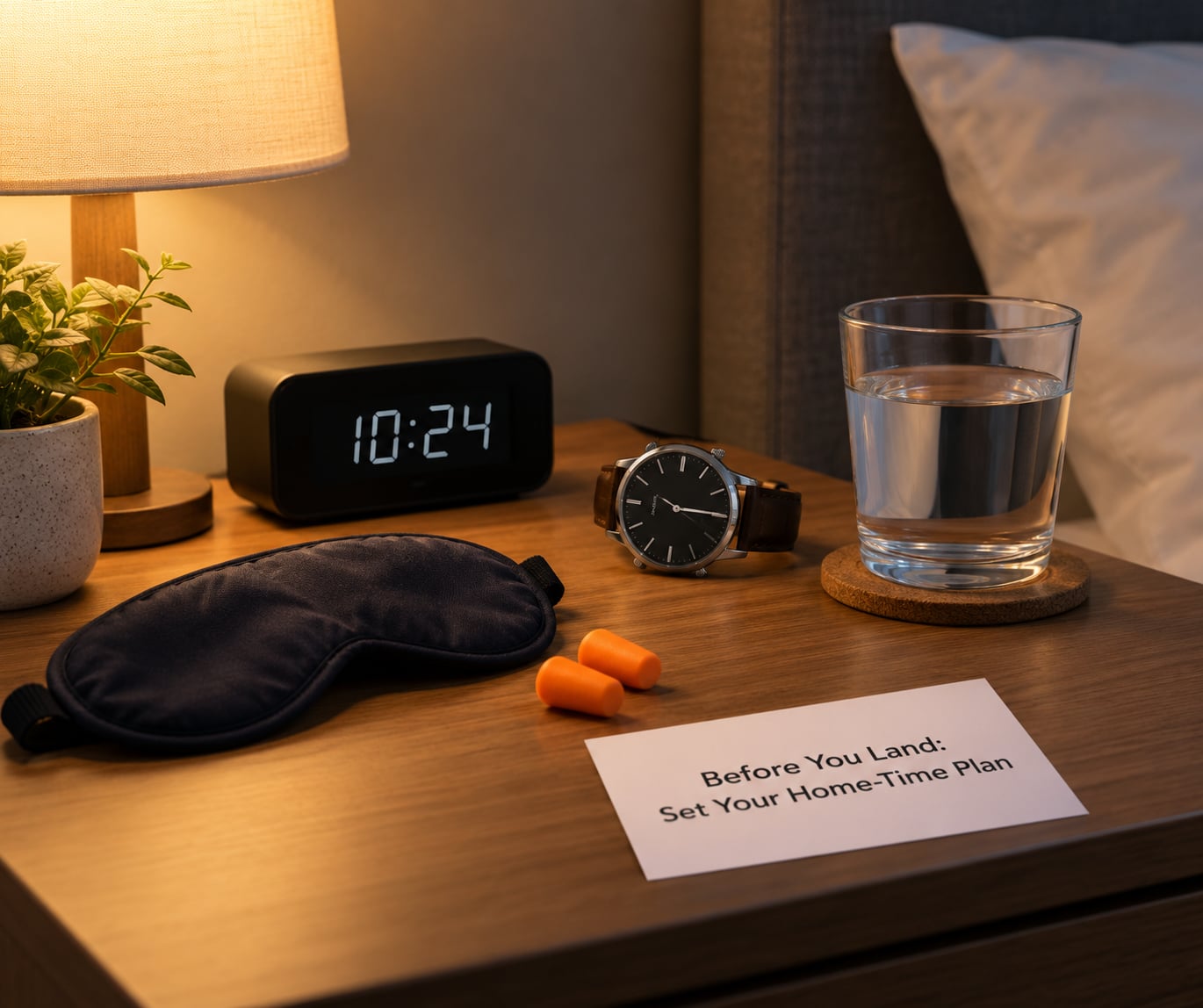
Work out the difference first. Nine zones is not something you can absorb in a single night, so pick a target bedtime that is realistic and hold to it, rather than aiming for your perfect bedtime and missing it.
Set your watch to home time the moment you board. From that point, everything on the plane is judged against home time, which is the same rule you will follow after landing.
Sleep on the flight only if it is night at home. If your home clock says 11pm and you are crossing the Pacific, a sleep mask and earplugs are the difference between getting five or six useful hours and none at all. If it is broad daylight at home, stay up and fight for it.
Drink water steadily through the flight rather than in bursts, and get up to move at least once an hour. Long seated stretches are what leave you stiff, and stiffness is not jet lag but it feels like it.
Skip the heavy meal and the drinks. Carbohydrates help if you are about to sleep on board; keep it lighter if you need to stay awake for the arrival. The single most regretted decision on a return flight is the free pour of wine an hour before landing.
During Arrival: How to Beat Jet Lag Coming Home in Your First 24 Hours
The first day is decided in roughly four windows. Which actions you take depends on the time you land, because a morning arrival and an evening red-eye ask opposite things of you.
- First thirty minutes. If there is daylight outside, go outside, even briefly and even if it is cold. If it is dark, keep the lighting low and skip the bright screens. Do not drive home if you crossed six or more zones. Reaction time after a long-haul flight is genuinely worse, and the drive is the one task where a bad hour becomes a serious problem.
- First three hours. Shower, change into normal clothes, and get something light to eat at your usual mealtime. Then walk. Twenty to thirty minutes outside does more for your body clock than anything you will do in bed, and it is the instruction that shows up again and again in traveller forums, from the advice to sit in cafes and wander around parks after a red-eye landing.
- Hours three to eight. This is the window where the nap temptation hits hardest, usually mid-afternoon. If you must, twenty minutes, an alarm set, and not a lie-in. Naps longer than that push you into deep sleep and then hand you a second wind at midnight that costs you the next night.
- Evening. Eat your normal home-time dinner with the household even if you are not hungry. Dim the lights in the last two hours before bed, because evening light is the signal that pushes your melatonin release further away from when you want it.
- Bedtime. Go to bed at your normal home time, not at the time your body insists on. If you cannot sleep, that is expected and not a sign the plan has failed. Get up anyway.
| Window | Morning arrival (landed 6am to 11am home time) | Evening red-eye arrival (landed 6pm to 11pm home time) |
|---|---|---|
| Light | Maximum daylight immediately and through the morning. Curtains open everywhere. | Skip bright light in the evening. Keep lamps low, screens dim, no shopping trip to catch up on. |
| First meal | Full home-time breakfast, even if you ate on the plane. | Light dinner with the household. A full heavy meal this late keeps you up. |
| Sleep | Stay awake to your normal bedtime. Twenty-minute nap only, and none after 3pm. | Go to bed at your normal home bedtime, even though your body wants a nap. Do not treat a 2am wake-up as a failure. |
| Movement | Outdoor walk straight away, then again in the afternoon. | Short walk on arrival to stay steady, then keep moving through the evening without strenuous exercise. |
| Biggest risk | Waking fine, then crashing hard in the evening and losing the whole first night. | Sleeping four hours, waking at 2am, and drifting through the next day half-awake. |
If you land in the morning and you feel fine, resist the relief. The classic morning-arrival failure is a good day followed by a terrible night, because the body finally asks for its debt at bedtime.
If there are children in the house, the plan is the same, just louder. Their schedule is fixed, which is a gift: you ride their daylight and mealtimes instead of building your own. A traveller in one long-haul thread put it simply, do not nap, stay awake as late as possible, and if you must, a short one. A five-year-old will still be awake at their normal bedtime, and following that is easier than arguing with it.
How Long Does Jet Lag Usually Last Coming Home?
The working rule is one day of adjustment per time zone crossed, and most sources put the total window at two to seven days. A return from Tokyo to London crosses eight or nine zones, so five to seven days is a realistic expectation, not a sign that you are doing something wrong.
Eastward is harder. Your natural cycle runs slightly longer than 24 hours, so moving your clock earlier means shortening the day, and shortening days are the direction the body resists. Westward is easier because you are lengthening the day, which is the direction it naturally drifts.
The hardest part is usually day two, not day one. On the first evening you are running on adrenaline and on the excitement of being home. Then your body clock’s natural low point, usually somewhere in the mid-afternoon, lands in the middle of a normal working day at home. That is the wall people describe in the second and third day threads, and it is when most people give up and go to bed at 4pm.
Adaptation is slower with age, and clinicians commonly note that travellers over 60 can need meaningfully longer than younger adults, sometimes 50 to 100 percent more time for the same number of zones. Individual variation is wide, and these figures are general guidance rather than a prediction about you.
North-south routes are worth separating out. A long flight up or down the Americas leaves you tired, stiff and dehydrated but keeps your clock roughly aligned. That is travel fatigue, not jet lag, and it clears with sleep and water rather than a light-timing plan.
Use Light, Caffeine and Food at the Right Times
Light is the strongest lever you have, because it is the signal your brain uses to set the clock in the first place. Direction decides when you want it.
| Strategy | Coming home east (for example Asia or Australia to Europe) | Coming home west (for example North America to Europe) |
|---|---|---|
| Best light | Bright light in the morning, within an hour of waking | Bright light in the late afternoon and early evening |
| Light to avoid | Evening light. Dim the house two hours before bed. | Bright light late at night. Use an eye mask if you wake early. |
| Sleep target | Go to bed earlier, not later. Protect the early night. | Stay up a little later, then sleep in a little. Push bedtime back gradually. |
| Meals | Front-load. Eat a bigger breakfast and a lighter dinner. | Back-load slightly. A slightly later dinner suits the later bedtime. |
| Caffeine cut-off | Six to eight hours before your target bedtime | Six to eight hours before your target bedtime |
| Best nap | Early afternoon, twenty minutes, none after 3pm | Early afternoon, twenty minutes, none after 4pm |
Get outside rather than sitting by a window. Outdoor light on a bright day is far stronger than anything indoors, and one traveller’s long-haul protocol on a Reddit biohacking thread reduces to two lines that cover most of the science: drink water and move every hour, and stop caffeine eight to ten hours before your target bedtime.
If you land in winter in a place where daylight is grey and short, a 10,000 lux light therapy lamp used in the morning for 20 to 30 minutes is the practical substitute. Sitting under one while you have breakfast is enough; it is not a treatment you need to schedule like a meeting.
Eat on home time even without appetite. Your stomach runs on cues from the clock and from meals, and a skipped lunch at 9am local because your body is not hungry teaches your body the wrong time. Small and light beats a large meal at the wrong hour.
Protect Tonight’s Sleep
Your first night home matters more than the first day, because the night is what locks in the new schedule. Four hours of poor sleep on night one usually means a rough day two.
If you use melatonin, time it to your target bedtime at home, roughly 30 to 60 minutes before, and start at the low end. Most guidance points to 0.5 to 3 mg, and more is not better: a high dose can leave you groggy and does not extend sleep once melatonin has worn off. It is a short-term adult tool. Check with a pharmacist or doctor if you are pregnant, taking other medication, or giving it to a child.
There are three timing errors worth naming, because they turn a helpful supplement into a wasted night. Do not take it early on the plane, several hours before you land, or you will be groggy through customs. Do not double up because the first dose did not work. And do not combine it with alcohol, which blunts the effect and fragments the sleep that follows.
There is also a case for skipping it entirely. If you land after 4pm and you are trying to force a full night at 10pm, melatonin can drop you into a heavy sleep at the wrong moment and make the following day worse. On a red-eye arrival, the first night is often better managed without it.
For the rest of the evening, keep the room cool, the lights low and the screens to a minimum. If you wake at 3am, do not look at the clock as proof that you have failed. Get up, sit somewhere dim, read something dull, and go back when you feel it.
Adjust Over the Next Few Days
Day two is the wall, and the cure for it is boring repetition. Same wake time, same breakfast, same walk, regardless of how the night went.
Hold your wake time even after a bad night. Sleeping in until noon on day two guarantees a second bad night, because it moves the clock in exactly the wrong direction for an eastbound return. If you slept badly, still get up at your normal time and get daylight.
Book your demanding work for day three, not day one. This is the part of coming home that hotel-based advice never covers, and it is the part that decides whether the trip costs you a week. Tell your team you are back but not yet sharp, hand over anything urgent before you fly rather than on landing, and put the one meeting that matters on the calendar for later in the week.
Keep moving daily. A walk at the same time each afternoon is more useful for recovery than anything you can buy, and it gives your family a version of you that is present rather than horizontal.
Bring the household with you where you can. Your partner is probably on normal working hours, so the evenings will be the point of conflict. Agree in advance who does bedtime, keep meals together at home-time hours, and expect to be the one in the house who is tired first. Children usually adjust faster than adults precisely because their schedule is enforced for them.
Watch for the arrival days where commitments and recovery collide: a red-eye landing followed by a school pickup, a business trip ending on a Monday, a long flight home the day before a wedding. Those are the cases where the plan above is a defensive strategy, not an optimisation.
Common Mistakes That Make Coming Home Worse
- Sleeping through the first day. You are awake for sixteen hours, your body is already confused, and you will wake at 3am completely functional and be finished by the following afternoon.
- Alcohol as a sleep aid. It shortens the time to sleep, damages REM sleep in the second half of the night, and reliably produces the 3am wake-up. It was the most common deal-breaker in traveller threads.
- Staying up until you collapse. Exhaustion is not the same as shifting a clock, and you end up awake for twenty hours with nothing gained.
- A heavy late meal. Large dinner at 10pm is a request for a restless night, especially on an eastbound return.
- Caffeine after mid-afternoon. It pushes sleep onset back by the same mechanism as the jet lag itself. Forum advice varies on the cut-off, but six to eight hours before bed is the most defensible number.
- Long naps. Anything over half an hour, and nothing in the late afternoon. The figure that comes up in both health guidance and traveller reports is fifteen to twenty minutes.
- Fasting or extreme meal-skipping. The evidence is thin and the practice is hard to keep while working a normal week. One insurer guide on jet lag is refreshingly blunt about it, and that scepticism is about right.
- Forgetting that dehydration is not jet lag. Headaches, dry mouth and dizziness after a flight are often travel fatigue. You cannot fix that one with sunlight.
When Jet Lag Is More Than a Time-Zone Problem
Ordinary jet lag is unpleasant, temporary, and follows a predictable pattern that follows the time zones. Anything that does not fit that pattern deserves a different response.
Get medical advice rather than adjusting your sleep schedule if you have one leg that is swollen, painful, warm to the touch or red, particularly after a long flight with little movement. The same applies to chest pain, shortness of breath, coughing blood, or a severe headache with confusion or vision changes.
Seek advice for a fever, persistent vomiting or diarrhoea, signs of dehydration that do not improve with fluids, confusion, or a marked change in mood that does not lift as the days pass. These are not circadian symptoms, and none of the advice in this article is designed to address them.
The same goes if symptoms have not started to ease after a week, or if you have a condition that makes travel harder, including anything affecting your heart, blood pressure, clot risk or eyes. A pharmacist or a doctor can adjust the plan to your situation, and that is a far better use of your time than experimenting on yourself at 2am on day three.
Frequently Asked Questions
Why is jet lag worse when coming home?
Because your schedule stops being negotiable. Flying out, you can sleep whenever your body wants. At home there is a commute, a job, a school run and a bedtime that happens anyway, and you have to function through them on a body clock that is still on holiday time. The lag itself is the same in both directions; the consequences are heavier on the way back.
How long does jet lag last coming back?
Allow roughly one day of adjustment per time zone crossed, with most people settling somewhere between two and seven days. A return across nine zones realistically takes five to seven days. Eastward returns run longer than westward ones, and travellers over 60 often need more time again. If symptoms have not started to shift by day seven, that is a reason to speak to a doctor.
What is the hardest day of jet lag?
Day two, for most people. On arrival you are running on excitement and adrenaline, so the first evening feels manageable. Then your body clock’s natural low point lands in the middle of your normal working day at home, and concentration goes with it. Hold your wake time, eat on home time and keep walking through day two, and the wall is much shorter.
Is it easier to recover from jet lag going east or west?
Westward is usually easier. Your natural circadian cycle runs slightly longer than 24 hours, so lengthening the day, as you do flying west, goes with the grain. Flying east shortens the day and the body resists it. Give an eastbound return one extra day, seek morning light, keep evening lighting low and go to bed earlier rather than later.
Should I take melatonin on the flight home?
Only if it is night at home when you are flying. Melatonin helps you fall asleep, it does not extend sleep once it has worn off, and the timing is what matters: roughly 30 to 60 minutes before your target bedtime at home, at a low dose between 0.5 and 3 mg. Taking it too early on board leaves you groggy through arrival, and combining it with alcohol fragments the night.
When do jet lag symptoms need a doctor instead of a good night’s sleep?
When they do not look like jet lag. Get advice for a swollen, painful, warm or red leg, chest pain, breathlessness, coughing blood, or a severe headache with confusion or vision changes. Fever, ongoing vomiting or diarrhoea, and confusion are also not circadian symptoms. If nothing has eased after a week, or you have a heart, blood pressure, clotting or eye condition, ask a doctor before adjusting anything.
Conclusion
Do one thing the moment you land: get outside into daylight, and set your watch to home time for good. Everything after that is maintenance, and the maintenance is unglamorous: eat at your normal mealtimes, stay awake to your normal bedtime, keep naps to twenty minutes, cut caffeine six to eight hours before bed, and hold the same wake time whatever happens overnight.
Give it a day per time zone crossed, expect day two to be the hard one, and stop driving for the first stretch if you crossed a lot of zones. Then let your household schedule carry you the rest of the way.