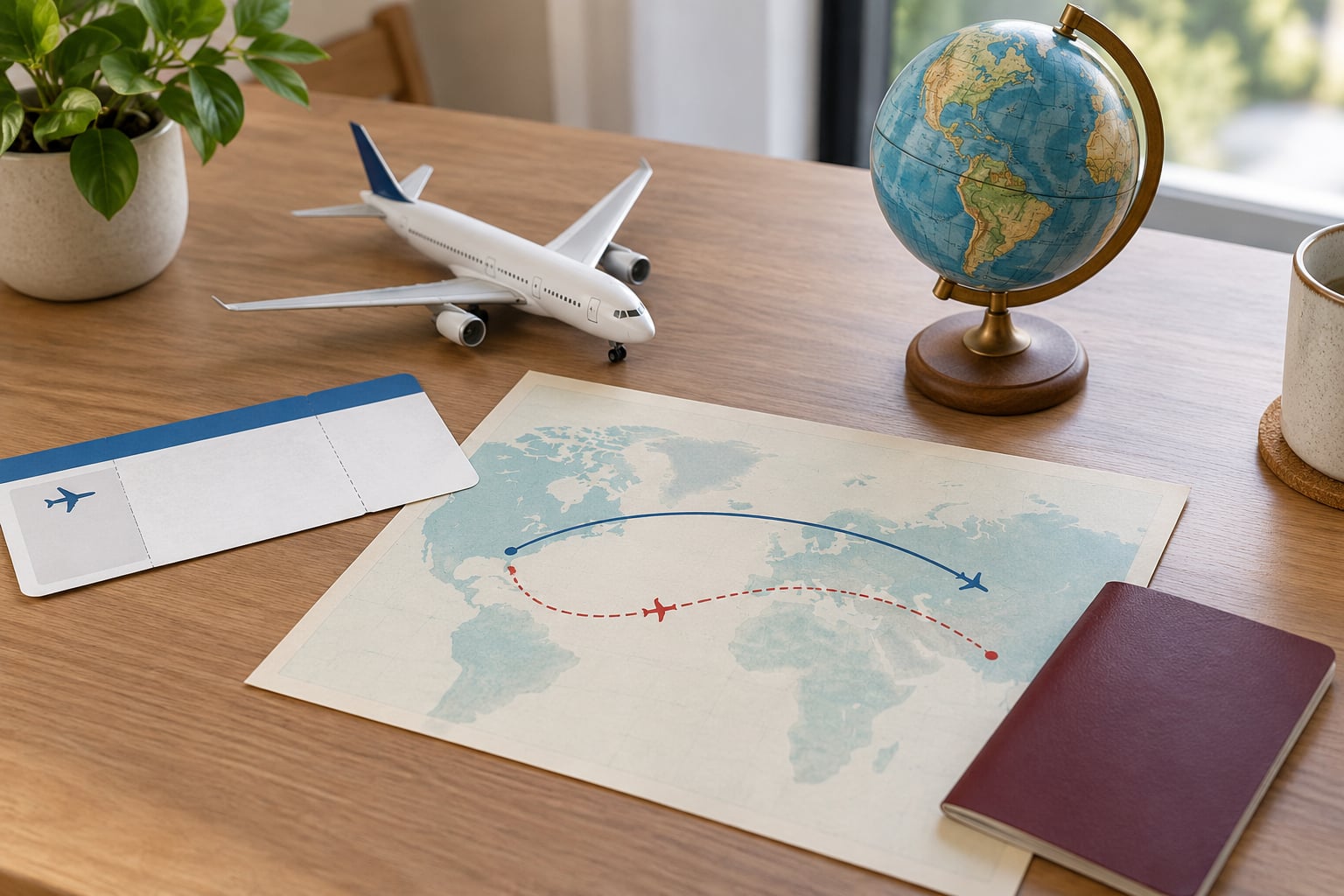
A nonstop flight flies from your origin airport to your destination with no intermediate landing: one takeoff, one arrival. A direct flight keeps the same flight number for the whole journey but may land at one or more intermediate airports along the way. You stay on board, and you do not change planes.
That is the entire distinction, and it is the one most booking sites blur. The words nonstop and direct are used interchangeably in conversation, so plenty of travellers assume they mean the same thing. Airlines and travel agents do not always help, because a direct itinerary can touch down in three cities and still be listed as a single flight.
So the nonstop vs direct flight difference explained in this guide matters on the day you travel, not just at the search box. A nonstop removes layover risk, missed-connection risk and an extra round of baggage handling. A direct flight with a hidden stop can add one to four hours to a short route, and you may not see it until you are handed a second boarding pass for the return leg.
I have pulled the definitions apart below, added a table you can screenshot, and listed the four things to check on any itinerary before you pay for it. If you have been burned by a hidden stop, you are in good company: it is the single most repeated question on travel forums, and the most common answer is that yes, this is normal, and no, most people did not know.
Table of Contents
- Nonstop vs Direct Flight Difference Explained at a Glance
- Does a Nonstop Flight Have Stops or Connections?
- Does a nonstop flight ever land in between anyway?
- Can a Direct Flight Include a Stop?
- Do you need a new boarding pass on a direct flight with a stop?
- What Happens If You Have a Connection?
- Why Do Airlines Sell Direct Flights With Multiple Stops?
- Is a stop on a flight the same as a layover?
- Can two flights have the same flight number?
- Which Is Better for Your Trip?
- How to check for a hidden stop before you book
- Which Should You Choose?
- Frequently Asked Questions
- Is a direct flight the same as a nonstop flight?
- Can a direct flight have more than one stop?
- Does a direct flight require changing planes?
- Is a flight with a connection always longer than a direct flight?
- What should I look for when comparing nonstop and direct flights?
- Does a stopover count as a connection?
- Conclusion
Nonstop vs Direct Flight Difference Explained at a Glance
There are three main types of flights, and the table below sets them against each other on the details that actually change your day. One column is nonstop, one is direct, and one is connecting.
| What changes | Nonstop | Direct | Connecting |
|---|---|---|---|
| Intermediate stops | None | One or more, sometimes labelled | One or more, always labelled |
| Change of aircraft | No | No, you stay on the same plane | Yes, you leave one plane and board another |
| Flight number | One | One for the whole journey | Two or more, one per leg |
| Boarding passes | One | One | Separate pass for each leg |
| Checked bags | Checked once, tagged to destination | Normally stay on board; only re-handled on a hard baggage stop | Re-checked at the connection, though most carriers through-tag them |
| Total travel time | Shortest of the three | Longer by however long the stop lasts | Longest, because a layover is added on top of both flights |
| Missed-connection risk | None | None, there is no connection to miss | Real, and higher with a short layover |
| Relative price | Usually the priciest option on a busy city pair | Often cheaper than nonstop, or priced the same | Usually the cheapest, especially on thin routes |
| Best for | Anyone who values predictability, families with kids, tight schedules | Travellers who want the arrival time without the nonstop premium | Cheap fares, long-haul routes, and thinner cities with no nonstop service |
Read the flight-number row again, because that is the whole industry rule. A direct flight is defined by the number staying the same, not by the aircraft staying in the air. Change the number and you have a connection, no matter which airline operates it.
Does a Nonstop Flight Have Stops or Connections?
No. A nonstop flight goes from point A to point B in a single leg, and the only landing is your destination. There is no intermediate airport, no fuel stop, and no second aircraft waiting for you somewhere else.
Nonstop is the only one of the three terms that describes a route rather than a schedule. If a booking engine says nonstop, the aircraft is committed to flying your itinerary in one piece. That is why nonstop service disappears on thin routes: filling a second leg on the same aircraft costs the airline another take-off and landing with no passengers on board, and on a quiet route that can be a hundred empty seats it is not worth it.
Does a nonstop flight ever land in between anyway?
Rarely, yes, and it is called a technical stop. A long-haul aircraft with a limited range may land to refuel, to let crew relieve themselves, or to wait out ground support restrictions at a busy field. The flight number does not change, and in most cases you stay in your seat with your bag in the hold.
Two things are worth knowing about technical stops. You normally do not disembark and you do not need a new boarding pass, but an interline technical stop can require passengers to get off briefly while the aircraft is unloaded. It is also a documented possibility that a flight branded nonstop is re-routed through a hub on the day, which is why frequent-flyer and award travellers read the arrival details as carefully as the label.
Can a Direct Flight Include a Stop?
Yes, and this is the definition most people get wrong. A direct flight is one that keeps the same flight number from origin to destination even when the aircraft touches down at an intermediate airport on the way. You stay on board the same plane, your bag stays with the aircraft, and the flight number printed on your boarding pass is the flight number you land on.
Some airlines will sell a direct flight with two or three stops. The example that circulates most widely on travel forums is a Southwest itinerary from Indianapolis to Orange County that touched down in Houston, Austin, San Jose, Los Angeles, Tucson and Las Vegas, all under one flight number. It was legal, it was sold as one flight, and it was nothing like the itinerary the traveller thought they had bought.
The most common reason for a direct stop is simple economics. A regional jet leaves a hub in the morning, collects passengers on a spoke route, and returns to the hub with a load of connecting traffic. The stop is not a failure of the schedule; it is the schedule working as designed for a hub-and-spoke network.
Do you need a new boarding pass on a direct flight with a stop?
No. One flight number means one boarding pass, and your checked bag is normally tagged to your final destination rather than the intermediate airport. Bags are only re-handled if the airline treats the stop as a hard baggage-handling point, which is uncommon. Forum travellers who ask this question usually just want to hear that there is no airport floor sprint between legs.
What Happens If You Have a Connection?
You leave one aircraft and board another, and the itinerary has a separate flight number for each leg. That is the defining feature of a connection, and it is why you get a separate boarding pass per leg and why your arrival time at the hub matters.
On a connection, the intermediate airport is a layover, and the time you spend on the ground can be anything from 45 minutes to five hours. A short layover is efficient and risky in equal measure, because a delay on the first leg eats directly into the departure time of the second. A long layover is safe and slow, and it can be a useful afternoon in an airport you actually wanted to visit.
Being on the same airline does not turn a connection into a direct flight. A United-branded itinerary operated with a partner carrier under a codeshare still runs on two flight numbers and still needs a change of aircraft. What same-airline connections do offer is protection: when both legs are on one ticket, a delay that causes a missed connection usually gets you rebooked on the next service without taking on the cost.
Travellers on r/SouthwestAirlines and r/Flights consistently point to missed connections as the reason they pay more for nonstop, sometimes more than the time saving justifies. That is a reasonable trade for a family with a tight onward booking, and an expensive habit if you are moving between cities for a weekend.
Why Do Airlines Sell Direct Flights With Multiple Stops?
Because a direct flight is a scheduling tool, not a promise of speed. Airlines build networks around a small number of hub airports, and most regional routes only work economically if the aircraft returns to a hub where it can pick up another load of passengers.
Other reasons show up in the timetable too. Demand changes seasonally, and a winter route that carries twelve passengers a day may be folded into an existing direct flight. Aircraft have to rotate back to base, so the crew and the plane both end their day at the hub. Weather, airspace restrictions and air traffic control congestion all add stops that no one planned and nobody advertised.
None of this means a direct flight is a trap. On a thin regional route it is often the only realistic service, and on a busy city pair it can be the option that gets you home at a civilised hour. It just means the word on the button describes the flight number, not your day.
Is a stop on a flight the same as a layover?
Not quite. A stop is any landing between your origin and your destination, which can be a technical refuel with everyone still seated. A layover is the scheduled time you spend on the ground between two separate flights. A direct flight can have stops and no layover at all, because you never leave the aircraft. A connection has a layover by definition, since the change of aircraft requires you to be at the terminal.
Can two flights have the same flight number?
Not the same number on two unrelated flights, no. A flight number belongs to one airline and identifies one aircraft on one schedule, which is what makes a direct flight a direct flight. It can, however, appear on paper with several airlines’ names on it when one carrier sells a seat on a flight operated by a partner under a codeshare, and a number is sometimes reused on different days of the week. So the flight number tells you the service; the airline and operating carrier printed beside it tell you who is actually flying.
Which Is Better for Your Trip?
It depends on which of the trade-offs you are actually paying for, and the answer changes by route. Start from total travel time: a nonstop wins on a busy city pair, but on a thin route a one-stop itinerary is often faster in practice than a direct flight that touches down three times on the way.
Next, look at predictability. Nonstop service has no layover to miss and no second boarding pass to read in an unfamiliar terminal, which matters most when you are travelling with children, a lot of checked luggage, or connecting onward to something you cannot afford to miss. Travellers on r/fearofflying routinely choose nonstop even when the itinerary is not the cheapest or the fastest, simply to remove the possibility of a mid-journey stop.
Then check arrival time rather than departure time. A nonstop flight that leaves at 6am and lands at noon can beat a direct flight that leaves at 11am and arrives at 8pm, and a connection that lands at 4pm is sometimes the only option that gets you to dinner.
Finally, consider what happens when things go wrong. If your itinerary is a single nonstop leg, a delay costs you hours. If it is a protected connection on one ticket, the airline rebooks you. If it is two separately ticketed flights, you are on your own, and that risk is real on a short layover.
How to check for a hidden stop before you book
- Read the stops field, not the headline. Booking sites show a stops count and usually a stopover list. If the entry says one stop or lists a city you never chose, it is a direct flight, not a nonstop.
- Compare duration against distance. A scheduled block time noticeably longer than the great-circle distance for that city pair is the giveaway. A two-hour hop scheduled at three and a half hours is almost certainly stopping somewhere.
- Check the flight number on every leg. One number across the whole journey means direct. Two or more numbers means a connection, whatever the site calls it.
- Ask the airline directly if the route is unusual. On routes with a history of technical stops or fuel stops, a quick call to the airline confirms whether the aircraft operates through or terminates.
Which Should You Choose?
Book nonstop when the trip is short, the day is fixed, or the cost of a delay is high: a weekend away, a school run, a connecting meeting, an elderly parent travelling with you. The premium travellers report on the same city pair commonly runs 20 to 40 percent over a one-stop fare, and for a busy route that premium buys you back hours of risk reduction.
Accept a direct flight when nonstop service does not exist on the route at all, when the direct option arrives at a workable hour and the nonstop does not run until the following morning, or when the difference in total travel time is small enough that predictability is not worth the extra spend.
Take a connection deliberately rather than by default. It is the right call on long-haul routes where the airline hub is a good transfer point, on award bookings where a premium cabin with one stop beats economy nonstop, and on any route where the saving is large enough to justify a long layover. Just book the legs on one ticket, leave yourself a comfortable connection, and check whether the carrier handles your bag through to the final airport.
For families with kids and a mountain of checked luggage, nonstop is the default I would pick every time. Forum threads about missed connections describe the same pattern repeatedly: one delay on the first leg, a longer delay on the second, and a family arriving at a destination airport in the wrong terminal at the wrong hour.
Rights differ by where you are flying. Flights departing from the EU are covered by Regulation EC 261, which sets compensation for delays, cancellations and denied boarding, while US domestic itineraries follow Department of Transportation rules on refunds and rebooking. If a flight you booked as nonstop is re-routed and you have to rebook yourself, keep the receipts and check what your route is covered under before assuming you are out of pocket.
Frequently Asked Questions
Is a direct flight the same as a nonstop flight?
No. A nonstop flight goes from your origin to your destination with no intermediate landing at all. A direct flight keeps one flight number for the whole journey, but the aircraft may land at one or more intermediate airports, refuel or drop some passengers, and carry on. You stay on board either way. The rule is simple: nonstop describes the route, direct describes the flight number.
Can a direct flight have more than one stop?
Yes, it can. Airlines are free to operate a single flight number across several legs, and some carriers sell itineraries with two or three intermediate stops under one number. The widely cited example is a Southwest route from Indianapolis to Orange County that touched down in six cities while keeping the same flight number. Always read the stop list on your itinerary, not just the flight number.
Does a direct flight require changing planes?
No. A direct flight is by definition flown on the same aircraft under the same flight number from start to finish, so there is no change of plane. Even when it stops en route, you normally stay seated and your checked bag is tagged to the final destination. If you are handed a second boarding pass or told to collect your bag, you are on a connection rather than a direct flight.
Is a flight with a connection always longer than a direct flight?
No. A connection adds a layover to the front of the second flight, so it is often longer than a nonstop. But a direct flight may stop at two or three intermediate airports, and a one-stop itinerary through a hub can be quicker door to door. Compare total travel time and arrival time, not the number of stops, before deciding which is faster.
What should I look for when comparing nonstop and direct flights?
Look at four things: the stops field on the booking, the flight number repeated across each leg, the scheduled duration compared with the distance, and the arrival time including any layover. One flight number means direct. Two or more means a connection. A block time far longer than the distance suggests a hidden stop. If a route is unusual, a quick call to the airline confirms how the aircraft operates.
Does a stopover count as a connection?
A stopover is a deliberate, often overnight, break in a journey where you leave the airport, sometimes for days. A connection is the short ground interval between two flights on one itinerary. Neither changes what nonstop or direct means, but a stopover means your ticket spans a longer period and your bag may travel separately. Check the dates on each leg before assuming a short layover is included.
Conclusion
The nonstop vs direct flight difference explained in one line: nonstop means no intermediate landing, direct means one flight number regardless of how many times the aircraft touches down. Everything else follows from that.
Before you book, check the number of stops, whether the flight number stays the same on every leg, the total duration including any layover, and the arrival time rather than the departure time. Those four fields tell you whether the nonstop vs direct flight difference is going to matter on your particular itinerary, and on most trips it matters more than the label did.