How to prevent back pain on long drives comes down to two levers: set the seat so your spine sits neutral and supported, then interrupt the sitting every 45 to 60 minutes. Recline the backrest to roughly 100 to 110 degrees, keep your knees slightly lower than your hips, put something behind your lower back, and stand up and walk on a schedule. Do both and most of the discomfort simply never starts.
Sitting still for hours is the problem, not the car. Your lumbar spine holds one loaded shape for the whole drive, the muscles that support it tire, and road vibration adds a low hum of movement your core quietly absorbs. Add a grip on the wheel, mirror checks, and bracing in traffic, and the shoulders and neck join in.
Ignored, that stiffness often outlasts the drive, sometimes for a day or two. Repetition is what turns it into a lasting problem: the same six hours in the same seat on the same commute is a lot of loading on the same tissues. Fifteen minutes of setup before departure is the whole difference between a trip you think about and one you do not.
Updated for October 2026
The two fixes to make before you pull out of the driveway
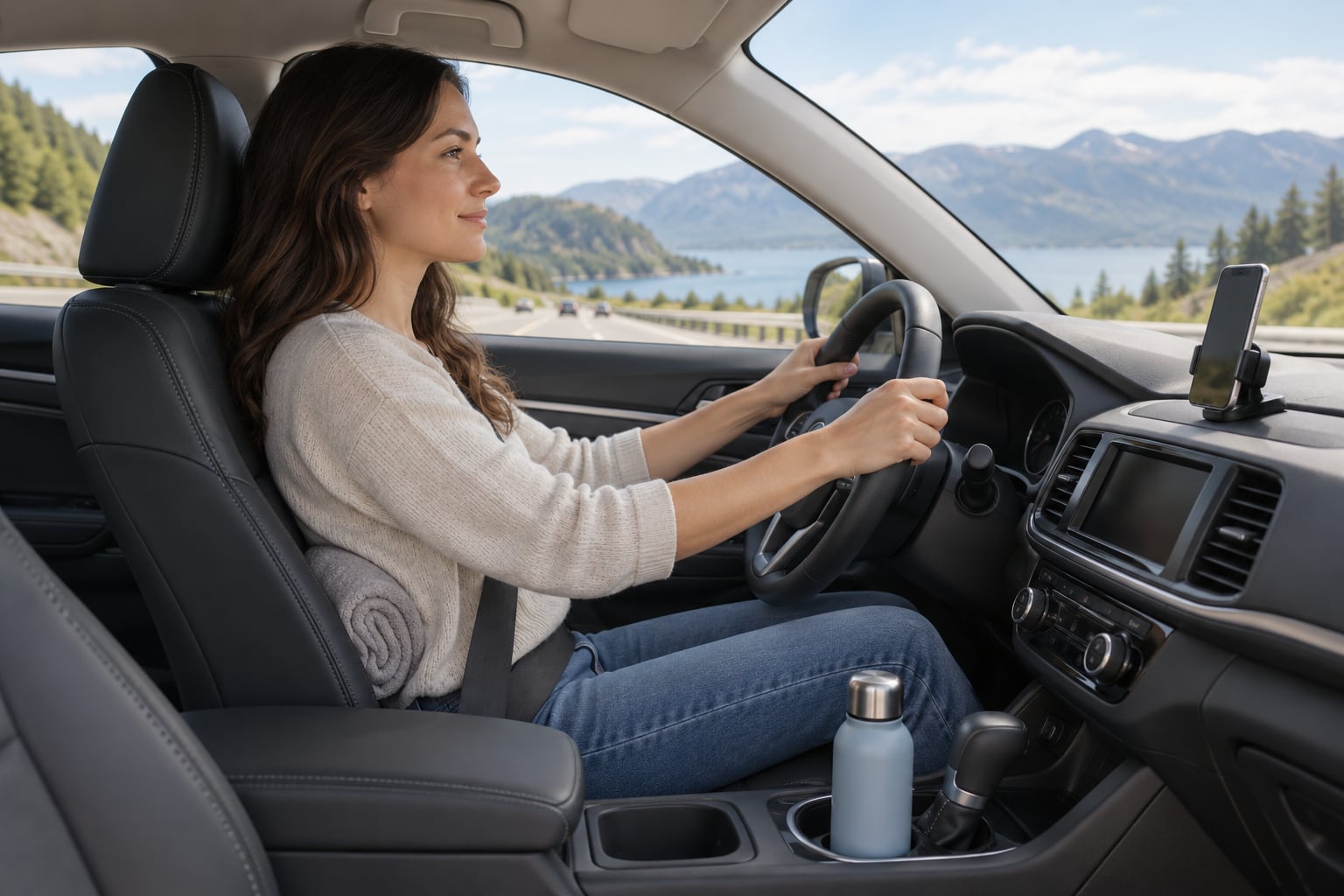
- Adjust your seat position: backrest at 100 to 110 degrees, not flat upright.
- Knees slightly lower than hips, feet flat on the floor.
- Grip the wheel at nine and three, pull it toward you.
- Add lower back support: a lumbar roll filling the seat’s curve.
- No cushion? Roll a towel or a sweatshirt and use that.
- Empty your back pockets before you sit down.
Table of Contents
- What You Need
- Step-by-Step: Adjust Your Driving Position
- Keep Your Lower Back Supported
- Change Position Without Waiting for Pain
- Take Regular Movement Breaks
- Use a Simple 30-Minute Comfort Routine
- Make the Vehicle Easier to Drive In
- Prepare for Passengers and Frequent Stop-and-Go Traffic
- Know When to Stop Driving
- Common Mistakes
- Frequently Asked Questions
- What is the best back support for long distance driving?
- What kind of cushion can I use for lower back pain while driving?
- How often should I stop on a long drive to stretch?
- Is it safe to drive long distances with sciatica?
- How do I tell if my back pain is muscular or spinal?
- As a passenger on a long ride, what can I do that a driver cannot?
- Conclusion
What You Need
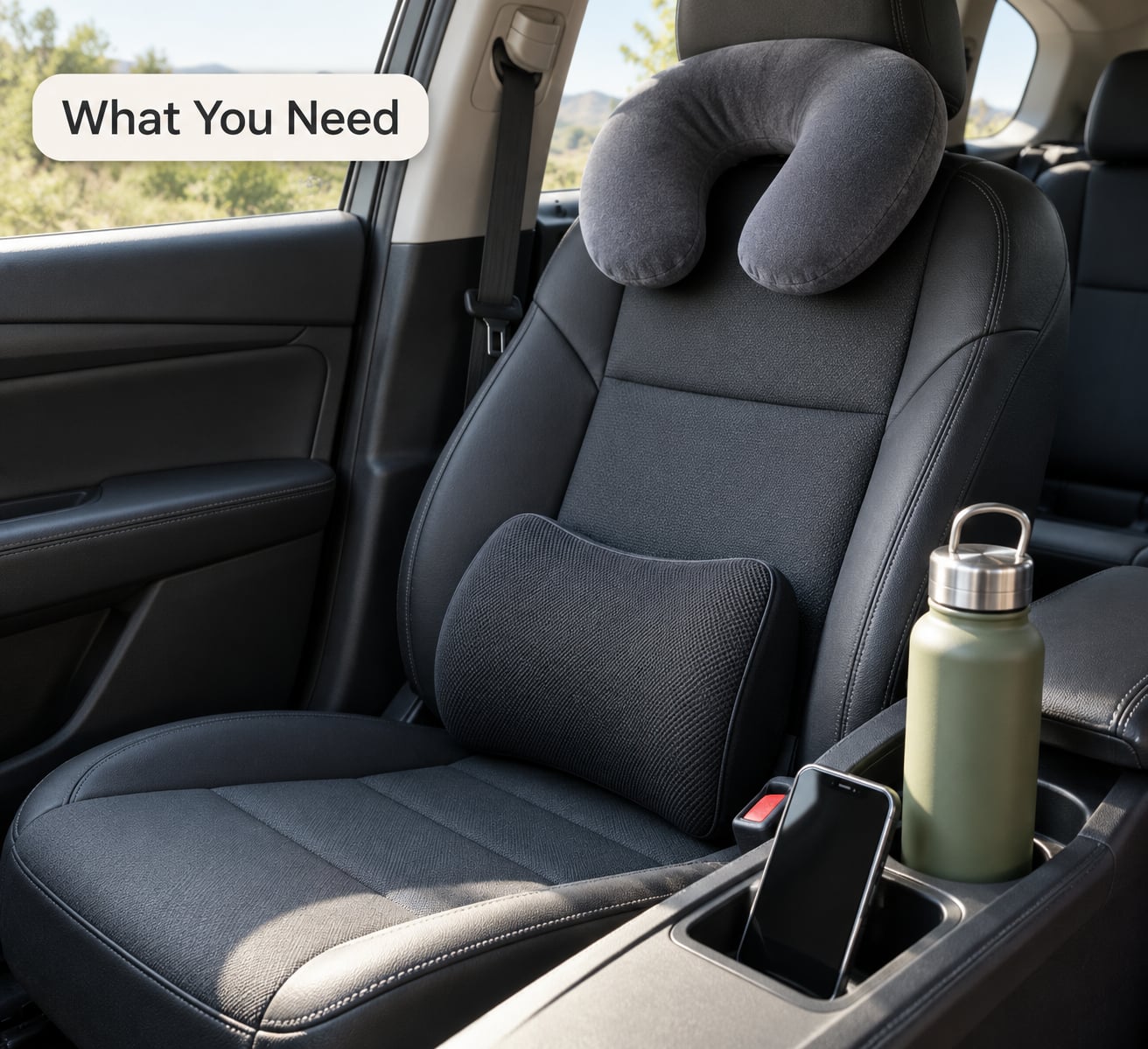
None of this is specialist kit. A lumbar cushion or a rolled towel handles the support job, and a two-minute setup handles the position job.
- Lumbar support: a foam cushion that fits the curve of your specific seat, or a rolled towel or sweatshirt for the small of your back.
- Flat, supportive footwear: thin soles and a low heel. High heels or thick platform soles change your hip angle within minutes.
- Water: a bottle within reach, so you are not twisting to the cup holder every time you are thirsty.
- A phone mount: keeps navigation off your hand and your neck out of a downward tilt.
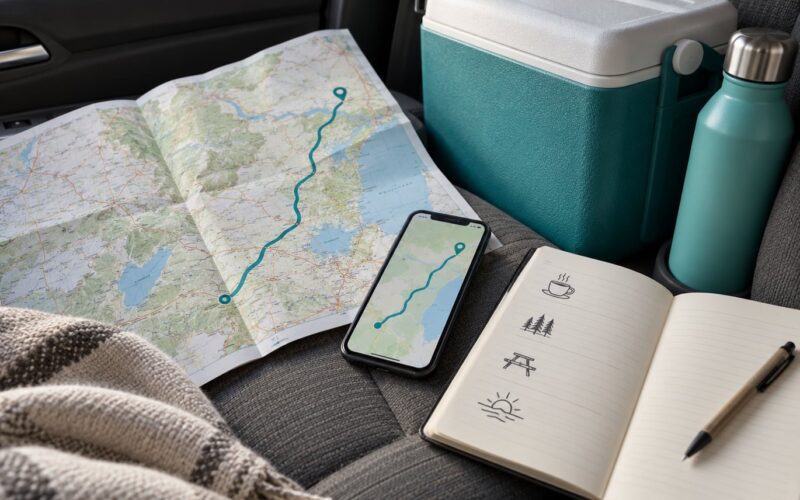
- A planned stopping routine: decide the break points before departure rather than deciding at mile 400.
- Optional: a heat pack or cold pack, and a second pair of hands if someone is riding with you.
The last one matters more than people expect. A passenger who is willing to take a turn at the wheel is the single biggest relief on a solo long drive, and it costs nothing but the decision to split the hours.
Step-by-Step: Adjust Your Driving Position
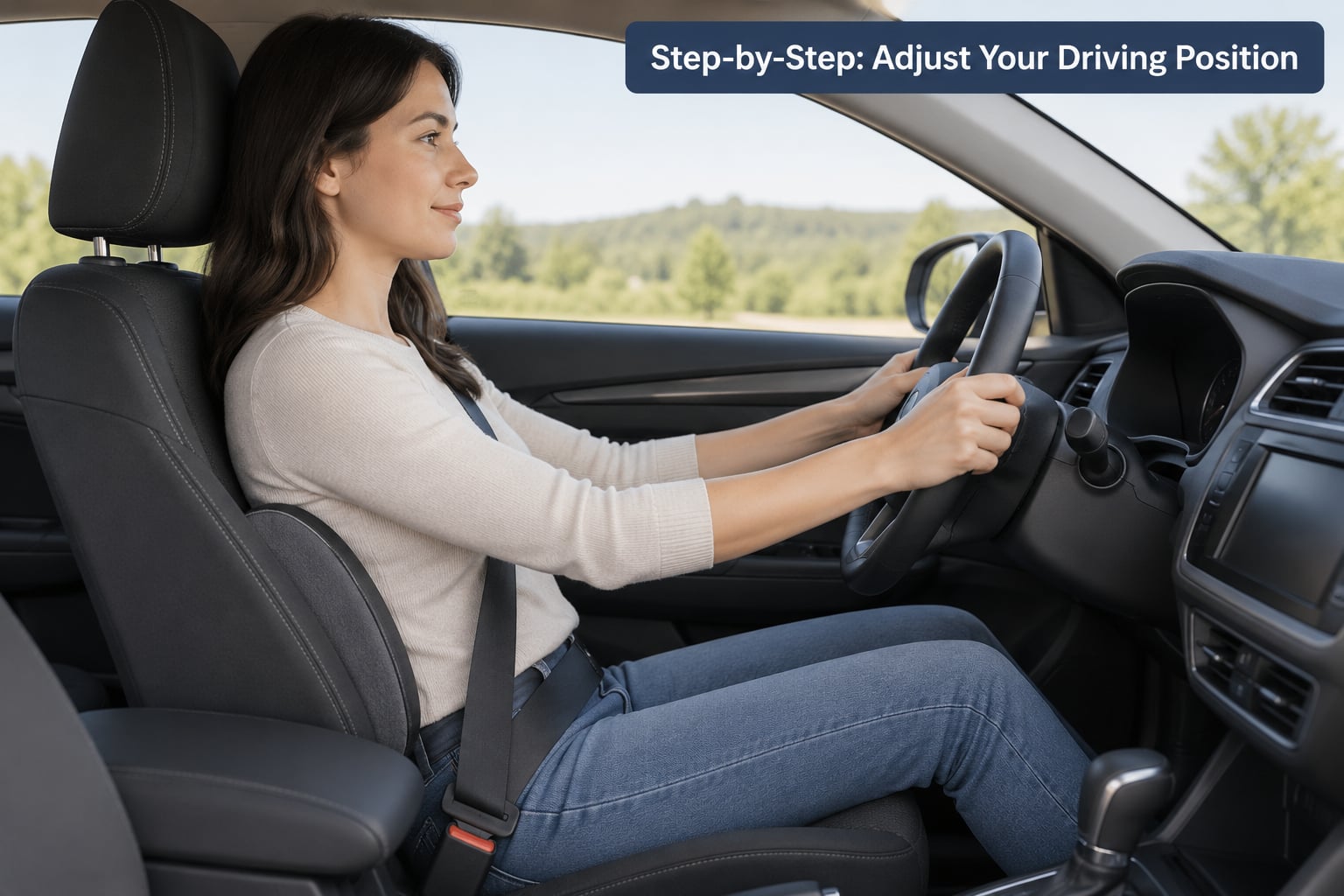
Work through this once, before you start the engine. Ten minutes at a service station beats four hours of adjusting in traffic.
Keep Your Lower Back Supported
Start with the backrest. Set it around 100 to 110 degrees, which is a clear recline from upright but nowhere near lying down. A seat locked straight up at 90 degrees pushes your lower back into a rounded shape and holds it there for the whole trip, and a seat folded too far back slumps your head forward onto your chest.
Next, the seat itself. Slide it back until your knees sit slightly lower than your hips, with your feet flat on the floor and your legs bent at roughly the knees rather than stretched straight out. Then place your support. A rolled towel goes in the small of your back, at belt height, filling the gap the seat leaves when it reclines.
Take your wallet and phone out of your back pockets before you settle in. Sitting on them tilts one side of your pelvis, and an hour of that tilt is a strange thing to hand your lower back at the end of a long drive.
Change Position Without Waiting for Pain
Waiting for pain is a bad signal, because by the time you feel it you have already been holding one shape too long. Change something small every fifteen minutes instead, while stopped or during a long, safe stretch of road.
- Move your hands from ten and two to nine and three. Higher grips pull your shoulders up toward your ears.
- Shift which foot rests lightly on the accelerator, and rock your heels so your knees are not locked.
- Slide the cushion a centimetre or two if it has migrated, or wedge it so it stops sliding.
- Take your shoulders up, back and down, then let them hang. Two seconds, more than you would think.
- Put the cruise control on for long, straight, clear stretches so you stop actively holding a position.
None of this has to be dramatic. The goal is simply that no single position lasts long enough to become a problem.
Take Regular Movement Breaks
Here is a schedule worth writing down before you leave, because most people intend to stop and then do not.
- Every 45 to 60 minutes: a five-minute stop. Stand, walk a couple of hundred steps, move your arms.
- Every two hours or roughly 100 miles: a full ten minutes out of the car. Walk, then stretch.
- Mid-drive pain: stop at the next safe place rather than pushing to the scheduled one.
At the longer stops, keep it simple. March on the spot for a minute, roll your shoulders backwards ten times, hinge forward at the hips with straight legs and let your arms hang, stand with your feet apart and rotate your trunk gently side to side, and stretch your calves and hamstrings by putting one foot on the bumper and leaning in. Stay inside the movement you can control, and skip anything sharp.
One rule runs through all of it: bend your knees and squat rather than bending over from the waist, and do not throw quick, sharp twists into your torso. The slow version of every movement is the useful one.
Use a Simple 30-Minute Comfort Routine
A repeating loop works better than a good intentions list. Every thirty minutes, run the same four steps:
- Check your position: back still against the backrest, shoulders down, cushion where you left it.
- Reset your hands and feet: nine and three, knees soft, headrest centred.
- Drink some water and take two minutes to move your neck and shoulders through a comfortable range.
- Reassess honestly: no tightness? Carry on. Some stiffness? Take the early break rather than the scheduled one.
I am not going to promise this prevents every bit of back pain. Some early-morning winter drives are just stiff, no routine prevents that entirely. What the loop does is catch a problem at the ten-percent stage, when moving still fixes it, instead of at the end of the leg when it does not.
Make the Vehicle Easier to Drive In
Your seat is one part of the setup. The rest of the car can quietly push you into a bad posture, and the body compensates without being asked.
Pull the steering wheel toward you so your arms are comfortably bent, not locked straight and not folded up. That is what keeps your shoulders from lifting. Set your mirrors so you check your blind spots with your eyes and barely move your head at all. If the headrest sits level with your ears rather than at the back of your skull, you will be craning to see, which is how upper back and neck pain arrive before your lower back has felt a thing.
Cabin temperature matters more than people expect. Cold, stiff muscles hurt sooner and stay sore longer, so keep the cabin warm rather than freezing for fuel economy, and use the heated seat in short bursts rather than leaving it running for hours.
Vehicle type changes the priority. A low sports coupe or small sedan may simply not give you enough headroom or legroom to sit at the right angle, and no cushion fully solves that. An SUV or pickup usually needs the seat slid forward and raised so your knees stay level. An RV or campervan has a swiveling captain’s chair you can turn to face the room for a break, which changes the whole feel of a long leg.
Prepare for Passengers and Frequent Stop-and-Go Traffic
City traffic is a different problem from highway driving. Stop-and-go means constant braking, accelerating and bracing, and the load lands on your ankles, hips and shoulders rather than your lower back. In that traffic the small adjustments matter more: relax your grip between stops, keep your knees soft at the lights, and check your shoulder tension at every red light instead of waiting for the highway.
Passengers get a much easier deal. You can cross your legs, turn to face a window, twist, stand in the aisle of a bus, or simply sleep the leg away. If you are riding rather than driving, use that freedom on purpose: change position every twenty minutes or so, walk at every stop, and do your stretching while the driver pulls over.
For riders who cannot move easily — a stiff neck, a recent injury, a long day, an older passenger — plan the pauses for them and make them short and frequent. A five-minute stop every forty-five minutes does more for someone who cannot shift around than one long stop every three hours.
Know When to Stop Driving
This section is about comfort, not treatment. None of the above is medical advice, and none of it replaces an assessment from a doctor or a physical therapist if you already have a diagnosed back problem.
Some symptoms during a drive are a signal to pull over, adjust, and reassess: pain that builds steadily rather than easing, pain that wakes you up or lands hard when you move, or an ache that does not settle within a few minutes of standing and walking.
Some symptoms mean the drive is over and you want medical advice rather than another two hours of highway. Get these checked rather than driving through them:
- New weakness in a leg, or numbness and tingling in a leg or foot.
- Numbness around the groin, or difficulty controlling your bladder or bowels.
- Fever, unexplained weight loss, or back pain that has nothing to do with the sitting.
- Pain that started after a collision, or is severe enough that you cannot find a position that eases it.
- Pain that wakes you from sleep, or that has been building for weeks rather than hours.
Sciatica makes this harder rather than easier. Shooting pain down a leg from sitting position is common, and staying put to finish the drive often makes the next few days worse. If you are driving with a diagnosed disc problem, ask your clinician before a long trip what your own limits are, and what to do if symptoms flare on the road.
Common Mistakes
Almost every one of these feels sensible in the moment. Here is what to do instead.
- Sitting bolt upright at 90 degrees. This is the single most common setup error. Recline to 100 to 110 degrees instead.
- Gripping the wheel at ten and two. Your shoulders will creep up and stay there. Move to nine and three, or lower the wheel itself.
- Driving with your wallet or phone in a back pocket. Empty the pockets first; sitting on them tilts your pelvis for the whole drive.
- Using a lumbar pad that is too thick or too firm. If it presses hard into the base of your spine, you will end up worse off. Look for support in the curve, not pressure on the sacrum.
- Reaching forward for the wheel or the radio. That forward lean is what people feel in their lower back an hour later. Bring the controls within reach before you leave.
- Holding the phone in your hand, or looking down at it. Mount it. The downward neck tilt is where upper back and neck pain come from.
- Sharp torso twists and bend-over stretches. Squat with your knees and keep every movement slow and controlled.
- Skipping breaks to stay on schedule. Five minutes every 45 to 60 minutes is far cheaper than arriving unable to get out of the car. Plan the stops into the timetable up front.
Two more worth naming: flat shoes with no support are worth a second look, and a cabin kept freezing to save fuel leaves you stiff from the first mile rather than the fourth hour.
Frequently Asked Questions
What is the best back support for long distance driving?
For most people a lumbar roll in the small of the back is the best support: a cushion that fills the curve the seat leaves when you recline it 100 to 110 degrees. A rolled towel or sweatshirt does the same job and costs nothing. Depth matters more than brand. If support pressed hard into the base of your spine makes things worse, it is too thick. Sit on it for fifteen minutes before a trip and adjust until the curve is filled without any pressure.
What kind of cushion can I use for lower back pain while driving?
Any cushion that fills the gap in the small of your back without pushing you forward works. Rolled towel, rolled sweatshirt, foam lumbar pad or an air-filled seat cushion all qualify. Test it in the car before the trip, because pads that look fine on a sofa slide around a real seat. Check that it stops your lower back rounding when you slump, and that you can still reach the pedals and the wheel comfortably.
How often should I stop on a long drive to stretch?
A five-minute movement stop every 45 to 60 minutes is a good target, with a longer walk and stretch every two hours or roughly 100 miles. The point is that no single position lasts long enough to become a problem, not that one exact number is magic. If pain starts, stop at the next safe place rather than waiting for your scheduled break. Solo drivers often plan fewer stops than they need, so write the schedule down before leaving.
Is it safe to drive long distances with sciatica?
It depends on your symptoms and your diagnosis, and it is a question for your own clinician rather than for a website. Sitting for hours commonly aggravates sciatica because the position loads the nerve roots, and pushing through a flare often makes the following days worse. If you have a diagnosed disc problem, ask your doctor what your limits are and what to do if pain builds on the road. Stop driving and seek advice if you notice new leg weakness or numbness.
How do I tell if my back pain is muscular or spinal?
Muscular pain usually comes from a change in activity and settles within a few days of moving and resting normally. Spinal pain often runs down a leg as shooting pain, tingling or numbness, or comes with weakness. That is not a diagnosis, only a pattern, and it is not something you should rule on yourself. New leg weakness, numbness around the groin, or changes in bladder or bowel control need prompt medical attention rather than another few hours of driving.
As a passenger on a long ride, what can I do that a driver cannot?
You have far more freedom than the person driving. Cross your legs, turn to face a window, twist, stand in the aisle of a bus, and walk around at every stop. Change position every twenty minutes or so rather than staying in one shape. Doing the shoulder rolls, hip hinges and trunk rotations at rest stops takes the strain out of your hips and lower back before it builds. Sleeping through a long leg is a legitimate strategy for passengers, and it is not an option for the driver.
Conclusion
Before your next long drive, do four things: recline the backrest to about 100 to 110 degrees, slide the seat until your knees sit slightly lower than your hips, put a lumbar roll behind your lower back, and decide your break schedule before you start.
Then work the small adjustments while you drive, move every 45 to 60 minutes, and keep the cabin warm and your shoulders down. Most of the pain people attribute to the trip started somewhere in the hours before they noticed it.
This is general comfort information, not medical advice. If you already have a diagnosed back problem, check with your doctor or physical therapist before a long drive, and if you notice new leg weakness, numbness around the groin, or changes in bladder or bowel control, stop driving and get medical help rather than finishing the leg.