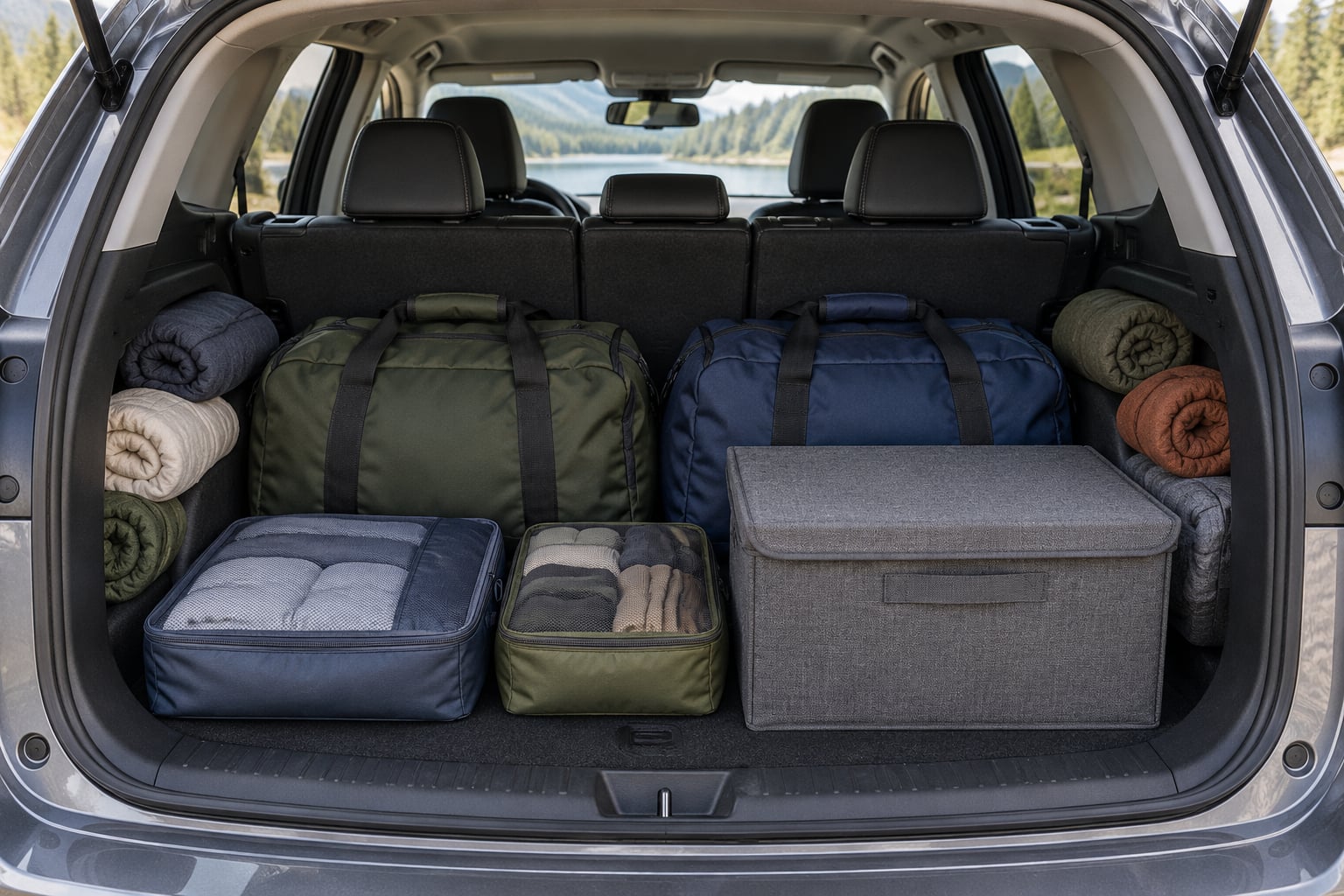
If you want to know how to pack a car trunk efficiently, the whole job comes down to order: heaviest bags low and pushed tight against the seatbacks, soft goods wedged into every gap, and the things you need on the way loaded last. Twenty minutes of sorting on the driveway saves an hour of unpacking at the motel.
Most trunks are not actually too small. They get crammed because nobody decides what goes where first, and soft bags end up underneath hard suitcases where they can never be reached. Fix the plan and the same trunk holds a family of four for a week.
This guide covers sedans, SUVs and wagons, plus the rental-car case where you have never seen the cargo bay before. It was rewritten for 2026 because the advice that matters has not changed since the last time I did it the hard way.
Table of Contents
- What You Need
- Step-by-Step: How to Pack a Car Trunk Efficiently
- 1. Measure the Trunk and Make a Loading Plan
- 2. Sort Bags by Weight, Size, and Frequency of Use
- 3. Load the Heaviest Items First
- 4. Fill Gaps With Soft and Flexible Items
- 5. Use the Side Walls and Vertical Space
- 6. Protect Fragile Items and Create a Top Layer
- 7. Secure the Load and Do a Final Safety Check
- How much can a trunk realistically hold?
- Should heavy items go in the trunk or the back seat?
- Common Mistakes
- Frequently Asked Questions
- How can I effectively organize my car trunk?
- What is the best trunk organizer for an SUV?
- What should I put in my trunk organizer?
- How do you pack a trunk so nothing moves?
- How much weight can you put in a car trunk?
- Is it safe to drive with a trunk full of luggage?
- Conclusion
What You Need
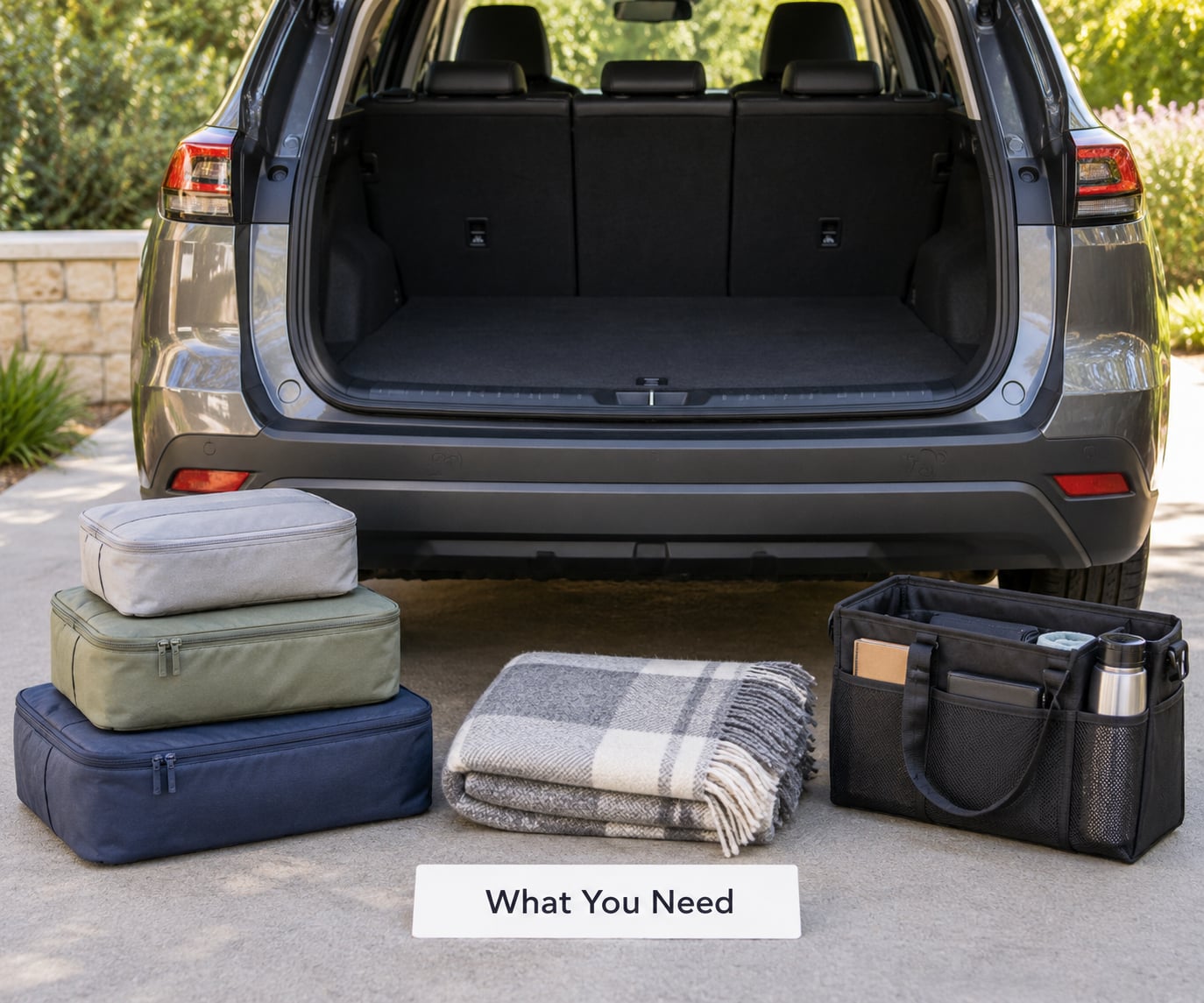
You do not need much. You need soft-sided containers, something to hold things in place, and roughly twenty minutes of decisions before a single bag gets lifted.
- A packing list. Everyone writes their own, then you compare. Duplicates come out fast, and the argument about who is bringing the third jar of salsa ends.
- Soft-sided bags. Duffels, backpacks and packing cubes compress into gaps that hard suitcases simply cannot enter. Across travel forums this is the single most repeated tip, and it is correct.
- A rigid item for the floor. One medium bin or a sturdy crate gives you walls to work against when everything else needs to be wedged around it.
- Two tie-down straps or a cargo net. Ratchet straps for heavy gear, a net for small loose objects. Bungee cords are fine for grabbing a grocery bag in a pinch, not for a highway at 70 mph.
- Padding. A folded blanket or two, plus a dry bag or zip-topped bags for anything wet, sandy or smelly.
- Measurements. Tape measure or a rough note of trunk opening width, height and depth to the seatbacks.
- A decided load order. Write it down. Heavy low and forward, mid-weight boxes upright, soft goods next, top layer last.
One note on containers. Redditers who keep collapsible crates in the car report the same thing: the crate cannot really be overloaded, so it doubles as a speed limit on how much junk comes along. That is a feature.
Step-by-Step: How to Pack a Car Trunk Efficiently
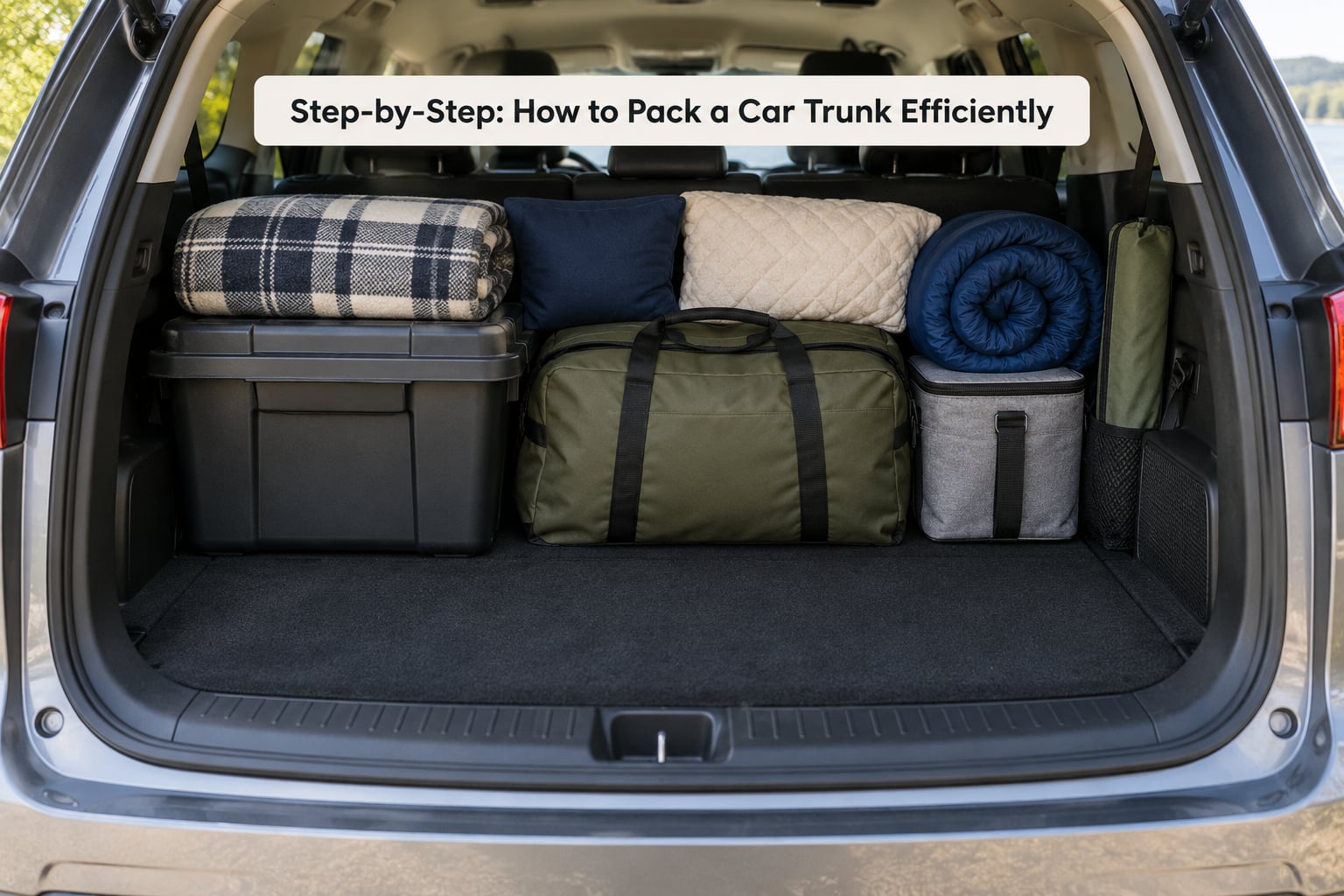
1. Measure the Trunk and Make a Loading Plan
Measure the trunk opening first, not the interior. A bag that fits inside but is wider than the opening is a bag you bring home again. Then measure the floor depth to the seatbacks and note where the wheel wells intrude, because that is wasted volume at the corners.
Now assign each bag a load zone on the sheet. Front-left against the seatback, front-right, upright row along the side wall, top layer last. It takes two minutes and it prevents the reshuffle that normally happens halfway through.
2. Sort Bags by Weight, Size, and Frequency of Use
Make four piles on the ground: heavy and rigid, fragile, frequently used, and last-needed. Water jugs, toolboxes and hard cases go in the first pile. Camera gear and anything breakable goes in the second. Snacks, roadside tools and the first-aid kit go in the third.
Anything in that third pile ends up on top or near the opening. If a bag is buried, it is a bag that will not get used, so it should not be packed.
3. Load the Heaviest Items First
Place dense bags low, tight against the seatbacks, and spread them evenly side to side rather than piling everything on one side. Weight sitting above and behind the rear axle makes the car handle loosely and pushes fuel use up.
Try to put the heaviest item where you can still see and reach it. If your hard case is going in first and cannot be lifted out without emptying the trunk, it is in the wrong spot.
4. Fill Gaps With Soft and Flexible Items
This is where the space actually appears. A duffel left in the corner of a trunk wastes the shape of the corner. Roll clothes, stuff towels, and pack a sleeping bag into the void so the next bag sits flat instead of tilted.
Compression bags help with volume, but they make a bag rigid, so save them for gear that does not need to flex. Rolling clothes saves more space than folding and takes about the same time.
5. Use the Side Walls and Vertical Space
Turn flat bags on edge and stand them along the side walls. A duffel on its side takes a narrow strip of floor and uses the full trunk height, which is usually the most underused surface you have.
Two limits though. Keep the rear sight line through the back window clear enough to see a car behind you changing lanes, and keep the trunk lid from touching the stack, since a lid that presses down on a bag crushes whatever is on top.
6. Protect Fragile Items and Create a Top Layer
Breakables go in the middle of the load surrounded by soft goods, never on the bottom where everything lands on them, and never on top where a hard stop sends them forward. Wrap them in a blanket or drop them into a padded bin and strap it.
The final layer is the access layer: water, snacks, maps, documents, a spare tire, roadside tools and the emergency kit. Keep one bag that closes without anything falling out of it.
7. Secure the Load and Do a Final Safety Check
Pull the tie-downs snug, not crushing. Push hard on the top of the stack with both hands and watch what moves, then push each side. Nothing should slide more than a centimetre.
Close the trunk and confirm it latches with nothing pinched in the seal. Sit in the driver’s seat and check your mirror. Pull out into the driveway, drive a few hundred metres, stop, and look again. Loads settle on the first corner or they do not settle at all.
How much can a trunk realistically hold?
Figures vary a lot by model, but the ballpark helps you plan before you arrive. A midsize sedan trunk usually runs about 15 to 17 cubic feet, a hatchback or small wagon something in the same range, a mid-size SUV around 30 to 40, and a minivan upwards of 50 with the seats folded. Three suitcases in a sedan is realistic. Three suitcases plus a camp kitchen is not, and the answer is a smaller load, not a roof rack.
Should heavy items go in the trunk or the back seat?
In the trunk, low and forward, unless passengers are involved. Once people are riding in the back, the seat becomes a safety consideration, and anything heavy or hard-edged back there becomes a hazard in a collision. If a bag is heavy enough that you would not want it flying forward, it belongs in the trunk.
Common Mistakes
Overfilling. The most common mistake and the one everybody corrects with the same advice: pack less. A car full of stuff you will not touch is heavier, harder to handle and impossible to unload efficiently. Before you load, pull anything out that did not make the final packing list.
Heavy items stacked high. Weight up high and behind the axle changes how the car handles in a corner and in a crosswind. Anything over about 25 pounds belongs low.
Valuables left loose in the trunk. Passports, wallets, medication, camera bodies and small electronics go in a bag you bring into the room with you. For a stop at a trailhead or a border crossing, take them with you; do not leave them visible in a parked car.
Straps that were never tested. A ratchet strap that was never pulled tight is decoration. Load, then pull, then push-test. Bungee cords belong to groceries, not to highway cargo.
Breakables at the bottom or on top. Both ends of the load are wrong. Middle, cushioned, and strapped.
Folding the rear seats without checking the opening. Long items through a folded seat need the trunk lid to actually close. Measure before you assume.
Forgetting wet, dirty and sandy gear. Wet boots and a wet towel will soak everything within a day. Put them in dry bags or a lidded bin, and give dirty laundry its own bag that sits on top.
Treating the roof as free space. Roof loads are the last resort, and they come with real caveats. Roof-rated limits, proper tie-downs, and the knowledge that lift increases with speed and crosswinds. People on road-trip forums raise this pushback constantly, and they are right.
Two habits finish the job well. Run a two-minute reset before every long drive, checking straps, sight line and the top bag. And assign one person the single responsibility of knowing what is in the trunk, because the real enemy of efficient packing is not space, it is forgetting.
Frequently Asked Questions
How can I effectively organize my car trunk?
Group everything by category before you load, then assign each group a load zone. Heavy rigid items go low and forward against the seatbacks, medium items stand upright along the side walls, soft goods fill the leftover gaps, and frequently used items sit in the top layer. Uniform containers with a rim you can pull against beat loose loading, because nothing shifts when the container moves.
What is the best trunk organizer for an SUV?
For most SUVs, two or three medium collapsible bins plus a cargo net work better than one large hard organizer. Bins hold small items and stop them rolling into the corners, while the net catches anything loose between them. Pick bins with solid bases so they stay upright, and leave the third one empty as overflow rather than filling all of them.
What should I put in my trunk organizer?
Small, heavy, frequently used, or breakable items: tool kits, tyre repair gear, jump starter, first-aid supplies, chargers, water, snacks, documents, sunscreen, and a spare shirt. Skip anything bulky that compresses well, and skip anything you will not use on the trip. Keep wet gear and dirty laundry in separate sealed bags so they do not reach everything else.
How do you pack a trunk so nothing moves?
Fill every void. Gaps are what let a load shift, so wedge rolled clothing and towels into the spaces beside heavy bags, then pull tie-down straps snug against the stack. Test it by pushing the top and each side with both hands; nothing should move more than a centimetre. Recheck after the first few kilometres, because loads settle once the car has turned a corner.
How much weight can you put in a car trunk?
The real limit is payload, which covers passengers and cargo together, and it is listed on the driver’s door jamb placard and in the owner’s manual. Most passenger cars sit between 800 and 1,200 pounds including people, while pickups and large SUVs allow considerably more. Exceeding payload hurts braking, steering and suspension, so check the placard rather than guessing from how the car feels.
Is it safe to drive with a trunk full of luggage?
A full trunk is fine if the load is ordered and secured. Keep heavy items low and forward, nothing loose on top, the rear sight line usable, and the trunk lid latching without pressure on the stack. Never carry fuel, propane cylinders, or solvents in the cabin or trunk. Anything above your head or unrestrained can become a projectile in a sudden stop, so treat loose luggage as a safety problem.
Conclusion
Start tonight, not in the morning: pull every bag out, weigh it by hand, and write a load zone next to each one on the list. When you load, go heavy and low first, wedge soft goods into the gaps, push-test the stack, and check the mirror. That sequence alone will get you most of the way to packing a car trunk efficiently.