The cheapest option is whichever costs less on the day you travel: multiply the single-ride fare by the number of rides you actually plan, and compare that total with the day pass price. Put simply, the transit day pass vs single ride question has a one-line answer. Rides needed to break even equals the day pass price divided by the single-ride fare. Round up. That number is your whole decision.
Fares last checked for 2026. Operators raise prices on their own schedule and rules differ city by city, so treat the figures below as worked examples of the arithmetic rather than a live price list. Always confirm on the operator’s own site before you travel.
What trips me up about this question is how much of it is not about money at all. A pass can be the better deal and still be the wrong ticket if it does not cover the bus you needed, or if it expired at midnight while you were still out. Getting the arithmetic right is the easy half.
Table of Contents
- Transit Day Pass vs Single Ride at a Glance
- How to Compare the Two Fare Options
- The break-even formula in three steps
- When a Single Ride Is Cheaper
- When a Transit Day Pass Is Cheaper
- Rolling 24 hours is not the same as a calendar day
- When a longer pass beats daily passes
- What to Check Before Buying
- Which Should You Choose?
- Day pass vs single ride in Los Angeles
- Frequently Asked Questions
- Is a day pass cheaper than single rides?
- How many rides before a day pass pays off?
- What time does a day pass expire – midnight or 24 hours from the first ride?
- Does a day pass cover the bus as well as the train?
- Do I need a pass, or can I just tap my bank card each ride?
- Can one day pass cover my whole family?
- Conclusion
Transit Day Pass vs Single Ride at a Glance
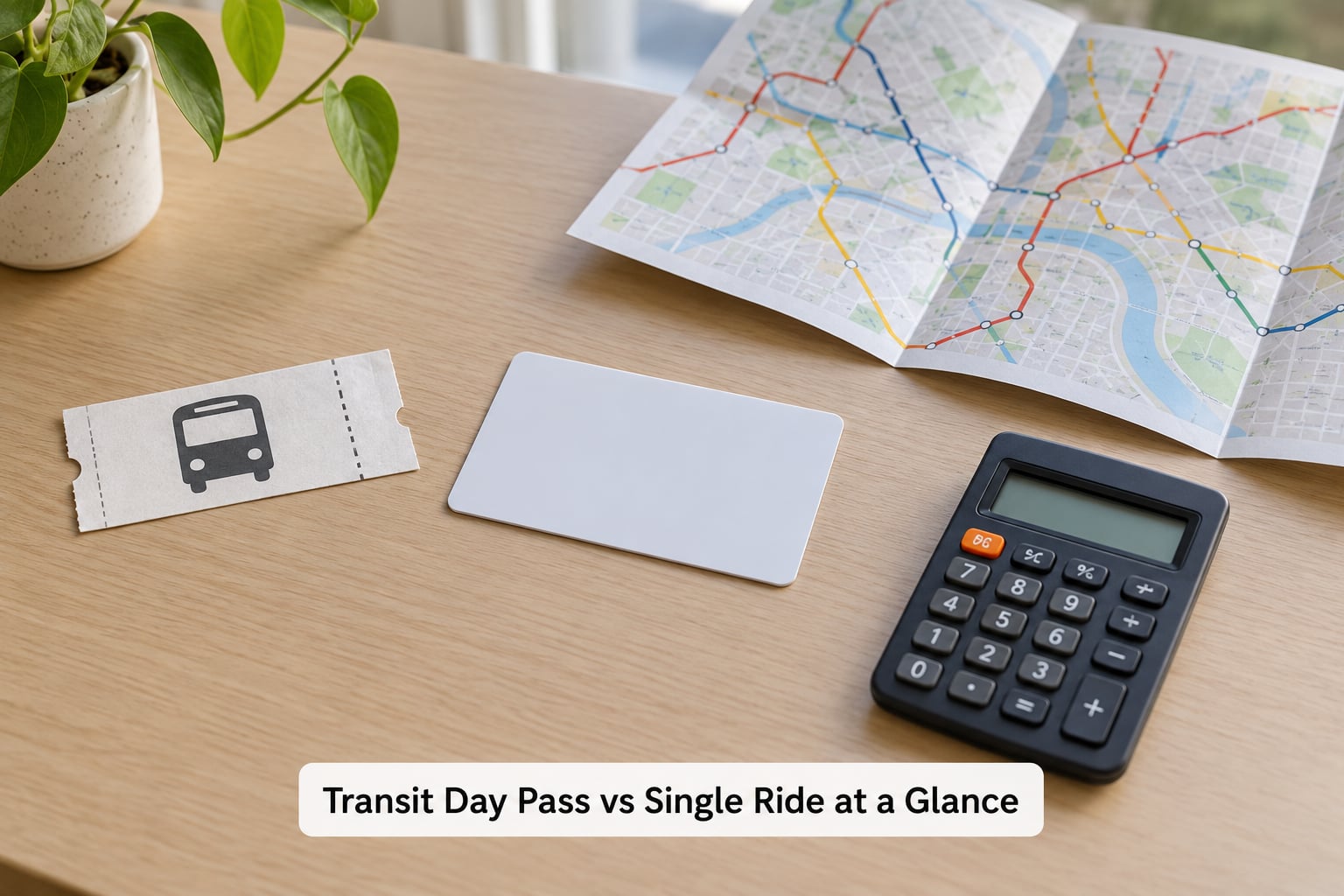
A single-ride fare, sometimes called a single ticket, is one charge for one trip between two points, sometimes with a free transfer window attached. A day pass is one charge that covers unlimited travel on the operator’s network for a fixed window, either a rolling 24 hours from your first tap or a calendar day. Neither is universally cheaper. The break-even formula decides it.
| Criterion | Single ride | Day pass |
|---|---|---|
| What you pay for | Each journey, priced by zone or distance | One price for unlimited rides in a fixed window |
| Best fit | One or two journeys in a day | Three or more journeys on one covered network |
| Risk if you misjudge | None. You never overpay for a ride you did not take | You pay full price for a day you barely rode |
| Free transfers | Often included, usually within a 30 to 90 minute window | Every transfer is free within the validity window |
| Coverage | Rider by rider, so you can mix operators freely | Operator-scoped. A metro pass may not touch the city bus |
| Who it suits | Short stays, one-off transfers, multi-operator days | Sightseeing days, families, anyone tapping a lot |
Here is the formula in practice, using fares documented by operators and transit forums. A day pass priced at 25 euros in Venice against a 2-euro single ride means you need 13 rides before the pass wins, though the tap-to-pay rules discussed below change that number. A day pass at 5 dollars in Los Angeles with an existing tap card against a 1.75 dollar single fare puts the break-even at 3 rides. Guernsey’s Island Wide Travel network, with singles around 1.50 to 2.00 pounds and day passes around 8 to 10 pounds, lands at 4 to 6 rides.
Notice how much those three answers vary. That is exactly why a single universal verdict does not help you. The number that matters is the one you compute for the city you are actually in.
How to Compare the Two Fare Options
You need five inputs before the arithmetic is worth doing. The first is the day pass price for the pass type you would actually buy, not the headline one. The second is the single-ride fare for the zone you are travelling in, since many systems price by zone rather than by trip. The third is your realistic ride count, which is the number most people get wrong by guessing too high.
The fourth input is transfer eligibility. If a single fare already includes two free transfers, two journeys can cost you the price of one. The fifth is the service-area limit: whether the pass covers the specific operator and mode you plan to ride. Once you have those five, the comparison takes about a minute.
The break-even formula in three steps
- Find the day pass price for the network you will use most, and the single-ride fare for the zone you will use most.
- Divide the pass price by the single fare, then round up. That is the number of eligible rides where the pass becomes cheaper.
- Count the rides your itinerary actually contains, then subtract any free transfers that would have cost you nothing anyway.
That third step is where most mistakes happen. Someone plans six rides and buys a pass, then discovers that two of those rides were walkable or that three of them were a single transfer chain. Run the count on rides that genuinely start a new charge, and the break-even number moves.
A useful sanity check: if your break-even is two rides, the pass is almost always worth it for a visitor. If it is ten or more, think harder, because that usually means the city has cheap singles, a strong free-transfer policy or both. A pass priced high against cheap singles is a commuter product more than a tourist product.
When a Single Ride Is Cheaper
Buying per ride wins in four situations, and all of them are common for visitors. First, low-frequency days. If your itinerary contains one or two journeys, no pass can beat paying twice, because the pass price is always more than one fare and usually more than two.
Second, short stays with scattered travel. A visitor who takes one train out to a beach town, rides a bus twice and comes home has four charges, and if those four charges are on different operators, a single-operator pass covers none of them anyway. Third, itineraries with no eligible transfers and no clustering. A pass punishes you for spreading your day thin, because the value is in repeated taps within a short window.
Fourth, cities where cheap singles are the point. A Tripadvisor thread on Nice had a local doing exactly this arithmetic and landing on roughly 1.50 euro per bus trip, with the regional train priced separately at around 4 euro. Stacking four such trips came to under the cost of a day ticket. A user in the same thread pointed out the same thing for the train leg: a short hop is not worth a pass.
There is also a hybrid case worth naming. Buy singles on your two or three lightest days and a pass for the one day you know will be busy. Nobody requires a single ticket strategy, and this is what most experienced travellers end up doing without calling it a strategy.
When a Transit Day Pass Is Cheaper
A pass wins once your eligible ride count clears the break-even number, and it wins harder than the arithmetic suggests because every transfer inside the window becomes free. Systems with tight connections force two rides for one journey. In those networks, a single-ride ticket plus a separate second ticket can cost nearly double the pass, and the pass looks cheaper well before the headline break-even.
That is why the Guernsey guide’s line about the day pass paying for itself after three single journeys became the most-cited rule in the sources I read. It is not universal, but it is a fair shape for a small, moderately priced network with few transfers.
Rolling 24 hours is not the same as a calendar day
This is the single most expensive misunderstanding in transit ticketing, and it belongs in its own section. Many passes run on a rolling 24-hour window starting from your first tap, not from midnight to midnight. A pass bought and tapped at 4pm on Tuesday expires at 4pm on Wednesday, and the hours between midnight and 4pm on Wednesday belong to a new window.
Riders on Reddit’s r/transit have complained about peak-only passes that appeared to break at 4:00am, leaving early-shift workers stranded mid-window. For a visitor, the same rule in reverse means you can carry a single pass across two calendar days without paying twice, which saves real money if your first tap is late and your last ride is the next morning.
The Venice rules make the same point from the other side. Passes there run in 24, 48, 72 and 168-hour tiers counted from the first tap rather than by date, and each rider needs their own card or device. That structure is not unusual, and it is why you should check the activation rule before assuming a pass is dead at midnight.
The more serious money mistake is buying one pass per day on a multi-day trip. A user in a Los Angeles forum worked the numbers for another traveller: four day passes at 7 dollars came to 28, while the 7-day pass was 25. The recommendation flipped from daily to weekly purely because of the arithmetic.
When a longer pass beats daily passes
Three tiers cover most stays: 24-hour, multi-day and weekly. As a rough guide for a visitor taking three to four rides a day, a 3-day pass usually wins over three singles days, a 7-day pass wins over seven, and a 14-day or monthly pass becomes worth checking from around week two when the weekly rate is not steeply higher.
Tap-to-pay changes this section more than any other. In several systems, tapping a bank card automatically generates the day and longer pass tiers for you once your cumulative spend passes each threshold. Users in a Venice discussion confirmed this: the 24, 48, 72 and 168-hour passes all appear on their own once spend reaches the relevant level, and the charges settle the following day. One traveller calculated that seven days of tapping could reach 175 euro where the 7-day pass was 65 euro. If your city behaves this way, the cheapest approach is to tap and let the system cap you.
What to Check Before Buying
Coverage is where the cost maths stops being simple. A day pass is scoped to the operator that sells it, and the trap list below catches most of the surprises. Riders in a Los Angeles forum were warned repeatedly that the Metro pass does not cover DASH municipal buses, which charge a separate small fare, so a day of unlimited rail travel still leaves money on the table if the bus is part of your plan. Similar gaps exist almost everywhere, just under different names.
| Transit mode or rule | Usually covered by a city day pass? | What to watch |
|---|---|---|
| Metro, subway and tram | Yes, in most systems | Peak and off-peak restrictions on some passes |
| City bus run by a different operator | Often no | Municipal buses are the most common exclusion |
| Airport rail or airport express | Frequently no | A separate airport fare or surcharge zone is common |
| Suburban and regional rail | Usually no | Often a separate company with its own fares |
| Ferry or harbour service | Mixed | Venice treats its People Mover as a separate fare |
| Night buses | Depends | Some passes are peak-only and stop early |
| Transfers between modes | Free within the pass | Tap-in and tap-out rules differ per system |
Beyond coverage, six practical details change the result. Check the validity window, whether it is rolling or calendar. Check the transfer window, usually somewhere between 30 and 90 minutes. Check whether you must tap in and tap out, and what happens if you forget to tap off on a bus, since several systems charge the maximum fare on a missed tap-out. Check the activation rule, because some passes do not start until your first tap and others start at purchase. Check whether mobile tickets need to be displayed as a barcode or activated in an app before boarding. And check the concession rules, since children travel free under an age threshold in many cities and seniors get reduced fares only with local ID.
One more: some systems run free or discounted travel days. A few cities hold city-wide fare-free days or monthly free-ride programmes for seniors, and a handful of promotional periods convert free passes into digital-only tokens. A Reddit thread out of Santa Monica described riders being confused when free passes became app-only and a rider simply wanted a single day ticket. Worth searching for before you buy anything.
Which Should You Choose?
The cleanest way to decide is by itinerary type rather than by city. One or two rides: buy singles, no hesitation. Three or four rides with connections: buy the pass, because free transfers push you past break-even faster than the raw count suggests. A single busy sightseeing day: the pass, and buy it at the airport or first station so you are not queuing later. A multi-day stay: compare three daily passes against the weekly price before you arrive, and check whether tap-to-pay already caps your spend for you.
Day pass vs single ride in Los Angeles
Los Angeles is a useful worked example because the exclusion bites. A day pass priced at 5 dollars for riders who already hold a tap card, with roughly 1 dollar extra for the card itself, puts the break-even at three rides. But Metro rail and Metro bus are not the whole network, and DASH municipal buses are charged separately. A day built around rail plus two DASH buses is closer to four paid equivalents, which moves the pass clearly ahead. The same city is a bad example for someone taking a bus to the airport once, where a single fare plus the airport-related costs beats any pass.
For a regional trip, the answer usually resets at every border. Fare systems, passes and tap rules are operator-specific, so a pass bought in one city is worthless in the next. Plan to buy fresh on arrival rather than assuming continuity.
And if you are weighing transit against a taxi for the last leg of the night, run that comparison too. In sprawling cities the transit journey time can exceed driving time, and two rideshare fares can sit under a day pass price. That is a reasonable trade for a single late-night gap, and it is not a failure of the transit maths.
Frequently Asked Questions
Is a day pass cheaper than single rides?
A day pass becomes cheaper once the number of eligible rides in one validity window exceeds the pass price divided by the single-ride fare. Round that up. Free transfers inside the window count as extra value, so a pass often wins a ride or two earlier than the raw division suggests. A pass rarely wins on one or two journeys.
How many rides before a day pass pays off?
It depends entirely on the city. A 5 dollar day pass against a 1.75 dollar single fare breaks even on the third ride. A 25 euro pass against a 2 euro single fare needs thirteen. The 8 to 10 pound Guernsey day pass against 1.50 to 2.00 pound singles needs four to six. Compute it for your own city rather than trusting a general rule.
What time does a day pass expire – midnight or 24 hours from the first ride?
In many systems a day pass runs on a rolling 24-hour window that starts at your first tap, not at midnight. Tap at 4pm on Tuesday and it expires at 4pm on Wednesday. Other cities do use calendar days. Check the operator’s terms before you buy, because buying one pass per calendar day on a rolling system is one of the most common and costliest ticketing mistakes.
Does a day pass cover the bus as well as the train?
Only if the bus is run by the same operator. City day passes are operator-scoped, and a metro or subway pass often does not cover the municipal bus of the same city. Riders in a Los Angeles forum were warned that the Metro pass excludes DASH municipal buses, which charge separately. Always check the operator list on the pass before planning a day around buses.
Do I need a pass, or can I just tap my bank card each ride?
In many systems you can skip the pass entirely. Open-loop contactless lets you tap a bank card or phone, and the system caps your daily and multi-day spend, generating day and longer passes automatically once you cross each threshold. Charges usually settle the day after travel. Tap-to-pay is not universal, so confirm the city supports capping before relying on it.
Can one day pass cover my whole family?
Usually not. Most systems require a separate card or device per rider, which is why each person on a Venice pass needs their own. Some newer open-loop systems let one device cover a small group if everyone taps within about a minute of each other at the same validator. Families should also check the free-travel age threshold, since children under a certain age often ride free and change the arithmetic substantially.
Conclusion
Multiply your single-ride fare by the number of rides you will genuinely start, then compare that total with the day pass price. Above that number, the pass is cheaper, and free transfers push the crossover earlier than the raw count suggests. Before you buy, confirm three things: whether the pass is rolling 24 hours or a calendar day, which operators it covers, and whether your city already caps contactless spend for you.
Start with the operator’s fare page for the city you are landing in, do the division, and write the break-even number on your phone. Every fare question after that one takes about a minute.