Yes, seven days fits in a carry-on, as long as every item earns its space. Knowing how to pack a carry on bag for a week comes down to three things: a capsule wardrobe where each piece works with at least three others, no more than two or three pairs of shoes, and a space-saving folding method instead of loose stacking. Most travelers who get this wrong are not short on technique, they just packed for a fortnight by accident.
Here is the process I would hand a friend leaving on Sunday, in the order that saves the most argument at 6am.
Table of Contents
- What You Need
- How to Pack a Carry On Bag for a Week: Step-by-Step
- Step 1: Check Your Airline’s Carry-On Rules
- Step 2: Build a Seven-Day Capsule Wardrobe
- Step 3: Build a 7-Day Carry On Packing List
- Step 4: Choose Space-Saving Packing Methods
- Step 5: Pack Shoes, Toiletries, and Electronics Carefully
- Step 6: Organize the Bag and Do the Final Check
- Common Mistakes
- Frequently Asked Questions
- Can I fit one week of clothes in a carry-on bag?
- What is the best way to pack clothes in a carry-on?
- How many pairs of shoes should I bring for a week?
- Can I do laundry during a one-week trip?
- What toiletries can I pack in my carry-on?
- How do I stop my carry-on bag from being overweight?
- Conclusion
What You Need
Before any clothes go in, four things need checking: the bag itself, the airline’s current rules, the forecast where you are going, and the dress codes you are walking into.
- The bag. An underseat personal item that fits under the seat in front of you, plus a cabin bag that stays inside your airline’s size limit. Most US carriers allow around 22 x 14 x 9 inches. If your bag is a soft shell, it can bulge past those numbers when full, so measure it packed, not empty.
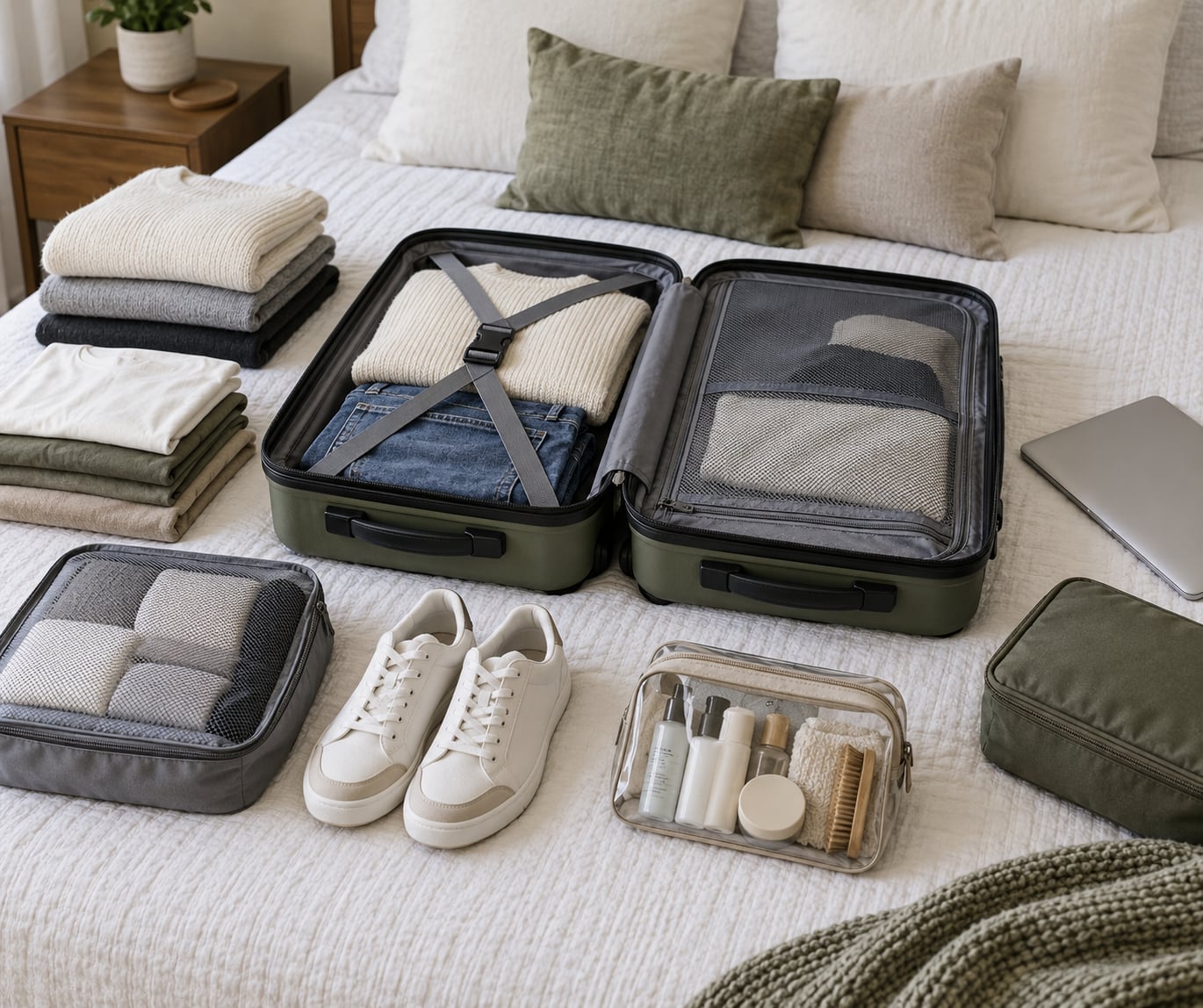
- Organizers. Three to five packing cubes, one shoe bag, one quart-size clear resealable bag for liquids, and a small waterproof pouch for wet swimwear or a damp jacket. Cube sets with a compression zipper do more for a full case than any folding trick.
- Toiletries. Anything liquid, creamy, gel-like, or in an aerosol has to live in that quart bag in containers of 3.4 ounces or less. Solids are unrestricted, so bars and sticks go in the main bag.
- Medicines and valuables. Keep prescriptions in their original labeled packaging in your personal item, not in a checked or stowed bag. Same for your passport, cards, and the phone charger you will want before your shoes.
- A plan for the return. A full outbound bag has no room left for a dirty t-shirt or a small souvenir. Decide now where that stuff goes.
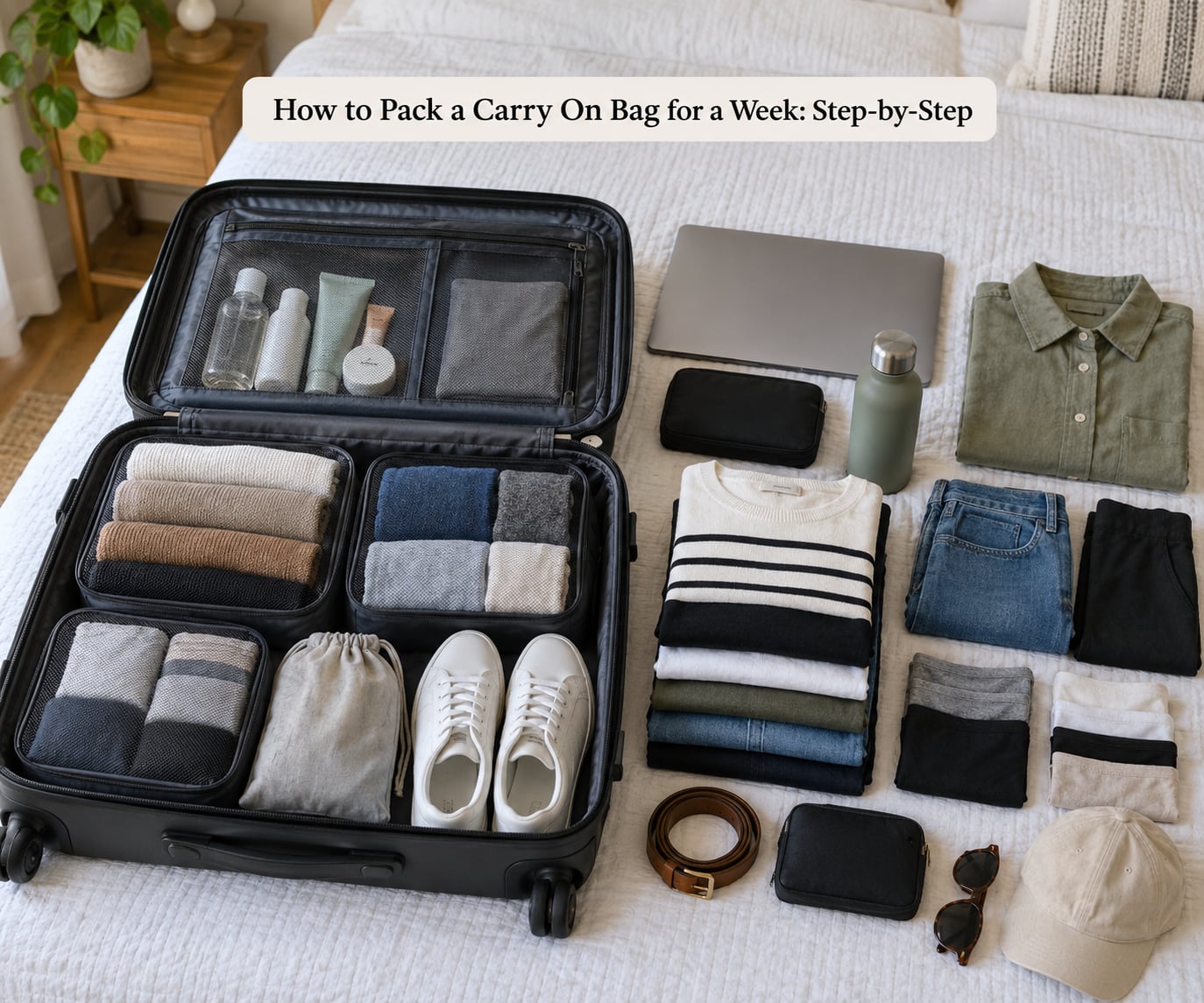
The 7-day list most travelers land on looks like this. Quantities assume no laundry, which is the harder version of the problem.
| Category | Quantity | Space note |
|---|---|---|
| Tops | 5 | Two short-sleeve, one long-sleeve, one layer, one dress or overshirt |
| Bottoms | 3 to 4 | Two pairs of trousers or jeans, one skirt or shorts, one spare |
| Shoes | 2, 3 at most | Wear the heaviest pair in transit, pack the rest in shoe bags |
| Underwear and socks | 7 sets plus one spare | The spare set is the one you will actually need |
| Sleepwear | 1 set | Thin, worn under a cardigan if it is cold |
| Layers | 1 to 2 | Wear the bulkiest one on the plane |
| Liquids | Quart bag | 3.4 oz bottles maximum, buy the rest on arrival |
| Electronics | Laptop, chargers, one power bank | Power banks stay in the cabin, never in a checked bag |
How to Pack a Carry On Bag for a Week: Step-by-Step
Step 1: Check Your Airline’s Carry-On Rules
Find your airline’s current size and weight page before you open the closet, not after. Most US carriers run a cabin allowance near 22 x 14 x 9 inches and about 22 pounds, while budget carriers such as Air Asia cap cabin weight at 15 pounds, or roughly 7 kg. Measure your bag including wheels and the handle, and weigh it empty once, so you know what the bag itself costs you.
How do you measure a bag that is already soft and full? Pack it, zip it, lay it flat, and measure the three dimensions at the widest points, including wheels and the top handle. If it fails on size, the fix is usually a smaller bag, not lighter contents. You will see more of the bag on your return flight anyway.
Step 2: Build a Seven-Day Capsule Wardrobe
Pick two neutral colors and one accent, then choose pieces that overlap. Five tops, three or four bottoms, and two layering pieces in that palette give you more outfit combinations than seven random tops ever would. You are aiming for outfits that work in sequence, not variety for its own sake.
Adjust the mix to the forecast, which you should check for the actual dates rather than the general season. In a hot climate, trade a long-sleeve for a second tank and add a wrap for air conditioning. In a rainy or cool week, add a shell and a pair of socks you can keep dry. If you are visiting temples or a conservative destination, plan a scarf or overshirt that covers shoulders and knees without adding a whole outfit.
Step 3: Build a 7-Day Carry On Packing List
Write the list and then pack from it, which sounds obvious and is where most trips go wrong. Clothing first, then shoes, then toiletries, then electronics, then the activity gear for whatever you are actually doing. If an item is not on the list, it does not go in, and a paper list is better than one in your head.
Washing buys you room. If you plan one sink wash or one laundromat stop on day four, bring five underwear sets and wash two of them, not seven sets and hope. Nothing on the list is unshockable either, except a microfiber towel that doubles as a gym bag, a beach towel, and a rain cover.
Step 4: Choose Space-Saving Packing Methods
Rolling wins for soft, wrinkle-prone clothing: t-shirts, leggings, underwear, socks, swimwear, and thin scarves. Folding wins for anything with structure or a crease you care about: button-downs, trousers, jackets, dresses, and blazers. A shirt that is rolled hard will look like it came out of a duffel for the rest of the trip.
Two-roller folding is the underrated middle option. Lay the garment flat, fold it loosely into a long strip, roll both ends inward, and the fold lines stay hidden inside the roll, so it resists the wrinkles a hard roll creates. Compression cubes then give back the last bit of volume once everything is packed flat. Leave some slack; an overstuffed case will not close, and forcing it is how seams fail.
Step 5: Pack Shoes, Toiletries, and Electronics Carefully
Shoes are the biggest space thief. Wear the heaviest and bulkiest pair in transit, put the rest inside shoe bags, and fill the shoes with socks or underwear so they keep their shape and stop taking up a hollow box of air. Heeled or structured shoes get wrapped in a sweater or a soft layer so nothing creases them.
For toiletries, the placement plan is simple. Quart bag in the top of the bag or the front pocket, so you can lift it out at security without unpacking anything. Medication stays in your personal item in its original packaging. Chargers, a power bank, and your most fragile electronics go in the personal item, wrapped, and a dry bag protects anything that might still be damp from the shower or the pool.
Step 6: Organize the Bag and Do the Final Check
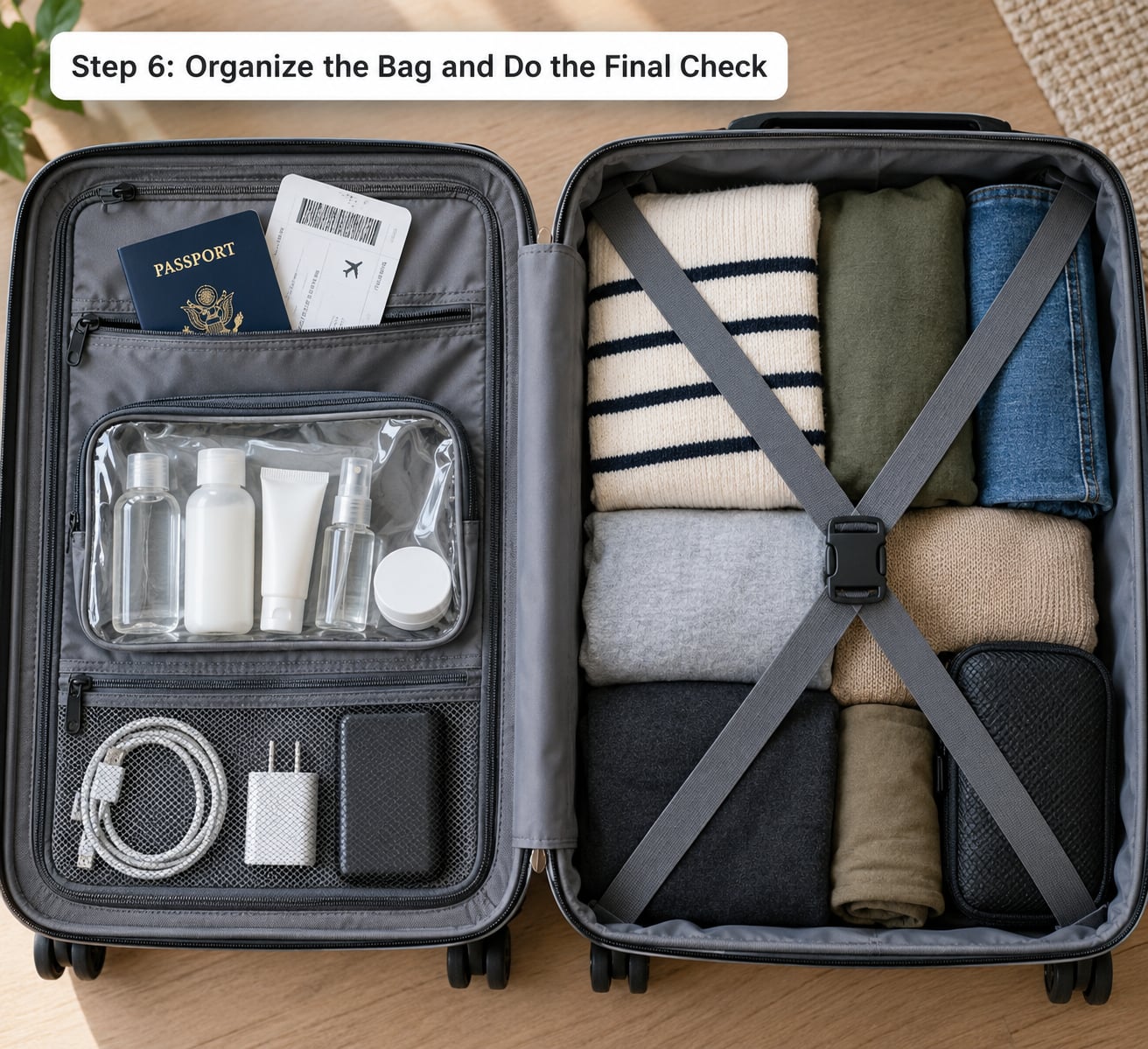
Zippers and pockets exist for airport access. Front pocket: documents, boarding pass, quart bag. Middle: the clothes cube you wear on day one and the one you need tomorrow. Bottom: shoes and heavy items, packed first so the lighter stuff sits on top and nothing gets crushed. Side pocket: the lanyard or pouch you want without opening the case.
Then the final pass. Weigh it, even empty-minded approximations drift. Check that the bag zips without strain, that nothing sits loose, that no liquid is outside the quart bag, that no sharp object is exposed, and that your documents are in the personal item. Then take out the one thing you added without thinking. There is always one.
Common Mistakes
These are the five errors I see most often, each with the fix that resolves it.
- Overpacking shoes. Four pairs of shoes consume the volume of your entire layering plan. Cap it at two, three if a specific activity demands it, and wear the bulkiest pair on the plane.
- Ignoring the weight limit until the gate. Some carriers weigh cabin bags at the gate and check them when there is no space left. Look up your airline’s number, weigh at home, and leave a few pounds of margin for souvenirs.
- Too many liquids. Everything liquid goes in one quart bag at 3.4 ounces or less, and anything beyond that is cheaper to buy after you land. Shampoo, sunscreen, and bug spray are the usual offenders.
- Packing bulky layers. A winter coat, a thick sweater, and a heavy jacket are one coat, one mid-layer, and a shell. Wear the thickest piece in transit and fold the rest.
- Keeping essentials at the bottom. Passport, medication, chargers, and anything needed in the first hour belong in the personal item or a front pocket, not under shoes.
A few habits that make the whole week easier. Pick a single color story so everything coordinates even when you are tired. Do not pack more than one book; travelers regret books more than anything else they carry. Use the personal item as a real second bag rather than a laptop sleeve, since it is the only space you keep with you when the gate agents make you check the case. And plan for a mid-trip wash, because the consensus on travel forums like r/onebag and r/TravelHacks is the same: pack for one week regardless of how long you are gone.
Frequently Asked Questions
Can I fit one week of clothes in a carry-on bag?
Yes, with a plan. Seven days of clothing fits a standard carry-on when every piece works with at least three others, you wear your bulkiest layer and heaviest shoes in transit, and you cap shoes at two or three pairs. Add seven sets of underwear and socks, one spare, one set of sleepwear, and a refillable water bottle, and the volume problem largely disappears.
What is the best way to pack clothes in a carry-on?
Rolling suits soft, wrinkle-prone pieces such as t-shirts, leggings, underwear, socks, and swimwear. Folding suits structured or sharp items: button-downs, trousers, jackets, and dresses, where rolling leaves a crease that lasts. Compression cubes recover the last bit of space once everything is folded or rolled flat, and they stop the bag turning into one solid block you cannot search.
How many pairs of shoes should I bring for a week?
Two is comfortable and three is the hard ceiling. One pair gets worn in transit, usually the heaviest and bulkiest. A second handles dinners and anything smarter than your walking pair. The third covers one specific activity, like sandals for a beach day or boots for rain. Four pairs is where shoes start eating the space your layers need.
Can I do laundry during a one-week trip?
Yes, and for many travelers one mid-trip wash is easier than carrying eight days of clothes. Wash on day three or four in a sink or laundromat, dry overnight, and you have a full load by morning. Two cautions: laundry prices vary widely by country, and a sink wash means bringing a small amount of detergent and a mesh bag for small items.
What toiletries can I pack in my carry-on?
Only liquids, creams, gels, and aerosols, and only in a single clear resealable quart bag with containers at 3.4 ounces or 100 milliliters each. Solids are unrestricted, so shampoo bars, solid deodorant, and stick sunscreen travel in your main bag. Buy full-size toothpaste, sunscreen, and other bulky liquids after you land.
How do I stop my carry-on bag from being overweight?
Weigh it at home, empty, before you leave. Many US carriers cap cabin bags near 22 pounds including the bag itself, and budget carriers go lower, with Air Asia at 15 pounds. A cheap luggage scale is worth it if you fly often. If you are over, the weight you can lose fastest is the second pair of shoes and half your toiletries.
Conclusion
Start with the airline’s size and weight rules, then build a capsule wardrobe in two neutral colors, wear your bulkiest items in transit, pack shoes and heavy items at the bottom, keep documents and the quart bag near the top, and weigh the bag at home. That sequence is the whole method behind how to pack a carry on bag for a week, and it takes one evening rather than a checked bag and a baggage carousel.