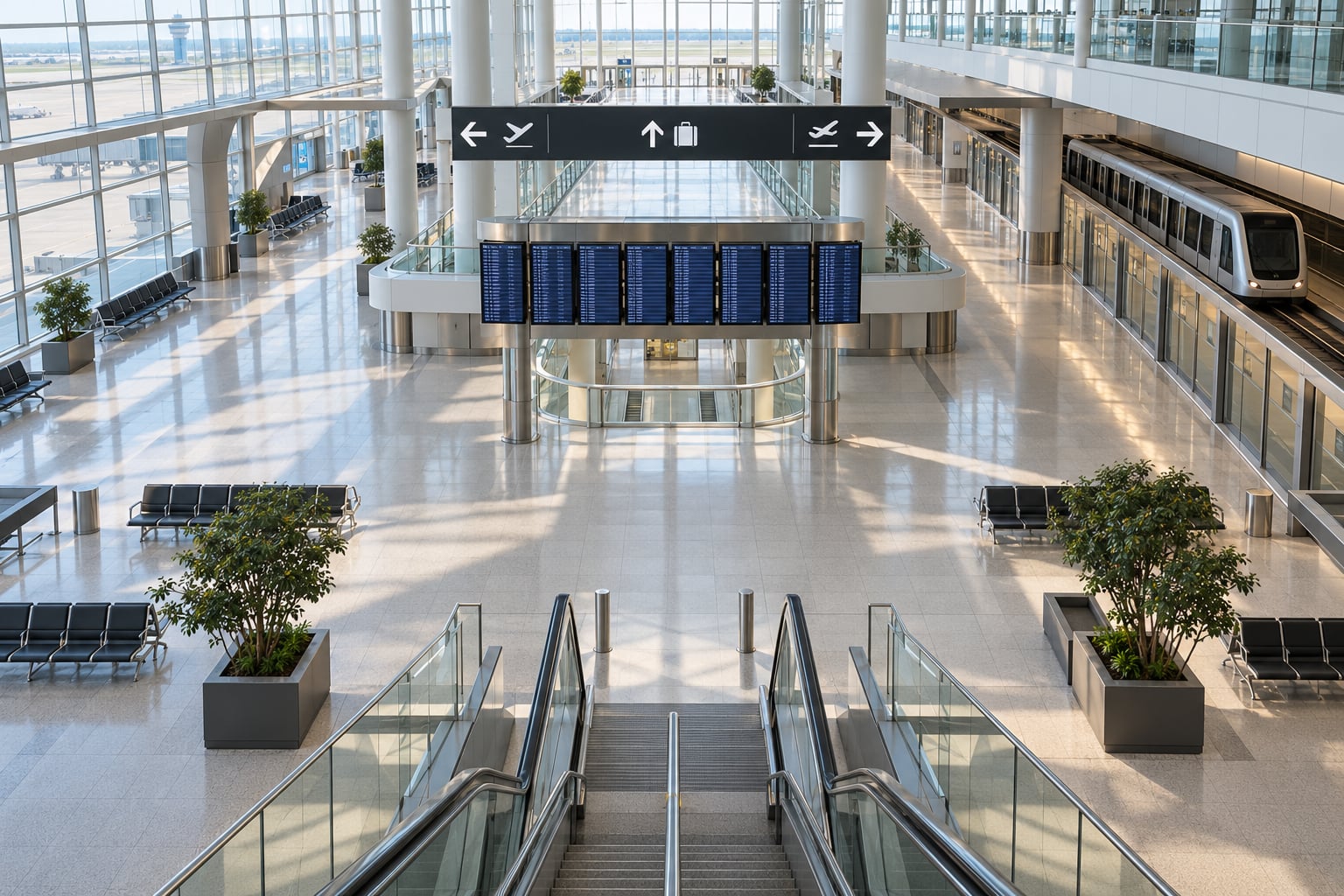
How to find your gate in a huge terminal comes down to one habit: look up your flight number on the airport departure screens or in your airline app, read the gate letter and number, then follow signs for that concourse until the numbers match. Ten minutes of preparation before you leave the hotel turns a huge terminal into a five-minute walk.
The reason it feels overwhelming is that a large terminal holds dozens of gates spread across buildings, walkways and train platforms. Nothing about it is a test, though. The system is consistent, and once you know the vocabulary, you can read any airport in the world.
What trips people up is waiting for information that has not been posted yet, and walking to a gate that moves. Both have straightforward fixes, and both are covered below.
Table of Contents
- What You Need
- Step-by-Step: How to Find Your Gate in a Huge Terminal
- Confirm the Terminal and Check the Flight Status
- Find the Right Departure Screen
- Follow Signs Through Security and the Main Concourse
- Recheck the Gate Because Assignments Can Change
- Common Mistakes
- Ask for Help Early When the Route Is Unclear
- Frequently Asked Questions
- How can I find my gate in the airport?
- What do I do if my gate is not on the board yet?
- What does final call mean at the gate?
- How long does it take to walk from security to a far gate?
- What happens if my gate changes while I am walking?
- What is the 45 minute rule at airports?
- Conclusion
What You Need
Everything you need fits in one hand and one pocket. Gathering these before you reach the terminal is what turns a stressful arrival into a routine one.
- Your boarding pass, on your phone or printed. It carries the flight number, the terminal and often the gate assigned at check-in.
- The airline app for your booking, with notifications switched on for gate and status changes.
- A tracking app such as Flighty or FlightAware, which often shows the gate before the airport screens update.
- The airport map or app for the terminal you are flying from, saved offline before you lose signal.
- A way to ask for help, which is simply knowing where the information desks and airline counters sit relative to security.
- Headphones and a charged phone, since gate announcements are easy to miss in a noisy hall.
Power banks matter more than people expect. Your phone is the map, the ticket and the alert channel all at once, and a flat battery at the wrong moment is a real problem in a building this size.
Step-by-Step: How to Find Your Gate in a Huge Terminal
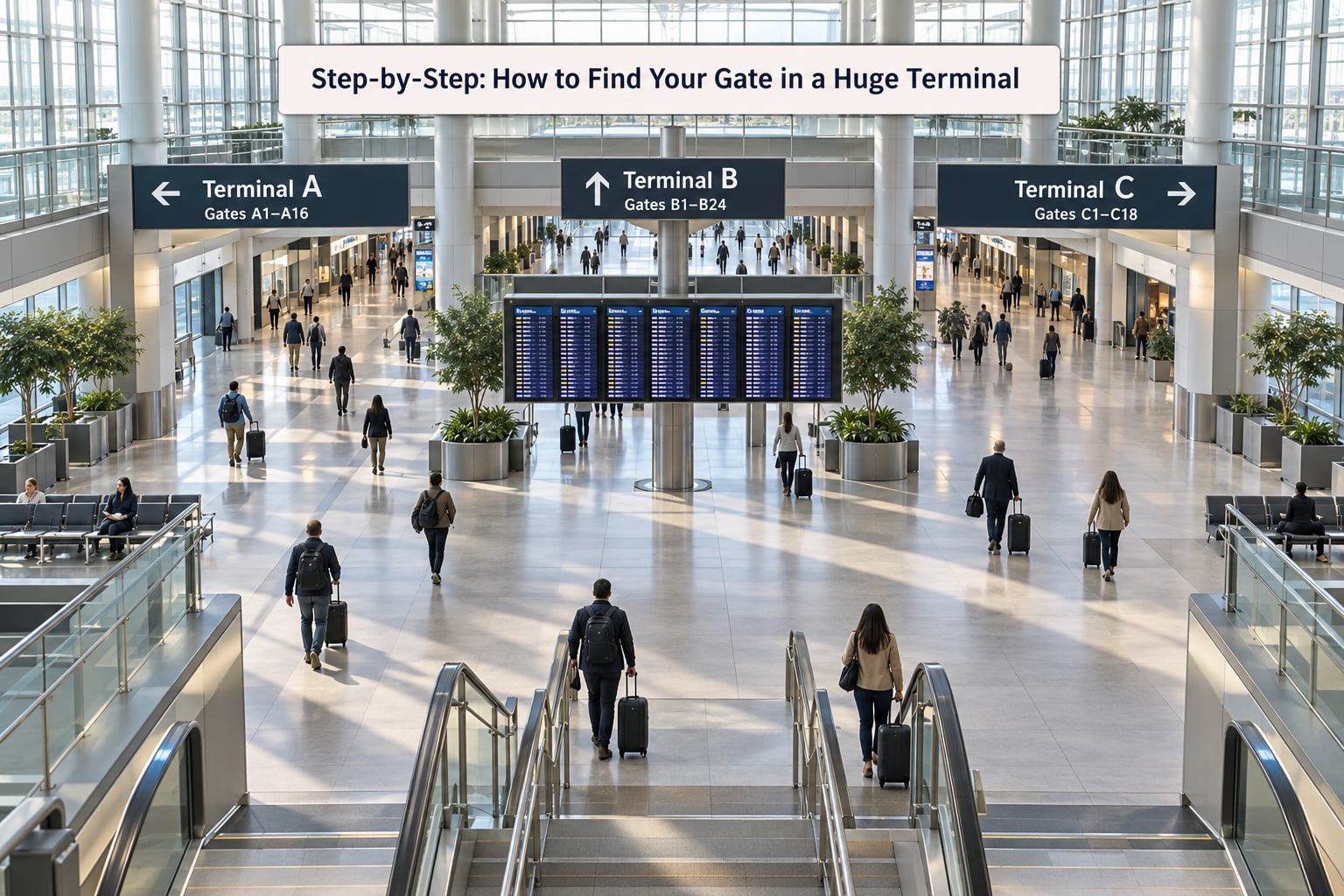
The method is the same at every airport, whether it has two gates or two hundred. Five moves, in this order.
- Confirm the terminal and check the live status of your flight before you leave for the airport.
- Clear security, then find the departure screens for your terminal and locate your row by flight number.
- Read the gate assignment and decode it into a concourse letter and a position in that concourse.
- Follow the signs and any transit train to that concourse, then walk the numbers until they match.
- Recheck the gate in the app and on the nearest screen once you arrive, because assignments change.
Confirm the Terminal and Check the Flight Status
Start before you leave the hotel. Open your booking and confirm the terminal, because terminals are separate buildings and a terminal change is the one mistake that costs real time.
Gate changes and terminal changes are different events. A gate change means a different door along the same concourse. A terminal change means a different building, often a different airport altogether, and it is rare enough to make it worth checking twice.
Check the airline app or your confirmation email for an operational update, and if you fly often from one airport, learn its terminal layout once. Travellers who already know which concourse their airline uses say the walk from security stops being the frightening part.
Find the Right Departure Screen
After security, the first thing you need is the main departure board, and you search it by flight number rather than by destination. Numbers do not change, destinations get spelled a dozen ways, and a flight code takes two seconds to scan for.
In a huge terminal the board is often split into several screens showing different time blocks, and not every screen carries every flight. Walk along the row of displays until you find yours. Airport staff at a wayfinding kiosk can point you to the right screen faster than you can read the header.
Your row gives you five useful fields: flight number, destination, scheduled and estimated departure time, boarding time, and the gate. The status column is the one most people misread, so here is what the common words actually mean.
| Status on the board | What it means | What to do |
|---|---|---|
| On time / Scheduled | Gate may or may not be posted yet | Check the app, then check again in 15 minutes |
| Gate assigned, boarding soon | Boarding has not started yet | Walk to the gate now, unhurried |
| Boarding | Your group is being called | Be at the gate before your group is called |
| Final call | The last group is boarding and the door may close | Move immediately, ask staff for a straight route |
| Gate closing | Doors close before scheduled departure | Go to the airline desk or gate agent, not the gate |
| Delayed / Cancelled | Time or flight has changed | Recheck the app and listen for announcements |
Do not trust a boarding pass printed the night before as your only source. A gate printed 12 hours ahead is a placeholder, and many travellers find the airport screens disagree with it.
Follow Signs Through Security and the Main Concourse
Once you have the gate, the signage does the rest, and the words on the signs have consistent meanings across airports.
| Term | What it actually is |
|---|---|
| Terminal | A separate building with its own security, check-in and gates |
| Concourse | A long hallway inside a terminal that holds most of the gates |
| Pier or satellite | A smaller building or stub attached to the end of a concourse |
| Gate | The door on the airfield where your flight boards |
| Airside | The secure area after security, where the gates are |
Gate numbers also carry a rough map. The letter usually names the concourse, so B32 sits in Concourse B. A higher number usually means further along that concourse, and in most terminals the odd and even numbers fall on opposite sides of the corridor. Travellers on travel forums describe big concourses as one long straight line rather than a maze, which is reassuring if you are picturing a tangle.
So B80 is not a random spot. It means Concourse B, near the far end, which is why people say to arrive early there and treat a walk of 15 to 20 minutes as normal.
Large hubs connect concourses with an automated people mover or a transit train rather than a tunnel. Board the train, stay on until the end of the line, and read the letter on the wall as you approach. Signs usually say gates to one side and the concourse letter to the other, and travellers who read them walking backward miss the connection.
One number matters more than the rest: the gate closing time, which usually lands 20 to 40 minutes before the scheduled departure. Missing that deadline, not the departure time, is what strands people.
| Time | What it means | Suggested buffer |
|---|---|---|
| Boarding time | When the first group starts lining up | Be at the gate 15 to 30 minutes before it |
| Gate closing | When the agent stops checking the boarding pass | Never plan to arrive after this |
| Scheduled departure | When the doors close and pushback starts | Too late to be planning around |
Recheck the Gate Because Assignments Can Change
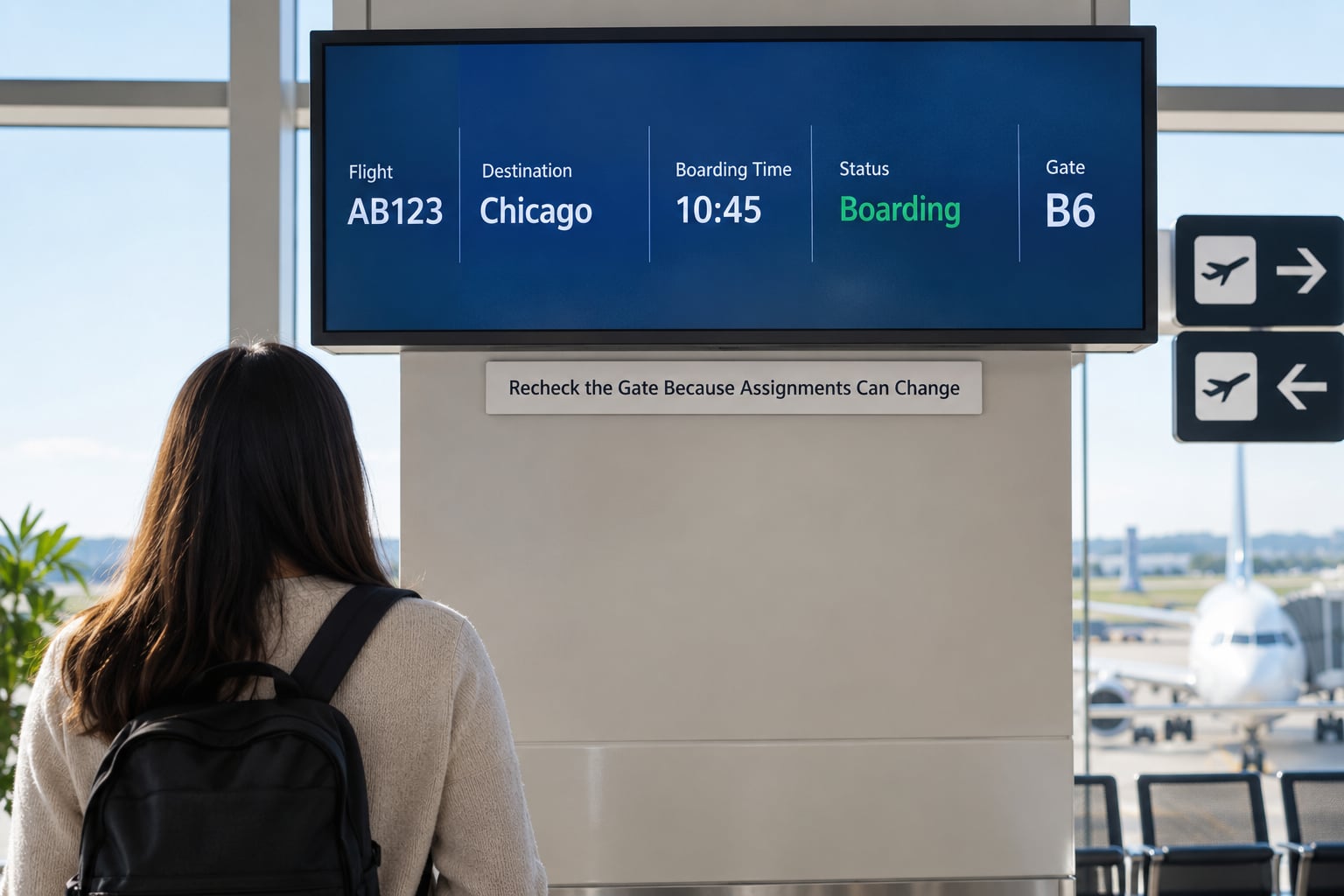
Gates get reassigned all the time, and a gate posted 90 minutes out can still move 20 minutes before boarding. Treat the gate as current information, not a fact, and recheck it every 15 to 20 minutes while you are waiting.
If the gate has not been posted at all, do not stand in front of the board refreshing. Search your flight number in your browser, a flight tracking app or the airline app, which often shows the assignment several minutes before the screens update. That workaround comes up constantly in traveller conversations, and it fills the gap while you wait.
Second option: ask the airline. Gate agents, customer service desks and lounge staff will look up your booking and tell you the current gate, and travellers with long layovers say this is how they learn about a change hours before it goes public. Give them your flight number and destination and they can usually answer in seconds.
If the gate changes while you are walking, the fastest move is to stop and open the airline app rather than keep going. Old directions on overhead signs are not removed instantly, and following a stale sign is how people end up in the wrong concourse with the gate closing behind them.
Plan the walk honestly, because this is where underestimate costs people. These are rough planning figures for large hubs, not guarantees, and construction and crowds stretch them further.
| Airport | Typical trip between distant gate areas | Watch for |
|---|---|---|
| Atlanta | About 10 to 20 minutes using the plane train plus walking | Six concourses, so the letter matters more than the number |
| London Heathrow T5 | About 10 to 15 minutes to a satellite building on foot | Satellite and main concourse are separate buildings |
| Frankfurt | About 15 to 20 minutes between concourses on the train | Long corridors, few places to sit mid-walk |
| Chicago O’Hare | About 10 to 15 minutes between concourses | Check whether your airline changed terminals recently |
| New York JFK | About 15 to 20 minutes including the train between terminals | AirTrain runs on a fixed loop, not between all pairs |
Remote piers have been known to run out of toilets, shops and seating, so use the facilities before you leave the main building. Some travellers also keep a photo of the terminal map on their phone, which makes the return walk obvious if you need a restroom.
Common Mistakes
Almost every bad gate story is one of a handful of predictable errors. They are all avoidable.
Assuming the gate is final. The boarding pass gate is an early guess. The board and the app are the live source, and travellers who watch both rarely get caught out.
Confusing a terminal with a concourse. Concourse B is a hallway inside Terminal 1. Sending someone to Terminal 3 for a B gate is a long detour that signs will happily confirm, which is what makes it confusing.
Missing the gate closing deadline. Doors close well before the departure time on the ticket. Treat gate closing as your real deadline and everything else becomes comfortable.
Following signs for the wrong airline. Wayfinding signs point to gates and airlines together, so a big sign for gates B20 to B40 is not an instruction to walk toward gates B20 to B40. Read the arrow and the letter together.
Waiting at a security area that does not serve your airline. Some large airports split checkpoints by airline and by terminal. Checking the airline app before you join a queue saves a long walk back.
Wandering instead of asking. A terminal that looks identical for three corridors is disorienting to everyone, not just visitors. Staff deal with lost passengers constantly, and being polite gets a fast, direct answer.
Ask for Help Early When the Route Is Unclear
Work up a short ladder rather than wandering. First, look for the nearest screen or a printed terminal map, since both give you the concourse letter. Second, open the airline app and check for a map or gate lookup.
Third, ask the nearest airport information employee, who can confirm the terminal, concourse and route. If the question is about boarding, timing or your booking, ask an airline representative or go straight to a gate agent, who has the authority that an information desk does not.
Have your flight number and destination ready, and say the destination out loud as well, because that is often what staff search first. If you are travelling with mobility needs or a service animal, ask early. Assistance requests are easier to arrange before you are halfway down a concourse, and airports publish their booking notice periods in advance.
And if you are simply nervous, say so. Travellers report that a short conversation with staff does more for calm than any amount of app checking, and nobody in that uniform finds it strange.
Frequently Asked Questions
How can I find my gate in the airport?
Open the departure screens after security, or your airline app, and search your flight number rather than your destination. The row shows your gate as a letter and number, such as B32. Follow signs for Concourse B, then walk until the gate numbers reach 32. Check the board again once you arrive, because gate assignments change.
What do I do if my gate is not on the board yet?
Search your flight number in a flight tracking app or your browser. These often show the assigned gate several minutes before the airport screens update, which fills the gap. If nothing appears, ask an airline representative or gate agent for your booking, and give them your flight number and destination. Gate information is often posted 30 to 60 minutes before departure.
What does final call mean at the gate?
Final call means the last boarding group is being called and the gate agent may close the door shortly after. The flight usually has not departed yet, so there is still time, but only minutes. Move toward the gate immediately, ask staff for the fastest route if you are unsure, and tell them your flight number. Walk quickly rather than run, and keep your boarding pass ready.
How long does it take to walk from security to a far gate?
In a large terminal, a walk from security to a far gate commonly takes 10 to 20 minutes, and a transfer between distant concourses with a train can reach 25 minutes. Add buffer for a full concourse, a family group or a mobility device. If your gate is at the high end of a letter, plan the extra time and leave before the boarding time, not before departure.
What happens if my gate changes while I am walking?
Stop where you are and open the airline app or check the nearest screen. Announcements are often missed in a noisy terminal, and old signs may still point to the previous gate. Follow the new gate number from wherever you stand rather than finishing the old route, since the walk is often shorter than returning to where you started. Staff at any information point can confirm the change.
What is the 45 minute rule at airports?
It is a guideline many frequent flyers use for domestic flights in the United States: aim to be at the gate roughly 45 minutes before departure. International flights, connections and larger airports need more, and the real deadline is the gate closing time printed on your itinerary. Some airports publish their own recommended arrival times, and those are worth following over any general rule.
Conclusion
The fastest way to find your gate in a huge terminal takes five moves: confirm the terminal, clear security, find your flight number on the departure screens, decode the gate letter and number, and walk the concourse while watching for changes.
Start before you leave the hotel by checking the terminal, gate and boarding status in the airline app, then look again once you are through security. If the gate is not posted, search the flight number in a tracking app or ask staff. That is the whole method, and it works in any airport in the world.