
If your trip is a city break, stay car-free: a walkable city puts most meals, sights and stations within a short walk of your hotel, so a rental just adds cost and parking stress. Pick a car-dependent destination instead when the beach, trailhead or canyon is the point, and you accept driving to reach it. This guide compares walkable cities vs car dependent cities for vacations across cost, comfort, access and trip length.
Getting this wrong is expensive in both directions. Rent a car in a dense downtown and you will spend the holiday queuing for parking. Skip the car in a spread-out resort region and you will spend it waiting for a shuttle that comes twice a day.
Below is the head-to-head, with the practical details that decide it: how far you will actually walk, what happens when it rains, whether a stroller works, and how many days of transport spending a car justifies.
Table of Contents
- Walkable Cities vs Car Dependent Cities for Vacations at a Glance
- How Easy Is It to Get Around Without a Car?
- How Do Transport Choices Affect Vacation Costs?
- Which City Is Better for Accessibility and Comfort?
- How Does Car Dependence Change What You Can See?
- Walkable Cities vs Car Dependent Cities: Weather, Luggage and Trip Length
- What Should You Look for When Choosing a Vacation Base?
- Which Should You Choose?
- Frequently Asked Questions
- Is it cheaper to visit a walkable city without a rental car?
- Can a car-free vacation work in a hot or hilly city?
- Should I rent a car in a city with good public transport?
- Is a car necessary for beaches, viewpoints and day trips?
- How much walking is realistic on a vacation each day?
- What is the best compromise for a long city stay?
- The Short Version
Walkable Cities vs Car Dependent Cities for Vacations at a Glance
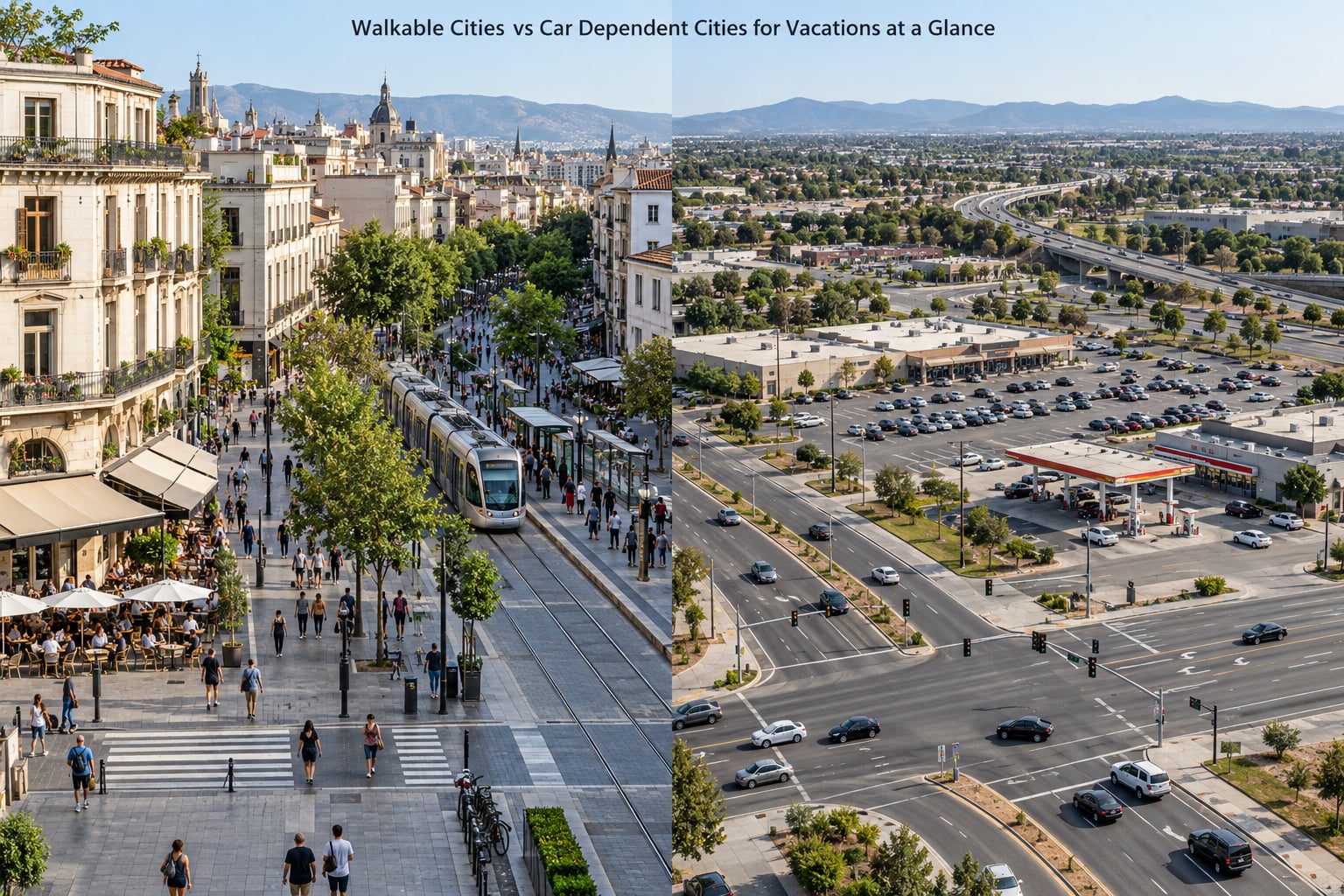
A walkable city rewards staying put; a car-dependent city rewards going further. The table below sets the two styles side by side across the criteria that actually change your day.
| Criterion | Walkable city | Car-dependent city |
|---|---|---|
| Daily transport | Walk, bike, tram, subway, bus | Drive, with fuel, parking and tolls |
| Typical transport cost | Low, mostly a transit pass or single fares | High, once rental, fuel, parking and insurance stack up |
| Accessibility | Pavements and lifts vary; stairs are common | Door-to-door, but depends on the parking spot |
| Flexibility | Easy to wander; harder to reach far-flung sights | Easy to reach anything; harder to improvise on foot |
| Pace | Slower by nature, often 8 to 15 thousand steps | Faster between stops, slower inside them |
| Luggage | Carry it, or use a taxi for the hotel leg | Keep it in the boot, but pay for the space |
| Weather | Rain and heat hit you directly, exposed | Climate-controlled between stops |
| Scenery | Streets, neighbourhoods, markets, waterfront | Parks, beaches, viewpoints, small towns |
| Best for | Short breaks, couples, repeat city visitors | Road trippers, families with mobility needs, long dispersed trips |
How Easy Is It to Get Around Without a Car?
In a genuinely walkable city, the daily errands are walkable, and the longer journeys are covered by frequent transit. That two-part condition is what people miss when they check a walkability score and book a room in the wrong part of town.
Walking works best on a grid. Short blocks mean you can cross a neighbourhood in fifteen minutes rather than twenty-five, and every café on the way counts as a possible stop. Pre-automobile street layouts in European and older American cities tend to give you this for free. A score for the city centre tells you little about whether your hotel sits on that grid, so check the specific neighbourhood.
Cycling fills the middle band, roughly two to eight kilometres, and bikeshare docks or e-scooters make it usable without owning anything. They are less reliable in heat, on hills, or in cities where the protected lane network is patchy rather than continuous.
Public transport is what turns a group of walkable neighbourhoods into one walkable city. Subways, light rail, trams and frequent buses handle the distance between areas that walking cannot. The details that decide whether it works on a holiday: how often the service runs, whether it runs late enough for dinner and theatre, and how far the stop is from your door.
Last-mile gaps are the classic failure. A fast line that deposits you on an arterial road three kilometres from your hotel is not fast. Forum travellers planning trips around Atlanta, Chicago, Nashville and Charlotte hit the same wall repeatedly, and the fix is always the same: pick a room within a short walk of a station, not merely in a city that has stations.
Rideshare is the pressure valve, not a strategy. It fills the late-night and off-route gap, and it is the reason a car-free city is not a car-trap city. Used as a one-off fallback it is sensible; used for every crossing it quietly becomes a more expensive version of a taxi-dependent day.
In a car-dependent city the logic inverts. Distances between points of interest are measured in kilometres, transit is a commuter bus rather than a visitor service, and the only reliable way to hit a beach or a trailhead at a chosen hour is to drive.
How Do Transport Choices Affect Vacation Costs?
Transport is usually the second or third largest line in a holiday budget after lodging and flights, and the two city styles invert it completely. Never book on a single rate; price the whole trip shape, because the rental, fuel, parking, tolls and insurance are one bundled decision.
In a walkable city, the maths is simple. A transit pass or a handful of single fares covers most days, and your walking does the rest. A short break of two or three days frequently costs no transport at all beyond airport transfers, because the airport is on the same line as the sights.
Car costs stack in layers. The rental itself is only the first one. Then there is fuel, the parking garage or the metered space, the toll road, the insurance decision at the counter, and the one-way or extra-driver fees that appear when a second person takes the wheel. Each of those is small on its own, which is exactly why holiday transport budgets drift.
Group size changes the picture. A single traveller or a couple can make a rental work, because the per-person cost is high but the car covers everything. Five people split across two cars often find transit and a couple of taxis cheaper, even in a city that looks drive-first.
Trip length sets the break-even. A weekend in one city favours passes or a rideshare fallback. A week that includes two day trips outside the city centre shifts the balance, especially if those trips have poor transit. Two weeks across a region with an overnight drive in the middle almost always favours a rental.
Parking is the item people forget. A car-dependent resort, a national park gateway town or a downtown with events on can add a daily parking charge to every leg, and those charges accumulate across the whole stay.
Which City Is Better for Accessibility and Comfort?
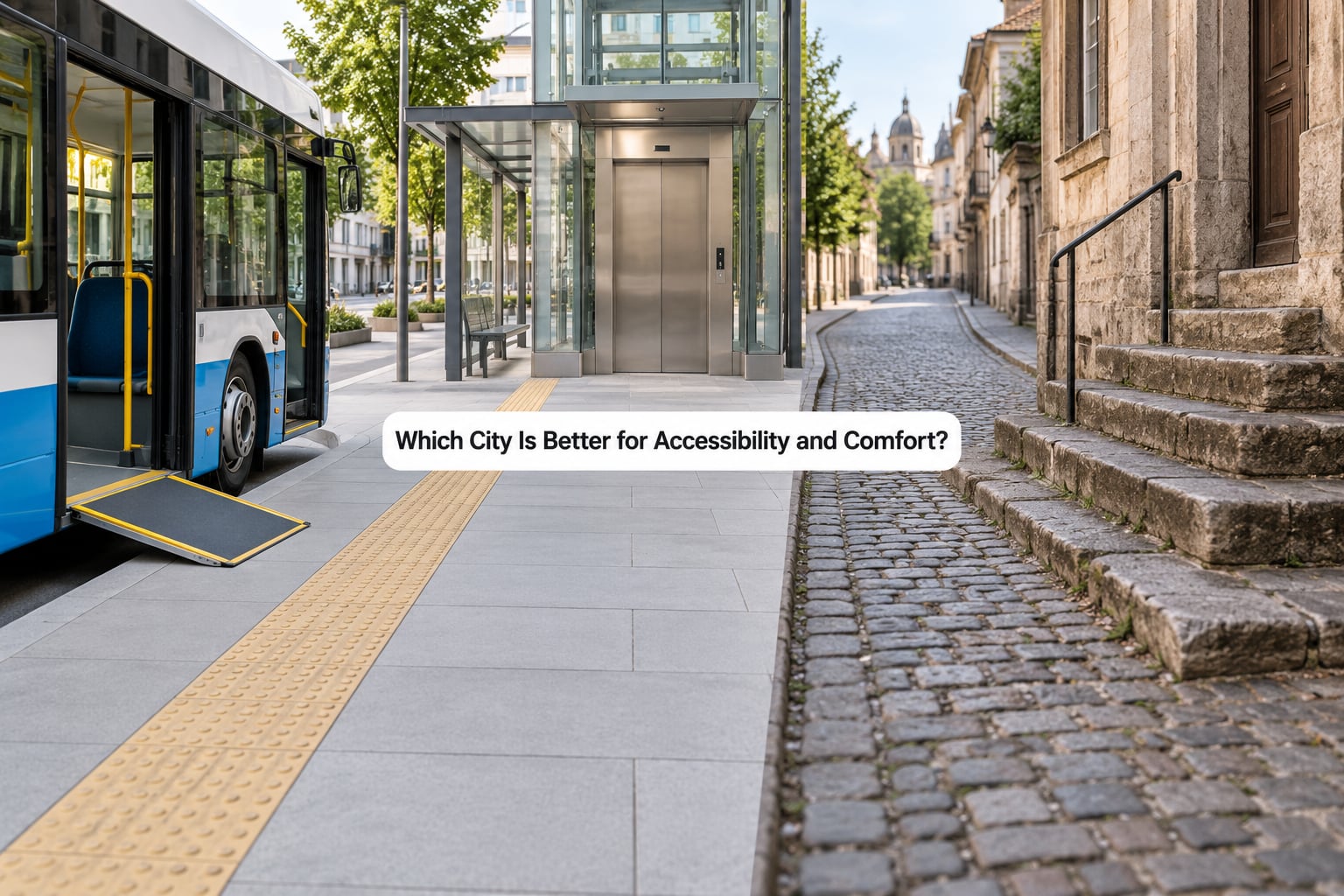
A car is the most accessible transport there is, and it is the only option that reliably removes stairs, hills, heat and luggage weight from the equation. The honest answer is that car-dependent destinations win for comfort, and walkable cities win for the immediacy that makes a city feel alive.
Pavement quality matters more than distance. Forum reports on walking holidays describe surfaces that are greasy, rough or broken, and a rough surface turns a short walk into a tiring one, especially for anyone with balance issues or a stroller. A smooth, continuous pavement route is worth more than a shorter route on bad paving.
Strollers generate the most repeated complaint in traveller forums. Lifts are not at every station, they are not always clearly marked, and the gap between platform and train is a genuine obstacle. Parents travelling with small children also hit the wall of tired legs long before the adults do, so a walkable city means shorter loops and more rides, not longer days on foot.
Older travellers and anyone with limited mobility face the same pattern: a beautiful city with an uneven walking surface, no working lift, and a hill between the hotel and dinner. A car removes all of these constraints at once, which is why a car-dependent holiday is not a lesser holiday for some people. It is a better-matched holiday.
Luggage is the quiet one. In a walkable core you carry bags from the station to the room, on cobbles, up stairs, in heat. In a car city the bags stay in the boot until you arrive. That single difference decides a lot of short trips.
How Does Car Dependence Change What You Can See?
Without a car you see a city from the inside: the street you walk down four times, the market stall you buy fruit from, the neighbourhood that never appears in a list of top ten sights. With a car you see the region: the headland, the trail, the vineyard an hour away that no itinerary would include.
That is the honest trade. Frequent travellers make the same point from both sides, that to feel a city properly you have to get out of the car and walk, and equally that a car is what gets you to the offsite destinations a walkable base cannot reach. A car in a dense city can also slow you down badly, since traffic and parking searches eat the time you thought you saved.
Walkable cities do widen access in one way people underrate: spontaneous evenings. A neighbourhood bar, a late gallery, a market that closes at nine. You cannot do those things reliably from a car parked far away in a spread-out destination.
Walkable Cities vs Car Dependent Cities: Weather, Luggage and Trip Length
Hot, rainy, hilly and wintry destinations tilt the decision more than any other factor, because walking puts your body in the weather with no shelter and no seat.
Heat and hills are the hard pairing. A car-free day in a hot city works if you plan two outdoor blocks and a midday indoor break, and it fails if you try a full sightseeing day at the wrong hour. Hilly cities add the same problem in a different season. Traveller forums describe a casual stroll that becomes a hike, and winter conditions that turn a routine walk into a risk rather than an inconvenience.
Rain changes the calculation too. In a walkable city, a downpour can flatten a walking day completely if you have no waterproof layers and no indoor alternatives close by. In a car-dependent destination, rain is genuinely just weather.
Luggage and children push the same way toward a car for the first and last legs, and a good compromise is to use a taxi or rideshare for the hotel transfer and walk only for the days out.
Trip length is the simplest rule of thumb. Short city breaks reward a car-free base, because everything you want is close and you gain the freedom to wander. Long stays reward a mix, typically walking plus occasional transit plus a car for the days that need it. Road trips through dispersed scenery are the case where a car is not optional.
What Should You Look for When Choosing a Vacation Base?
Check these eight things before you pay for a room, because most disappointing car-free trips are booking mistakes rather than bad cities.
- Where the accommodation actually sits. Look at the street, not the city average. A room fifteen minutes from the nearest frequent line will shape every day of the stay.
- What is within a fifteen-minute walk. Map the coffee, the grocery, a meal you would actually want, and a park. If those exist, the car-free version of the trip works.
- Transit frequency and service hours. A line every fifteen minutes is usable. A line every forty-five minutes is a day trip, not a way to move.
- Your honest walking tolerance. Decide whether a full day of eight to fifteen thousand steps is a holiday you want. People who enjoy city days on foot enjoy this; others find it a grind by day three.
- Parking and rental logistics in the other direction. If you are considering a car, check whether the hotel has a space and whether the local area charges for street parking.
- Road conditions if you plan to drive further. Seasonal passes, tolls, mountain roads and border rules change the budget and the timing, and none of them are obvious from the map.
- Your planned excursions. List the day trips by name and check each one for transit. Two good destinations reachable by rail is a car-free week; a beach 40 kilometres away is not.
- A fallback. Confirm you can get a rideshare or taxi at the hour you expect to want one, especially if you plan an evening out.
Two free tools do most of this work. A walkability score per neighbourhood, not per city, narrows the search, and a satellite view of the streets around your shortlisted hotel tells you quickly whether you have a grid, a car park, or a six-lane road between you and dinner.
Which Should You Choose?
Match the city style to the trip, and the choice is usually obvious. Here is how the decision breaks down by traveller.
- First-time visitors to a big city. Choose walkable. The sights are concentrated, and walking is how you understand the layout instead of memorising it from a car window.
- Couples on a short break. Choose walkable, especially for two to four days. Less luggage, no parking, and the walk to dinner is part of the evening.
- Families with babies or small children. Choose a car if you want beaches, big hotels with pools, or anything outside the core. A walkable city works if you keep days short and use a stroller-friendly route.
- Travellers with limited mobility. Choose a car, or a walkable city with genuinely accessible routes and working lifts. Do not decide this from a city-level score.
- Budget travellers. Choose walkable for the base, then rent a car for one or two days if a distant excursion matters to you. That hybrid is usually the cheapest sensible pattern.
- Road trippers. Choose car-dependent. A week of dispersed scenery, national parks or small towns is not a city holiday with worse transport, it is a different holiday.
- Remote scenery seekers. Choose car-dependent, and build the trip around the drive rather than treating it as a commute between towns.
- Travellers who want to feel a neighbourhood. Choose walkable. Immersion is a side effect of not having a car in front of you.
Frequently Asked Questions
Is it cheaper to visit a walkable city without a rental car?
Usually, yes, especially for trips of two to seven days. In a compact city your transport cost is usually a transit pass plus a few single fares, while a rental adds fuel, parking, tolls and insurance on top of the base rate. The saving shrinks on very long trips, on large group bookings, and whenever your hotel charges for parking.
Can a car-free vacation work in a hot or hilly city?
It can, but it needs a different rhythm. Plan two outdoor walking blocks and a midday break indoors, carry more water than you think you need, and keep routes flat. In hilly cities, choose a base that limits the climbs and check lifts at the stations you need. Skipping midday walking is a plan, not a failure.
Should I rent a car in a city with good public transport?
Only for specific reasons: a distant day trip with no service, a large group with heavy luggage, a mobility need, or a stay of two weeks or more. A good transit network is a reason to skip the car, because the rental then costs you money while you sit in traffic. Many travellers rent for one day rather than the whole week.
Is a car necessary for beaches, viewpoints and day trips?
For an ocean beach 40 kilometres away, a rural trailhead, or a viewpoint across a national park, it usually is. For a city viewpoint, a riverside walk or a museum district, transit normally is. List your planned day trips by name before booking and check each for a service that runs at the hour you want to leave.
How much walking is realistic on a vacation each day?
Comfortable city days run somewhere between 8,000 and 15,000 steps, and many travellers settle at 10,000 or less after a few days. Traveller forums repeatedly describe a child’s legs giving out long before an adult’s. Budget for one shorter day and one indoor rest stop so the week does not turn into a marathon.
What is the best compromise for a long city stay?
A car-free base with a car for selected days. Walk or use transit for the days inside the city, then rent for one or two longer excursions to the coast, hills or surrounding towns. Book the rental for the specific dates rather than the whole stay, and return the car before the final city days to keep those days traffic-free.
The Short Version
Before you book anything, open a map and check what sits within a fifteen-minute walk of the actual room you are booking. That single check resolves most of the walkable cities vs car dependent cities for vacations question, and it costs you five minutes. If the neighbourhood scores well and your day trips have transit, leave the car at home. If the sights are kilometres apart, a car is not a luxury on that trip, it is the transport.