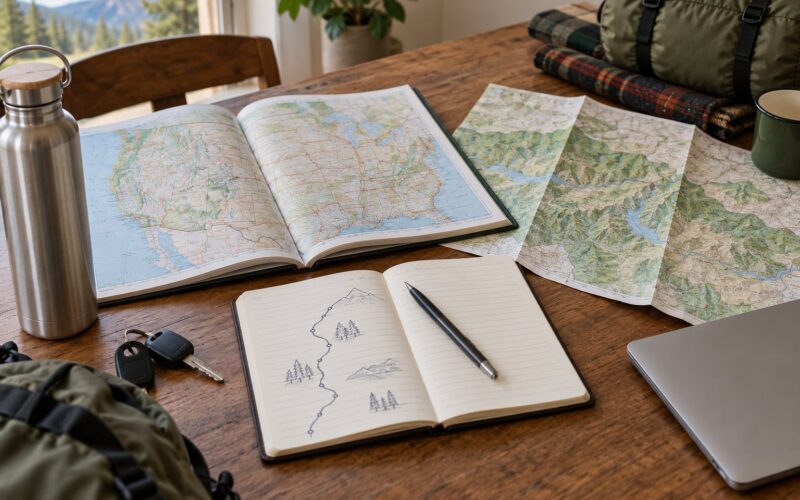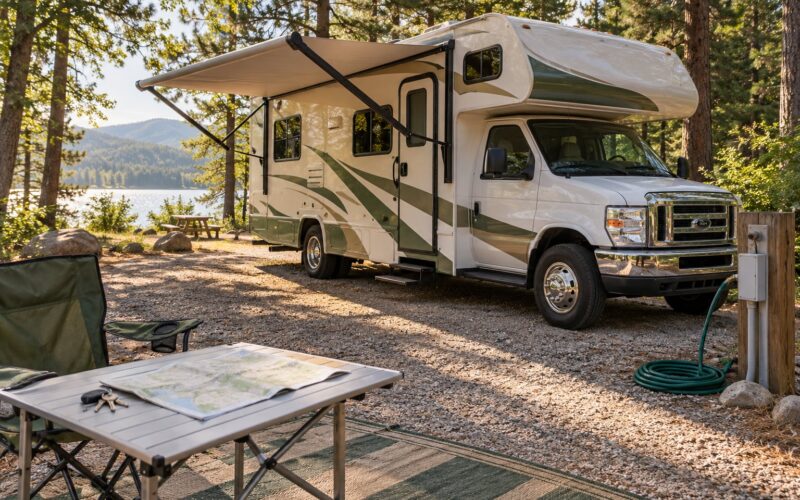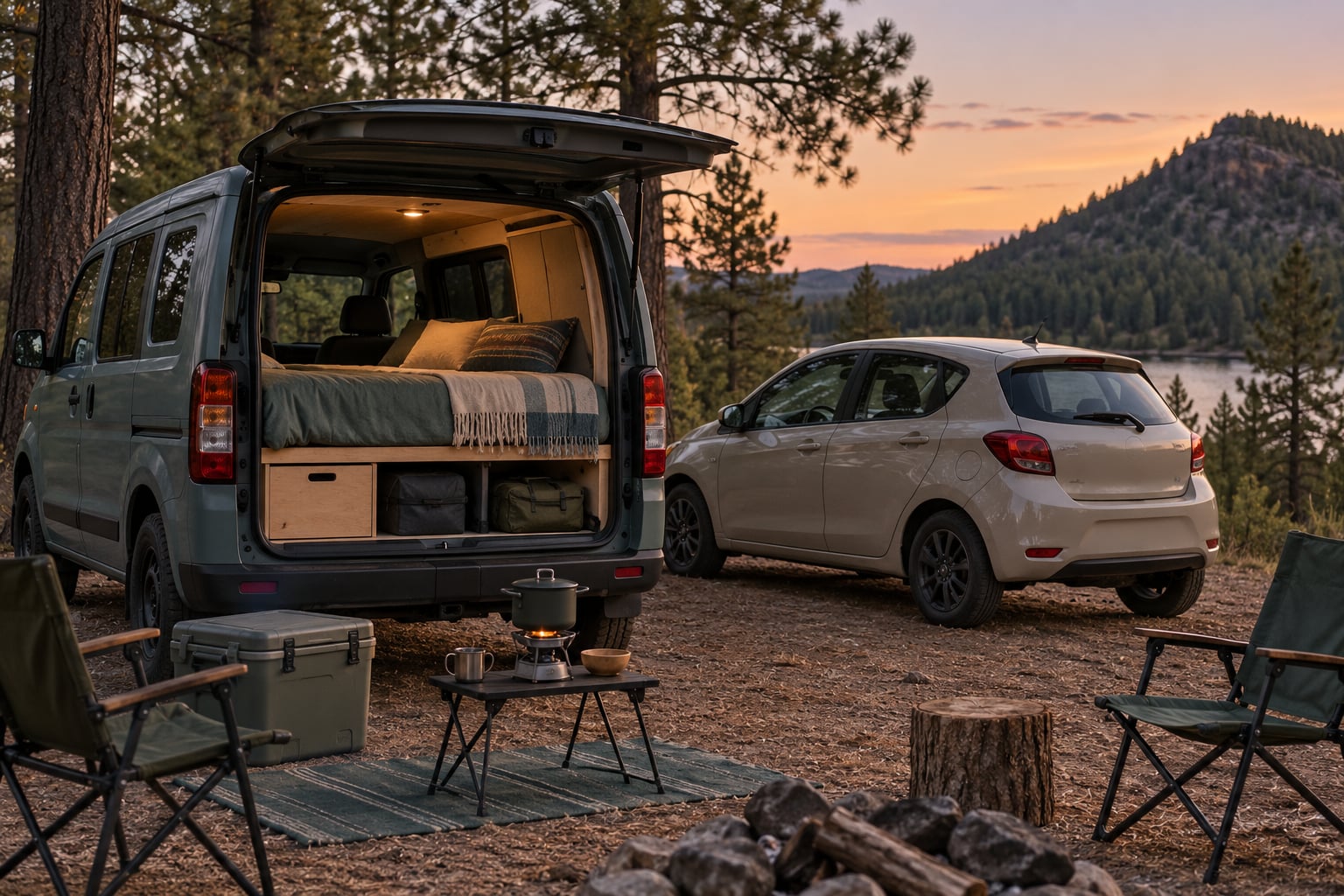
The short answer on rv vs car camping for a first trip: most people should car camp. You sleep in the vehicle you already own, drive the roads you already know, and spend your budget on a few pieces of gear instead of a rental. An RV makes more sense when you are traveling with small children, when the trip runs a week or more, or when you already know you want to camp repeatedly.
That is the short version, but the decision turns on four things nobody mentions early: how much comfort you genuinely need, how far you plan to wander from one campsite, whether the sites you want will even take a vehicle that size, and how much effort you want to spend before the fun starts. Get those four right and the answer basically picks itself.
So here is the branch-by-branch version:
- Choose car camping if this is a one- or two-night trial, you are within driving distance of a real campground, you want to keep spending low, and you would rather spend your trip walking than managing hookups and holding tanks.
- Choose an RV if kids are coming along, the trip is a week or longer, the weather is unreliable, you want a bathroom and a real bed, or you already know you will be camping again this year and next.
- Choose neither yet if you are traveling solo in winter, you want to see a lot of miles between campsites, or you have never slept anywhere other than a bed with sheets. Do a single overnighter close to home first, or rent a small campervan for one night, before committing to a two-week rig.
A note on vocabulary, because it trips people up. Car camping here means sleeping inside a normal vehicle with a sleeping platform built in the back, sometimes with a rooftop tent for extra room. It does not mean pitching a tent next to the car, which is a different activity with different costs. And RV camping means travelling and sleeping in a purpose-built motorhome or travel trailer, not sleeping in an SUV.
We looked at how campers describe both experiences on forums, what the long-form comparison guides actually cover, and where the real costs hide. The differences below are the ones that change the decision.
Table of Contents
- RV vs Car Camping at a Glance
- Comfort, Space, and Sleep Quality
- When RV vs car camping comfort actually matters on a first trip
- What sleeping in a car is really like
- What sleeping in an RV is really like
- Flexibility, Driving, and Campsite Access
- Vehicle size and the roads you can actually take
- What the fuel gap costs you over a trip
- Campsite access and the rules that bite
- Which option wins if you want to change plans mid-trip
- Cost, Reservations, and Equipment
- What a car camping first trip costs
- What an RV trip costs, and where the surprises sit
- Compare total trip cost, not nightly rates
- The campervan middle tier
- Setup, Weather, and First-Trip Difficulty
- Arriving at an RV site
- Arriving as a car camper
- The safety points nobody puts in the brochure
- A first-trip checklist you can actually run
- When not to make a first trip
- Which Should You Choose?
- Choosing by traveler type
- Frequently Asked Questions
- Can you actually sleep in your car overnight?
- Do I need a tent if I am car camping?
- Is car camping cheaper than RV camping?
- How hard is it to drive a large RV for the first time?
- Is it legal to sleep in your car at a campground?
- Do RVs depreciate as fast as cars?
- Conclusion
RV vs Car Camping at a Glance
| Factor | RV camping | Car camping |
|---|---|---|
| Shelter | Built-in walls, roof and climate control | Vehicle body; you are exposed to condensation and drafts |
| Sleeping | Full-size mattress, often with a slide-out | Folded rear seats or a custom platform, usually shorter than a bed |
| Privacy | Windows can be curtained; often a separate bedroom area | Window covers and a sleeping bag for the head area |
| Storage | Interior cabinets, exterior compartments, dedicated garage space | What fits in the footwells, cubbies and roof box |
| Cooking | Full kitchen: stove, sink, refrigerator, freezer | Camp stove on a tailgate or folding table plus a cooler |
| Bathroom | Toilet and shower on board | Campground bathhouse or rest stop |
| Driving | Longer stopping distances, wide turns, height clearance to think about | Drive exactly as you drive every day |
| Parking | Extra room needed; harder in towns and at trailheads | Any standard parking space works |
| Campsite choice | Needs sites that accept the rig length and weight | Fits drive-up sites, dispersed spots and many farms |
| Setup at arrival | Back in, level the rig, hook up water and power, deploy slides or awning | Park, level by moving the car slightly, close the covers |
| Weather | Insulated and heated or cooled | Temperature swings and overnight condensation |
| Cost shape | Rental or purchase, plus fuel at lower economy, campsite fees, hookups, storage | A one-time gear kit, fuel at normal economy, campsite fees |
| Best fit | Families, longer trips, four-season travel, repeat campers | First trips, short weekends, solo travel, budget-conscious trips |
Read the bottom two rows first. Cost shape matters more than any single number, because an RV turns one purchase decision into a chain of ongoing ones, while car camping turns it into a kit you buy once and reuse for years.
Comfort, Space, and Sleep Quality
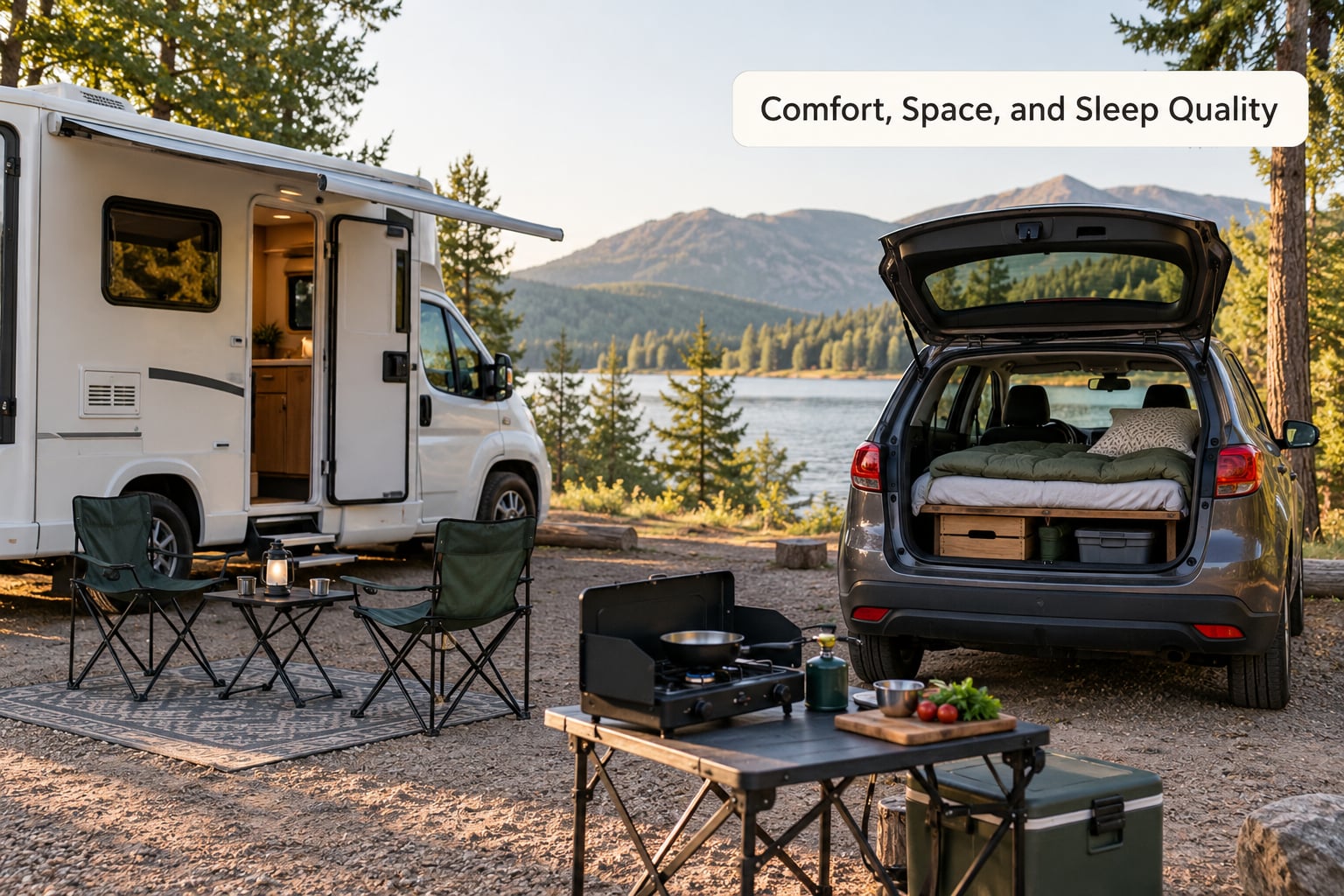
This is the category where RV camping wins, and it wins more decisively than most first-timers expect. The difference is not a nicer mattress. It is walls.
When RV vs car camping comfort actually matters on a first trip
Comfort stops being a luxury the moment three things are true: you are traveling with a child under about ten, the forecast is wet, or the trip is longer than three nights. A ten-year-old who sleeps badly in a cold car at 5 a.m. has not had a camping trip. They have had a bad night followed by a long drive home.
For two adults in mild weather, the gap is much smaller than the marketing suggests. Two adults sleeping in a hatchback with the seats folded will manage, provided you build the platform properly and manage ventilation.
What sleeping in a car is really like
The overnight comfort of a car depends almost entirely on three things: how flat your sleeping surface is, how warm the air gets, and how much moisture collects on the windows and ceiling.
A flat surface is straightforward. Fold the rear seats, measure the drop, and either cut a plywood board to fit with the fold line shimmed with foam, or use a purpose-built platform that slots between the seat bases. Add a 3 to 4 inch mattress pad on top. Sleeping pads work but thin out over a few hours, which is exactly what you feel at 4 a.m.
Warmth and moisture are the same problem. Breathable in a body creates moisture, warm air holds more of it, and a car interior is a sealed box. The result is condensation on the inside of the glass, and it is the single most common complaint from first-time car campers. The fix is boring and effective: crack a window two inches, keep a fan running on low aimed at the ceiling, and use window covers that block drafts without sealing everything up.
Never run a combustion heater or stove inside the vehicle with the windows shut. Carbon monoxide is colorless and odorless, and a small space is where it accumulates.
What sleeping in an RV is really like
An RV gives you a real mattress, insulation on all sides, and a furnace or air conditioner that a person can adjust from a dial. On a wet night in the mountains, that difference is the entire argument.
The catch is that comfort inside the RV does not extend to the campsite around it. Slide-outs need clear space, awnings need clearance from trees, and leveling needs a site that will let you adjust the rig. A comfortable rig on a badly chosen site is still a bad night.
One thing worth flagging: among travelers who have tried both, a recurring regret about RV comfort is that it makes the trip comfortable enough to sit still. People report staying at the campsite longer because the rig has air conditioning, and getting less done outside. If the point of the trip is a specific trail, a town, or a region, that cuts the other way.
Flexibility, Driving, and Campsite Access
Here the ranking flips, and car camping wins by a wide margin. Everything below comes down to one number: how long your vehicle is.
Vehicle size and the roads you can actually take
A car fits anywhere a car fits. That sounds obvious until you have a rig that is longer than a city parking space, wider than a two-lane shoulder, and taller than the branch you thought you cleared.
On a car camping trip you can pull into a town for lunch without circling the block, sleep at a trailhead, take a forest road that narrows at a bridge, or follow a spur that ends at a meadow. With an RV, each of those becomes a calculation involving overall length, height on the roof including the air conditioner and vents, and weight on the road.
Typical fuel economy shows the same gap in your wallet. A sedan or hatchback commonly returns something in the high twenties to mid thirties per gallon, an SUV or Class B van in the high teens to low twenties, a Class C in the low-to-mid teens, and a Class A closer to single digits. Over a long trip those gaps add up quickly, and the low-mileage numbers are the ones people underestimate before booking, not after.
What the fuel gap costs you over a trip
The ranges below are typical highway figures for each type of rig, and they are wide because payload, terrain, and driving speed matter more than most ads suggest. Load the tanks full, add passengers and gear, and expect to sit at the bottom of the range rather than the top.
| Rig type | Typical highway mpg | What it costs you in practice |
|---|---|---|
| Car or hatchback | High 20s to mid 30s | The baseline; nothing to plan around |
| SUV or wagon | Low 20s to high 20s | Modest premium, still easy to park |
| Class B van or campervan | High teens to low 20s | Near-car handling, a real sleep platform |
| Class C motorhome | Low to mid teens | Over-the-cab sleeping, fuel adds up on mountain routes |
| Class A motorhome | Single digits to low teens | The biggest per-mile penalty in this comparison |
Run the arithmetic before the trip rather than after. Take your expected round-trip mileage, multiply by the difference between your car’s economy and the rig’s, and you get a number that usually settles the argument on its own. Add a detour for every mountain pass and every hour spent crawling through a slow parking lot, and the Class B or campervan column starts to look like the sensible middle.
Backing is the other practical gap. A large rig needs far more room behind it than you think, and campsite pads that look generous on the map are narrow in the dark. If you plan to drive one for the first time, practice backing into a marked space in an empty parking lot, in daylight, before you meet a tree line.
Campsite access and the rules that bite
Campsites are built around a length limit, and exceeding it is the most common reason a rig gets turned away. Many drive-up sites cap out around 35 to 45 feet. A Class C with a slide-out and a Class A can run well past that, which means you need to reserve a site specifically for an RV and confirm the pad length before you drive out.
Car campers have the opposite problem, and it is a rules problem rather than a space problem. Some campgrounds treat anything without a tent as camping and require a site fee accordingly. Some do not allow vehicle sleeping at all without a tent. Dispersed and privately hosted sites generally welcome cars, because the host’s only concern is where you park.
Check the rules before you go, not when you arrive at dusk with kids in the car. The specific questions to ask: is vehicle sleeping allowed, is a tent required, what is the maximum vehicle length, and can you park on level ground.
Which option wins if you want to change plans mid-trip
Car camping wins, and by more than the vehicle size suggests. Changing plans in a car means moving forty miles before lunch. Changing plans in an RV means a fuel stop, a re-level, a drive around the block looking for an open pad, and a check that the new site takes your length.
That said, an RV can stay in the general area and absorb a weather day without any planning at all. If your trip has one fixed anchor and a lot of weather buffer, the RV’s stability is worth something.
Cost, Reservations, and Equipment
Every guide on this topic compares costs, and almost all of them do it vaguely. The useful version is a list of what you are actually paying for, because the two options fail in opposite directions.
What a car camping first trip costs
The car path is front-loaded: you buy a kit once, and the kit keeps working for as long as you camp. Most of it has ordinary household substitutes.
- A flat sleeping platform and a mattress pad, which is the one item worth getting right.
- Two window covers, plus a simple fan for airflow.
- A sleeping bag rated for the expected low temperature, not the daytime one.
- A camp stove and a cooler, or a small battery-powered fridge if you want fresh food.
- A headlamp per person, and a small first-aid kit.
The consensus advice from experienced car campers is consistent and worth repeating here: start cheap and upgrade later. Most first-timers end up using a cooler, two blankets, a pillow, and a folding table. The platform is the exception, because a badly flat sleeping surface spoils the trip every single night.
Then the recurring costs, which are smaller: campsite fees, fuel at ordinary economy, park or entrance passes, and food. If you camp monthly, gear has already paid for itself.
What an RV trip costs, and where the surprises sit
The RV path is a rental or a purchase decision first, then a chain of smaller recurring costs. When renting, the advertised daily rate is the least interesting number. The things that surprise people are mileage allowances and per-mile charges, insurance or damage-waiver options, setup and cleaning fees, and generator hours. Shop the total, not the headline rate.
When owning, the costs are not only fuel and campsites. They include insurance, maintenance and tires for a very heavy vehicle on a car chassis, registration, and storage when the rig will not live on your driveway year-round. Depreciation is the big one to think about honestly.
Do RVs depreciate as fast as cars? Faster, and there is no resale market with the depth of the used car market. Motorhomes are expensive to store, hard to finance, and expensive to fix when something goes wrong. Class A and Class C rigs typically lose a large share of their value in the first few years, and the popular entry classes hold value better than the big ones. That is exactly why renting first is the sensible beginner move: it tests the lifestyle without testing the balance sheet.
Compare total trip cost, not nightly rates
This is the comparison most people skip, and it changes the answer more often than they expect. When you run rv vs car camping for a first trip through a real budget, ask of every option: what is the total, including the one-time gear or rental cost spread across the nights, fuel, campsite fees, and anything mandatory you did not plan for.
Also price the baseline honestly: a car plus a motel for the same nights. The RV is often competitive with that baseline, sometimes cheaper, sometimes not. Car camping usually wins outright, but not in expensive areas where campsites are pricey and hotels are not.
The campervan middle tier
Most first-timers who want more comfort than a car offers end up looking at a campervan or a Class B van rental. It sleeps on a platform that does not move when you drive, has running water and a small stove, parks like a large car, and needs no leveling. It is the bridge option for someone who wants the RV experience on one weekend without the RV logistics. That middle tier is underused, and it is a genuinely good fit for a first trip.
Setup, Weather, and First-Trip Difficulty
Here is the honest part: an RV has real procedures, and they are easier than people fear and more numerous than the brochures suggest.
Arriving at an RV site
The sequence is repetitive, which is good. Back the rig into the pad, set the parking brake, drop the stabilizers, use the leveling blocks or jacks until the rig sits level, connect shore power, attach the water hose and fill the fresh water tank, connect the sewer hose if you have a full hookup, then deploy slides and the awning last because they cannot be moved once they are out.
Nothing here is difficult. It is just a sequence, and on a first trip it takes three times longer than it will ever take again. Budget forty-five minutes on arrival and you will not be stressed.
Know which sites you book. A full hookup means water, sewer and electric. A partial hookup usually means water and electric. A dry site means you carry everything you need in your tanks, which means watching your fresh water and gray water closely and dumping before you leave.
Arriving as a car camper
Your arrival routine is: park, check the site rules and bathroom location, level the car by moving forward or back slightly until it sits flat, set up the platform if it is removable, run the fan, and put the covers on. Fifteen minutes, and it gets shorter.
Check the weather before you go, not while you are packing. Warm nights mean more condensation; cold nights mean condensation too, because the same moisture forms when your breath hits a cold window. Cold clear nights are the easiest condition, and wet nights are the hardest.
The safety points nobody puts in the brochure
- Never leave a person or a pet in a parked, closed vehicle. Vehicles heat up dangerously fast, and running the air conditioning requires the engine or an external power source.
- Do not run a combustion heater, propane stove or generator inside a car or RV with windows closed. Carbon monoxide has no color and no smell.
- Keep ventilation on whenever you are cooking or sleeping, especially in a vehicle.
- Arrive before dark on your first trip so you can see the pad, the bathroom and the exits.
- If you are solo, tell someone the campsite name and your return time.
A first-trip checklist you can actually run
Beginners do better with a short list than with more planning. Work through this the week before you go, in this order.
- Call the campground. Ask whether vehicle sleeping is allowed, whether a tent is required, what the maximum vehicle length is, and where the nearest bathroom is.
- Check the forecast for the overnight low, not the daytime high. This sets your sleeping bag and your insulation decisions.
- Test your sleep setup indoors for one night. Sleep on it in the dark and find out about the gap over the folded seats before you rely on it outdoors.
- Walk the gear list the night before and pack it into the car, not into a pile. Anything you leave behind is the thing you will need at 9 p.m.
- Confirm you can park where you are going. For an RV, that means a pad length that fits your rig with the slide-outs out.
- Save offline maps. Cell service is unreliable at many good campsites, and searching for an open site after dark is a bad time to discover that.
- Tell someone the campsite name, your site number if you have one, and when you plan to leave.
- Plan the bail-out. Know the nearest town, the nearest hospital, and what your trip would cost to cut short by a day.
Number four is the one people skip and the one that ruins first trips. A test night in your own driveway costs nothing and tells you more than any review.
When not to make a first trip
Skip the trial run if the forecast is severe, if you would be camping above the tree line in shoulder season, or if your first attempt is a multi-day drive arriving at midnight. If you are going to go, go somewhere close, with hookups or a bathhouse, on a weekend with a stable forecast.
Which Should You Choose?
Choose car camping if this is a trial, the trip is short, and you want the lowest-risk version of the experience. Most people who want to keep camping long term start here, and there is nothing remedial about it.
Choose an RV, or more likely a rented RV or campervan, if kids are along, if the trip runs a week or more, if weather is uncertain, or if you already know this is a yearly habit rather than a maybe. Rent first, always. The day you rent should be booked as an experience, not a financial test.
The third path is a campervan rental for one night. It solves the length problem and the comfort problem at the same time and costs less than a Class A does for the same weekend. If you are genuinely undecided, this is the option that gives you the most information per night.
Neither suits a trip built around moving between towns and sleeping once in a while. If that is your trip, rent a car and book rooms. Camping is not cheaper than a bed when you are paying campsite fees every night in a place you were going to leave by noon anyway.
Before committing to anything, do one practice trip close to home: one night, a real campground with bathrooms, a car or a rented rig, and a forecast you trust. People who do this talk about it differently afterward. They know what they are getting into, and they can decide based on that instead of on the idea of it.
Choosing by traveler type
The general rule bends in predictable ways, so here is where it bends.
Solo. A car is the easier choice for a solo first trip. It is cheap, and if the weather turns or you simply want to go home, you drive away with no teardown. The trade-offs are real: solo campers who have done both report that an RV removes the anxiety of a remote campsite, because you are inside a locked, solid structure at night. If that matters more to you than fuel economy, take the larger vehicle.
Couples. Nearly a tie. A car is cheaper and frees the budget for good food and activities; an RV gives you a real bed and a private bathroom, which matters more after a long driving day than it does on paper. Couples who camp once a year usually pick the car. Couples who already camp often pick the rig.
Families with kids. This is where the answer stops being close. Young children, cold nights, and a campsite bathroom at 8 p.m. are a hard combination in a car. The RV, or at minimum the campervan with a real mattress, is the difference between a trip your child asks to repeat and one they ask to end.
Travelers with a dog. Car camping is kinder to the dog. Dogs manage a vehicle they know far better than a rig, and a car lets you stop anywhere for a walk. Just remember that a parked vehicle heats up fast, and never leave a dog in one with the windows closed.
Cold-weather and shoulder-season trips. Choose the RV, or skip the trip entirely. Sleeping in a car below freezing is a different experience from camping in one at 60 degrees, and this is where first-timers most often underestimate the gap.
Frequently Asked Questions
Can you actually sleep in your car overnight?
Yes, thousands of people do it every weekend. You need a flat sleeping platform so your back is not on a folded seat hinge, a window cover for your head, a sleeping bag rated for the overnight low, and a fan or a cracked window to manage condensation. Folded rear seats alone are usually not level enough to sleep on comfortably all night.
Do I need a tent if I am car camping?
Usually not, but check the campground rules before you go. Many campgrounds treat a car without a tent as camping and charge a site fee. Some do not permit vehicle sleeping at all. Dispersed and privately hosted sites generally welcome cars because the host only cares where you park. A cheap shade or a small tarp is the easy compromise if a tent is required.
Is car camping cheaper than RV camping?
For one or two nights, yes, and the gap is wide. Car camping is a one-time gear kit plus campsite fees and fuel at normal economy. An RV rental adds daily fees, mileage charges, insurance, setup costs, and fuel at much lower economy. Over a long trip the gap narrows, and sometimes flips, because an RV saves money on lodging. Compare the total for your whole trip, not the nightly rate.
How hard is it to drive a large RV for the first time?
Longer stopping distances, wider turns, and height clearance are the three things that catch people out. Back up in daylight first, in an empty lot, before you arrive at a campground with trees and pads. Know your overall length and height including roof vents and the air conditioner, and reserve a site that accepts that length. Most drivers get comfortable within a day.
Is it legal to sleep in your car at a campground?
Usually, as a registered guest paying the site fee, but the campground sets the rules, not the law alone. Check whether vehicle sleeping is allowed, whether a tent is required, and the maximum vehicle length before you leave. Overnight parking at a rest stop or retailer is a separate question and depends on the state. Sleeping in a running or parked car anywhere that bans it is not worth the risk.
Do RVs depreciate as fast as cars?
Faster, and the used market is much thinner. Motorhomes are costly to store, finance, and repair, and larger rigs in particular lose value quickly in the first few years. Popular smaller classes hold value better. That resale reality is the strongest argument for renting on your first trip: it tests the lifestyle without committing the money that is hardest to get back.
Conclusion
Most first trips should be car camping, because the whole point of a first trip is finding out whether you like it. Keep it short, keep it close, spend little, and build a kit you can use for years. Move up to a rented RV or campervan when a real trip demands one: kids, a week or more, bad weather, or a bathroom you are tired of walking to.
Before you book anything, check four things in this order: the campground’s rules on vehicle sleeping and maximum length, your vehicle’s actual dimensions, your total trip budget including one-time gear or rental fees, and the overnight low temperature. That is how rv vs car camping for a first trip gets decided in practice, and picking the option that answers those four questions without the most regret is the whole job.