Most hikers need about 0.5 to 1 liter of water per hour of moderate hiking in mild weather, which works out to roughly 2 liters for a half-day and 3 to 4 liters for a full day in the heat. Start there, then adjust for temperature, altitude, pack weight and how far you are from a refill point.
The trouble is that the rules of thumb floating around the web rarely agree with each other. One says half a liter an hour, another says a liter every two hours, a third says a liter per five miles, and a fourth says two to three liters a day. They are not all wrong, but they are answering different questions.
This guide sorts them out, gives you a calculation you can actually run in your head at the trailhead, and covers what to do when the plan goes sideways. It is general planning information, not medical advice.
Table of Contents
- How Much Water Do You Need for a Day Hike?
- What Factors Change the Amount of Water You Should Carry?
- A Simple Water Calculation for a Day Hike
- How to Pack and Store Water for a Hike
- How to Drink Enough Without Overdoing It
- What to Do If You Run Out of Water or the Trail Has No Refill Point
- Frequently Asked Questions
- Is one liter of water enough for a day hike?
- How much water should I carry for a four-hour hike?
- Do I need electrolytes for a normal day hike?
- How much water should a child carry on a hike?
- Can I drink untreated water from a spring or stream?
- Should I carry more water than the trail map recommends?
- Conclusion
How Much Water Do You Need for a Day Hike?
The base rate most outdoor authorities use is 0.5 to 1 liter per hour for moderate activity in moderate temperatures. Everything else — season, terrain, sun, fitness — is an adjustment on top of that number.
| Hike length | Liters | Ounces | Ounces per hour |
|---|---|---|---|
| 1 to 2 hours | 1 to 1.5 L | 34 to 51 oz | 17 to 34 |
| 2 to 3 hours | 1.5 to 2.5 L | 51 to 85 oz | 17 to 34 |
| 4 hours (half day) | 2 to 3 L | 68 to 101 oz | 17 to 25 |
| 6 hours | 3 to 4 L | 101 to 135 oz | 17 to 23 |
| 6 hours plus, in the heat | 4 to 5 L | 135 to 169 oz | 23 to 34 |
Two caveats belong next to that table. First, these are planning estimates for a healthy adult, not an individualized prescription. Second, the wide ranges are not filler. The difference between 34 and 17 ounces an hour is a hot desert climb versus a shaded coastal loop, and both are legitimate day hikes.
One liter of water weighs one kilogram, or about 2.2 pounds. So the 4 to 5 liter figure above is 9 to 11 pounds of pack, carried the whole way.
| Water carried | Weight in your pack |
|---|---|
| 1 liter | 2.2 lb |
| 2 liters | 4.4 lb |
| 3 liters | 6.6 lb |
| 4 liters | 8.8 lb |
| 5 liters | 11 lb |
Keep that weight table in mind when you read any recommendation. A number that sounds reasonable in liters becomes a slog on your shoulders at mile six.
What Factors Change the Amount of Water You Should Carry?
Heat is the big one. Warm air raises sweat rate sharply, direct sun roughly doubles it again, and humid air stops sweat from evaporating so it runs off you instead of cooling you. A 35-degree day in dry desert country is harder than a 28-degree day in the mountains, even though the thermometer says otherwise.
Elevation above roughly 8,000 feet adds a subtler drain. You breathe faster at altitude, and each breath loses more moisture than it does at sea level. It is not dramatic over a single day hike, but it tips the calculation upward.
Elevation gain matters too, in a practical rather than physiological sense. Climbing burns more energy, and you stop more often, which means more drinking stops and more drinking opportunities. A 2,000-foot climb and a flat walk of the same length are not the same outing.
Then there are the boring factors that catch people out. A heavy pack makes you sweat. A fast pace does too. Kids and dogs carry nothing but still need water, and they need it handed to them on a schedule rather than offered when they ask.
| Condition | Multiplier on base rate |
|---|---|
| Cool, overcast, forest trail | 0.75 |
| Mild, partly sunny | 1.0 |
| Hot, exposed sun | 1.25 to 1.5 |
| Desert or high heat, no shade | 1.5 to 2.0 |
| Above 8,000 feet, or a steep climb | Add 0.25 |
| Pack over 20 lb | Add 0.25 |
Season matters for the same reasons. Winter hikes need less water than summer ones and still need regular drinking, because cold suppresses thirst more than any other condition.
And the variable people leave to chance: reliable refill points. A creek you can count on halves what you carry. A seasonal spring that is dry in August does not count. If you are not certain, plan to carry water past the last point you trust.
One warning about planning by thirst. By the time you feel thirsty you are already behind, and in cool weather you may feel nothing at all while losing water steadily. Thirst is a useful on-trail signal, not a planning tool.
A Simple Water Calculation for a Day Hike
Run the math in this order at the trailhead.
Step 1: Estimate your hours. Look at the distance, the elevation gain on your map, and the pace you actually walk when loaded. Add 10 percent for the stops that happen regardless of intent. A 7-mile hike with 1,500 feet of climbing for an average weekend hiker is a five-hour day, not a four-hour day.
Step 2: Multiply by 0.5 to 1 liter. Pick 0.5 if the trail is shaded and the forecast is mild. Pick closer to 1 if you will be in open sun, if the terrain is steep, or if you will be walking fast.
Step 3: Add the condition modifiers. Use the table above. Desert plus loaded pack can add half a liter or more.
Step 4: Subtract what you will refill. Only subtract water you are confident about. Reliable piped water or a stream crossing you can reach costs you nothing to carry; a listed spring in late summer might as well not be there.
Step 5: Round up, then stop. Round to a size your containers can actually hold, and cap the total at what your body and pack can reasonably manage. Carrying more than you can drink does not make you safer.
Here is what that looks like in practice.
Example one: a cool two-hour walk. A shaded forest loop, mild forecast, some low hills. Two hours at 0.75 liters is 1.5 liters. Subtract nothing, because the loop has no water. You pack 1.5 liters, call it 4.4 pounds, and you will probably finish with a bit left over. That leftover is not wasted planning. It is the margin that covers a slower pace or a longer snack stop.
Example two: a warm four-hour hike. Open grassland in summer, rolling terrain, no sources. Four hours at 0.5 liters is 2 liters, and the hot-and-exposed multiplier of 1.25 to 1.5 pushes that to 2.5 to 3 liters. You pack 3, which is 6.6 pounds, and drink steadily through the middle hours.
Example three: a hot full-day desert hike. Seven miles, 1,500 feet of climb, July, one creek crossing at mile three that flows reliably. Eight hours on the trail. Eight hours at 0.5 liters is 4 liters; the desert multiplier of 1.5 to 2 takes it to 6, which is too much to carry. Here the creek matters. Assuming you can refill roughly 1 liter there, carry 4 to 4.5 liters out and 3 to 3.5 liters in. If you are not certain the creek runs, you carry the difference and accept the weight.
There is also a distance-based version for long dry routes. The common field rule is about 1 liter per 5 miles, derived from desert thru-hiking experience. It works well for planning legs between sources on the PCT or in desert terrain. It underestimates in summer heat and overestimates on a shaded northern trail, so treat it as the desert version of the same idea.
| Distance | Liters (1 L per 5 miles) |
|---|---|
| 5 miles | 1 L |
| 10 miles | 2 L |
| 12 miles | 2.4 L, call it 2.5 L |
| 15 miles | 3 L |
On a 10-mile hike on flat ground in spring, 2 liters is plenty. On the same 10 miles in August in open desert, you would want closer to 3.
How to Pack and Store Water for a Hike
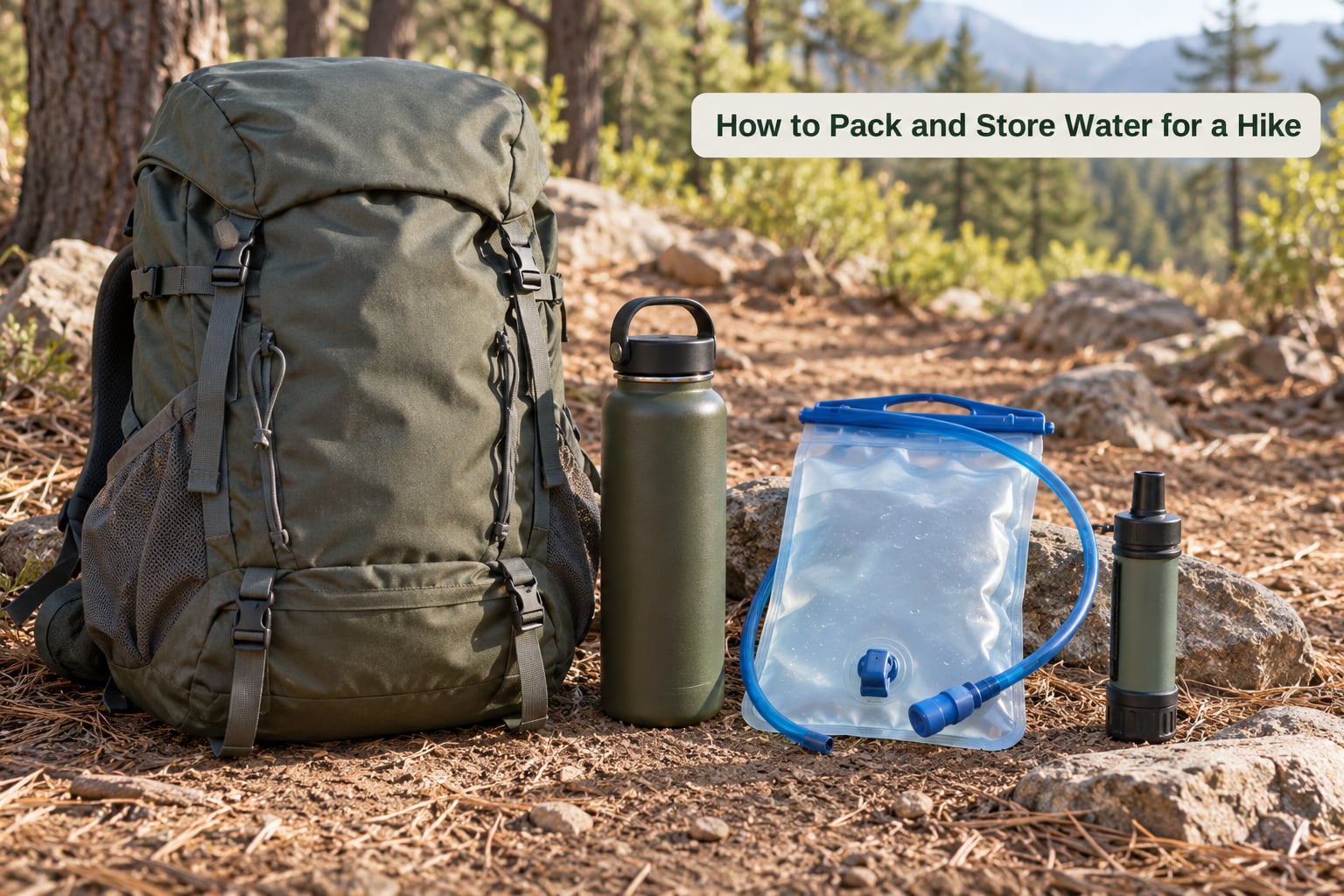
How you carry water matters less than how much, but a bad setup makes you drink less than you planned, because you stop noticing it.
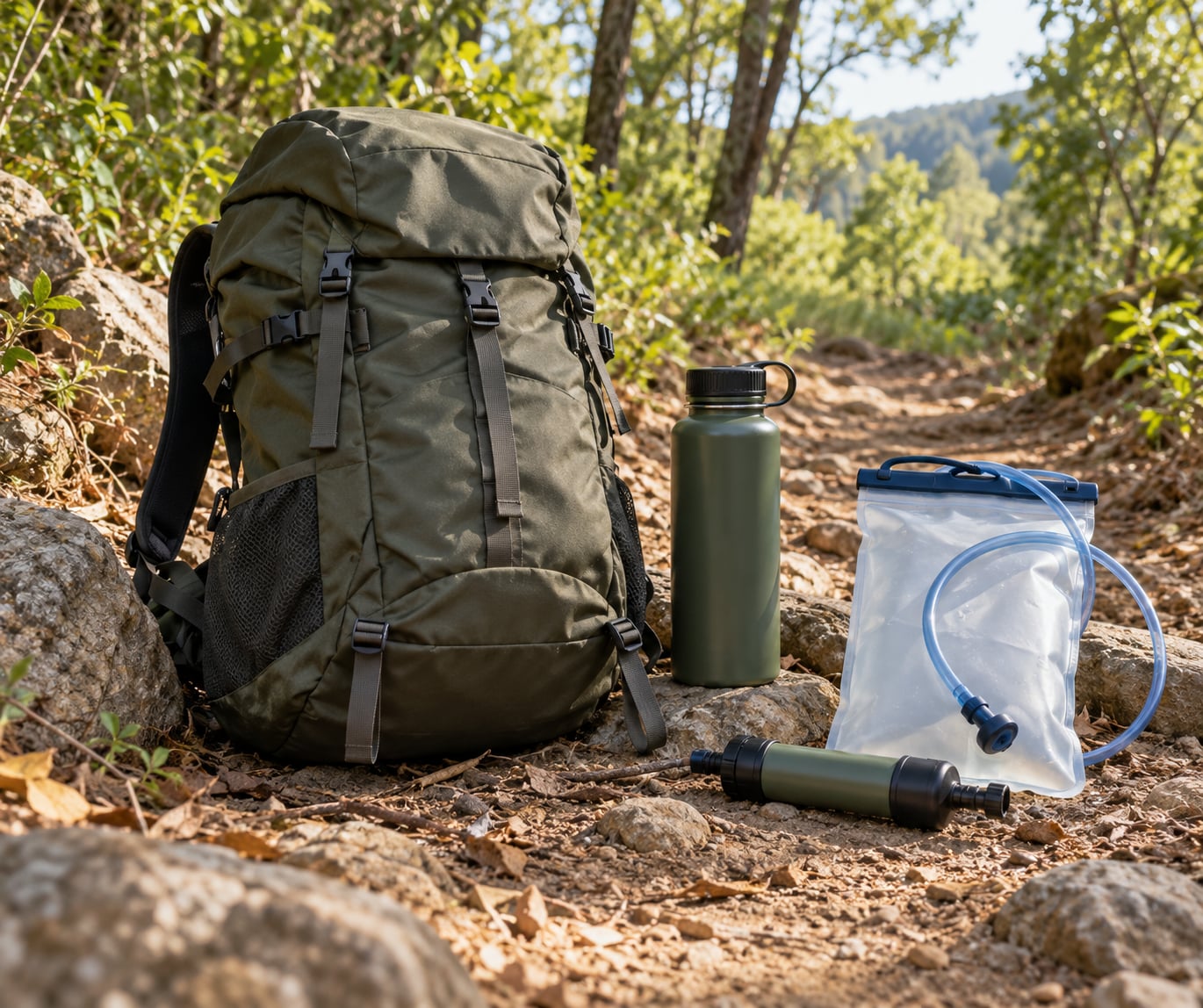
Bottles. One to three liter bottles in a side pocket or on the shoulder strap. You can see how much is left, they survive being dropped, and the wide mouths are easy to fill from a stream. The downside is that you have to reach for them, and some hikers simply forget.
Hydration reservoirs. A bladder with a hose that runs to a bite valve you drink from without stopping. They are the best option when you want to drink often without breaking stride, and they hold more in one place. The tradeoffs are that you cannot see how much is left, and a hose or bladder failure empties water across your gear. Check the hose routing so it does not snag.
Shoulder strap holders. A soft flask holder that clips to a shoulder strap, holding 0.5 to 1 liter within reach. Cheap, light, and a good middle ground between the two options above.
Collapsible containers. Useful if you know a reliable refill point and want to collapse the empty as you drink. They collapse, they leak, and they pick up every bit of creek sediment, so rinse them properly.
No matter what you use, keep the drinking supply separate from anything you might be treating. A hydration reservoir that has been filled at a backcountry source should not be the same reservoir you later fill with treated water without a thorough clean. Cross-contamination is the quiet way people get sick on otherwise clean hikes.
If you plan to rely on natural sources, you need a treatment method. A filter works and handles most bacteria and protozoa. Purification tablets are lighter still and cover viruses, though they take time and some people find the taste difficult. Boiling works and costs nothing but attention. Whatever you pick, it belongs in your pack even if you expect not to use it, because expectations about water are wrong often enough.
Cleaning matters more than most gear guides admit. Rinse reservoirs with water and a squeeze of soap, air-dry them with the hose off, and do it again when you get home. A biofilm in a reservoir you use every few weeks is a hassle you get to deal with anyway.
How to Drink Enough Without Overdoing It
Drink on a schedule, not on thirst. Sipping a few mouthfuls every 15 to 20 minutes keeps fluid levels steady and stops the stomach-heavy feeling that comes from draining a bottle at a stream.
The clearest picture of your own need comes from weighing yourself before and after a hike. Do it in underwear, without drinking for an hour before and after, and the difference in pounds is roughly the water you lost. If you lose 3 pounds, you are running a heavy sweat, and you should carry and drink more. Most people never do this measurement once and are surprised by the result.
Early dehydration is quiet. Dark urine, thirst, dry mouth, headache, and a drop in energy are the first signals. Serious dehydration is unmistakable: dizziness when standing, confusion, rapid breathing, no urine for many hours, or a racing heart. At that point you are not finishing the hike. You are getting to safety.
Electrodes and electrolytes fill a narrower gap than most marketing suggests. For a normal day hike in mild weather, water and ordinary food are plenty. They earn their place when you are out for many hours in heat, sweating heavily, or recovering from a day where you drank little.
Gummy bears and other gels come up in every hydration article because they contain sodium and sugar. That is a fair point in their favor. Eating them is fine. It does not replace drinking water, and it is not a substitute for a meal.
The upper end deserves mention, because it is a real risk that most day hikers never consider. Drinking far more than you lose, particularly plain water over many hours, can dilute your blood sodium. This is how people feel fine, keep drinking, and then get headache, nausea and confusion that look like dehydration but are the opposite. If your urine stays pale all day and you feel bloated, ease off.
If you have a heart or kidney condition, or a clinician has told you to limit fluids, these general figures do not apply to you. Ask your doctor or pharmacist what is appropriate for your situation, and do it before the season starts.
What to Do If You Run Out of Water or the Trail Has No Refill Point
Running dry at mile seven of a twelve-mile hike is a problem, but it is usually a solvable one. The damage comes from decisions made in the wrong order.
Stop where you are, if you can do so safely and out of the sun. Panic burns water. Get out of direct sun, sit down, take stock of exactly what you have left and how far you have gone.
Recalculate honestly. How far to the trailhead, how far to the next source, and how fast can you move at your weakest? If you have more than about half a liter and the trailhead is within two hours, you walk it out at a steady pace. Slower pace buys more water per mile, so slow down rather than speeding up.
Protect what you have. Do not drink everything at once, do not skip the shade, and do not take the shortcut that adds distance. If you have a filtration method, this is the moment to use it — and stay with the water source until it runs.
Turn back when turning back is the safe answer, which is more often than people admit. Getting to a trailhead with a third of a liter beats pressing on with none.
| Your situation | What to do |
|---|---|
| Half a liter or more, trailhead within 2 hours | Walk out slowly and steadily to the trailhead |
| Less than half a liter, trailhead more than 2 hours away | Stop, treat any source you can reach, reassess before moving |
| Full sun, no shade, mid-day | Rest out of the sun first, then move during the cooler hours if you can wait |
| Cell service available | Call for help before you get too weak to describe where you are |
| Confusion, stumbling, no urine | Call for help now. This is a rescue situation |
| Children or animals in the group and water is short | Give water to them first and accept that you will move slower |
If you have no service, send a partner out only if they are genuinely stronger than you. Two weak people moving slowly is slower than one strong one walking to get help.
Frequently Asked Questions
Is one liter of water enough for a day hike?
One liter is enough for many short, mild-weather hikes, especially on shaded trail under about three hours. It stops being enough once you add sun, elevation gain, a heavy pack or a full day of walking. The honest test is how far you are from water: if the trailhead is 90 minutes away and the weather is warm, one liter is a thin margin. Most hikers are better served carrying a liter and a half and finishing with some left.
How much water should I carry for a four-hour hike?
Plan on 2 to 3 liters for a four-hour hike, which is 68 to 101 ounces. In open sun or hot weather, go toward the top of that range and consider 3.5 liters. On a shaded, mild trail with a reliable stream, 1.5 to 2 liters is usually plenty. Remember that 3 liters is 6.6 pounds of pack weight.
Do I need electrolytes for a normal day hike?
Usually not, if it is under a few hours in mild weather and you are eating a normal meal. Electrolytes help when you are sweating heavily for many hours, in high heat, or at altitude, because you are replacing sodium as well as water. Carrying a few tablets costs nothing and covers the case where the forecast turns. Food with a little salt and sugar does the same job.
How much water should a child carry on a hike?
Children generally need proportionally more water than adults per hour of hiking, and less body mass to buffer a mistake. Give them their own bottle within easy reach rather than sharing yours, and offer it on a schedule every 15 to 20 minutes. Kids rarely ask for water on a trail even when they need it. For a group, plan on roughly half a liter to one liter per person per hour and add extra for the slowest walker.
Can I drink untreated water from a spring or stream?
Not without treating it, and the risk is higher than most hikers assume. Water from backcountry sources can carry giardia, bacteria and viruses, and you cannot see or taste any of them. A filter, purification tablets or boiling will handle it. Note that viruses pass through many filters but not tablets, which matters in areas with human or livestock contamination upstream.
Should I carry more water than the trail map recommends?
Trail advice usually assumes average conditions and an average hiker. Your load, your pace and the forecast that morning may all be worse than the map assumed, so adding a margin is reasonable. The limit is your ability to carry it. Past about four liters on a day hike, the weight starts to slow you down enough to hurt the whole plan. A better move is to plan a route with a confirmed refill point instead of carrying extra.
Conclusion
Estimate your hours, multiply by 0.5 to 1 liter, adjust for heat, sun, altitude and pack weight, subtract water you are certain you can refill, and round up. Then pack it and drink on a schedule rather than waiting for thirst.
Before you go, check official trail and land manager guidance for the route you are on, since seasonal water availability is the single most common planning error. If you have a medical condition or a fluid restriction, ask your clinician what is right for you instead of applying a general number. Carrying the wrong amount of water is a solvable problem on the trail. Knowing which errors are not worth making is the job.