How to read hotel reviews without being fooled comes down to one habit: ignore the headline star rating and read the text, filtered to the last few months and to the kind of stay you are actually booking. A score is an average. An average hides the one thing you need, which is the pattern underneath it.
The gap matters more than most travelers realize. The same property can sit at 8.8 on one booking platform and 7.1 on another, and both numbers are arithmetically correct. That is not a rounding error to shrug off; it is a full rating point of disagreement about whether the place is good.
This guide was reviewed and updated in October 2026. It takes about fifteen minutes per property once you have the method down, and it works whether you are booking a weekend in Lisbon or a fortnight in Bali.
Table of Contents
- What You Need
- Step-by-Step: How to Read Hotel Reviews Without Being Fooled
- 1. Start with the review system, not the individual review
- 2. Match the review to your exact stay scenario
- 3. Separate facts from opinions
- 4. Look for repeated patterns, not one-offs
- 5. Check the review against the hotel’s current information
- 6. Read the most useful one-star and five-star reviews
- 7. Turn review evidence into a booking decision
- Who should you trust, and what do the numbers mean?
- How to tell if a hotel review is fake
- What each traveler type should look for
- Common Mistakes
- Frequently Asked Questions
- What is the 15-5 rule in hotels?
- How to tell if hotel reviews are fake?
- Which website is the best for reading hotel reviews?
- Why does the same hotel have different ratings on Booking and Google?
- Can a hotel remove a negative review or punish you for writing one?
- How many reviews should a hotel have before I trust its score?
- Conclusion
What You Need
Before you open a single review, pin down five things about yourself. The reviews are filtered through them, and a review you skip is a review you did not waste time on.
- Your actual dates. Peak week in July and the same room in early September are different products as far as noise, queues and price go.
- Your room type. A review of a standard double tells you almost nothing about a suite, and Booking.com scores are heavily shaped by whichever room type reviewers book most.
- Your travel purpose. Business, family, couple, solo and group trips want different things from the same building.
- Your priorities, ranked. Pick two that matter and two you can live without. Quiet beats a bigger room for some people; a desk beats a view for others. You cannot weigh everything equally.
- Your starting pages. The property’s own page for current facts, plus two or three review platforms.
Write the two priorities down. It sounds fussy and it is the single change that most improves a booking decision, because it converts a vague sense of unease into a yes or no condition.
Step-by-Step: How to Read Hotel Reviews Without Being Fooled
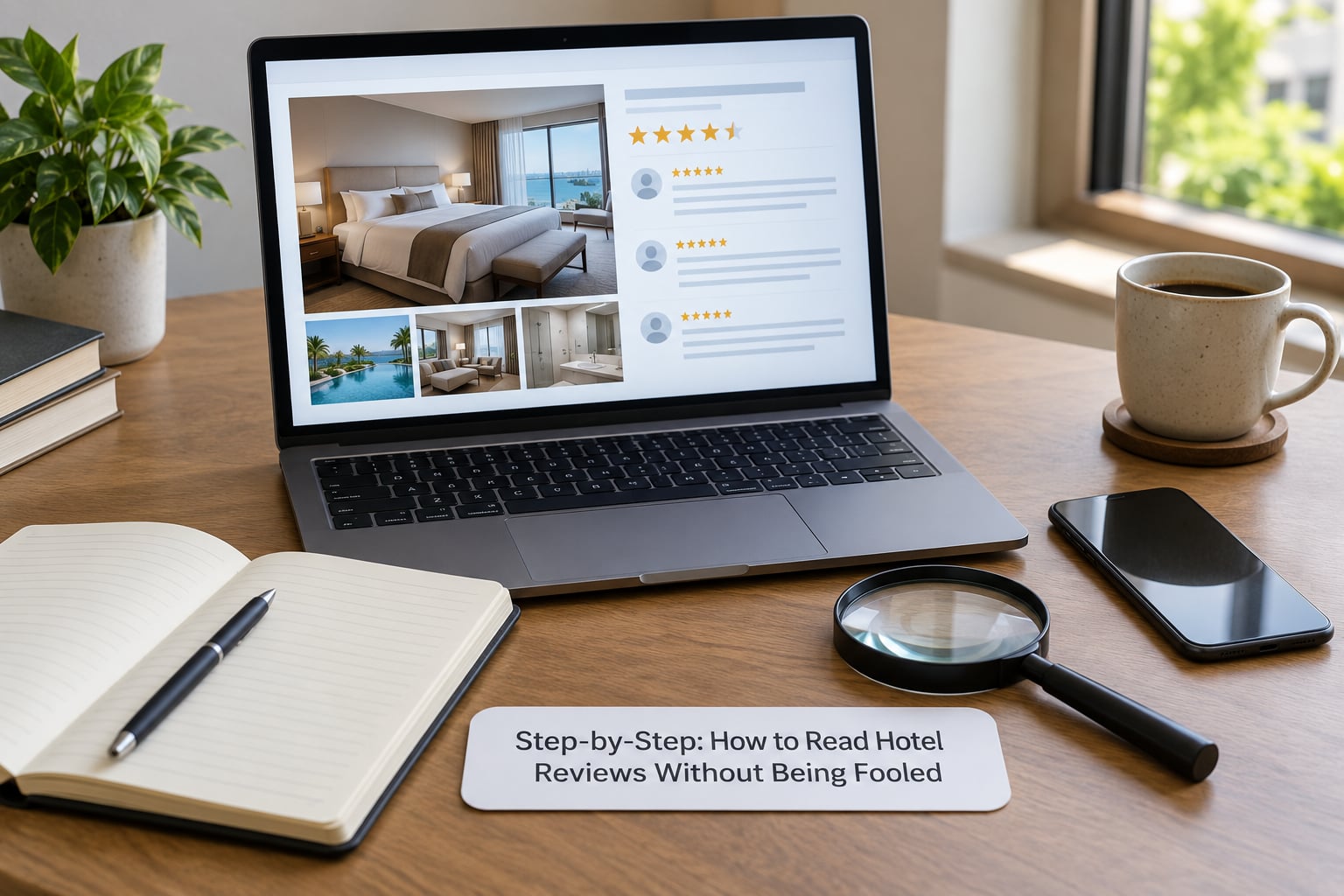
Read in this order and you will get a different answer from the same page than the default view gives you. The order matters because each step narrows what the next one has to consider.
1. Start with the review system, not the individual review
Every platform shows you an aggregate first, so interrogate the aggregate before you read a word. Look at the total count, the spread between the best and worst sub-scores, and the shape of the recent history rather than the current number.
A property with 40 reviews is not a 4.6-star property. It is 40 data points, and one loud group can carry all of them. Experience travelers tend to use 70 or so as a working floor, and the reasoning matters more than the number: below that, a single party of guests reviewing after a weekend away can move the figure by a full star.
Booking.com breaks its headline score into sub-scores for staff, cleanliness, comfort, facilities, value for money, location and free Wi-Fi. That breakdown is the most useful free diagnostic on the site, because it shows where the property is genuinely strong and where it is coasting on one category. A 9.2 overall sitting on a 5.9 for location tells you the building is lovely and the neighbourhood is not, which is a different booking decision.
Google Reviews works differently. Its star rating on Maps is closer to a running mean that anyone can nudge, which makes it useful as a sanity check and dangerous as a sole source. My habit is to read Google last, after Booking or Agoda, so a 3.7 out of 5 across 2,200 reviews lands as context rather than as a verdict.
2. Match the review to your exact stay scenario
Most review sections have filters and almost nobody uses them. Sort by most recent, narrow to your dates where the platform allows it, and read only reviews from travelers whose trip looks like yours.
Booking.com lets you filter reviews by traveler type. That single click is worth more than any other feature on the site for a family or a business trip. If you are travelling for work and the Wi-Fi sub-score is 6.4, the booking is already effectively decided regardless of what the food reviews say.
Match on stay length too. A three-night stay and a two-week stay produce completely different complaints from the same room, because problems that a short visit absorbs become unbearable by day nine.
3. Separate facts from opinions
A fact is something you could verify and act on: the air conditioning did not run, the bathroom was not cleaned on arrival, the walk to the station is fifteen minutes with luggage, the walls are thin enough to hear the neighbours’ television.
An opinion is a mood the reviewer is selling you: boring, ugly, overpriced, overrated. Those words tell you about the reviewer, not the property, and they carry no information you can book against.
Watch for the middle case, which is a fact dressed as an opinion. Overpriced is an opinion until you compare it against what the same room type costs nearby on your dates. Overpriced for a weekend in peak season is not a complaint, it is arithmetic.
4. Look for repeated patterns, not one-offs
One angry review is a story. Three reviews from three unrelated guests naming the same thing is a pattern, and patterns are what you book against.
Do this by counting. Search within the reviews for the terms you care about. If you search noise, or lift, or fee, and read the hits, you get a rough incidence rate for that problem across everyone who cared enough to mention it. That is far more informative than the star score.
Experienced travelers read the worst reviews first, then the middle, and skip the pile of glowing five-stars. It is counter to what the platforms push, and it is the right instinct: the negative review is where the specific information lives. A r/TravelHacks poster described the habit as a way of filtering out potentially paid praise, and it works for the same reason it feels unfair.
5. Check the review against the hotel’s current information
Reviews describe a moment. The property page describes now. Any gap between the two is what you need to resolve before paying.
Check the room description against what reviewers describe. If the page promises a 20 square metre room and three separate reviews call it small, the page is either wrong or the reviews are about a different room type. Either way, find out which before you book.
Check the policies too. Resort fees, mandatory breakfast, parking charges and cleaning surcharges turn up in reviews constantly because they arrive at the end, after the payment is done. Read the actual fee list on the property’s own page rather than trusting a review that said the fee was fair.
Then check for change. Renovations, a new nightclub, a change of ownership or a building next door going under construction show up in reviews months before they show up in official descriptions. If a complaint about noise starts appearing in the last three months and not before, something changed, and it may still change back.
6. Read the most useful one-star and five-star reviews
Extreme reviews are not automatically the most useful, which surprises people who assume five stars are pure filler. The useful five-star review names something specific and admits one real flaw. A reviewer who says the room was excellent, the staff friendly and the breakfast unremarkable is telling you something a 10 out of 10 does not.
The useful one-star review is specific too. Dirty linens, no hot water for two hours, a booking that fell through on arrival, a charge that appeared at checkout. Those are actionable. Vague hostility, personal attacks on staff and complaints about the weather or the destination are not about the hotel and should carry no weight at all.
There is a category worth naming. A small number of reviews read as an attempt to extract something: a discount, an upgrade, a late checkout, a refund. If a review implies the guest expects compensation for writing it, it tells you very little about the room. This is not as common in hotels as it is in some other sectors, but it exists, and the tell is usually a review written on the property’s own device at check-in.
That last point is worth dwelling on, because it explains a lot of suspicious batches. A reviewer on the TripAdvisor forum boards pointed out that businesses commonly invite happy customers to write a review on a computer in the lobby. Nothing about those reviews is fabricated; the guest really did stay. But the selection is entirely the hotel’s, and a run of them arriving within twenty minutes of each other tells you the score was curated, not collected.
7. Turn review evidence into a booking decision
By this point you are not reading, you are applying conditions. A workable method has three questions, in this order.
- Are there any conditions I said were non-negotiable that failed? Unreliable air conditioning, a cleanliness complaint in the last six months, or a fee you did not know about is a stop. Do not average it against a good location score.
- Do the warnings repeat across independent guests and across platforms? One platform complaining and another silent is different from two platforms complaining independently, which is the hotel’s own pattern showing through.
- How much uncertainty can you tolerate? If the worst plausible outcome ruins the trip, book somewhere with fewer unknowns and a cleaner record, not somewhere with a better score.
If your conditions pass and the only problems are ones outside the hotel’s control, book. A historic building with no lift is not a defect. Sargassum on a Caribbean beach in a particular season is not a defect. Missing these distinctions is how travelers talk themselves out of perfectly good properties.
Who should you trust, and what do the numbers mean?
No platform is reliable on its own, and each one fails in a different way, so the useful question is which failure mode you can tolerate.
| Platform | How reviews are verified | Who writes there | How easily it is gamed | Best used for |
|---|---|---|---|---|
| Booking.com | Verified-stay badge where the guest booked through the platform | Guests who booked directly through them | Moderate; verification rules vary by region | Subcategory scores, room types and traveler-type filters |
| Google Reviews | Any account can review; business claims its profile | Wider public, including people who never stayed overnight | High; location businesses in particular | Recent sentiment, owner replies, cross-checking a score |
| TripAdvisor | Open system with fraud screening and poster warnings | Mix of real guests and travellers who did not book a room | Moderate to high | Consistency over years, property response patterns |
| Agoda | Verified stays on most inventory | Internationally weighted guest base | Moderate | Asian and long-haul properties, price comparisons |
| Expedia and Hotels.com | Verified stay on most bookings | Package and loyalty-program guests | Moderate | Package stays and points bookings |
The reason scores diverge so sharply is structural, not accidental. Booking platforms have a commercial relationship with the hotel that lists there and control the review prompt at the moment of greatest compliance, which is check-in. Open platforms like Google have no such pressure and no such filter, so they collect every complaint as well as every compliment. A r/TravelHacks thread asking exactly this question got the answer that OTA listings skew generous and Google skews blunt, and that is close to right.
A sudden unexplained drop in a long-running score is its own signal. It usually means the hotel lost a management dispute, stopped replying to complaints, or something real changed. Check the historical trend on Google Maps before assuming a trend line is noise.
How to tell if a hotel review is fake
Human detection of fake reviews performs barely better than chance, according to research from Cornell University, where the Review Skeptic algorithm reached roughly 90 percent accuracy. That finding should lower your confidence in instinct, not raise it in the tool, but it does mean the signals below are worth checking rather than guessing at.
- Uniform praise with no specific detail about the room or the stay.
- Reviews describing the trip rather than the property, with no floor or bathroom mentioned.
- Marketing language lifted straight from the property’s own description.
- A reviewer account with one review, no photo and a generic name.
- Several reviews from different names with near-identical wording and photo sets.
- Photos that appear under many reviewer names across multiple properties.
- A cluster of reviews posted within days of each other after a quiet spell.
- Wide-angle room photos that look far larger than the square footage claimed.
- Reviewers with no history at all, who appear once and vanish.
- Repeated review dates that do not match any known occupancy pattern.
- A perfect five-star profile that never mentions a single drawback.
- Reviews that ask for something in exchange for the score.
Cornell’s work found that fabricated hotel reviews skip spatial detail, which is why the omission of where the reviewer actually was is a useful marker. Travel writer Matthew Hairsnape offers a simpler version of the same idea: a property with hundreds of reviews and not one improvement suggestion is implausible, because real stays are never perfect.
Consumer research supports the instinct too. Mintel found that 57 percent of consumers are suspicious of products carrying only positive reviews, and 49 percent believe companies incentivize reviews.
And Steven Carvel of Cornell University’s Hotel School has pointed out the structural weakness underneath all of this: for a long time there was no robust link between paying for a reservation and leaving a review, which is exactly the gap incentives exploit. Verified-stay badges narrow that gap, though they guarantee only that a reservation existed, not that the review is honest or that the reviewer stayed the whole trip.
What each traveler type should look for
Matching reviews to your trip is the step most people skip. Here is the short version for the common cases.
| Traveler type | Prioritize in reviews | Watch out for |
|---|---|---|
| Solo traveler | Location score, staff responsiveness at night, check-in hours | Descriptions of the surrounding streets at night |
| Couple | Recent noise complaints, room size, atmosphere | A bar or nightlife venue on the ground floor |
| Family | Room capacity, connecting doors, breakfast options, pool complaints | Renovation noise and lifeguard coverage |
| Business traveler | Wi-Fi reliability, desk and chair, early check-in, lift hours | Weekend reviews written by people not working there |
| Budget traveler | Hidden fees, resort and parking charges, value sub-score | Mandatory extras that appear at checkout |
| Long-stay guest | Kitchen facilities, laundry, weekly-holiday and cleaning schedules | Complaints that only surface after day seven |
Common Mistakes
Almost every bad booking traced back to one of these six errors, and each has a straight correction.
- Booking on the headline score. A single number averages every review ever left, on any date, from any kind of guest. Correction: open the sub-scores and the recent history before you open the reviews.
- Ignoring which room type is being reviewed. A review of the cheapest room describes the cheapest room. Correction: filter by your room type, or read the reviews that name it.
- Treating reviews from three years ago as current. Staff, owners, noise and construction all change. Correction: set a recency filter of three to six months and treat anything older as history.
- Rejecting a property over one complaint. One bedbug mention is worth investigating; one bedbug mention from one guest in a 400-review history is not a verdict. Correction: count independent mentions before you decide.
- Reading only the five-stars. That is precisely the sample a motivated host curates for you. Correction: read the worst reviews first, then the middle tier.
- Trusting a score without checking the source. An 8.8 and a 7.1 for the same property are two different claims, not one fact. Correction: cross-check at least two platforms, including one where anyone can post.
Two more worth adding: do not treat a hotel’s reply to a bad review as proof it cares, since a copy-paste response to three different complaints proves the opposite, and do not skip the official property page, because the fee list and cancellation terms in the reviews are often out of date.
Frequently Asked Questions
What is the 15-5 rule in hotels?
It is a quick sampling method: read fifteen five-star reviews, then five one-star reviews. The five-stars show you the property at its best, which tells you what a good visit looks like. The one-stars show you the worst realistic outcome, which tells you what could go wrong. Fifteen and five is not a scientific ratio; it is simply enough text to spot a pattern in a few minutes before you commit to deeper reading.
How to tell if hotel reviews are fake?
Look for praise with no specific detail, marketing language copied from the property page, reviewer accounts with a single review and no photo, and clusters of near-identical wording posted days apart. Cornell research found fabricated reviews skip spatial detail such as floor or bathroom, and described the trip instead. Check the reviewer profile and the review dates as well as the wording.
Which website is the best for reading hotel reviews?
None is best on its own. Booking.com is best for subcategory scores and traveler-type filters, Google Reviews is best as an independent cross-check because anyone can post, and TripAdvisor is best for long-term consistency. Read at least two, ideally including one open platform. The scores will disagree, and that disagreement is useful information rather than a flaw.
Why does the same hotel have different ratings on Booking and Google?
Booking platforms have a commercial relationship with the hotels that list there and control the review request at check-in, when guests are most likely to agree. Open platforms like Google collect complaints as readily as praise, from people who never stayed. The gap is structural, and a score above 8 on an OTA paired with a score near 7 on Google usually means the property is good and imperfect.
Can a hotel remove a negative review or punish you for writing one?
Platforms do not allow hotels to delete reviews simply because they dislike them, but they can dispute a review as factually incorrect or abusive, and that can lead to removal. Hotels are also free to contact you privately about a review, which is worth treating carefully. Writing an honest review of a stay you paid for is protected, and any attempt to discourage it should be reported to the platform.
How many reviews should a hotel have before I trust its score?
Around 70 or more is a reasonable working floor for a stable rating. Below that, a single group of guests reviewing together can shift the number by a full star. If a property has very few reviews, look at the individual texts and the reviewer history instead of the average, and check that the score has not recently dropped for no visible reason.
Conclusion
Your first action is simple: set a recency filter on the property’s last three to six months of reviews, search for your two non-negotiable priorities, and read the worst and the middle before the five-stars.
Then check what you found against the hotel’s current page, fees, room description and policies. Book when the repeated issues fall outside your priorities, and keep looking when one of them lands on something you said you could not compromise on. The score was never the evidence; the pattern is.