Flying with medication legally comes down to three separate checks, and most trouble happens when travelers only prepare for the first one. You pass airport security, then your destination country’s import law applies at customs, and any transit country you connect through has its own rules. Prepare for all three and the process takes an evening of paperwork.
This guide covers what to pack, what to say at the checkpoint, and how much medication counts as a personal supply. Last reviewed October 2026, with the current TSA rule set, CDC guidance and destination-country embassies as sources.
One thing to keep in mind: officers have discretion. A rule that says “permitted” still leaves room for a human being to ask what a pill is and why you take it.
Table of Contents
- What You Need
- Step-by-Step: How to Fly With Medication Legally
- How to Check Domestic Flight Rules
- How to Handle Medication at Airport Security
- How to Pack Medication for Carry-On and Checked Bags
- How to Fly With Medication Legally on International Routes
- Common Mistakes
- Frequently Asked Questions
- Do pills need to be in prescription bottles when flying?
- Can I bring my pills in a pill organizer through TSA?
- Do I have to tell TSA what my medication is for?
- Do I need to declare prescription medication at customs?
- Can I check medication in my luggage?
- What do I do if my medication is lost or confiscated?
What You Need
You need documents and packaging that prove every medicine in your bag belongs to you and is medically necessary for this trip. Here is the short list most travelers need, and it is the part people skip when they are working out how to fly with medication legally.
- Original pharmacy-labeled containers for anything controlled, injectable or narcotic. Plain tablets are the most flexible, but labels remove every argument at the checkpoint.
- A printed copy of each prescription, showing drug name, dose and prescriber. Name the generically, not just the brand, because a foreign officer may not recognize the brand.
- A typed medication list on one page: generic name, brand name, strength, frequency, why you take it, and the prescribing doctor’s name and phone number.
- A doctor’s letter for controlled drugs, injectables, refrigerated biologics, psychiatric medication and any drug your home country restricts but your destination restricts differently. Include the diagnosis only if you are comfortable; the letter can say “for a chronic condition” instead.
- Identification that matches the name on the prescription labels and, on international trips, your passport.
- Contact details for your prescriber and pharmacist, plus your insurer’s international emergency line and the U.S. State Department or your home country’s foreign ministry.
- The destination’s embassy or consulate contact, for controlled drugs you are unsure about. Save it offline; airport Wi-Fi is unreliable.
- A cold-chain kit if you carry insulin, biologics or anything labeled refrigerated: an insulated pouch and gel ice packs.
Ask your pharmacist for printed extra labels if your bottles are old and the ink has worn off. A pharmacy will usually reprint them for free while you wait, and a faded label is the sort of small thing that turns into a long conversation at the checkpoint.
Step-by-Step: How to Fly With Medication Legally
How to Check Domestic Flight Rules
For a U.S. domestic flight, TSA allows prescription medication in carry-on bags and, in most cases, in checked luggage. The rule that matters: solid pills do not have to be in original containers, but the recommended practice is to keep them labeled anyway, especially anything controlled.
Liquids are the constraint most people hit. The 3.4 ounce (100 mL) limit applies to liquid medication too, with one exception: quantities larger than that are allowed when medically necessary. Declare it, and expect a secondary screening while an officer confirms.
Small differences exist between US airports. Some carriers and some airports ask for a doctor’s letter even domestically, and some state rules are stricter than TSA’s. If your medication is a controlled substance, treat the strictest reading as the one that applies. You will do the whole trip in minutes, not hours, when a screener opens your bag and finds a clear, labeled bottle with your name on it.
How to Handle Medication at Airport Security
At the checkpoint, tell the officer what you are carrying before they ask. A plain sentence works: “I have prescription medication in my carry-on, including insulin and an auto-injector.” Being upfront shortens the stop, and you are not required to disclose a diagnosis.
- Keep medication in your carry-on, within reach at the top of the bag, rather than buried under clothes.
- Remove injectable items, inhalers, insulin pens and auto-injectors into a separate clear bag if a body scanner flags you.
- Ask for a private screening if you are comfortable with it. You can also ask a passenger in line to check your bag instead.
- Carry your prescription list and doctor’s letter in your hand, not in the suitcase you hand over.
- Expect injectable medicines to be screened by X-ray first, since the liquid density rules do not apply the same way.
Two things get stopped often. Aerosol inhalers and large liquid volumes usually draw a look and get cleared on the spot with your documentation. CBD and cannabis-derived products are the exception: TSA does not prohibit them, but federal law still classifies cannabis as a Schedule I substance, so officers have little room to allow them on a flight.
On the medical side, insulin pumps and continuous glucose monitors are usually fine to wear through screening, and manufacturers list which models are safe around X-ray and metal detectors. Ask your device maker rather than guessing.
How to Pack Medication for Carry-On and Checked Bags
Keep essential medicine in hand luggage. Checked bags get delayed, misrouted and left on tarmac; a bag that arrives two days late is a real problem for anyone on daily medication. Pack a spare dose or two in your personal item for that reason.
Use this as a quick guide by medication type:
| Medication type | Pack it this way | At security |
|---|---|---|
| Solid pills | Carry-on; original bottles or organizer plus labeled bottles in a clear bag | Usually passes without inspection |
| Liquid medicine | Carry-on, sealed; over 3.4 oz needs the medically necessary exemption | Declare before screening |
| Injectables, insulin pens, auto-injectors | Carry-on, in a labeled case with needles and sharps container | Separate out if flagged; X-ray first |
| Refrigerated biologics | Insulated pouch with gel ice packs; confirm whether your medicine must stay cold or only stay out of heat | Gel packs may be frozen solid and still allowed |
| Controlled substances | Carry-on, original bottle, prescription copy, doctor’s letter | Officer may ask what it is and who prescribed it |
| Narcotics | Original bottle plus import permit where the destination requires one | Allowed with valid prescription in the US |
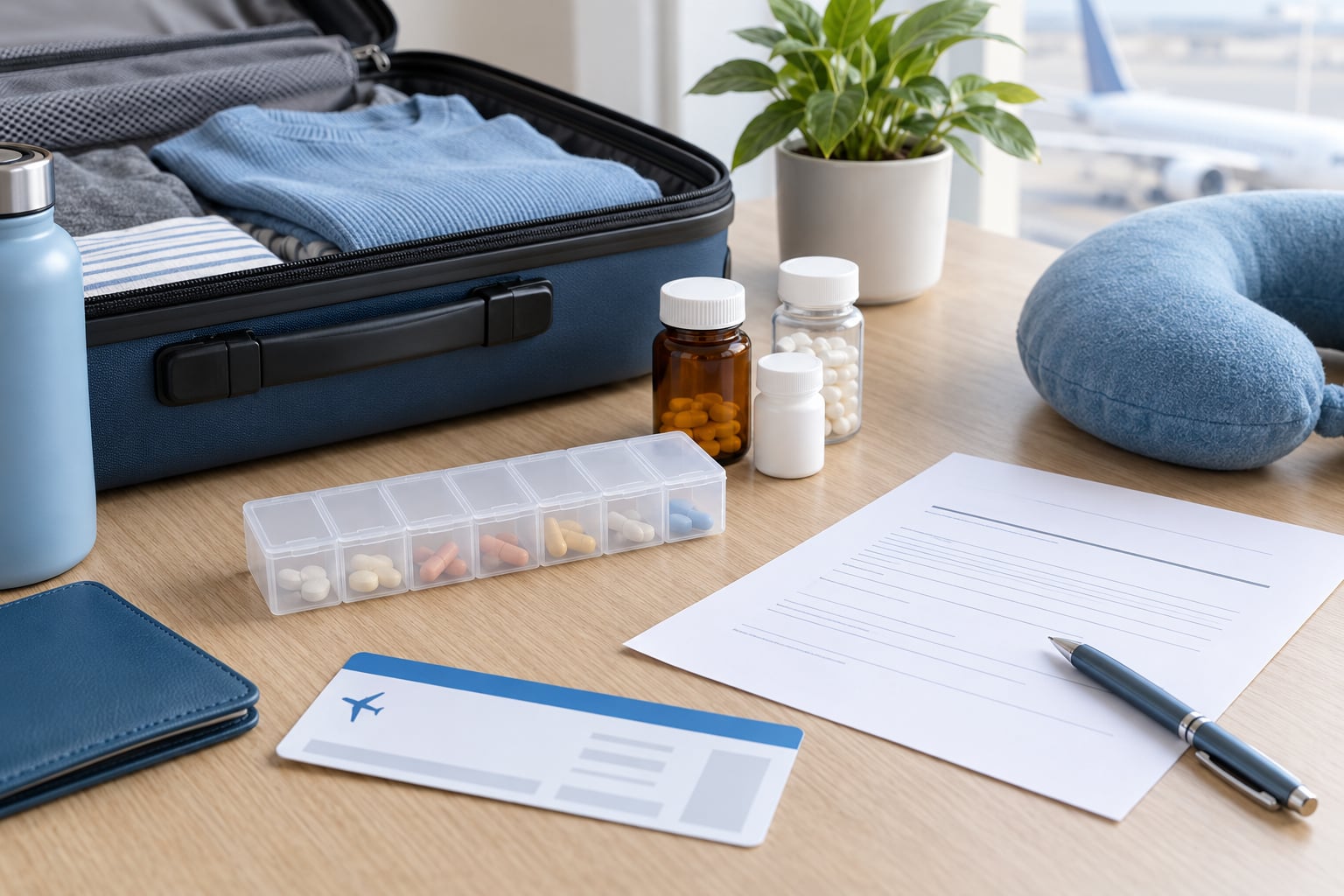
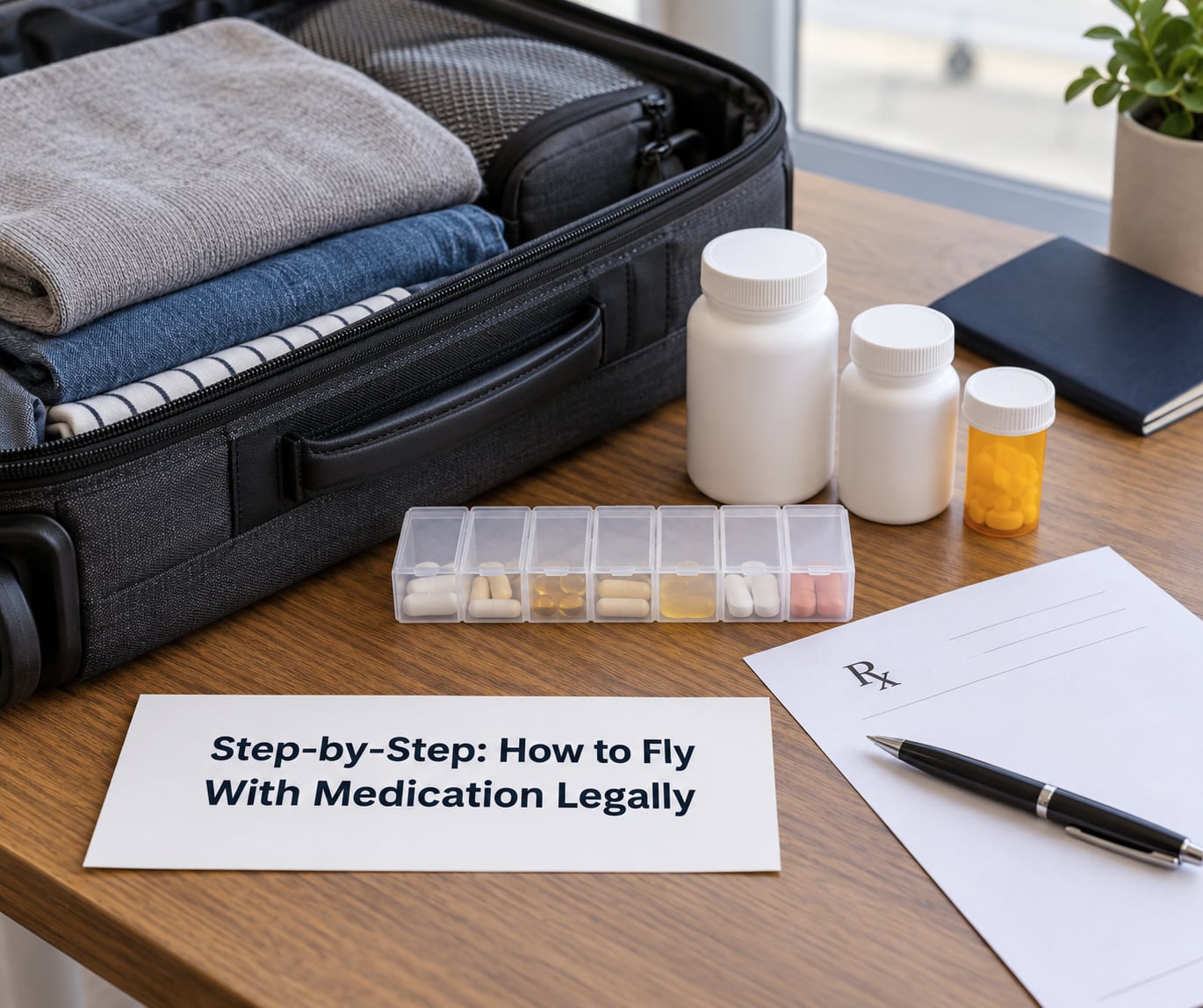
Original container versus pill organizer: the organizer is legal for solid, non-controlled pills and much easier to pack, while original bottles are the safe answer for anything controlled, injectable or narcotic. A common compromise is to bring the organizer for daily use and keep the labeled bottles alongside it in the same clear bag.
None of that requires a bag that fails a size check. Travelers on half a dozen medications often ship their pharmacy labels home, buy a small folding pouch and label each compartment by hand.
How to Fly With Medication Legally on International Routes
Airport security is where you leave. Customs is where you arrive, and that second check is the one most guides skip. At customs you are asked whether you are carrying any medicines, and the answer is yes for anything prescription, injectable or controlled. Declaring truthfully is not an admission of wrongdoing; hiding medicines is what creates a legal problem.
Most countries allow a personal-use supply, commonly one to three months of what you take. Some specify by number of packages rather than days, and Japan is strict about quantity limits for certain stimulants. Anything beyond a personal-use supply needs an import certificate or personal import permit, usually applied for weeks ahead through the doctor’s office or an online permit portal.
Here is the short version of where travelers most often hit a wall:
| Country | What to know before you fly |
|---|---|
| Japan | Strict quantity limits; some common stimulants and cold medicines are restricted or prohibited. Apply for a permit for anything unusual. |
| United Arab Emirates | Narcotics, some sedatives and many amphetamines are prohibited entirely, and personal-use allowances are narrow. |
| United Kingdom | All medicines should be in original packaging with a valid UK prescription label or a doctor’s letter; consider the personal import certificate route for larger quantities. |
| Canada | Original containers with your name on the label, and a recommended supply limit of 90 days. |
| Australia | Apply for a personal importation scheme approval in advance for anything controlled, including some opioids and sedatives. |
| Singapore | Apply in advance for an import permit for controlled medicines. |
| Schengen area | A maximum of 30 days of treatment per medicine, original packaging, and a doctor’s letter in English or the language of the first entry country. |
Working out how to fly with medication legally means checking every country on the route, not just the one you land in. Transit countries count. If you connect through a country for a few hours without clearing customs, that country still applies its rules to medicines in your carry-on, and a Schengen connection on a non-Schengen itinerary can pull you into Schengen rules. Check every airport on the route, not just the destination.
Documentation travels better than email. Carry paper copies, keep scans on your phone for the online forms some countries require, and make sure the doctor’s letter is in English or translated. Check the U.S. CDC Yellow Book and the destination’s embassy site before you book, not at the gate.
Common Mistakes
Treating domestic TSA rules as if they apply abroad. The checkpoint and customs are different authorities with different rules. Security in Frankfurt or Singapore tells you nothing about entry into the country you are flying to.
Assuming a controlled drug is fine because it is prescribed. Prescription legality at home means nothing at the border. Japan, the UAE and Australia each restrict or ban drugs that are routine prescriptions elsewhere, and the penalties range from confiscation to prosecution.
Bringing loose pills with no labels. Technically fine for non-controlled tablets in the US, and a bad idea everywhere else. It is the single change that removes most checkpoint friction.
Forgetting the name match. If the prescription, the bottle and your passport carry different names, expect questions. That is a solvable problem at home and a much worse one on arrival.
Carrying too little or too much. Too little and a delayed bag ends your trip. Too much and a customs officer may treat the surplus as more than a personal supply, which is the trigger for an import permit you do not have.
Checking medication in a suitcase. Bounded by airline rules on batteries and liquids and by temperature in the hold, and with no recourse if the bag lands somewhere else.
Counting on buying it at the destination. Your exact drug may need a local prescription, and even common brands are sold under different names. Bring enough for the trip plus a margin, and ask your pharmacist about a vacation override so your insurance will pay for an early refill.
Frequently Asked Questions
Do pills need to be in prescription bottles when flying?
For solid, non-controlled tablets, US rules do not require original prescription bottles, so a pill organizer is allowed through TSA. Keep medicines labeled anyway when anything is controlled, injectable or narcotic, because a labeled bottle removes questions at the checkpoint. For international flights, many countries require medicines in their original packaging with your name on the label.
Can I bring my pills in a pill organizer through TSA?
Yes, for solid tablets that are not controlled substances. TSA does not require original containers, though officers can ask what a pill is and why you take it. A practical middle ground is to travel with the organizer for daily doses and keep the pharmacy-labeled bottles in the same clear bag, so you can produce labels without unpacking your whole bag.
Do I have to tell TSA what my medication is for?
No. You are not required to reveal a diagnosis, and officers cannot compel you to share it. Do say plainly that you are carrying prescription medication and, when it applies, name the type of item, such as insulin or an auto-injector. Declaring the category speeds screening; explaining the condition is your choice.
Do I need to declare prescription medication at customs?
Yes, on arrival. Customs asks whether you carry any medicines, and the accurate answer covers everything prescription, injectable or controlled. Declaring truthfully is routine and expected, while undeclared medicines can be treated as smuggling. Have the medication list, prescription copies and your passport ready, and check whether the country requires an import permit in advance.
Can I check medication in my luggage?
TSA generally permits medication in checked bags, but most travelers should avoid it. Holds run cold or hot depending on the season and the aircraft, and temperature-sensitive medicine can be damaged without any visible sign. A delayed or misrouted suitcase also removes your supply entirely. Keep essential medicines and a spare dose in your hand luggage instead.
What do I do if my medication is lost or confiscated?
Contact your prescriber and insurer immediately, since a lost supply becomes a prescription emergency abroad. Your insurer can usually arrange an emergency refill at a local pharmacy, and in some countries a doctor can issue a local prescription from your records. If medicine was confiscated, ask the officer for a written record and keep your prescription copies, which are your evidence for a replacement.
Start with the destination country, not the airport. Check its import rules for each drug you take, get the prescription copies and doctor’s letter printed, and pack everything labeled in your hand luggage. Your prescriber or pharmacist can assemble most of that paperwork in one visit, and for controlled or unusual medicines it is worth calling the destination embassy before you book.