Most dangerous trail encounters share one cause: the animal had no idea you were there until you were already close. How to stay safe around wildlife on trails comes down to a short list of repeatable habits: check the current advisories, make noise as you move, keep food and scent locked away, and know each species’ response before you need it. Preparation takes about ten minutes. Skipping it is what turns a walk into a bad day.
Most safety guides bury that in one page per animal, which is not how you use the information in the moment. What works is a sequence. You cut the odds before you walk, you read the ground while you walk, and you respond calmly if something shows up anyway.
Serious incidents are genuinely rare. Plenty of hikers go decades without a dangerous encounter. The people who did have one usually describe the same thing: a surprise at close range, an animal reacting defensively, and a few seconds in which nobody knew what to do.
Table of Contents
- What You Need
- Step-by-Step
- 1. Check Trail Conditions and Wildlife Advisories Before You Leave
- 2. Plan Your Route, Pace, and Turnaround Time
- 3. Make Food and Scent Less Accessible
- 4. Read the Ground: Tracks, Scat and Other Warning Signs
- 5. Make Space and Stay Calm When an Animal Notices You
- 6. Keep Children and Dogs Close
- 7. Follow Local Rules and Leave Wildlife Habitat Unchanged
- 8. Know When to Back Out and What an Encounter Requires
- Common Mistakes
- Frequently Asked Questions
- What should I do if a bear or other large animal approaches me on a trail?
- Does bear spray work, and when should hikers use it?
- Should I run if a wild animal starts chasing me?
- How far away should I stay from wildlife while hiking?
- What should I do if my dog chases wildlife on a trail?
- Conclusion
What You Need
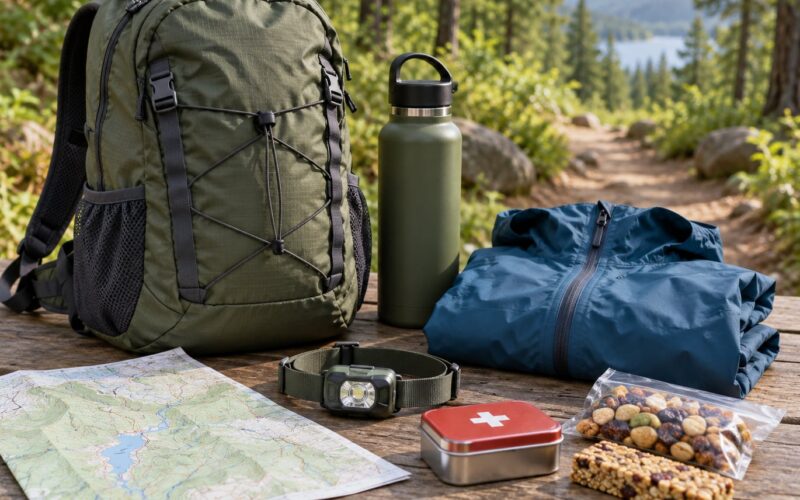
The gear list is short, but every item on it solves a specific problem. Grab these before you start driving.
- Current advisories from the agency that manages the land: trail closures, active feeding areas, fire restrictions, recent animal activity, and seasonal closures.
- Route information — distance, elevation gain, difficulty, bail-out points, and where water or road access sits.
- A charged phone plus offline navigation, either downloaded maps or a paper map as a backup. Cell service is not something to plan around.
- A first-aid kit with the basics for cuts, sprains and bites, plus anything your party specifically needs.
- A whistle. It carries much further than your voice and takes no breath to use.
- A headlamp with spare batteries, even for a day hike, because unplanned delays happen.
- Weather-appropriate layers you can adjust quickly, since you will want to move fast if an encounter goes sideways.
- An approved food storage system for wherever you are going: a bear canister, a bear locker, a lockable car storage box, or another container the managing agency accepts.
- A deterrent, where it is legal. Bear spray is the option most wildlife agencies recommend, and it belongs on your chest or hip, not at the bottom of your pack.
Requirements differ by park and by state. Some places hand out free canisters and require them at specific trailheads, some ban bear spray entirely or restrict it on certain routes, and some mandate a canister even for a day hike. Confirm what your managing agency requires before you rely on a particular method.
Step-by-Step
Run these in order. Each one removes a different way an encounter can start, and skipping a step puts more weight on the ones after it.
1. Check Trail Conditions and Wildlife Advisories Before You Leave
The managing agency’s site is the source of truth for how to stay safe around wildlife on trails today, not a blog post written two seasons ago. Look for closure orders, active feeding reports, fire restrictions, rutting and calving notes, recent sightings, and current rules on containers and deterrents.
Read the access rules too, not just the wildlife notes. A route closed for a hazing operation or a carcass is closed for a reason, and walking around a closure is how people end up in places with no cell coverage.
You have done this right when you can say, without looking it up again, where you are going, which hazards are active right now, and what behaviour that specific park wants from you.
2. Plan Your Route, Pace, and Turnaround Time
Most surprise encounters happen late in the day when light is going, feet are slow, and people stop paying attention. Build your plan around daylight, weather, fitness, difficulty and group size. If the group includes small children or an older dog, your effective pace is the slowest member’s pace.
Set a hard turnaround time and a check-in contact, then stick to it. Tell someone your route, your vehicle description and when you expect to be out. Where there is no cell service, a satellite messenger or a personal locator beacon is worth the weight.
This step is done when you could navigate the whole route on paper without a signal and still be back at the trailhead before dark or before the weather turns.
3. Make Food and Scent Less Accessible
Use the storage system that is approved where you are. A canister that is required at the trailhead is a condition of entry, not a suggestion. If hanging is allowed instead, the counterweight has to be high enough, out of reach, and in a spot a bear would have to work for.
A few habits matter as much as the container:
- Clean camps immediately. Wash dishes, wipe surfaces, pack out wipes and trash, and never rinse anything where it runs downhill toward a water source.
- Keep packs and sleeping gear well away from where you store food, and never inside the tent at night.
- Never leave food in a vehicle. Bears break windows for a granola bar wrapper.
- Keep scented items, toiletries, sunscreen and insect repellent out of reach alongside your food.
- Never feed wildlife, even when it looks harmless. A fed animal usually does not survive to winter, and the park usually responds by removing the animal.
You have done this right when an animal has no reason to associate your camp or your route with food. That is the entire goal of scent management.
4. Read the Ground: Tracks, Scat and Other Warning Signs
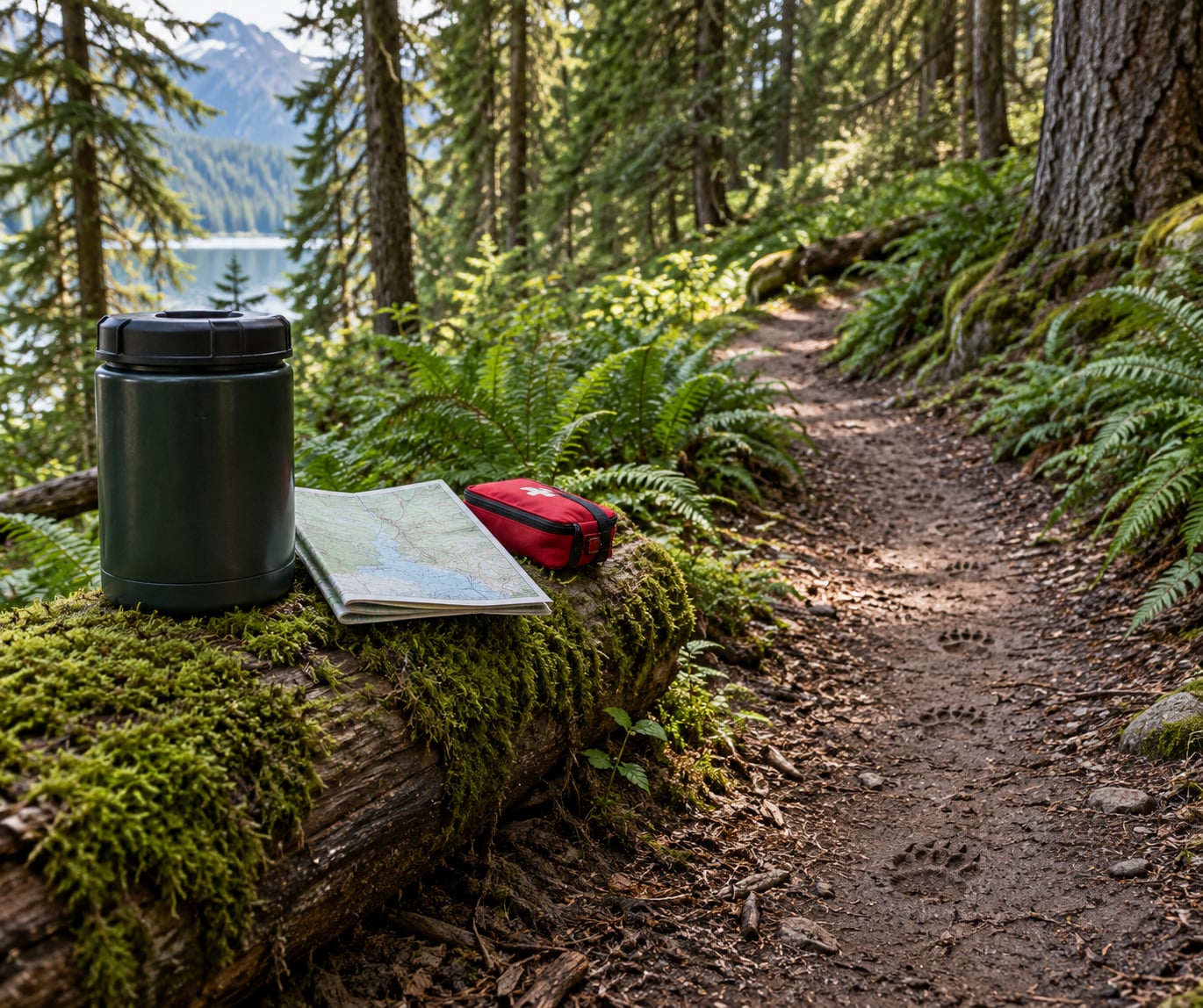
Wildlife tells you it is there before you see it. Look at the trail surface as you walk for fresh tracks pressed into soft dirt or mud, scat in the centre of the tread rather than at the edges, scratch marks on trees, soil pushed aside where something dug for food, and displaced rocks. Bird alarm calls and sudden silence from everything else count too.
Signs that point to a large animal: tracks with toes you can see in mud, a broad scat, and layered prints that cross each other. Signs that point to repeated use: multiple sets of tracks travelling the same direction along your route.
Do not approach a carcass or a feeding site. Do not crouch over a print to measure it. Signs support your judgement, but they cannot reliably tell you the species or exactly how far away it is, so treat them as a reason to slow down rather than a reason to relax.
5. Make Space and Stay Calm When an Animal Notices You
If an animal has noticed you, the priority is space, not identity. Slow down. Do not run, do not scream, and do not make a sudden movement. Speak in a calm, low voice so it can tell you are human, and back away diagonally rather than straight back, keeping the animal in sight.
Give it a clear exit toward food, water, cover or its young. Never stand between an animal and any of those. Keep dogs leashed and on the far side of you from the animal.
A few species-specific notes worth knowing in advance:
- Bears. Give bears 100 yards where that is the rule, more in practice. Most charges are bluff charges and end without contact. If a grizzly or brown bear makes contact, play dead on your stomach, hands clasped behind your neck, legs spread, pack on. If a black bear keeps attacking after you have tried to appear large, fight back hard and do not give up.
- Cougars. Do not run, and do not turn your back. Face it, stand tall, speak firmly, and give it room to leave. Never assume a cougar that watches you has already decided against you.
- Elk, moose and bison. Give these much more room than instinct suggests. A bull elk in rut, a cow with a calf, or a bison cow protecting her calf will not hesitate to charge, and speed, agility and horn span are all on their side.
- Snakes. Most bites happen when someone steps over a log or reaches into brush without looking. Stop, back away slowly, give the snake a path and let it go. Do not try to identify it while you are standing over it.
Success here means the animal moves off and nothing escalates. That is the outcome in the large majority of cases.
6. Keep Children and Dogs Close
Adults position themselves between children and any animal, and dogs stay leashed and close to you, not trailing. An off-leash dog turns a quiet sighting into a chase, and a chasing dog can provoke exactly the defensive response that ends with an injury to the dog.
Teach children early: stop when an adult stops, do not run toward an animal, never touch or feed one, and hand over snacks rather than dropping them. Most animals interpret a dropped food wrapper as an offering, and food is the fastest route to conflict.
If a child or dog moves toward wildlife, get between them calmly and back them out. Don’t chase a running dog into the trees, because two people running fast in that direction makes the situation worse.
The safest plan is distance, applied early. Instructions shouted at the edge of a chase rarely work.
7. Follow Local Rules and Leave Wildlife Habitat Unchanged
Carry bear spray only where it is legal, keep it on your chest or hip in a readily accessible spot, and carry the manufacturer’s instructions. Practise once with an inert trainer if you can. Aim as the label shows, which is not straight at the animal’s face, and deploy it when the animal is charging or has closed to about 20 feet. Spraying a bear that is simply passing by wastes the canister and makes things worse.
Audio and scent products such as bear bells and ammonia-impregnated patches have mixed results and differ by species, so check local guidance before you pack them.
Some places allow firearms, and that debate shows up constantly on hiking forums. Where it is legal, it is a personal decision; where it is not, the question is settled. Also read the rules on drones, which are restricted in most national parks because of wildlife disturbance.
Leave the habitat alone. No feeding, no selfies at close range, no calling animals in, no moving rocks or logs to look underneath, no loud playback to draw wildlife toward you.
8. Know When to Back Out and What an Encounter Requires
Backing out early is a skill, not a failure. Turn around if you find fresh signs and the animal does not appear, if visibility drops, if a barrier or gate closes behind the trail, if the weather turns, or if you simply feel like the conditions have changed. Tell someone when you are out.
For an immediate defensive situation, the general pattern is consistent: do not run, make yourself look larger, speak firmly, give the animal room, and only use a deterrent when it is closing. Species-specific guidance from the managing agency always takes priority over anything written here.
Never approach an animal to identify it, and never turn around to retrieve a dropped item. Give the animal space and leave your gear.
Common Mistakes
Almost every avoidable incident traces back to one of these.
- Running. It triggers a chase reflex and starts a race you lose. Fix: back away slowly, keep facing the animal, talk calmly.
- Feeding, or posing for a photo too close. Both habituate animals to people and get people relocated or removed. Fix: use a zoom lens and enjoy the shot from where you stand.
- Leaving food accessible. A pack set down “just for a minute” is how animals learn your habits. Fix: pack never comes off in bear country unless you are using the required system.
- Assuming a dog makes you safer. Most dog-related incidents start as a chase. Fix: leash short, dog behind you, and pick up the leash when wildlife is near.
- Ignoring fresh signs. Tracks in soft mud with defined edges are recent. Fix: slow down, talk louder, and step off the tread if the signs are on your line.
- Using deterrents that local rules do not permit. Fix: read the current regulations, not last year’s blog post.
- Deploying spray too late. Waiting until the animal is on top of you wastes it. Fix: use it at roughly 20 feet when the animal is committed to closing.
- Continuing past a closure or a barrier. Fix: turn around. The detour is the reason the closure exists.
- Following a defensive animal. Circling back to get a better photo or a second look is how a bluff charge becomes a contact. Fix: leave, and report aggressive behaviour to the managing agency.
Three reminders cover most of the rest: check the local guidance the morning you go, keep the group together, and turn back early when conditions change. Turning back is always available to you and never available to a grizzly.
Frequently Asked Questions
What should I do if a bear or other large animal approaches me on a trail?
Stop moving, speak calmly in a low voice so the animal knows you are human, and back away slowly without running. Give it a clear path to leave. If a grizzly or brown bear makes contact after a defensive charge, lie face down on your stomach with hands clasped behind your neck, legs spread, pack on. With a black bear that keeps attacking, fight back hard. Species guidance from the managing agency always wins.
Does bear spray work, and when should hikers use it?
Carry it where it is legal, on your chest or hip rather than buried in your pack, and practise once with an inert trainer. It is the most effective deterrent most hikers carry, effective at short range of roughly 20 to 30 feet. Spray when the animal is charging or has closed to about 20 feet, aiming as the label shows. Never spray at an animal that is only passing by.
Should I run if a wild animal starts chasing me?
No. Running triggers a chase response in bears and large cats and shortens a race you cannot win. Back away slowly, keep facing the animal, talk calmly, and put something solid between you and it, such as a large rock or a full-length trekking pole. Running is only sensible from something smaller that is not a genuine threat, and even then, backing away works better.
How far away should I stay from wildlife while hiking?
Give large mammals a wide berth. Where regulations apply, 50 yards is the common minimum for elk, moose and bison, and 100 yards for bears and other animals you are watching, which is roughly three to four bus lengths. If an animal moves toward you, add distance rather than holding your ground. Use your phone zoom instead of walking closer for a better view.
What should I do if my dog chases wildlife on a trail?
Call the dog back with a flat, urgent voice, and use a long leash if you have one. Do not run after the dog yourself, since two people sprinting toward wildlife makes it worse. Keep children close and quiet while you sort it out. A chasing dog can turn an animal that was already leaving into a defensive attacker, so back off together and report aggressive wildlife to the park.
Conclusion
Start with one action: check your managing agency’s current advisories and rules before you drive out, then match your food storage and deterrent to what that land requires. After that, the rest is habit.
Learning how to stay safe around wildlife on trails is mostly about preparation, distance, calm movement and an early turnaround. The animals you meet are usually just doing what they do; the variable you control is how much space you leave them.