
Hidden hotel fees are mandatory or optional charges that are not part of the advertised nightly rate and surface later: at the checkout screen, at the front desk, or as a charge on your card after you have gone home. Working out how to avoid hidden hotel fees takes about fifteen minutes of reading plus five minutes per booking. This checklist covers all three moments: before you pay, at the desk, and after checkout if a line looks wrong.
The reason fees catch people out is simple arithmetic. A nightly rate of 90 dollars becomes roughly 130 dollars once taxes, a facility charge and parking are added, and that gap rarely shows up until the last screen. Guests on r/hyatt describe the reverse problem just as often: a points stay that looked fee-free at booking, followed by a 28 dollar charge at 12:01am with no warning at all.
Last updated October 2026.
Table of Contents
- What You Need
- Step-by-Step: Check the Total Price Before Booking
- How to Avoid Hidden Hotel Fees Step 1: Compare the Same Room
- How to Avoid Hidden Hotel Fees Step 2: Separate Mandatory Fees From Optional Extras
- How to Avoid Hidden Hotel Fees Step 3: Read the Fine Print
- How to Avoid Hidden Hotel Fees Step 4: Confirm the Rate in Writing
- How to Avoid Hidden Hotel Fees Step 5: Check at Check-In
- Common Mistakes
- Frequently Asked Questions
- Can I avoid hotel resort fees?
- Are resort fees included in the price shown by online travel sites?
- Should I book directly with the hotel or use a third-party website?
- How can I dispute a hotel fee that appears after check-in?
- Do hotel loyalty programs help avoid hidden fees?
- Conclusion
What You Need
You do not need any special membership, tool or expertise. You need five ordinary things, and most trips need only the first three.
- A browser with two or three tabs open. One for the booking site, one for the hotel’s own site, one for your email inbox so you can open the terms.
- The hotel’s rate sheet or total-price breakdown. On the hotel’s own site this is usually a taxes and fees line or a mandatory-fees list before you reach checkout.
- The final checkout summary for each option you are weighing. Not the search results page, not the map view. The last screen, the one with the total.
- A credit card. Only needed if you intend to pay at the property or to dispute a charge later, since card networks handle disputes far better than cash.
- A copy of your confirmation email. Keep it somewhere you can reach from your phone without logging in to five apps.
If you skip the third item you are guessing, and guessing is what produces the shock at the front desk.
Step-by-Step: Check the Total Price Before Booking
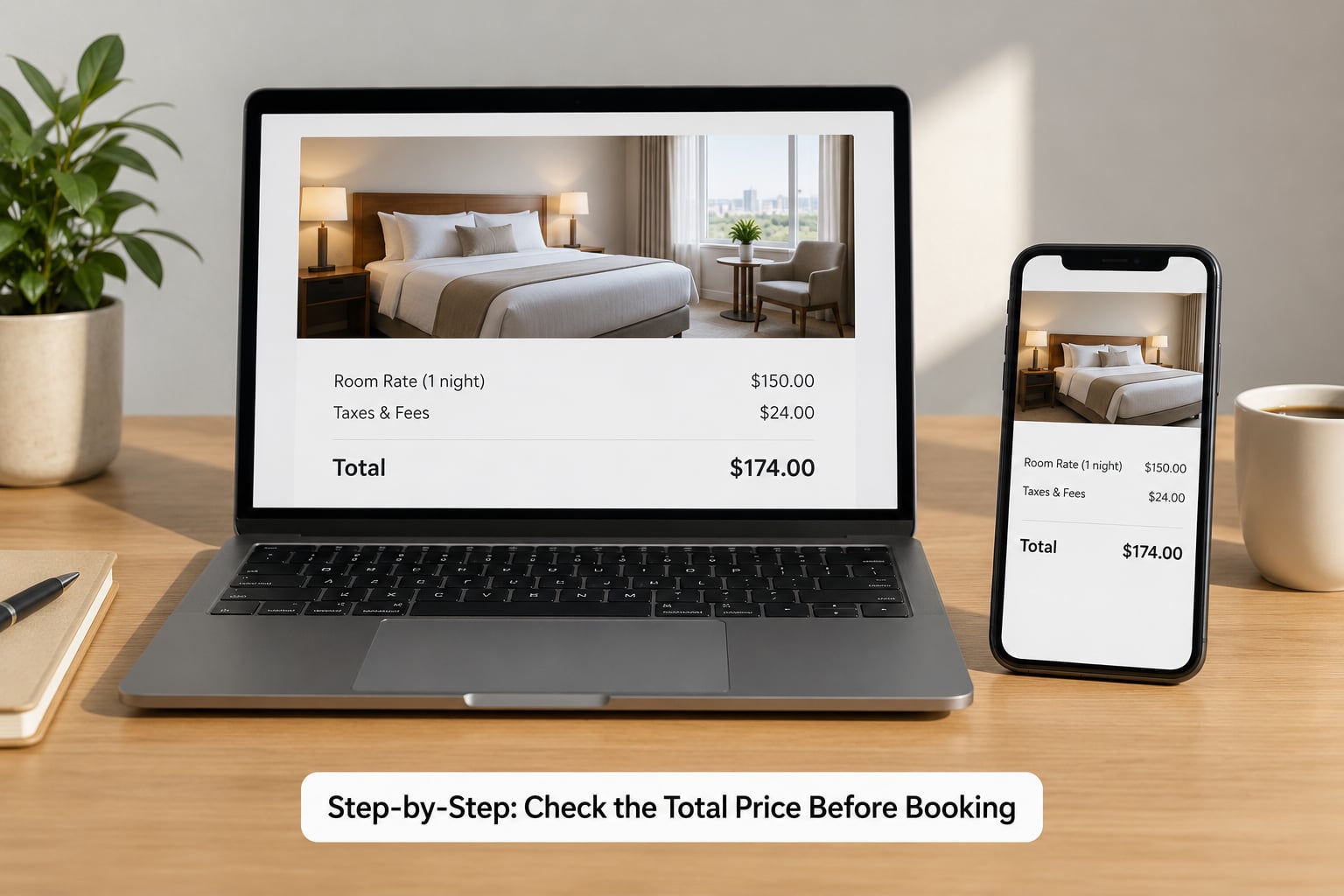
The process takes about five minutes once you know where the total hides. Run it every time, even for a city break you have booked a dozen times before, because fee policies change between properties rather than between chains.
How to Avoid Hidden Hotel Fees Step 1: Compare the Same Room
Most misleading comparisons are not lies. They are mismatches: a standard room against a room on a prepaid non-refundable rate, or two adults against three, or a rate with free cancellation against one that forfeits the deposit. Match room type, dates, number of guests, cancellation terms and payment requirements before you compare any numbers at all.
Then check what is included. A rate that bundles breakfast, parking and airport transfers can be cheaper than the headline rate plus four add-ons. You worked out how to avoid hidden hotel fees wrongly if you compare a bare room against a bundled one.
How to Avoid Hidden Hotel Fees Step 2: Separate Mandatory Fees From Optional Extras
Mandatory charges apply to everyone who books and cannot be declined: occupancy or sales taxes, destination and facility fees, parking in cities where every garage charges, linen or cleaning charges in some European properties, and the resort charge that appears on properties which are not resorts at all. Optional extras are things you choose: minibar items, in-room dining, spa access, late check-out, room safe use, a second pillow from the closet.
The distinction matters because optional extras are a choice you can decline in under a minute. Mandatory charges are a condition of the rate, which means your only lever is picking a different property or a different room tier. Forum posters on r/hyatt note that ordinary non-resort hotels increasingly attach destination or amenity fees, so the label tells you nothing about what you are paying for.
How to Avoid Hidden Hotel Fees Step 3: Read the Fine Print
Open the terms rather than skimming. You are looking for four things: the deposit or prepayment rule and its deadline, the incidental hold amount, any restriction on how the reservation may be changed, and the list of charges that can appear after you check out. On a prepaid rate, find the cancellation deadline in writing and set a calendar reminder for it the moment you book.
Skip this step and a change of plan can cost you the full stay. Refundable rates usually cost a little more up front and buy you that optionality for free.
How to Avoid Hidden Hotel Fees Step 4: Confirm the Rate in Writing
Before you pay, send one message through the booking platform’s own channel, which keeps a record. Ask for the total per night including taxes and fees, the resort or destination fee if one applies, whether parking is charged, what the cancellation deadline is, and whether any charge will be added after checkout. The written confirmation should show an all-in total, the inclusions, and the deadline.
Ask one specific question: what does the facility fee cover? A hotel employee quoted in travel media argues these charges are negotiable more often than guests assume, and you cannot negotiate a line item you have never asked about. If the reply is vague, that is your signal to book elsewhere.
How to Avoid Hidden Hotel Fees Step 5: Check at Check-In
At the desk, ask for the rate you booked and the itemised total before you hand over a card. When the folio prints or appears on screen, read every line while you are still standing there. Unfamiliar charges are far easier to remove in person than twenty days later by email, and asking about a line you do not recognise costs nothing.
For incidental holds, note the amount and ask when it is released. A pre-authorisation is not a charge: it is a temporary hold that normally disappears a few days after checkout, but it can eat your available balance for days. One guest on r/hyatt describes a points booking with no fee disclosed, followed by a 28 dollar charge after midnight; the lesson is to reconcile the folio against your confirmation before you leave the property.
Common Mistakes
Comparing headline rates only. Two rooms at 95 and 110 dollars mean nothing until both totals are on the same page. Search results pages optimise for click-through, not for your budget.
Booking through an unclear third party. Forum threads on r/vegas describe the pattern repeatedly: third-party sites leave resort fees off the headline rate, and the surprise lands at the counter where there is nothing to compare against. A prepaid package bought through an agent once left a guest unable to check in until a fee paid, and the fee appeared in neither the brochure nor the agent’s description.
Ignoring deposit terms. A rate that is cheaper because it is prepaid and non-refundable is a bet on your plans. Free cancellation inside the stated window is worth more than the difference most of the time.
Assuming the resort fee is optional. It is mandatory, which is why asking to remove it rarely works. What can work is asking to remove it from the rate, which is a different conversation, and points or elite bookings at brands that waive the fee outright.
Disputing a charge with nothing in hand. A screenshot of the checkout summary showing the all-in total is the single most useful piece of evidence, and it is free. One Tripadvisor reviewer who had a resort fee added to an already-paid package got a reimbursement from chain headquarters after complaining with the original confirmation in front of them.
A few habits prevent nearly all of it: keep the confirmation email, read the total rather than the rate, ask about facility fees by name, and reconcile the folio on departure day. Waivers are not guaranteed and elite status only improves your odds, as travel experts point out, but asking gets you a waiver far more often than staying quiet does.
Frequently Asked Questions
Can I avoid hotel resort fees?
Sometimes, and the route depends on the property. Points and award bookings with brands that waive resort fees are the cleanest way, and elite status improves your odds of a waiver at check-in without guaranteeing one. In high-fee cities, choosing a room tier that is not part of the resort-fee category can drop the charge entirely. Otherwise your real option is a different property in a different block. Asking for removal of a mandatory fee is usually a no, asking to move you to a rate without it sometimes works.
Are resort fees included in the price shown by online travel sites?
In the United States they are supposed to be now. The FTC junk fees rule requires mandatory charges such as resort, destination and facility fees to be included in the advertised total price rather than dripped in at checkout. In practice, some booking platforms still surface the nightly rate first and reveal fees on the final screen, and the rule does not cover every country. Always check the total on the last screen, and check the hotel’s own site as a comparison.
Should I book directly with the hotel or use a third-party website?
Direct booking usually shows the all-in price most clearly, and it gives you one person to argue with when a charge is wrong. A third-party site is fine for comparison and sometimes has better cancellation terms or points pricing, but it adds a layer between you and the front desk. Whichever you choose, pay attention to the final total rather than the search result, and avoid bookings made on a third party whose fee policy is not stated in writing.
How can I dispute a hotel fee that appears after check-in?
Start with the hotel. Call or email the property, quote the confirmation number, state the all-in total you were shown at booking and attach that screenshot. Then ask your card issuer to dispute the charge, which is a separate process from asking the hotel for a refund and often more effective. If it was never disclosed, that is a stronger case than simply disliking it. Keep a record of every message, and allow the issuer’s stated timeline to run.
Do hotel loyalty programs help avoid hidden fees?
Partly. Elite status commonly waives things you would otherwise pay for, such as internet access and late check-out, and it improves your odds of a resort fee waiver at check-in without any guarantee. Award bookings at certain large chains waive resort fees entirely, while others add them to the points price, so the programme brand names matter less than the specific property’s policy. Status also makes a disputed charge easier to escalate, because you have a direct contact and a member services team.
Conclusion
If you do one thing differently after reading this, make it the total. Before you pay, compare the tax-inclusive price on the hotel’s own site against the booking site for the same room, dates and cancellation terms, and ask the hotel in writing what the fee covers and whether anything else will be added later. Everything else in this checklist is recovery. That step is prevention.