
The trick to how to plan a trip around someone else’s schedule is simple: treat their fixed commitments — work, school runs, medical appointments, a wedding — as the frame, then build dates, destination and daily plans inside whatever space is left over. You are not persuading anyone to rearrange their year. You are finding the overlap first and planning inside it.
That is the version of this problem almost nobody writes about. Every guide online assumes mutual availability: everyone has roughly the same free weeks, everyone wants the same trip, and the job is just to agree on a place. Real life rarely cooperates. One person’s leave is already committed. Someone’s mum has a hospital follow-up on a Thursday. A wedding date was set by someone else, months ago.
Working around a person’s calendar is not being submissive, and it is not a favour you are doing them. It is the only workable version of the trip when the dates are not yours to choose. Ask the awkward questions early, keep the plan loose enough to breathe, and everything after that gets easier.
How long this takes depends on how many people are involved. Two people with different work patterns can be sorted in an afternoon. A multi-generational trip around a fixed wedding takes three to four weeks of careful collecting before you spend anything.
Table of Contents
- What You Need
- Their fixed commitments
- Date windows that survive those commitments
- A shared place to write it down
- Money rules
- The practical needs
- Step-by-Step
- Step 1: Mark the schedule you cannot change
- Step 2: Find the best overlap
- Step 3: Choose a home base and plan around it
- Step 4: Build a priority-based itinerary
- Step 5: Book the fixed parts first
- Step 6: Share the plan and create a backup
- Common Mistakes
- Frequently Asked Questions
- How do I plan a vacation when my partner has a fixed work schedule?
- Can I travel around someone else’s appointments without taking the whole trip?
- How much free time should I leave between activities each day?
- What should I do if my travel companion wants a completely different pace?
- How far in advance should I book transportation and accommodation around work commitments?
- What backup plans work best for last-minute changes during a trip?
- Conclusion
What You Need
Before you open a booking site, collect five things. Anything you book before this list exists is a purchase you will probably regret.
Their fixed commitments
Ask directly and without ceremony: annual leave already approved, recurring meeting patterns, school holiday dates, childcare arrangements, medical appointments, existing travel, a season they never travel in. Write them down as dates or date ranges, not as vague feelings about how busy they are.
Date windows that survive those commitments
You want at least three workable windows, not one. A person who can only travel in a two-week band every quarter has given you a recurring pattern, and patterns survive bad weeks better than single dates.
A shared place to write it down
One calendar, one document, one chat. Use a shared Google Calendar for time blocks, a shared Google Doc or Google Drive folder for bookings and confirmations, and a group chat for decisions. Tool fragmentation is the single most common complaint in travel planning forums — people lose track because the plan lives in six places instead of one.
Money rules
Agree a rough per-person range and a payment deadline before anything is reserved. Splitwise or Settle Up handles the running total once money starts moving; a plain spreadsheet works just as well if the group is small and everyone is honest. Decide who fronts deposits and gets reimbursed.
The practical needs
Transport limits, mobility needs, stairs, walking tolerance, dietary requirements, and two or three things each person genuinely wants to do. This is also the moment to ask who is joining for only part of the trip, so the itinerary does not assume everyone is present for every day.
Step-by-Step
Step 1: Mark the schedule you cannot change
Put every immovable item on one calendar first: work hours, standing meetings, school dates, childcare, medical appointments, a family event, existing trips, and the person’s normal sleep pattern if they are an early riser or a night owl. Treat their rest needs as a commitment, not a preference.
Send the list back to them and ask one question: which of these could move if the trip were worth it? Their answer tells you what is genuinely immovable and what is habit.
Step 2: Find the best overlap
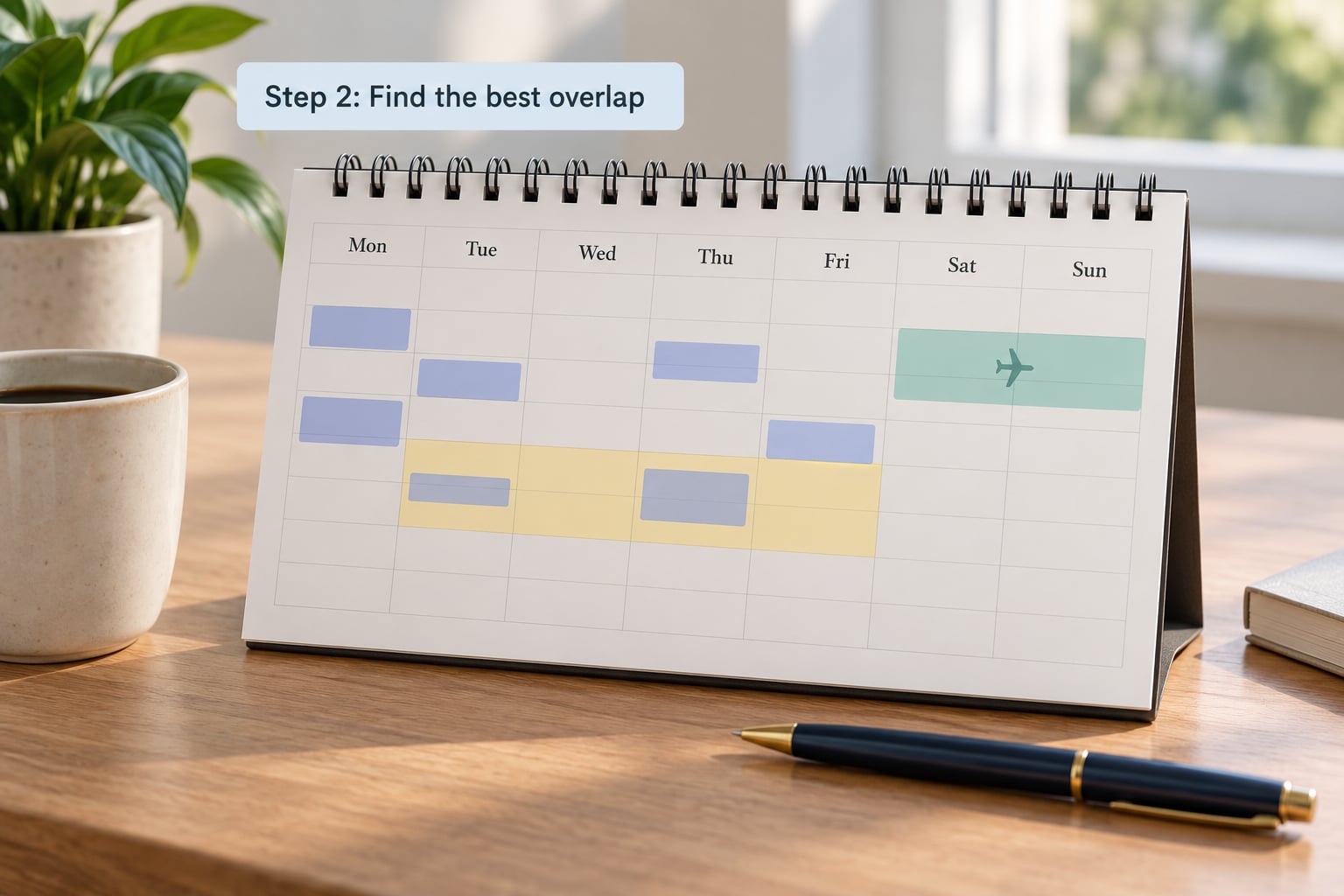
Now line up every traveler’s constraints and look for windows where they all intersect. A simple grid works better than a group chat message, because everyone can see the same picture and nobody has to guess who is free. Travellers down one side, dates across the top, mark the days that are genuinely available for each person.
| Traveller | 1 to 5 May | 6 to 12 May | 13 to 19 May |
|---|---|---|---|
| Sam | Unavailable | Available | Available |
| Priya | Available | Available | Available |
| Tom (joins day 3) | Unavailable | Unavailable | Available |
| Everyone free | — | — | 6 to 12 May |
Then confirm the surviving windows with a proper poll instead of a group-chat message. Doodle or a short Google Form with date ranges, not yes-or-no questions. A form lets someone mark “these days work, those don’t” in one pass, which is far easier than replying to a chat full of opinions. Give everyone a deadline of a few days, and decide in advance what happens if someone never answers.
Step 3: Choose a home base and plan around it
Pick one accommodation near the commitments that matter most, usually whatever is closest to the fixed event or the person’s medical appointments. Staying put for the whole trip removes daily packing, checkout friction and the stress of a moving itinerary built around someone else’s diary.
If the schedule genuinely splits the trip into two parts, book two bases and treat the changeover as part of the plan rather than an emergency.
Step 4: Build a priority-based itinerary
Split every idea into three buckets: must-do, if-time-allows, and optional. Must-dos go on the days that suit the constrained person’s energy and health. Optional items are opt-in blocks with no expectation of attendance, so nobody is obliged to do something that clashes with their rhythm.
Leave real gaps. If the map says a drive takes 20 minutes, plan 30, because groups move slower than individuals. One anchor activity per day is plenty; two is a maximum on a day that includes a long transfer or a wedding.
Step 5: Book the fixed parts first
Lock in transport and accommodation around the confirmed dates, then anything scarce and high-demand, then everything else. Booking order matters: the dates and the base come first because every other reservation hangs off them.
Read cancellation terms before you pay, and check realistic connection times rather than the fastest option. A 40-minute layover that ends up costing someone a missed event is worse than the extra fare saved. Around a fixed date you usually book three to six months out for flights and rooms, and passport or visa lead times can run longer, so check those first of all.
Step 6: Share the plan and create a backup
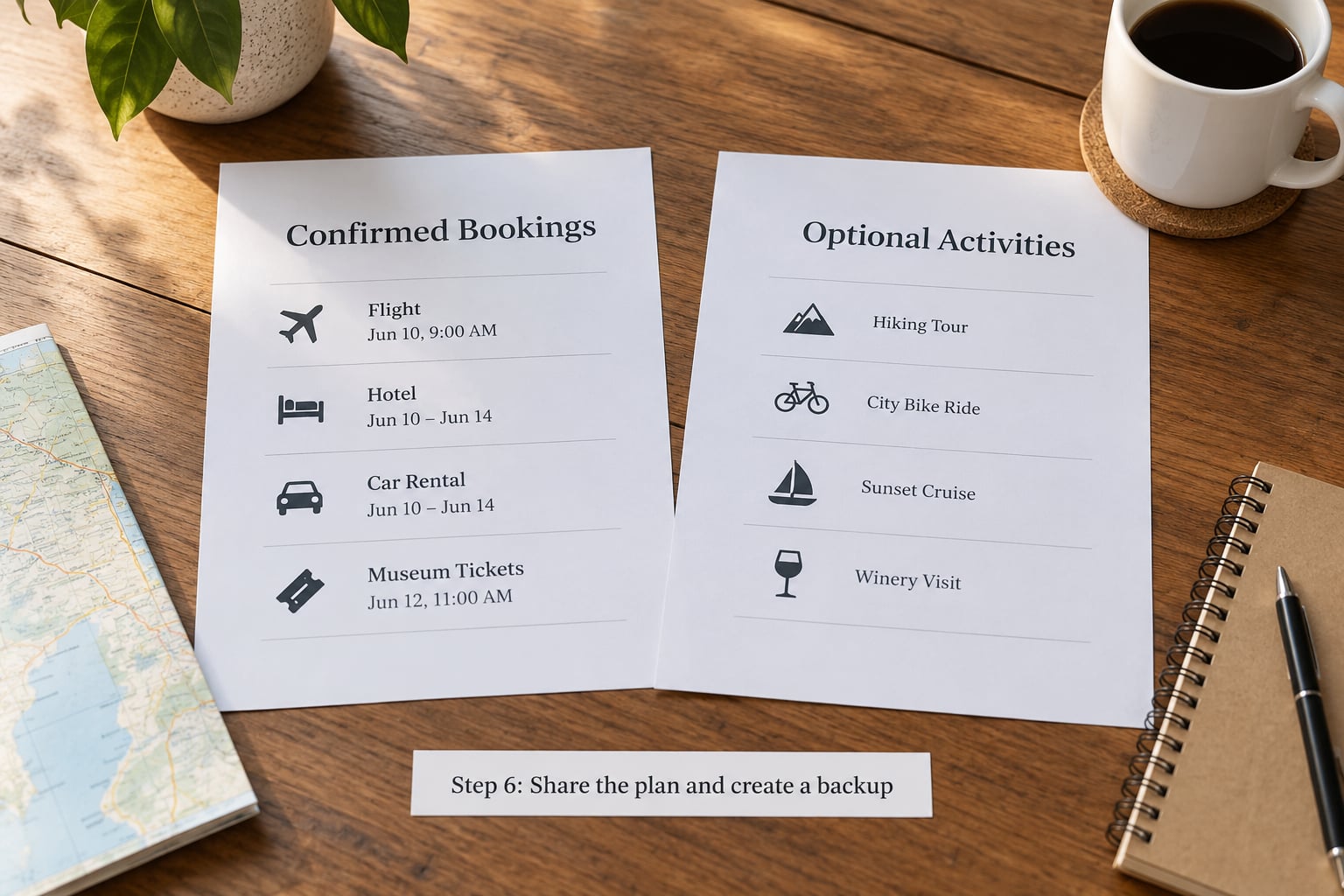
Turn the itinerary into a shared document that clearly separates confirmed bookings from suggestions. Confirmed items carry a reference number and a time; suggestions carry a note about who they suit. One page is better than ten, and it should be the version people actually read.
Then prepare one backup activity for weather, exhaustion, transport delays or a cancelled plan. A nearby indoor option with flexible tickets does the job. Decide in advance who can be skipped without guilt, and agree what happens if someone’s schedule changes mid-trip: who books, who absorbs the cost, and how far in advance they must say.
Common Mistakes
Almost every failed trip built around someone else’s schedule fails for the same handful of reasons.
Packing every hour. The itinerary looks efficient on paper and exhausting in practice. Fix: one anchor per day, plus two or three genuinely empty blocks. Downtime is part of the plan, not leftover space.
Ignoring recovery time. Long travel days followed by early starts will produce a bad trip no matter how good the sights are. Fix: schedule the lightest day right after the longest transfer, and treat a rest afternoon as a non-negotiable line item when you are travelling with an older relative or anyone managing a health condition.
Booking nonrefundable things before consensus. Waiting for a group’s “yes” costs more, but a wrong nonrefundable booking costs far more. Fix: hold rooms with free cancellation until the dates are locked, set a decision deadline, and check what happens to the deposit if the schedule shifts.
Assuming everyone wants the same trip. You may be booking a museum-heavy city break for someone who mostly wants to sit somewhere warm. Fix: ask for two or three non-negotiables per person before you pick a destination, not after.
Making every plan mandatory. Opt-in blocks exist so nobody has to perform enthusiasm they do not feel. Fix: mark optional items clearly, and never book anything on behalf of the whole group without a yes from the person it affects.
One more: appoint a single coordinator. Planning around someone else’s schedule is genuinely draining, and when it falls on one person by default that is the fastest route to resentment.
Frequently Asked Questions
How do I plan a vacation when my partner has a fixed work schedule?
Start with their calendar, not yours. List the leave they already have, recurring meeting patterns and the weeks they never travel, then look for windows that fit. Plan backwards from those dates: choose a destination and a base, then book. Keep daily plans light and put optional items as opt-in blocks so nobody is obliged to join. If their leave is not approved yet, hold refundable rooms until it is.
Can I travel around someone else’s appointments without taking the whole trip?
Yes, and you should plan the overlap rather than the total. Mark every confirmed appointment on a calendar, then build the trip inside the gaps between them. Anchor each day to the nearest free window instead of to a fixed time, so a two-hour consultation does not blow up the evening. When the appointments cluster in one region, choose a home base nearby and treat everything else as optional.
How much free time should I leave between activities each day?
Plan on roughly half the day free. That means one anchor activity, a long lunch or a proper rest block, and an evening that could go anywhere. Add 10 extra minutes per transfer, because groups move slower than individuals and someone using a walking aid or travelling with small children sets the pace. Extra space is the difference between a relaxed day and a race between car doors.
What should I do if my travel companion wants a completely different pace?
Decide early whether you are planning your holiday or theirs, and say so plainly. Then split the days: early starts and packed sightseeing for one, later starts and longer stops for the other, with a shared midday and a shared dinner. If the mismatch is about pace rather than budget, an opt-in structure fixes it. If it is about what matters entirely, you may be looking at two trips rather than one.
How far in advance should I book transportation and accommodation around work commitments?
For trips built around fixed dates, book transport and rooms three to six months ahead, and earlier for peak weeks or long-haul routes. Check passport and visa lead times first, since those can run much longer and cannot be sped up. When you are waiting on someone’s leave approval, reserve refundable accommodation as a placeholder and set a hard decision date for the nonrefundable flights.
What backup plans work best for last-minute changes during a trip?
Keep one indoor option per day that needs no planning and has walk-up or same-day tickets, plus a nearby town or neighbourhood with cafes and a bookshop. Agree a simple signal, such as a weather check at breakfast, so nobody has to argue about whether to abandon an outdoor plan. And pre-decide that any plan can be dropped with no guilt attached.
Conclusion
The first action is small: write down every commitment that cannot move, then find the window where they all line up. Everything after that is easier. Choose one base near those commitments, add two or three anchor plans for the days that overlap, and let everything else stay optional. People travel around other people’s schedules more often than guides admit, and it works best when the constraint is treated as the frame rather than the problem.