You can rent a car at 18 in Michigan and New York, at 19 in parts of Alabama and Nebraska, and at 21 in the rest of the United States. Between 21 and 24 you will usually pay a young driver surcharge on top of the base rate and lose access to luxury, specialty and performance vehicles, so learning the age rules before you search is the whole trick.
Booking takes about 20 minutes online and another 20 to 30 at the counter. This guide covers how to rent a car under 25 in the United States: what to bring, which vehicles you are actually allowed to take, and the three places most young renters quietly lose money.
One thing to accept early: minimum age, accepted payment methods, deposits, license requirements and vehicle restrictions all vary by rental company and by branch. Any quote you read is only real once it is tied to your age, your home state and the exact address you will pick up at.
Table of Contents
- What You Need
- Step-by-Step
- Confirm Your Age Policy and Restricted Locations
- Compare the Full Price, Not Just the Daily Rate
- Choose a Vehicle You Are Eligible to Rent
- Book Directly and Protect the Reservation
- Pick Up the Car and Complete a Careful Inspection
- Common Mistakes
- Frequently Asked Questions
- Can I rent a car at 18, 19, 20, 21, 22, 23 or 24?
- Why do rental companies charge a young driver fee?
- Can I use a debit card instead of a credit card to rent?
- Can someone older rent the car and add me as a driver?
- Can I avoid the young driver surcharge with a membership or discount?
- What happens if I do not return the car to the location I selected?
- Conclusion
What You Need
The counter will not rent to anyone who is missing one of these, and the online booking flow will not warn you about most of them either.
- A valid driver’s license that you have held for at least a year, matching the name on your payment card. Some companies require a longer holding period for larger vehicles.
- A credit card in the primary renter’s name, with available credit for the deposit plus the estimated rental total. Debit cards are accepted at many branches but usually trigger a larger hold, extra ID, a credit check or a return-flight itinerary.
- Government-issued photo ID for anyone who will drive. Additional drivers almost always need their own license and ID, even if they share your address.
- Your booking confirmation, with the reservation number, the exact branch address and the rate you agreed to.
- An international driving permit if your license is not in the Latin alphabet or if you are renting outside the United States. It travels with your home license, never instead of it.
- A return plan: where the car goes, what time, and how the branch charges for fuel and for late returns.
- Proof of insurance if a college, employer or insurer requires it for a replacement or business rental.
Checklist worth running before you search: confirm the minimum age at your age for the specific city, check that the license requirement matches how long you have held yours, confirm a card in your own name is acceptable at that branch, confirm the vehicle class is permitted for your age band, and only then compare totals. That five-minute pass saves the surprise at the counter that most people under 25 talk about later.
Step-by-Step
Renting under 25 is a normal rental with two extra layers: an age surcharge and a vehicle list. Work through these steps in order and the process takes about an hour from first search to driving away.
Confirm Your Age Policy and Restricted Locations

Start with the age policy, not the car. Most large national brands set the minimum age to rent at 21 throughout the United States, with two well-known exceptions: Michigan and New York, where it drops to 18. Some parts of Alabama allow 19-year-olds to rent, and Nebraska has partial exceptions. Government and military orders can unlock the standard minimum age in some programs.
The next thing most guides skip: the branch can differ from the brand. Airport counters, franchise locations and specialty desks frequently publish their own minimum age, sometimes well above the national number, and they are not listed in the company’s central policy page. A downtown neighborhood branch may take a younger driver than the airport terminal four miles away.
So verify three things before you search prices. Is my age legal at this brand in my state, is my age legal at this specific branch, and is the vehicle class I want permitted for my age band? A quote generated with the wrong age is not a discount, it is a draft.
Compare the Full Price, Not Just the Daily Rate
The online quote almost never shows the young driver surcharge, because rental systems price the base rate first and apply the age fee later, usually at the counter or in the final checkout. That gap is why a five-day rental can land at roughly double the number a first-time reader saw while searching.
Line by line, a young renter’s total usually contains more than the nightly rate: the young driver fee, state and local taxes, a facility or airport concession recovery fee, optional products such as damage waivers and roadside plans, a toll package, and a one-way drop fee if you return somewhere other than the pickup branch.
Three of those items move with your specific inputs rather than the car’s sticker rate. The young driver fee moves with age, so the 21-to-24 band and the 18-to-20 band are priced separately in states that rent to 18-year-olds. The airport recovery fee moves with location, and off-airport neighborhood branches are usually the cheapest place to start because they skip that line. The damage waiver and roadside plan are optional by law, and if your personal auto policy or credit card already covers rental damage, that is money you can decline at the counter.
Worked example, illustrative only and not a quote: a five-day compact rental at a mid-size airport branch in the 21-to-24 band lands well above the same five-day search result because the age fee applies per day and the airport line items stack on top. The same five days from an off-airport branch, with the damage waiver declined, moves in the other direction. Compare the checkout total for both branches before you commit, not the headline daily rate.
On fee reduction, three kinds of programs come up constantly in traveler forums. Roadside-assistance and auto-club memberships often waive the young driver fee or discount it at one of the national brands, military and veteran associations often extend the same waiver to members and their households, and universities and employers sometimes publish rental agreements that waive it too. These programs change without notice, so treat them as worth checking rather than a promise. Memberships are not the only route, but they are the ones renters report using most.
Choose a Vehicle You Are Eligible to Rent
This is the step that quietly determines your budget, because the vehicle classes locked to drivers 21 and older are exactly the classes with the highest margins. Standard age bands work roughly like this, and every company applies them slightly differently.
| Age band | Where you can rent | Vehicle classes most renters get |
|---|---|---|
| 18 to 20 | Michigan and New York, plus limited programs and partial exceptions elsewhere | Economy, compact, intermediate |
| 21 to 24 | Most of the United States | Economy, compact, intermediate, standard, full-size sedan, minivans, cargo vans, pickups, compact and standard SUVs |
| 25 and over | Everywhere, with no age surcharge | All classes including luxury, premium, specialty, performance and oversized vehicles |
Luxury and premium sedans, specialty and performance vehicles, exotic and supercar fleets, and most large off-road and premium SUV tiers are off the table under 25. That is not a judgment about your driving, it is a fleet and insurance category. Trying to reserve one anyway produces a booking that gets refused or reclassified at the counter, which costs more time than picking a mid-size car up front.
Filter inside the booking flow instead of guessing. Most sites expose an age input, and some let you filter by vehicle class before quoting, so set your real age first and see what remains. Then size the car to the trip rather than to the fee: a compact with a folding rear seat is usually enough for two travelers with carry-ons, while a minivan exists for groups rather than for luggage volume alone.
One more check worth doing before payment: confirm the passenger count. Every named driver usually has to be on the agreement, and every additional driver can carry a daily fee of its own, sometimes with a different age-based rate.
Book Directly and Protect the Reservation
Book on the rental company’s own site whenever you can. Third-party brokers are convenient for comparison shopping, but when a fee, a vehicle class or an age rule is disputed, the branch will only honor what its own system recorded.
At checkout, enter your age as your actual date of birth. Typing a rounded or borrowed age does not lower the fee, it just creates a mismatch between the reservation and the ID you will hand over at the counter. Choose the correct pickup branch by address rather than by airport name, since a multi-airport city can have several very different branches.
Save three things: the confirmation email with the reservation number, a screenshot of the price breakdown at the moment you booked, and the cancellation and modification terms. Those terms are the protection. A prepaid rate that cannot be changed, refunded or shortened will hurt when the flight gets cancelled, so read that section before the payment screen rather than after.
Then recheck the reservation a few days before pickup. Schedules, branch inventory and policy details change, and a car that existed at booking is the same one that may be substituted at pickup. A short confirmation call to the branch is cheap insurance and lets you restate your age, vehicle class and card type out loud.
Pick Up the Car and Complete a Careful Inspection
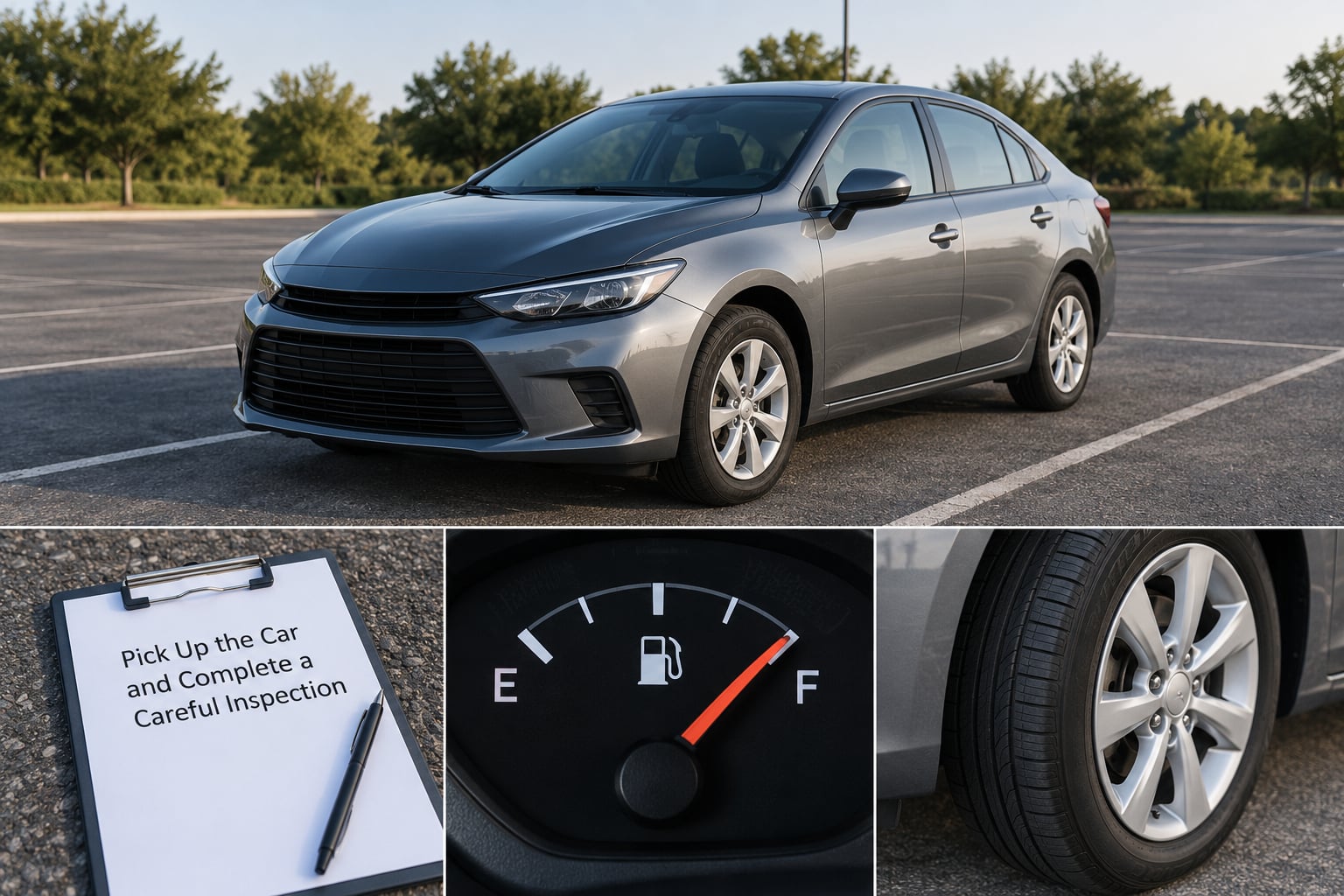
At the counter, expect to present your license, photo ID and the payment card in your own name, and expect the agent to re-run a check even though you already paid. That pause is where the age fee usually appears, so compare the counter total against your saved breakdown before you sign.
Read the rental agreement rather than skimming it. Check the driver names, the return location and time, the fuel policy, the mileage allowance, the damage waiver and deductible if you took one, the toll terms, and any additional driver you added. If a line differs from what you booked, ask before signing. Signing first and arguing afterwards is how deposits get held longer.
Walk the car before you move it. Photograph every panel, the windshield, the wheels and rims, the roof, the glass, the interior, the odometer and the fuel gauge. Note existing dents and scratches on the inspection sheet yourself, not just verbally, and make sure the recorded fuel level matches the gauge. Check tire condition and that the spare or repair kit is present if the car has one.
Save those photos where you can find them on the trip. Damage discovered later gets attributed to you by default, and a timestamped set of pictures is the simplest way to contest a charge weeks after you returned the car.
Common Mistakes
Entering the wrong age at booking. A mismatched age means the fee, the vehicle class and the branch policy all get recalculated at pickup, sometimes with worse terms than the search result. Correct it in the reservation before you travel, and confirm the fix by email.
Judging a rental on the base daily rate. This is the single most reported complaint from young renters, and the counter total regularly lands near double the search result. Ask for the all-in checkout total with your age entered, then ask the branch for the same total on the damage waiver declined.
Booking a branch you are not eligible for. Airport and specialty desks set their own minimum ages. Call the exact branch before paying, and if a nearby off-airport location is an option, price both.
Using someone else’s card. A parent’s or friend’s card in your name fails the cardholder match at the counter and can end the reservation. Use your own card, or use the parent’s card with the parent present as the renter and driver, which is the legitimate version of that scenario. A parent cannot rent a car, hand you the keys and list you at 17: companies do not permit drivers below the minimum age, and an unlisted driver can void the damage waiver and the personal auto policy coverage that normally follows the rental.
Adding a second driver at the last minute. Spouses and partners are often included automatically at some brands and never at others, and each additional driver can add a daily fee with its own age-based rate. Name every driver who will touch the wheel before you sign.
Skipping the damage record. A five-minute photo set and a written note on the inspection sheet prevent a small scratch becoming a full-panel charge. Do it at pickup, not at return.
Three habits cover most of it: compare branches early and off-airport, confirm your age and class in writing before pickup, and keep every receipt, photo and email until the final charge clears.
Frequently Asked Questions
Can I rent a car at 18, 19, 20, 21, 22, 23 or 24?
In the United States the standard minimum age to rent is 21, with Michigan and New York allowing renters as young as 18 and some limited exceptions at 19. At 21 to 24 you can rent nearly every standard class, from economy cars to pickups and minivans, but not luxury or performance vehicles. Rules differ by company and by branch, so confirm the age at your exact pickup location.
Why do rental companies charge a young driver fee?
The fee is priced from loss and liability data. Drivers under 25 carry higher claim rates on average, so rental companies price that risk into the contract instead of absorbing it. Because the charge is built into the rate structure rather than billed as an extra, it shows up per day of rental and is hard to negotiate. The better lever is a waiver program such as an auto-club or military membership, or an employer or university agreement.
Can I use a debit card instead of a credit card to rent?
Many branches accept a debit card, but they usually require additional proof: a return flight itinerary, a utility bill, a larger authorization hold, and sometimes a credit check or proof of return travel. Policies vary by company and branch, and some vehicle categories are credit-card only. If you have no card history, ask the branch what it specifically requires before you book.
Can someone older rent the car and add me as a driver?
Only if you meet that company’s minimum age for a driver. A parent can rent in their own name, but an underage driver cannot be added, and an unlisted driver can void the damage waiver and your personal auto coverage. Companies do check the listed driver’s ID at pickup, so a swap at the counter fails. Rent a car share vehicle or a peer-to-peer listing instead.
Can I avoid the young driver surcharge with a membership or discount?
Often, yes, and that is how to rent a car under 25 without the fee stacking up. Auto-club members, military and veteran association members, and renters using an employer or university travel agreement commonly get the surcharge waived at one of the national brands. Confirm the waiver applies to your age band and your branch, and that the discounted rate still shows all taxes before you pay.
What happens if I do not return the car to the location I selected?
The original reservation usually does not cover it. One-way fees vary widely by company and route, and dropping a car in a different city or state can add a large flat charge plus a higher daily rate. Some programs only allow one-way moves for renters 25 and over, so check the rule before booking, not after. Returning late also triggers late fees and can change your damage waiver terms.
Conclusion
Confirm eligibility first: your age, your state, and the specific branch. Then compare the complete checkout total with your age entered, including the age fee, taxes and location charges, rather than the headline daily rate.
Choose a vehicle your age band permits, pick an off-airport branch when the numbers are close, and inspect the car with photos and a written damage record before you drive away. The most reliable quote is always the one tied to your age, residence, payment method and exact pickup address.