Learning how to drive in heavy rain safely comes down to four habits: slow down before the water builds, triple your following distance, keep your lights on low beam, and never touch a flooded road. Wet pavement contributes to roughly 1.2 million traffic crashes a year in the United States, and the Federal Highway Administration reports that about 75 percent of weather-related crashes happen on wet pavement.
Hydroplaning is what happens when a film of water builds under your tires faster than the tread can push it away. The tires stop touching the asphalt for a second or two and the car glides on water instead of gripping the road. Steering, braking and acceleration all go unreliable in that moment, and it can happen at speeds as low as 35 mph on good tires.
One detail catches people out. The most dangerous minutes are usually the first five to ten after rain starts, not the middle of the storm. Oil and grease film off the asphalt mixes with the new water, and the first shallow puddles have not drained yet. Give the first minutes of any downpour your most cautious driving.
Table of Contents
- What You Need Before Driving in Heavy Rain
- Step-by-Step: How to Drive in Heavy Rain Safely
- 1. Check the Weather and Road Conditions Before You Set Off
- 2. Prepare the Car and Reduce Speed Before the Water Builds
- 3. Improve Visibility Without Creating Glare
- 4. Handle Standing Water and Hydroplaning
- What Floodwater Does to a Car
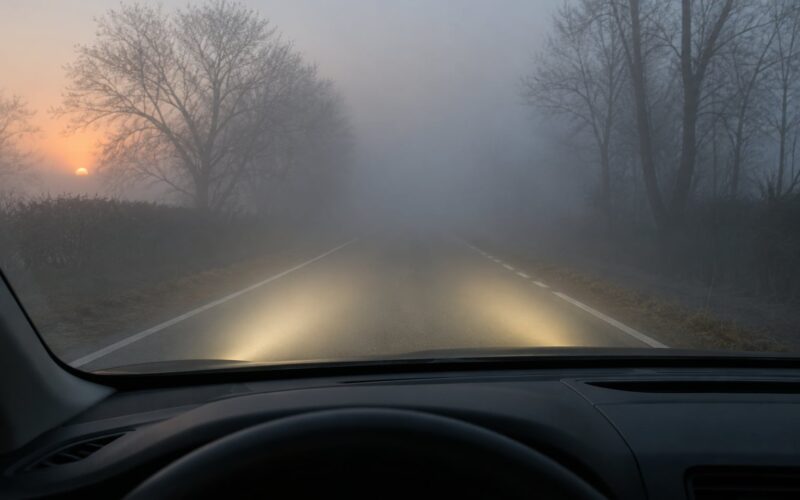
- 5. Adjust to Night, Fog, and Extra Traffic
- Common Mistakes and How to Fix Them
- Frequently Asked Questions
- Is it safe to drive during heavy rain?
- How fast should I drive in heavy rain?
- Should I use cruise control when driving in the rain?
- What should I do if my car starts hydroplaning?
- Can I drive through a flooded road during heavy rain?
- Should I turn on my high-beam headlights in heavy rain?
- Bottom Line: Brake, Then Turn, Then Accelerate
What You Need Before Driving in Heavy Rain
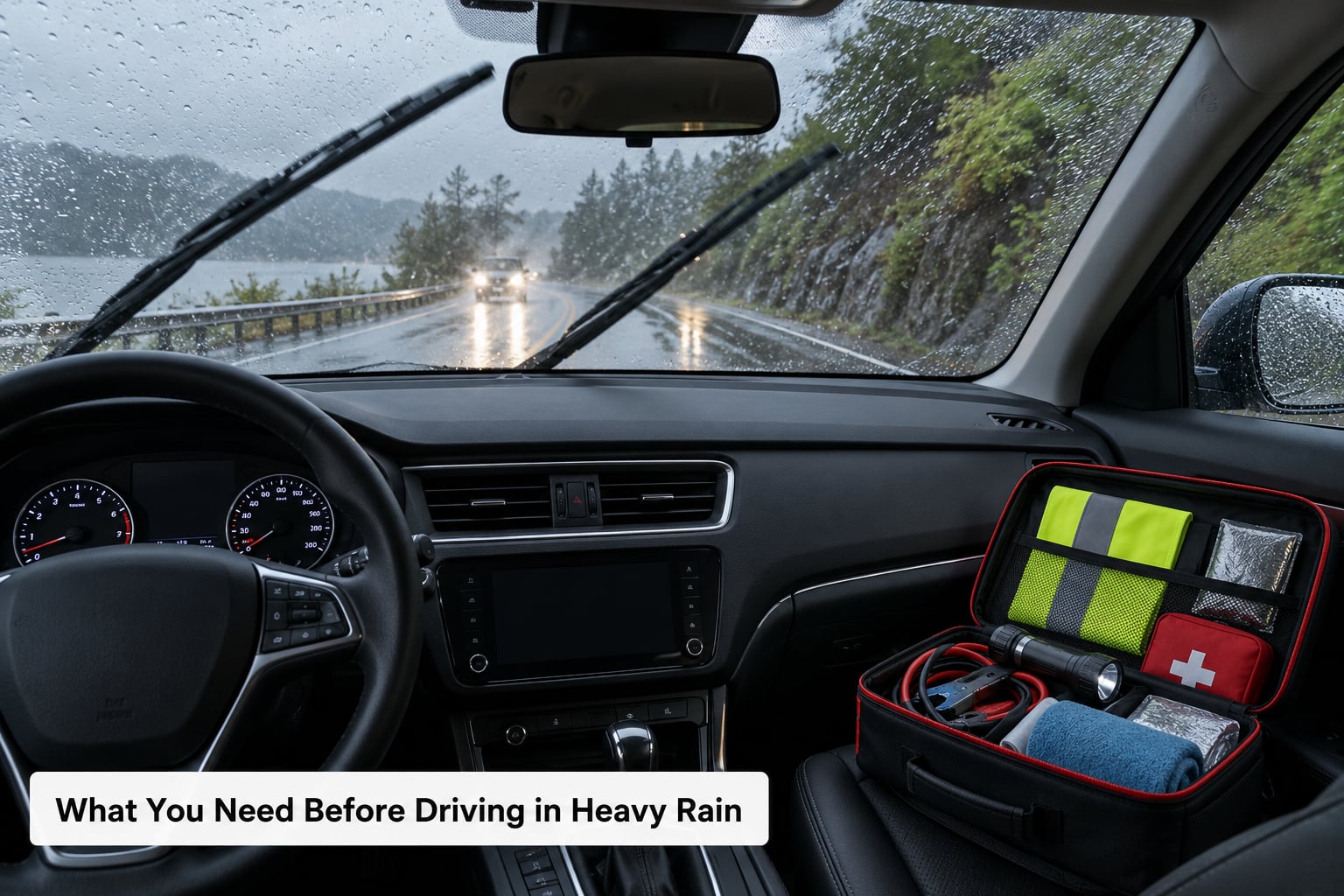
A few minutes of preparation before you leave prevents most of the problems that show up later on a wet road. Run through this list in the driveway or on the forecourt, not at the motorway speed limit.
Tires. Check tread depth with a quarter: if the top of the quarter is hidden below the tread surface, the tire is worn past the point where grooves can channel water out. Cold tire pressure drops roughly a pound per 10 degrees Fahrenheit, so check before the car has been driven rather than on the way out of it.
Wipers and washer fluid. Rubber blades harden and streak after a season or two. Wipers that smear are worse than no wipers, because the smear creates glare at exactly the moment you need to see lane markings. Fill the washer reservoir and confirm both blades sweep cleanly.
Lights. Walk around the car and check that both low beams, the tail lights and the brake lights come on. Also switch on the front and rear fog lights if the car has them, since fog lights are designed to work in exactly this kind of visibility.
Brakes and fuel. Have the brake pads and fluid checked if the car is due a service. Fill the tank before a long drive so you never run low while crawling in traffic, and check that the spare or the tire repair kit is actually in the boot.
Emergency supplies. A reflective vest, a torch, a phone charger, water and a few energy bars. If you pull onto the shoulder in the dark, the vest is what makes you visible to passing traffic.
Weather information. Open the National Weather Service alerts for your route, or your national equivalent, before you turn the key. Look for flood warnings, flash flood watches and road closures rather than just a rain icon. Pulling over and waiting twenty minutes is a normal decision, not a failure.
Your owner’s manual sets tire pressure figures, fluid types and light controls for your specific car. Follow it over anything you read online, including this guide.
Step-by-Step: How to Drive in Heavy Rain Safely
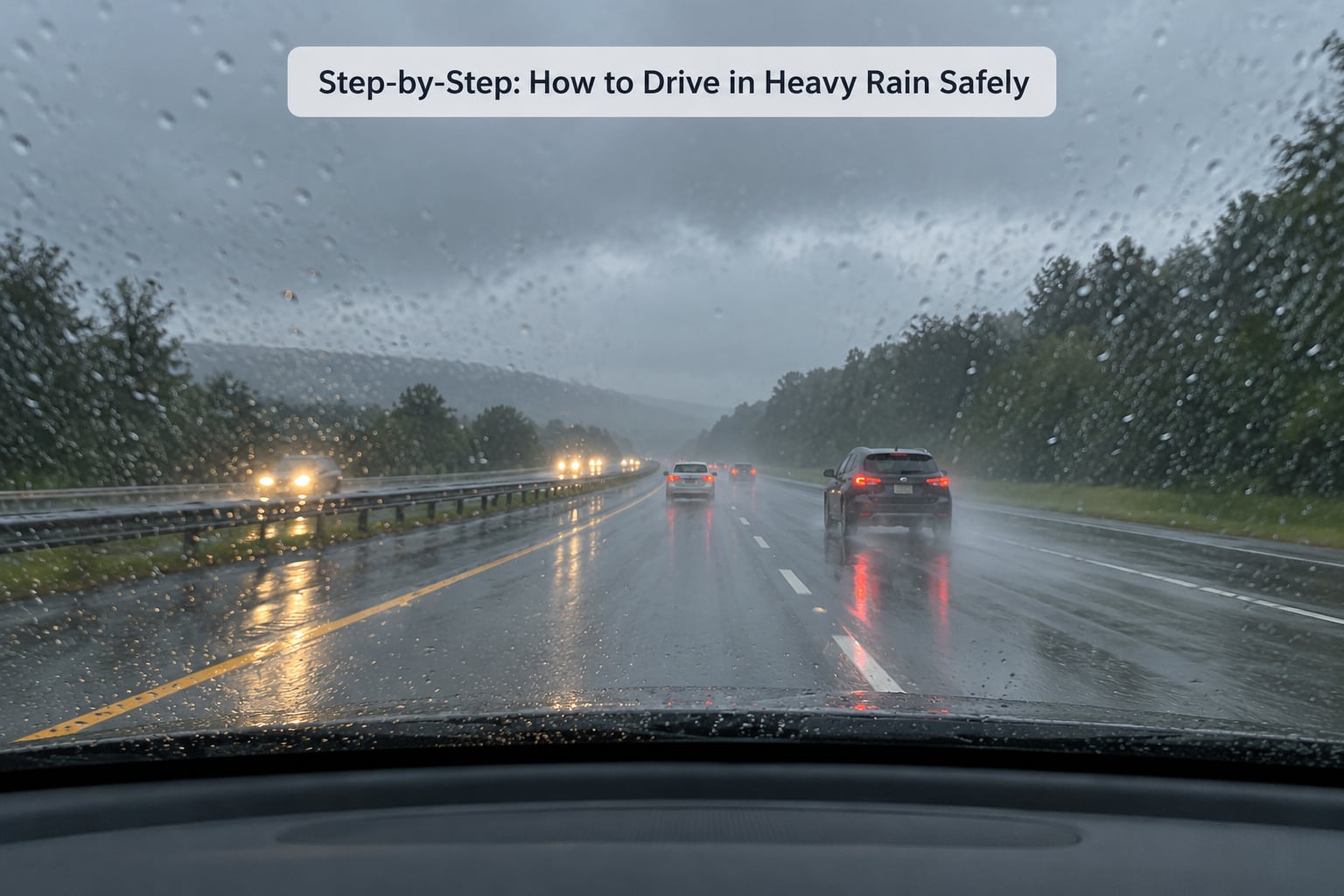
Work through these five stages in order. Each one depends on the one before it, and the sign that a step is working is simple: you can see further ahead, you have more time to react, and nothing in the car feels close to the limit.
1. Check the Weather and Road Conditions Before You Set Off
Start with official alerts, not an app icon. The National Weather Service issues flood warnings for stretches of road where water is expected, and flash flood warnings for storms that can drop several inches in an hour, sometimes in places that were dry when you left home.
Understand the difference between the three kinds of warning. Heavy rain is reduced visibility and a wet road, which is a drive-with-care situation. A flood watch means conditions are possible later. A flash flood warning means water is happening or about to happen, and the correct answer is to stay off that road entirely.
Check your whole route, not just your departure point. If you are driving abroad, the equivalent national weather service publishes the same kind of alerts, and monsoon season warnings deserve the same respect. Your navigation app can reroute around closures, but only if you opened it before the water closed the road.
It works when you can name, in one sentence, what the worst part of the drive will be and where it is. If you cannot name it, wait for the radar to clear.
2. Prepare the Car and Reduce Speed Before the Water Builds
Slow down before the rain starts, not during it. Speed is what creates the water film: the faster you go, the more water your tires have to displace per second, and past a certain point they stop clearing the contact patch entirely.
On a wet highway, staying at or below the posted limit is sensible but often not enough. Drop to a speed that feels like you could stop within the distance you can actually see, and count seconds rather than car lengths. Dry-weather following distance is two to three seconds. In heavy rain, make it six to eight, or three to four times the dry figure.
Make every input smooth. Brake earlier and more gently than you would in the dry, turn the wheel in small increments, and hold a steady line. Sudden inputs are what break traction on a wet surface, so the goal is a car that never surprises you.
It works when the vehicle ahead is a moving dot rather than a shape you can read the plate of. If you can see their number plate clearly, you are probably too close.
3. Improve Visibility Without Creating Glare
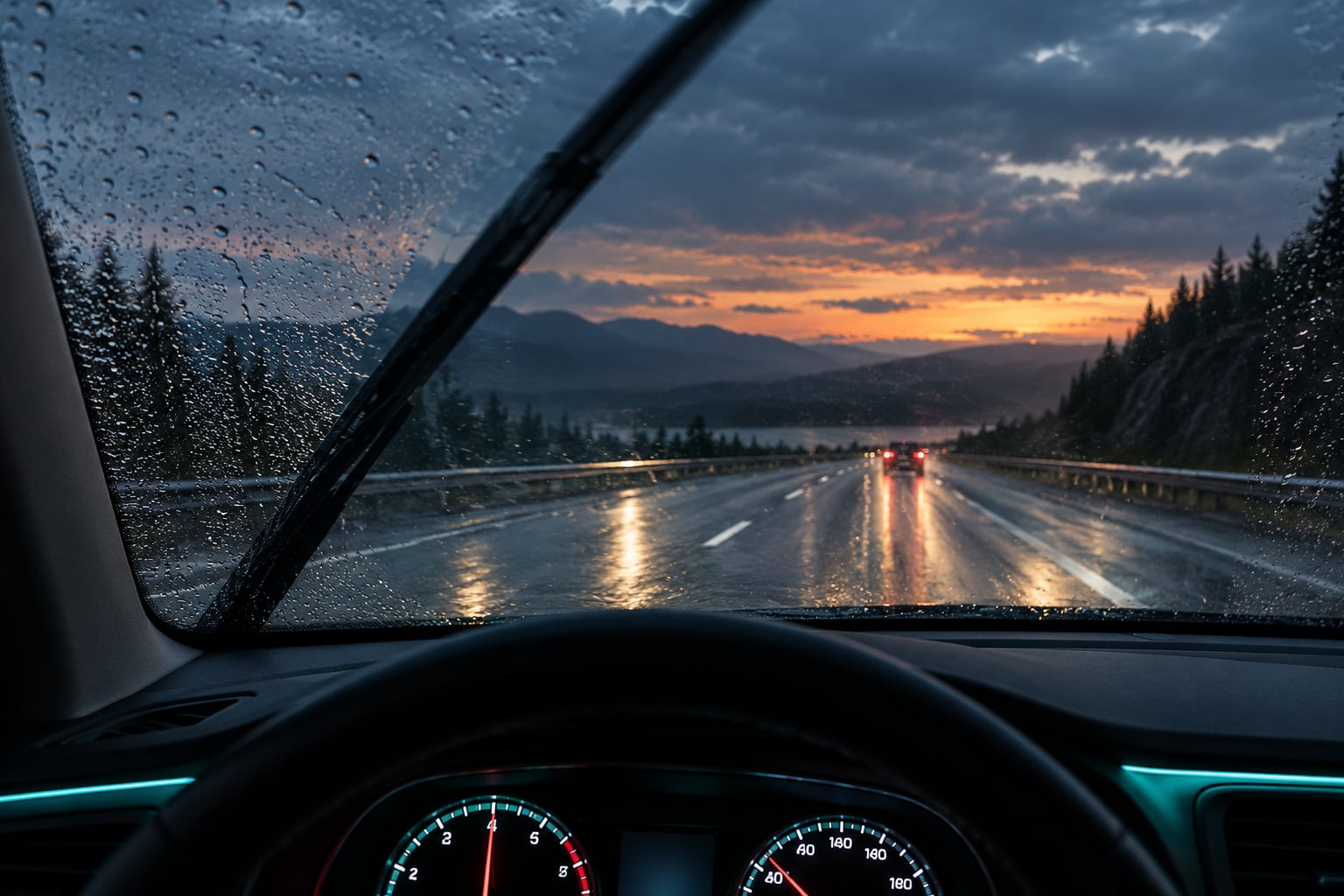
Switch on your low-beam headlights as soon as the rain starts, and keep them on for the whole drive. Low beams light the road ahead and make your vehicle visible to other drivers without bouncing back off the rain. High beams do the opposite: the light reflects off the falling water and off wet pavement straight back into your eyes, which flattens the scene to a grey wall.
Use your wipers at a speed matched to the rainfall. If you can see through the wiper arc but not between sweeps, go up a setting. Many cars have an intermittent or sensor setting that does this on its own, and it is worth learning where the control is before the storm rather than during it.
Run the windshield defroster before you think you need it. On most vehicles the defroster draws air from the HVAC system, so switching it on often clears fog on the side and rear windows at the same time. Fresh air through the vents beats recirculated air when the windows fog from the inside.
Expect a wet windshield to fog on the outside too, and that one wipes off. Leave a gap of air around the base of the windshield if you can, and check the washer nozzles are actually spraying rather than blocked.
4. Handle Standing Water and Hydroplaning
Water that cannot drain off the road sits in ruts and dips, and it is heaviest right after a long dry spell because the asphalt is sealed and water-repellent. Slow down before you reach standing water, in a straight line, and never brake or steer sharply while you are in it.
If the tires go light on the wheel or the revs climb without the car accelerating, you are hydroplaning. Do three things in this order: ease off the accelerator, hold the wheel pointing straight ahead, and wait for the grip to come back. Then brake gently. Do not slam on the brakes or snap the wheel over, because a locked or sharply turned tire has even less ability to bite the road.
If your car has anti-lock brakes, stand on the pedal and let the system do its work. Pumping the brake pedal defeats ABS. Without ABS, pump the brake pedal rapidly to build and release pressure, because the tire needs to regain a contact patch.
Stay in the wheel tracks of the vehicle ahead when you can see them. That strip of road has already been drained, so your tires are working on a thinner film. On unlit roads, lane markings, painted crossings and metal covers are slick in the same way; cross them at a shallow angle and never while braking.
What Floodwater Does to a Car
- About 6 inches deep. The tire contact patch is partly covered and steering and braking turn vague. Slow well down, hold a straight line, and switch off cruise control before you reach it.
- About 12 inches deep. A typical passenger car can begin to float and lose steering entirely. Do not enter. Turn around and find another route.
- About 2 feet deep. Most cars and many SUVs are swept away, and the real danger is often a hidden washout or drop-off on the far side. Never attempt it, even on a familiar road.
These are averages for a typical passenger car, not a permission slip. Never drive into moving water, because a current can push a vehicle far further than its depth suggests, and never drive into water you cannot see across. FEMA’s rule for flooded roads is Turn Around, Don’t Drown, and it exists because the majority of flood deaths happen to drivers who thought they could cross.
It works when a pedestrian crossing water ahead of you is obvious enough that you decide to find a bridge instead.
5. Adjust to Night, Fog, and Extra Traffic
Night turns a wet road into a glare problem. Your eyes need a few minutes to adjust when you leave a lit area, and reflective lane markers and oncoming headlights produce halos that make distance judgement harder. If you are moving into unlit country roads at night in rain, reduce speed again and lean on your headlights, not on your own eyes.
Leave extra room around trucks and buses. Their tires throw up a wall of spray that blinds vehicles behind them for several seconds at a time, and a car that disappears into that spray often reappears in your blind spot. Stay out of the lanes beside them, and add distance when you pass back in front.
Watch for people on foot. Pedestrians in bright or reflective clothing step into the road without expecting a fast car in poor visibility. Cyclists and motorcyclists are narrower and harder to see, and they are usually painted into the edge of your lane.
Turn your hazards on if you have to travel well below the speed of traffic, such as in standing water, and stay in the right-hand lane while you do it. Hazards are a warning that you are moving too slowly for conditions. They are not a licence to crawl in the middle lane while the queue behind you builds.
Common Mistakes and How to Fix Them
Matching the speed of traffic in the rain. Everyone else is also slowed by glare and spray, and the car in front may be a hazard itself. Pick a speed based on the road surface, not on the tail lights ahead of you.
Keeping the usual two-second gap. Braking distance on wet pavement roughly doubles for the same speed, so double the gap before you double anything else. Count six to eight seconds in heavy rain and treat that as a minimum, not a target.
Leaving cruise control on. Cruise control holds a pre-set speed through a curve or a flooded patch and applies more throttle than you would. Cancel it before the rain starts and stay in manual control until conditions improve.
Switching to high beams to see further. High beams make the falling rain and the wet road brighter, not the road clearer. Low beams are the correct choice in heavy rain, and fog lights help where your car has them.
Testing flooded roads to see how deep it is. One vehicle entering a flood routinely causes several others to follow, and the second vehicle arrives as a stronger current and debris arrive. Turn around and take the long way.
Pumping the brakes to stop on a wet road. With ABS, hold firm pressure and let the system work. Without ABS, pump on a locked wheel to restore a contact patch. Either way, brake earlier than you think you need to.
Reacting to a slide with the wheel. The instinct is to steer away from the slide. Ease off the gas, hold the wheel straight, let the tires re-establish contact, then brake and steer smoothly. One action at a time: brake, then turn, then accelerate.
Avoiding rain entirely, or driving through it badly. Plenty of drivers find heavy rain genuinely frightening, and that reaction is common rather than silly. The workable middle ground is preparation plus a slower, duller drive. If the worry is stopping you from making necessary trips, do the pre-trip check, drive the first ten minutes at a deliberately low speed, and the tension usually drops a notch.
Frequently Asked Questions
Is it safe to drive during heavy rain?
Heavy rain is drivable with reduced speed and much more distance, but not at normal speeds and gaps. Wet pavement contributes to about 1.2 million US crashes a year, and roughly 75 percent of weather-related crashes occur on wet roads. If visibility drops so far that you cannot read a sign or see lane markings, or a flood or flash flood warning covers your route, do not drive.
How fast should I drive in heavy rain?
Slow down before the rain starts rather than braking hard once it arrives, and pick a speed at which you can stop inside the distance you can see. Speed is what builds the water film under your tires, so at highway speeds you will likely need to be below the posted limit. AAA notes that even new tires can lose road contact on standing water at around 35 mph.
Should I use cruise control when driving in the rain?
No. Cancel cruise control before the rain starts and drive in manual control. Cruise control holds a set speed and can add throttle through a curve or a flooded patch, and it responds more slowly than you would when you suddenly need to back off. Use it again only when the road is dry and clear.
What should I do if my car starts hydroplaning?
Ease off the accelerator first, hold the wheel pointing straight ahead, and wait for the tires to regain grip. Then brake gently. Do not slam on the brakes or snap the steering wheel. With anti-lock brakes, hold firm pressure on the pedal and let the system work, since pumping defeats it. Without ABS, pump the pedal rapidly to build and release pressure.
Can I drive through a flooded road during heavy rain?
Only if the water is shallow enough to stay well below the tires and you can clearly see the far side of the road. Around 6 inches can make steering and braking vague, and about 12 inches can float a typical passenger car. Never enter moving water or water you cannot see across. FEMA’s guidance is simple: turn around, do not drown.
Should I turn on my high-beam headlights in heavy rain?
No, use your low beams. High beams reflect off falling water and off the wet road straight back toward you, which produces glare and flattens your view. Low beams light the road ahead and make you visible to other drivers at the same time. If your car has front and rear fog lights, use them, since that is the condition they are designed for.
Bottom Line: Brake, Then Turn, Then Accelerate
If you remember one thing from this guide on how to drive in heavy rain safely, make it the order of operations: brake, then turn, then accelerate. One action at a time, and never two at once.
Before you leave, check the tires, the wipers and the alerts. On the road, slow down first, triple your gap, keep the low beams on, and turn around at the first sign of flooded pavement. Pulling over for twenty minutes beats a rescue, every time.