How to find clean restrooms on the highway comes down to two habits: choose your stop before you need it, and read what recent travelers said before you take the exit. Ratings from restroom apps and map reviews narrow the field in about a minute, and a fast look at the lot, the lobby, and one stall tells you whether the stop is worth taking.
It matters because a highway restroom is one of the few facilities you cannot choose to skip. Get it wrong and you have burned twenty minutes, added a bad stop to the trip, and made the next stretch worse. Screen first and the choice becomes routine.
Everything below works with the map app already on your phone. I have planned stops this way on long interstate runs, and the difference is that you arrive at a decision instead of taking whatever exit appears first.
Reviewed October 2026.
Table of Contents
- What You Need to Find Clean Restrooms on the Highway
- An offline map of your route
- Your route and remaining drive time
- A stop interval you actually keep
- A fuel or charging plan that includes a stop
- A habit of weighting recent reviews
- Step-by-Step: Choose a Restroom Before You Need One
- 1. Identify Your Next Planned Stop
- 2. Compare More Than One Restroom
- 3. Check Maps and Recent Reviews: How to Find Clean Restrooms on the Highway
- 4. Confirm Hours and Current Conditions
- 5. Look for the Right Facilities
- 6. Use the Parking and Access Details
- 7. Make a Safe Stop and Reassess
- Common Mistakes and Quick Fixes
- Relying on reviews that are years old
- Waiting for the last possible exit
- Taking the first result without comparing
- Ignoring accessibility and family needs
- Treating a listing as proof of cleanliness
- Last-minute tips when you have nothing planned
- Frequently Asked Questions
- What is the most reliable way to find clean highway restrooms?
- How far in advance should I plan a restroom stop on a road trip?
- Are gas station restrooms a good backup for highway service areas?
- How can I tell whether a restroom review is recent and useful?
- What should I do if every nearby restroom has poor reviews?
- Are rest stops at highway rest areas usually accessible?
- Conclusion
What You Need to Find Clean Restrooms on the Highway
Four things make the method work. Without them you are scrolling reviews at the last exit with a full bladder, which is the worst possible time to research.
An offline map of your route
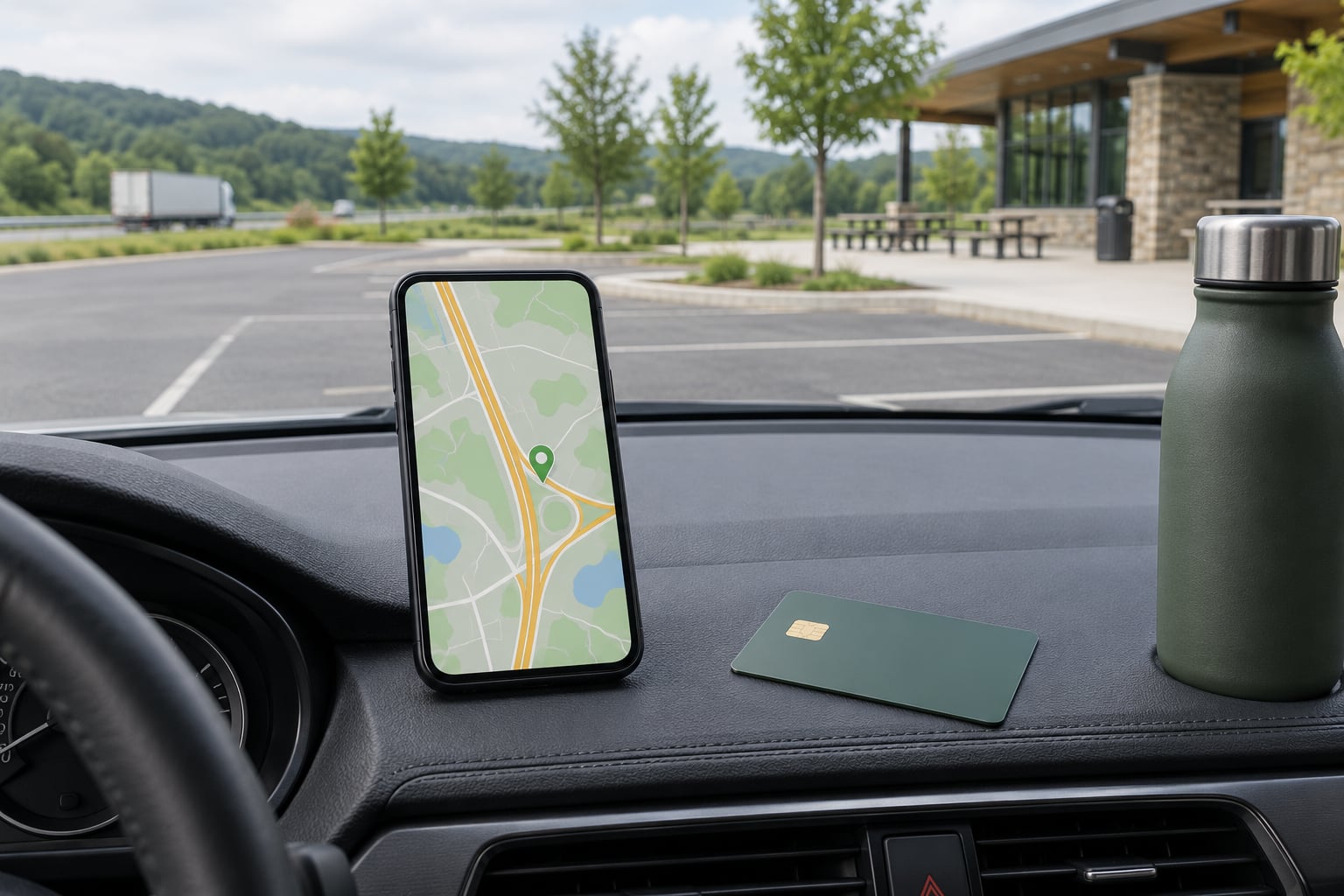
Download the corridor before you leave signal coverage. Both major phone map apps save a region offline, and a saved region still shows exits, service plazas, and gas stations along the route.
State department of transportation pages are the second layer. They list rest areas by exit number and mile marker, which is more reliable than a crowdsourced pin when a facility has had recent work or a closure.
Your route and remaining drive time
You need to know roughly how many hours sit between now and your destination. That number sets your stop interval and tells you whether a stop thirty minutes off route is worth the fuel and time.
A stop interval you actually keep
A workable default is a break every two hours, or every 100 to 150 miles, whichever comes first. It keeps the decision routine, and routine decisions are the ones you make well when you are tired.
A fuel or charging plan that includes a stop
Nearly every good restroom stop is also a fuel or charging stop, so schedule the two together. That removes the separate dilemma of needing fuel in thirty miles and a restroom now.
A habit of weighting recent reviews
Ratings go stale. A four-star review of a rest area from four years ago tells you about a maintenance crew that has probably changed. Sort by newest and look for repetition instead of averages.
Step-by-Step: Choose a Restroom Before You Need One
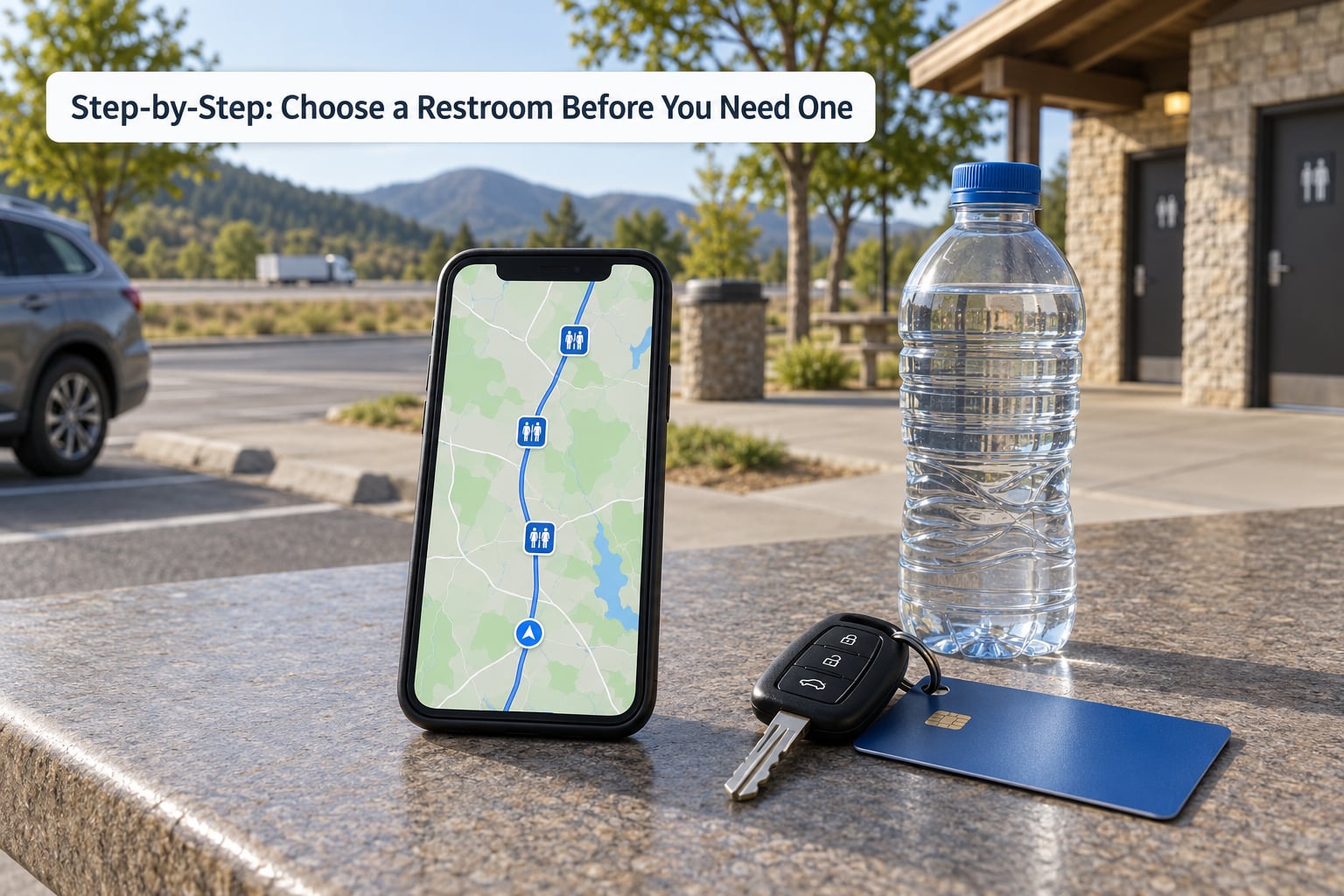
Seven steps, in order. Each one ends with a signal that tells you the step worked, so you can stop as soon as you have a clear primary and a clear backup.
1. Identify Your Next Planned Stop
Look at your route and find the next service area, service plaza, or exit cluster that sits inside your interval. Decide it before you are uncomfortable, not after.
Check that the stop fits the route and gives you enough time to park, use the facility, and get moving again. Ten extra minutes at a planned stop beats a scramble.
How you know it worked: you can name the exit number or mile marker without guessing, and the timing is comfortable rather than urgent.
2. Compare More Than One Restroom
Pick a primary and a backup before you commit to either. Look at state and federal rest areas first, then travel plazas and truck stops, then convenience-store gas stations, then anything a listing marks as a visitor center or public facility.
Compare them on distance from your route, whether they are open around the hour you will arrive, and whether the facility is inside the building or out in a separate structure in the lot.
Users on travel forums repeat one rule often: state and federal rest areas tend to be cleaner and quicker than an arbitrary gas station exit, because they are built and staffed for exactly this stop. They are not open everywhere, which is why you still need a backup.
How you know it worked: you have two named options, and the backup is genuinely reachable if the first one is closed or full.
3. Check Maps and Recent Reviews: How to Find Clean Restrooms on the Highway
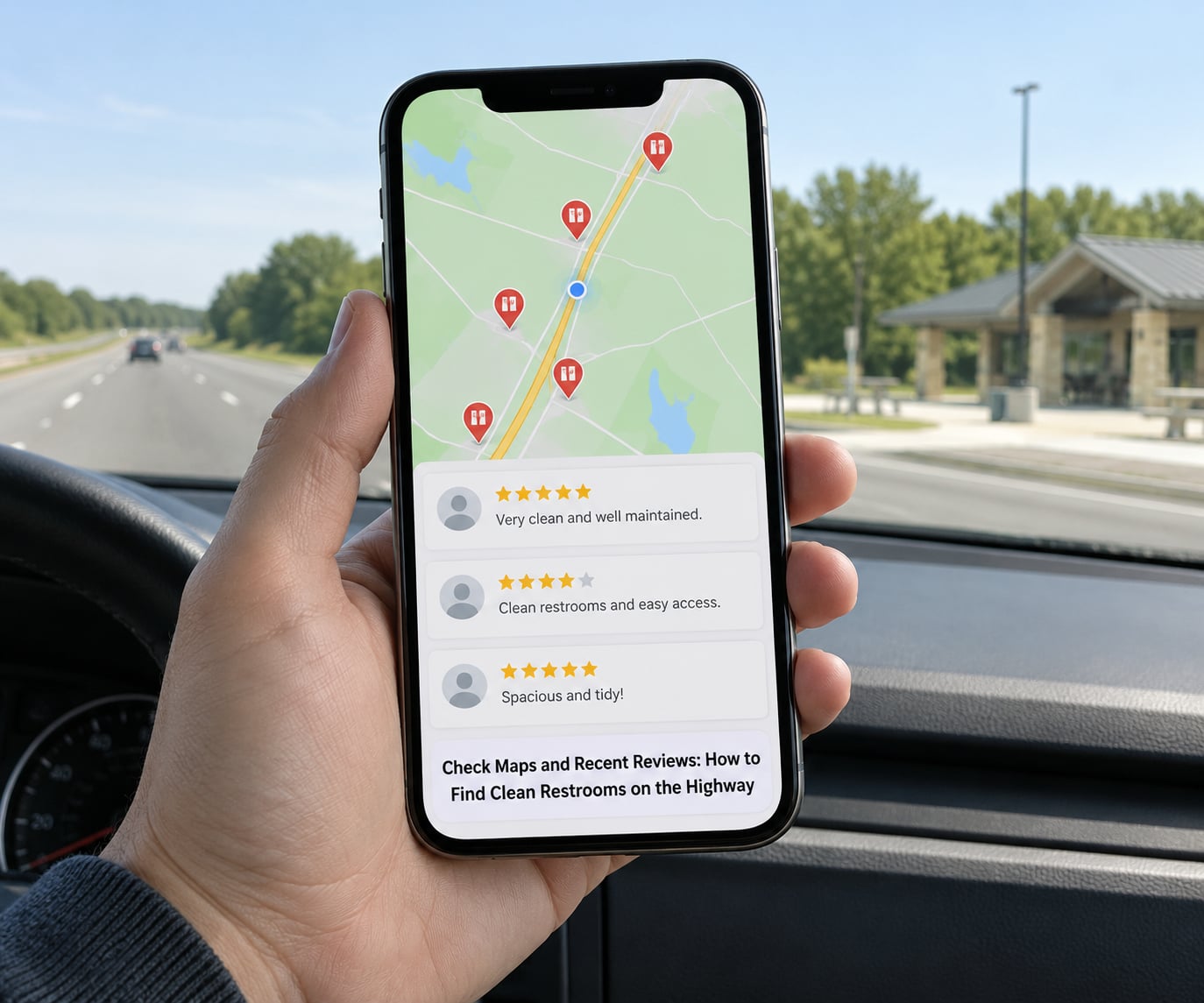
Open the listing for each option and sort reviews by newest. What you are looking for is repetition: several recent comments naming the same condition is a real signal, while one vivid outlier is usually a bad afternoon.
The conditions worth scanning for are specific. Toilet paper and a working soap dispenser show whether supplies are managed. Overflowing trash outside the building usually means the same inside. Comments about lighting, water temperature, broken locks, or a closed family room tell you about maintenance, not opinion.
Photo reviews beat text when the photos are recent. People photograph an empty stall or a full trash bin and rarely photograph a perfectly ordinary clean one, so a lack of photos is not bad news by itself.
Restroom-rating apps add one layer over map reviews. They score stops on cleanliness, smell, privacy, wait time, supplies, and safety, which is closer to what you are actually deciding. The honest limitation is coverage: many stops have few ratings, and a three-star score built on four reports is not much better than nothing.
How you know it worked: at least two recent reviews from the last few weeks agree about the same condition at your primary stop.
4. Confirm Hours and Current Conditions
Before you commit, confirm the facility is open at your arrival time. Some states lock rest-area buildings overnight while keeping the parking lot open, and a handful close seasonally or between a stretch of remote highway.
Check for construction notices, a posted closure, or a recent review mentioning a blocked entrance. If the listing conflicts with the state page, trust the state page.
Confirm accessibility at the same time, since a family restroom, an accessible stall, or a single-occupancy room changes the whole stop for certain travelers. Accessible facilities are standard at state and federal rest areas and uneven at smaller fuel stops.
How you know it worked: current information from an official source or a reliable listing says the door is open when you plan to be there.
5. Look for the Right Facilities
Useful signals include permanent plumbing rather than a portable unit, several stalls so one occupied stall is not a problem, handwashing supplies inside, overhead lighting, and accessible facilities.
These amenities do not promise cleanliness. Their absence is the better clue: a facility with no lighting, one portable toilet, and a locked gate at your arrival hour is a limited stop maintained by nobody at that time.
Single-occupancy rooms, where a lockable toilet sits behind a counter door, are the most private option and are worth searching for when privacy matters to you.
How you know it worked: the listing and the photos show lighting, more than one stall or a lockable room, and supplies inside.
6. Use the Parking and Access Details
Note which side of the highway the stop is on. On divided highways, crossing to the far side can add several minutes and force you through slower lanes, so a slightly cleaner stop on your side may win.
Look for a clear, direct entrance rather than one that requires backing out into traffic or crossing a truck apron. Truck stops can mean a long walk through parked trailers, which is unpleasant at night and awkward for families.
Check the parking area as you approach. Well-lit pavement, visible signage, and an obvious entrance are all reasonable signals of a stop that expects people to be there, including after dark.
How you know it worked: the map or signage shows a direct access route and no reversing into moving traffic.
7. Make a Safe Stop and Reassess
Park under light, take what you need, and check the stall before you commit to it: toilet paper present, soap working, floor dry, bowl in reasonable condition.
If the conditions are not usable, do not force it. Look for a second building or a family restroom on the same property first. Failing that, use your own supplies and move on rather than searching the lot while distracted.
Submit a report if the app supports it. A photo and a one-line note about supplies or cleanliness takes under a minute and is how the next driver’s rating becomes useful.
Before pulling back onto the highway, confirm two things: the immediate need is handled, and your onward plan still works if the backup stop is also closed.
How you know it worked: you drove away from a facility you would use again, or you left knowing exactly which backup you are taking.
Common Mistakes and Quick Fixes
Relying on reviews that are years old
A five-star review written four winters ago describes a specific crew and a specific set of fixtures. Sort by newest and treat anything older than a season as background, not as a rating.
Waiting for the last possible exit
By the time you are scanning frantically, you take whatever appears. Fix it upstream: pick the stop at your two-hour or 100-to-150-mile mark and decide then, while you still have options.
Taking the first result without comparing
The top map result is usually the closest, not the best. Spend the extra sixty seconds naming a backup. When the first one is closed, dark, or full, the backup is the difference between a plan and a problem.
Ignoring accessibility and family needs
It is unpleasant to discover at the door that the only stall is not accessible, or that there is no family room with a changing table. Check this during the screen step, where it costs nothing.
Treating a listing as proof of cleanliness
A map listing proves a place exists, has parking, and is sometimes open. It says nothing about the condition of the restroom. Listings are for routing and hours; reviews are for condition; your own inspection is the confirmation.
Last-minute tips when you have nothing planned
Ask the passenger, not the driver. Set a specific arrival time rather than a distance. Choose the stop with more recent reviews over the one with a higher average, because freshness beats a better number. And when you arrive, spend the extra five seconds looking at the trash and the lobby floor, since those two things predict the stall better than anything else.
Frequently Asked Questions
What is the most reliable way to find clean highway restrooms?
Combine two sources before you commit to an exit: recent reviews from a restroom-rating app or map listing, plus your own inspection once you arrive. Reviews sorted by newest, with several people reporting the same condition, are the most useful pre-commit signal. The inspection confirms it. No app can tell you about a broken soap dispenser discovered five minutes ago.
How far in advance should I plan a restroom stop on a road trip?
Plan the next stop while you are still comfortable, roughly every two hours or 100 to 150 miles. That interval leaves margin for traffic, a slow fuel stop, or a full bladder. Name a primary and a backup before you need either, so a closed rest area never becomes an emergency.
Are gas station restrooms a good backup for highway service areas?
They work as a backup, with two caveats. Many convenience-store restrooms are single-occupancy rooms with a lock, which can be a plus for privacy, but staffing is thin overnight and supplies are restocked by whoever is on shift. Check recent reviews and confirm the door is unlocked at your arrival hour.
How can I tell whether a restroom review is recent and useful?
Sort reviews by newest and look at the dates. Reviews from the last few weeks tell you about the current staffing and fixtures; anything from a previous season is background. Usefulness comes from detail: a note about toilet paper, soap, lighting, or trash carries more signal than a single word about cleanliness.
What should I do if every nearby restroom has poor reviews?
Accept that no option is clean and pick the most workable one: the facility with the best lighting, the most stalls, and the nearest entrance. Bring your own supplies as backup, use a family restroom or second building if the property has one, and submit a report so the next driver has current information.
Are rest stops at highway rest areas usually accessible?
State and federal rest areas are generally the most consistent for accessible stalls, lighting, and a separate family restroom, because they are built and maintained for high traffic. Smaller fuel stops vary widely and may offer a single lockable room. If accessibility matters for your group, confirm it on the listing or state page before taking the exit.
Conclusion
Choose a primary restroom and a backup before the final stretch, confirm both are open when you will arrive, and use recent reviews as supporting evidence rather than a guarantee.
Then trust the three-stage look on arrival: lot, lobby, stall. That is how to find clean restrooms on the highway without gambling on the first exit you see, and it costs about a minute of planning for every two hours behind the wheel.