Rental car mileage limits come down to two numbers: how many miles you are allowed, and what each mile past that costs. Either the company gives you unlimited miles for one flat daily rate, or it hands you an allowance and bills every extra mile separately, usually somewhere between 10 and 30 cents each. If you are trying to work out how rental car mileage limits work before a long drive, this guide covers how the allowance gets counted, what an overage really costs, and which contract clauses can quietly turn an unlimited rental into a large bill.
Quick answers
- A mileage limit is a cap the rental company places on how far you may drive during the rental period.
- Allowances are usually counted per 24-hour day, and each day gets a fresh allotment rather than one shared pool.
- Unlimited plans charge a flat daily rate with no mileage line. Capped plans cost less up front and add a per-mile charge when you go over.
- Rental companies record every mile even on unlimited rentals, because service schedules and resale value both depend on the odometer.
- Discount, prepaid and pay-later rate plans often carry a daily cap that the headline rate does not advertise.
Table of Contents
- How Rental Car Mileage Limits Work
- Daily Mileage Allowances Explained
- Unlimited Mileage vs Limited Plans
- How rental car mileage limits work on peer-to-peer rentals
- How Extra Mileage Charges Are Calculated
- The 25,000-mile rental that produced a 10,000 dollar bill
- What Can Void or Change Your Mileage Allowance?
- How to Estimate the Mileage You Need
- Questions to Ask Before Signing the Rental Agreement
- Frequently Asked Questions
- Does a rental car mileage limit reset every day?
- Is unlimited mileage always cheaper than paying for extra miles?
- What happens if I go over the mileage allowance on my rental car?
- Are airport rental cars more likely to have strict mileage limits?
- Does a rental car’s mileage limit apply to every driver?
- Can I avoid mileage overage charges by buying unlimited mileage after pickup?
- Choose the Right Mileage Plan Before Booking
How Rental Car Mileage Limits Work
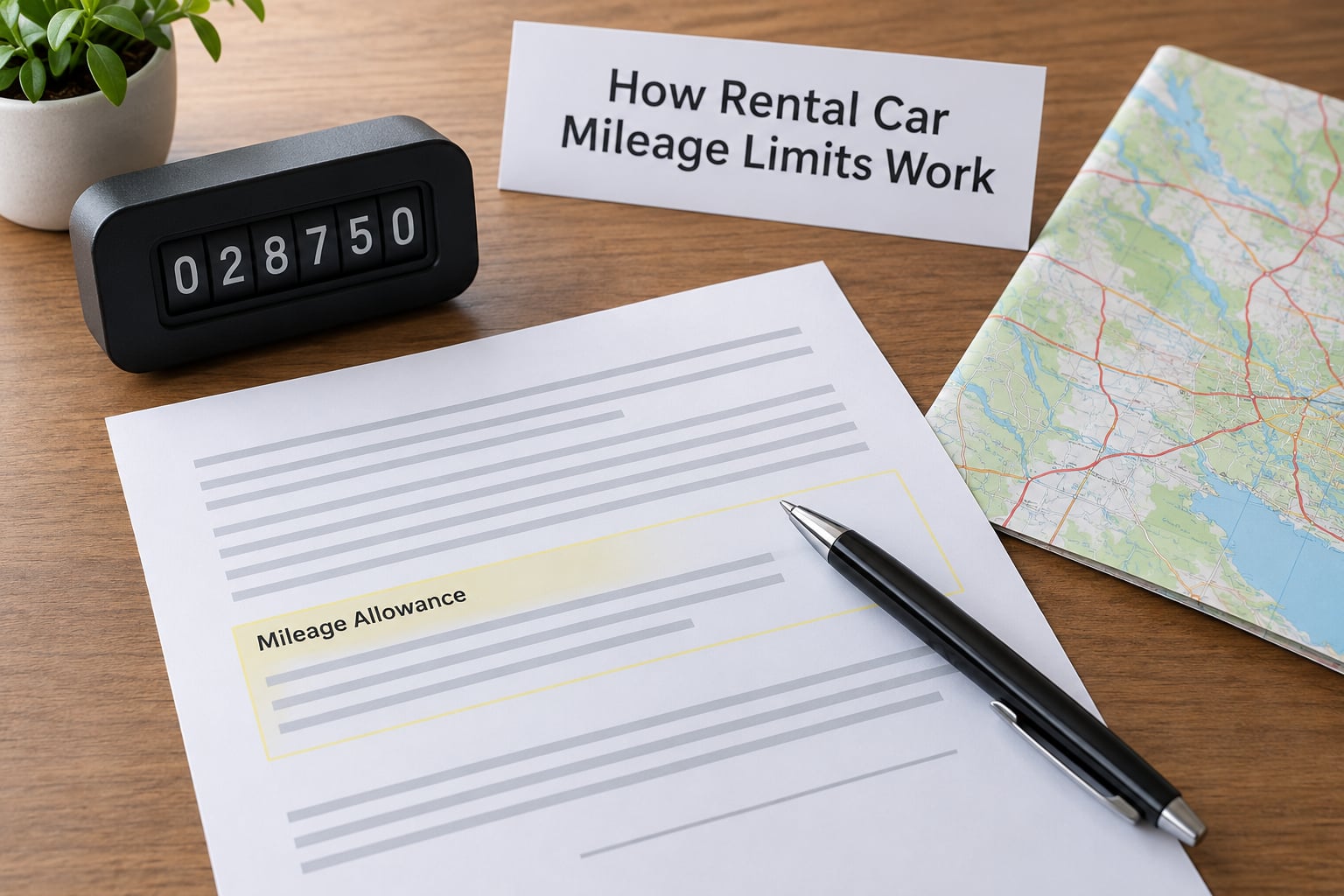
Your agreement holds two mileage numbers, and the whole system runs off them. The first is the odometer reading when you take the keys. The second is the allowance attached to the rate you booked. Miles are counted from the first number to the second, and anything past your allowance turns into an overage charge at the per-mile rate printed on the same page.
Rental companies cap mileage because the car is a depreciating asset with a service schedule attached to it. Oil changes, filters, tire rotations and brake work all key off odometer milestones, and the same car is worth noticeably less at 150,000 miles than at 60,000. Distance is also a rough proxy for how hard a vehicle has been worked, which matters when the fleet is re-sold or re-fleeted a few years later.
How the rate reaches you changes the mechanics. A prepaid reservation is a fixed total agreed up front, and its mileage terms come with it. A pay-later or walk-up reservation usually carries an estimate, and the company bills what actually happened at the counter.
Published Hertz terms state the estimate mechanism unusually plainly: “We have calculated the estimated mileage that will be used throughout the rental period. An excess mileage charge may apply in accordance with product restrictions or negotiated contract terms.” Read that as the company deciding in advance what your trip is probably worth in miles, then charging the difference if reality runs higher. It is also why a renter who drives far less than the estimate still cannot assume the estimate is what gets billed.
Photograph the odometer at pickup and again at return. It takes ten seconds and it settles most mileage arguments later, because the billing system starts from the reading you recorded.
Daily Mileage Allowances Explained
Most US contracts express the allowance as miles per day, and the day is a 24-hour period starting from the moment the car leaves the lot, not a calendar date. Caps across limited-mileage contracts run from roughly 20 miles a day at the tight end to about 250 at the generous end. Economy and compact cars tend to sit at the higher figure. Passenger vans, cargo vans, luxury sedans and exotics sit much lower, often in the 60 to 150 mile range per day.
Each day resets with a fresh allotment, which is the part most people get wrong. A five-day rental at 100 miles per day gives you 500 miles of allowance, and driving 350 miles on day two does not eat into what is left for days three through five. The trade-off is that a heavy driving day can consume several days’ worth in one go, and a three-state weekend can use up a week of allowance in a single afternoon.
| Allowance structure | Typical range | How it resets | What to watch |
|---|---|---|---|
| Per day | 20 to 250 miles per 24 hours | New allowance at each 24-hour mark | Most common structure; check the low caps on vans and exotics |
| Total for the whole rental | One pool for the full length | Nothing resets until you return the car | Slow days offset heavy ones, which suits mixed business and leisure trips |
| Weekly | A seven-day block | Resets at a fixed day of the rental | Used on longer rentals; confirm the reset day, not the pickup day |
| Monthly or long-term | Often 200 miles per day, about 6,000 miles a month | Resets on the billing cycle | Common on replacement, insurance and work rentals |
Unlimited Mileage vs Limited Plans
A flat-rate or unlimited plan charges one daily rate with no mileage line, and you can drive as far as the rest of the agreement allows. A capped plan is cheaper day to day and comes with an allowance. Which one costs less depends entirely on how far you drive against that cap, and you can work it out in about a minute before you book.
| Factor | Unlimited mileage | Capped mileage |
|---|---|---|
| How you are charged | One flat daily rate, no mileage line | Lower base rate, then a per-mile fee past the allowance |
| What you get | Any distance, subject to the agreement’s other conditions | A stated allowance per day or per rental |
| Best for | Long road trips, cross-state runs, itineraries you cannot predict | Airport pickups, city trips, short business rentals, fixed daily routes |
| Biggest risk | Paying for distance you never drive | A surprise charge at return, calculated from an estimate |
| Tracking needed | None for billing, but photograph the odometer anyway | Essential; you need to know your running total against the allowance |
Run your own numbers before deciding. If a trip averages 180 miles a day and your cap is 200 a day, a capped rental never goes over and unlimited buys you nothing. If the cap is 100 a day, you are about 80 miles over each day, and at 25 cents a mile that is roughly 20 dollars a day of overage stacking on the base rate. On a multi-day haul, that adds up faster than people expect.
Pre-purchased miles sit in the middle and are often the smart middle. A block of extra miles bought before pickup usually costs less per mile than paying overage afterward, and it beats a flat unlimited upgrade when you expect to be only slightly over. The catch is that it is generally non-refundable and tied to the specific booking rather than the account.
How rental car mileage limits work on peer-to-peer rentals
On a peer-to-peer platform the mechanic changes, and this is where most of the confusion sits. The host owns the car, but the mileage allowance usually comes from the platform’s protection plan rather than the host’s personal policy. Bookings are commonly quoted as included mileage plus a per-mile rate, such as 1,000 miles included on a one-month plan at roughly 50 cents per excess mile.
Hosts report the same arithmetic from the other side. One trip totalling 864 miles against a 200-mile standard allowance at one dollar per excess mile, with the platform taking its share of the charge, lands close to five hundred dollars before cleaning fees. Two practical points follow: an unlimited-sounding listing can still carry a cap if the plan tier you booked does not, so read the plan rather than the photos. And because the host absorbs the cost, hosts tend to be stricter about where the car goes and who drives it.
How Extra Mileage Charges Are Calculated
The formula is simple subtraction. Take the odometer at pickup, take the odometer at return, subtract the allowance that applied to those days, and multiply whatever is left by the per-mile rate on your agreement. Nothing about it is mysterious, though the rate varies and the allowance is usually the smaller half of the equation. Once you know how rental car mileage limits work on the specific rate you booked, the whole charge is predictable before you turn the key.
Typical per-mile overage runs about 10 to 30 cents. Enterprise’s published range for capped vehicles is roughly 10 to 25 cents per additional mile. Hertz’s own worked example in its terms shows a 50 dollar charge for 125 excess miles, which works out to 40 cents a mile.
The 25,000-mile rental that produced a 10,000 dollar bill
One widely reported case makes the mechanic concrete. A renter took a Hertz agreement his paperwork described as unlimited mileage and drove about 25,000 miles in a month on a cross-country trip. The bill arrived at roughly 10,000 dollars, which is 40 cents a mile applied to mileage the company had estimated rather than measured against a cap on the agreement.
He argued at the counter that his contract listed miles allowed as free miles, and the dispute did not resolve in his favour. The lesson is not that unlimited rental companies are dishonest. It is that the operative number is the rate plan plus the product restrictions attached to it, and that an unlimited label on a summary page does not override the estimate clause in the terms.
What Can Void or Change Your Mileage Allowance?
Most renters never read the clauses that switch mileage rules on or off. These are the ones that matter.
- Geographic restrictions. Flat-rate mileage can be limited to a defined service area. Drive outside it and the rental can be re-rated under capped terms even though nothing about the booking page suggested a region limit.
- Cross-border and one-way travel. Crossing a national border or dropping the car in another state usually requires separate permission, and the mileage treatment can change with it. Cross-border fees are charged on top.
- Unauthorised drivers. Miles driven by someone not listed on the agreement are the classic source of a bill nobody can explain. Additional drivers are normally added at the counter, before pickup.
- Prohibited use. Delivery driving, ridesharing, food delivery and commercial work are excluded from most leisure agreements, and distance covered that way is billed at the overage rate.
- Discount and prepaid rate plans. The headline rate is often the most restricted one on the sheet. Prepaid, member, discount and pay-later rates frequently carry a daily cap that standard rates do not.
- Vehicle class exclusions. Large passenger vans, cargo vans, large SUVs and luxury or exotic cars are routinely excluded from flat-rate mileage, no matter what the brand’s general policy says.
- Long rentals. Some policies treat rentals past roughly three weeks differently, and long-term or replacement rentals often reset weekly or monthly rather than daily.
- Return conditions. Wear and tear, fuel and return deadlines are separate conditions in the same agreement, and each one is handled as its own charge.
How to Estimate the Mileage You Need
Estimate before you choose the plan, not after. A ten-minute exercise now beats a surprise at the return counter.
- Map the real route first. Distance from pickup to drop-off along the roads you will actually use, not the crow-flies number.
- Add the edges. Airport to hotel, hotel to the trailhead, the parking-lot loops nobody counts.
- Add detours honestly. Ten to twenty percent covers a closed road, a wrong turn and one scenic stop that turns into an hour.
- Multiply by days only if you drive every day. A rental where you sit at a desk for six hours burns none of the day’s allowance.
- Convert to a daily average. Total miles divided by rental days is the number to compare against the cap, and it is the one the reservation system is also estimating.
- For a month-long rental, compare against the 6,000 mile monthly pattern that a 200-mile daily allowance produces.
Track it while you drive. Note the odometer at pickup in your phone, glance at it whenever you fuel up, and take a second photo at return. I also keep a running note of major legs, because two or three written numbers beat a fuzzy memory three days later.
Road-trip forums fill up with one recurring question: can you even get unlimited mileage on a van for a multi-state trip? The answer usually depends on the vehicle class rather than the company, which is why checking the class exclusions first saves a lot of second-guessing.
Questions to Ask Before Signing the Rental Agreement
Run through these at the desk, before the keys change hands.
- Is this specific rate plan unlimited or capped, and if capped, how many miles per day?
- Is the allowance counted per day, per week, or across the whole rental?
- What is the overage rate per mile, and does it change for any driver?
- Does my exact vehicle class qualify for flat-rate mileage, or is it excluded?
- Are there regional, one-way or cross-border conditions attached to the mileage terms?
- Can I pre-purchase additional miles, and what is that per-mile rate?
- Does my agreement contain the estimated mileage clause, and what odometer reading is recorded at pickup?
- What is the fuel policy, the return location and the return deadline?
If the answer to the first question is not written on the agreement, ask for it in writing before you sign. A verbal assurance at the counter is the hardest thing to argue with later.
Frequently Asked Questions
Does a rental car mileage limit reset every day?
It depends on the structure printed in your agreement. Most US contracts give you a daily allowance, and a new allotment starts at each 24-hour period measured from pickup rather than from midnight. Other rentals use a single pool for the whole booking, and long rentals sometimes reset weekly or monthly. A monthly replacement rental often works out to about 200 miles per day, which equals roughly 6,000 miles a month.
Is unlimited mileage always cheaper than paying for extra miles?
No. If your driving stays under the cap, a flat-rate unlimited plan is simply extra money spent. The comparison depends on your daily average against the allowance and the per-mile overage rate, which commonly runs 10 to 30 cents. Pre-purchasing a block of extra miles is often the cheapest option when you expect to go only slightly over the cap.
What happens if I go over the mileage allowance on my rental car?
The company calculates the excess miles between the pickup and return odometer readings, subtracts the allowance that applied to your rental days, and multiplies the rest by your agreement’s per-mile rate. The charge usually appears after the trip rather than at the counter, which is why it comes as a surprise. Photographing the odometer at pickup and return makes any dispute much easier to resolve.
Are airport rental cars more likely to have strict mileage limits?
They can be. Airport locations often carry the highest base rates, which is what makes a flat-rate unlimited plan look like a better deal there, and several locations apply their own overage rates. Airport pickup is also where pay-later and discounted rate plans are most common, and those plans frequently carry a daily cap that the quoted rate does not mention. Check the terms for your specific pickup location.
Does a rental car’s mileage limit apply to every driver?
The allowance covers the rental as a whole, not each driver separately, so miles are pooled across everyone authorised to drive. Miles driven by someone who is not listed on the agreement are the hardest to explain later and are often billed at the overage rate. Add any additional driver at the counter before pickup rather than after.
Can I avoid mileage overage charges by buying unlimited mileage after pickup?
Sometimes, but it is not reliable. Flat-rate plans are usually priced per rental agreement, so adding one mid-trip often means re-pricing the whole booking rather than just the remaining days. Ask at the counter before you accept the keys, and if the trip is long, decide the plan before pickup. Overage rates charged after the fact are generally higher than anything you would arrange in advance.
Choose the Right Mileage Plan Before Booking
Start by estimating the miles you will actually drive, then compare that number against the daily allowance printed on the rate you are booking. Knowing how rental car mileage limits work for that specific rate is what turns this from guesswork into arithmetic. If your daily average sits comfortably under the cap, take the capped rate and pre-purchase a small block of extra miles as a cushion. If the trip is a genuine road trip with unpredictable legs, the flat-rate plan is worth it, as long as you read the exclusions for vehicle class, geography and prohibited use first. Then photograph the odometer before you drive away. That is the habit that makes every mileage question afterwards a short one.