Most surprise charges are created in the few minutes between sitting down at the rental counter and signing the agreement, and they are hard to undo once you have driven away. So here is how to pick up a rental car without surprise charges: match the contract to your confirmation line by line, decline the optional products you did not ask for, and photograph the car before it leaves the lot. Allow an extra 15 to 25 minutes for that process, and the pickup becomes routine instead of stressful.
The desk agent works from a rate sheet, not from your booking. Your quoted total gets checked against mandatory items, then optional protection products and equipment get added on top. Every addition should be written on the agreement before you initial it, and anything that differs from what you booked deserves a question on the spot rather than after the trip.
This guide walks through the whole pickup in order: what to bring, what to check at the desk, what to say, how to inspect the vehicle, and how to handle a price that does not match your confirmation.
Table of Contents
- What You Need
- Step-by-Step: How to Pick Up a Rental Car Without Surprise Charges
- 1. Confirm the Reservation and Final Price Before You Arrive
- 2. Bring the Correct Documents and a Card for the Security Deposit
- 3. Review the Rental Agreement Before Signing
- 4. Inspect and Photograph the Vehicle Before Driving Away
- 5. Ask Questions About Fuel, Tolls, Mileage and Location Fees
- 6. Confirm the Final Receipt and Keep the Contract
- Common Mistakes
- Frequently Asked Questions
- What is the best way to avoid surprise charges when picking up a rental car?
- Do rental car companies charge more if I choose to pay at the counter?
- Can I decline rental car insurance without losing protection?
- Why do rental car companies charge a security deposit, and when is it returned?
- What should I photograph before leaving the rental car lot?
- How do rental companies handle fuel charges and prepaid fuel programs?
- Final Check Before You Drive
What You Need
Grab these before you leave for the airport. Rushing is what turns a careful check into a rubber stamp.
- Your reservation confirmation, on your phone or printed, including the confirmation number.
- The quoted total from your booking screen, saved as a screenshot. Screenshots date-stamp what the price actually was.
- Your driving licence, matching the name on the reservation exactly.
- A credit card in the primary driver’s name with enough available credit for the rental plus an authorisation hold.
- Passport or other photo ID when you are renting abroad or picking up at an airport.
- Your insurance details, whether that is your auto policy, your travel policy, or the coverage your card issuer provides.
- A phone with data for card verification texts and photos.
- Your itinerary details, including flight numbers, so the desk can tag the reservation if your flight shifts.
On timing, arriving during the lunch or evening rush is when the queue is longest and when agents push optional products hardest. Mid-morning on a weekday is calmer.
Step-by-Step: How to Pick Up a Rental Car Without Surprise Charges
1. Confirm the Reservation and Final Price Before You Arrive
Open your booking the day before travel and read the terms, not just the daily rate. Look for the total including taxes and fees, the fuel policy, whether mileage is capped or unlimited, any one-way drop-off charge, the additional-driver fee, and the cancellation or no-show condition. Most reservations carry a cutoff after which the booking is released and the rate is lost.
Two timing rules catch people out. Picking up earlier than the start time sometimes triggers an extra billed day, and reserving without collecting usually converts into a no-show fee or a full charge of the first day, depending on the contract and how much notice you give. If your flight lands in the early morning, set the start time to match realistic pickup rather than the earliest slot shown.
2. Bring the Correct Documents and a Card for the Security Deposit
The card usually has to be a credit card in the name of the primary driver, and it must have headroom for an authorisation hold on top of the rental cost. Debit cards are accepted at some locations with extra conditions such as a credit check, proof of return travel, or a much larger hold.
Hold versus charge. A deposit is an authorisation hold, not money taken. It reduces your available credit, usually disappears within a few business days after the car is returned and inspected, and on some cards never appears as a line item at all. A charge is a real debit. Ask directly: how much is the hold, is it released automatically, and how long before my credit line is back to normal?
Many desks quote deposits as a flat figure in the low hundreds, with higher amounts for larger vehicles, premium card declines, international rentals, and airport locations. A posted hold is a cash-flow issue rather than an extra cost, but a difference of several hundred dollars in available credit can still trip a decline on another card you were planning to use.
If someone else is paying for the rental, the booking can usually be made in their name, but the person collecting the car generally has to be present with their own licence and card, and some companies require the payer to be a driver. Confirm that arrangement with the location before you fly.
3. Review the Rental Agreement Before Signing
Ask for the agreement to be printed or shown on screen and read it before the pen moves. Check these lines:
- Daily rate and number of days billed, including whether the pickup day and the return day each count.
- Taxes and mandatory surcharges, including airport concession recovery fees, facility fees and any vehicle licence fee.
- Fuel terms, full-to-full or otherwise, plus the refuelling rate and any service fee per gallon.
- Mileage allowance, the cap per day and the surcharge that applies above it.
- Additional drivers, the fee per day, and whether spouse or domestic partner coverage applies in your state.
- Cross-border rules, especially if you plan to leave the country.
- Loss damage waiver and liability terms, plus your own excess if a waiver is declined.
Here is a short script that works. Say it calmly, once.
“Before I sign, can you show me the total with taxes and fees? My confirmation shows X. Can you break down the difference line by line?”
“I do not want the personal accident and personal effects cover. Can you remove those?”
“What is the deposit hold, what triggers it, and when is it released?”
“What is the fuel policy and the refuelling rate?”
“Is this car eligible for the toll programme, and what is the daily charge?”
On insurance, the products are easy to mix up. Collision or loss damage waiver reduces your liability for damage to the rental, and your own excess is the amount you still owe. Supplemental liability covers injury to others and property damage beyond state minimums. Personal accident insurance covers injury to you and your passengers, and personal effects coverage covers belongings. Your personal auto policy or your travel insurance often handles injury to you and liability to others, while a premium credit card usually handles damage to the rental as secondary coverage, which only pays after your own insurance responds. Confirm with your insurer or card issuer before you fly, and ask for the answer in writing or in an email, because the counter is not the place to find out.
If the desk price is higher than your confirmation, stay calm and stay at the counter. Ask whether the difference is a correction to your quote or a new charge, request the itemised version, and check whether your rate was re-quoted at pickup. If the desk insists on a price that contradicts a confirmed booking, declining the car and walking to the lot exit is a legitimate option, though it costs time.
4. Inspect and Photograph the Vehicle Before Driving Away
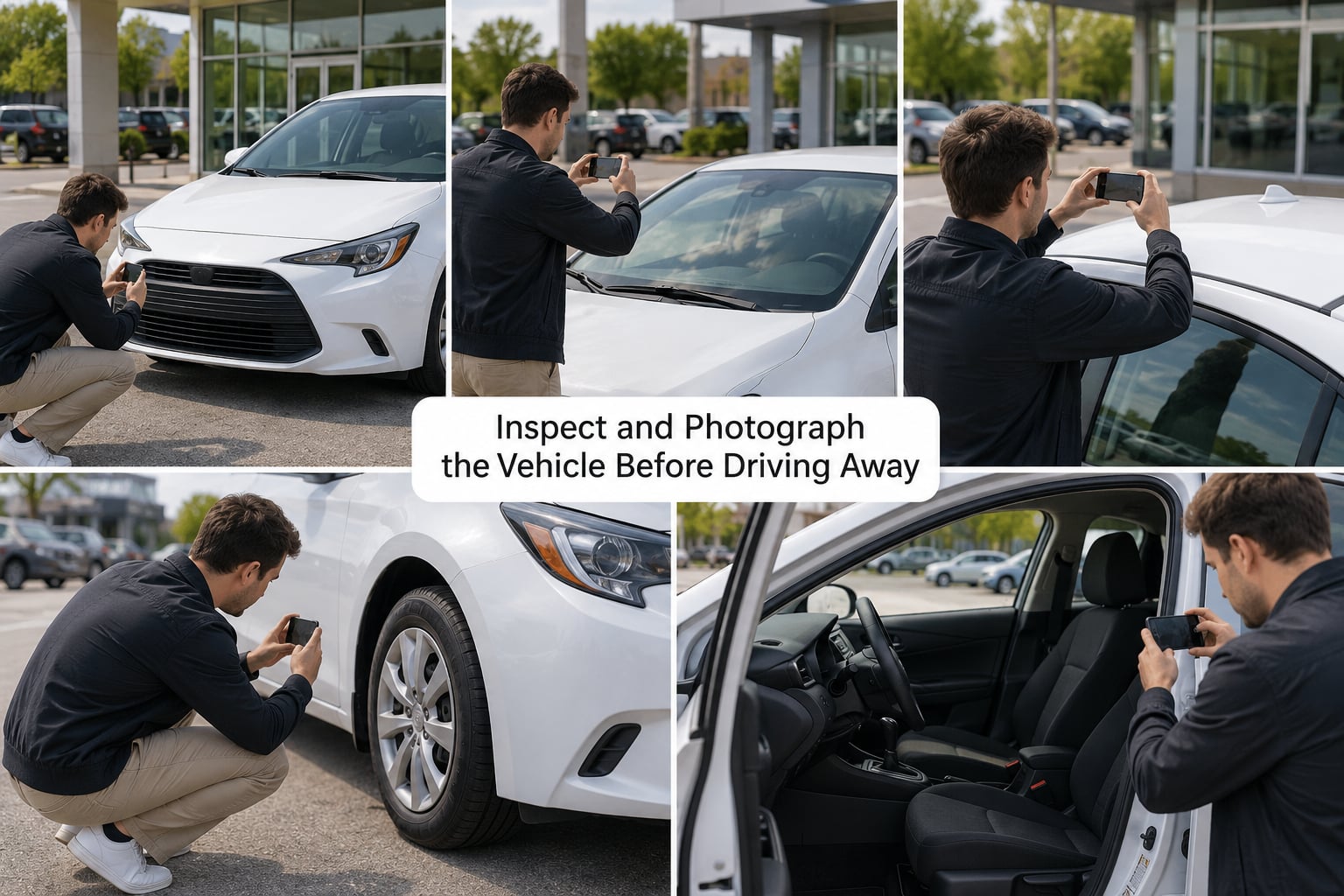
Budget ten minutes for the walk-around and take more photos than you think you need. Time-stamped pictures at pickup are the strongest evidence you will have if a damage charge appears later.
- Body panels: all four sides, bumpers, corners, roof, and any panel with a dent, scratch or paint mismatch. Move close enough to show the flaw fills the frame.
- Wheels and tyres: rims, sidewalls, tread, and any curb rash.
- Glass: windshield chips and cracks, mirrors, and window seals.
- Lights: headlamps, brake lights, indicators, and licence plate lights.
- Interior: seats, dashboard, door panels, headliner, parcel shelf, and any stains or tears.
- Gauge cluster: photograph the odometer and the fuel gauge in one frame, then a close-up of the trip reset.
- Warning lights: record any light that is on when you turn the key, before you start the engine.
Mark every existing issue on the damage report and initial that line yourself. A report signed with blank damage boxes becomes the company’s version of events. If the agent will not note a defect, ask for a supervisor and ask that the car be swapped. A photo of your own handwritten marks on the report, taken before you leave the desk, completes the record.
5. Ask Questions About Fuel, Tolls, Mileage and Location Fees
These are the categories most often billed after the trip, and most of them are optional.
- Prepaid fuel buys a full tank at pickup so you do not refuel. Convenient, usually the most expensive way to buy fuel, and usually charged per gallon at a service rate above the local pump price. Under full-to-full terms, refuelling near the return point is usually cheaper.
- Toll programmes charge a daily fee on top of the toll, sometimes for every day of the rental whether or not you drive through a toll road. Declining often means the agency charges an administration fee per toll plus a violation fee later. Read the programme terms before choosing.
- Mileage beyond a daily cap adds a per-mile or per-kilometre surcharge. Confirm the cap and whether unlimited mileage is included in your rate.
- One-way drop-off is charged when the car is returned to a different location from pickup.
- Airport concession recovery fees come with airport locations and are effectively unavoidable there. Off-airport city locations often cost less overall even with a taxi or rideshare to reach them, a point people in travel forums repeat whenever airport pricing is the complaint.
The main categories, so you can tell at a glance what you can decline:
| Fee or charge | Typical scale | Mandatory or optional | Can you avoid it? |
|---|---|---|---|
| Sales tax and vehicle licensing charges | A few percent of the base rate | Mandatory | No |
| Airport concession or facility fee | Roughly 10 to 20 percent of the rate | Mandatory at airport locations | Only by renting off-airport |
| Young driver surcharge | Per day, often 20 to 40 percent of the base rate | Mandatory under age 25 at most companies | Sometimes, by booking at age 25 or waiting |
| Additional driver fee | Per day, usually 10 to 15 dollars | Optional | Yes, if only you drive |
| One-way drop-off fee | Flat charge, often 50 to 100 dollars or more | Optional | Yes, by returning to the pickup location |
| Loss damage waiver (CDW or LDW) | Per day, 15 to 40 dollars | Optional if you hold primary coverage | Yes, after confirming your own coverage |
| Supplemental liability | Per day, 10 to 25 dollars | Optional | Yes, if your policy already covers it |
| Personal accident and personal effects cover | Per day, 5 to 15 dollars | Optional | Yes, if your travel policy covers you |
| Prepaid fuel | Above the local fuel price, per gallon | Optional | Yes, by refuelling yourself |
| Toll programme daily fee | Per day of rental, plus per-toll administration | Optional | Yes, with careful route planning |
| Mileage above the cap | Per mile or per kilometre | Charged on use | Yes, by staying under the cap |
| Late return penalty | Hourly, then a full extra day | Charged on use | No, but timing avoids it |
| Authorisation hold | Often a few hundred dollars, higher for some vehicles | Refundable hold | Not a cost, but it ties up credit |
Treat every figure above as a typical US range that changes by state, airport, company and season, and treat taxes and facility fees as local rules you cannot negotiate. Anyone promising an exact number before you arrive is guessing.
6. Confirm the Final Receipt and Keep the Contract
Before you accept the keys, ask for the amount due now and the amount due later, and check the charge already taken against your card’s app. Make sure the hold amount is what you agreed to. Take a photo of the agreement, the damage report and the receipt, and keep all three until the final statement clears.
Also confirm the return time, the return location, the after-hours key drop procedure and the fuel requirement in writing. That single habit prevents most post-rental arguments.
Common Mistakes
- Accepting the first price offered. Ask for the itemised total and compare it with your screenshot before agreeing to anything.
- Signing before reading. Read the terms before the agent starts the transaction, not after the printer runs.
- Treating every line as optional. Taxes and airport concession fees are real and unavoidable; arguing about them costs time and good faith.
- Declining coverage without checking first. A card’s coverage is usually secondary, so confirm with the issuer before you decline anything.
- Skipping the photographs. Time-stamped photos of every panel, wheel and the gauge cluster are what resolve a damage dispute weeks later.
- Signing a blank damage report. Mark the defects yourself and initial that line, or ask for another vehicle.
- Accepting prepaid fuel without comparing the rate. Refuelling yourself is usually cheaper unless you are returning with very little time.
- Ignoring the fuel gauge reading. Photograph it at pickup and at return, or you may be charged for fuel you did not use.
- Noting the damage but not the condition report copy. Ask for your copy or photograph every page.
- Leaving the lot before the contract matches. Anything that changes later is far harder to dispute than anything you stop at the desk.
Frequently Asked Questions
What is the best way to avoid surprise charges when picking up a rental car?
Compare the itemised contract against your booking screenshot before you sign, decline every optional product you did not request, and ask for the deposit amount, fuel terms and final total in writing. Photograph the vehicle and the odometer before leaving the lot. Most post-rental bills trace back to an add-on accepted quickly at the desk or damage that was never documented at pickup.
Do rental car companies charge more if I choose to pay at the counter?
Sometimes. The counter rate can differ from an online quote because of re-pricing, availability at pickup, and add-ons the desk applies by default. Prepaid bookings often lock in a rate, though they usually change refunds and cancellation rules. The practical move is to arrive with your confirmation total written down and ask for an itemised breakdown before you agree to pay anything.
Can I decline rental car insurance without losing protection?
Only if something else covers you. Many personal auto policies extend to rental cars, and premium credit cards often cover damage to the rental as secondary coverage that pays after your own insurance responds. Confirm with your insurer or card issuer before travel, because a counter decline based on an assumption is the single most expensive mistake in this whole process. Liability to others is usually still worth keeping.
Why do rental car companies charge a security deposit, and when is it returned?
The deposit covers fuel, damage, tolls and late returns. It is normally an authorisation hold rather than a charge, so it reduces available credit and is released after the car is returned and inspected, usually within a few business days, sometimes up to two weeks depending on your bank. Ask for the hold amount and the release conditions at the counter, and keep your receipt.
What should I photograph before leaving the rental car lot?
Take time-stamped photos of every panel and corner, both bumpers, all wheels and tyres, the windshield and mirrors, the lights, the interior including seats and door panels, and the gauge cluster showing the odometer and fuel gauge. Capture any existing damage close up and note it on the inspection report yourself, initialing that line so it cannot be disputed later.
How do rental companies handle fuel charges and prepaid fuel programs?
Most rentals use full-to-full terms, meaning you return the car with a full tank or the company refuels it at a rate above the pump price, often with a per-gallon service fee. Prepaid fuel programs let you pay for a full tank at pickup and usually cost more per gallon. Photograph the fuel gauge at pickup and return, and keep the pump receipt from your refuel.
Final Check Before You Drive
Stand at the desk for thirty seconds before you turn the key. The contract total matches what you agreed, the deposit amount is what you expect, every optional add-on is one you chose, the damage report lists every mark you found and you initialed it, and the fuel gauge and odometer are photographed.
If a charge arrives weeks after you return the car, send the pickup photos, the signed report and your receipt to the company’s billing team first, then to your card issuer as a disputed transaction if the charge is wrong and you tried the company first. Keep the evidence, and expect the company to respond within a couple of weeks. That ten-minute delay is the whole price of knowing how to pick up a rental car without surprise charges, and it saves far more than it costs.