To handle a bad hotel room, work through four moves in order: get to a safe spot, photograph everything, tell the front desk immediately, and ask for one specific remedy before you escalate. Front desk agents usually handle routine requests, while a manager on duty can authorize a room change, an upgrade, or a credit.
The order matters more than the volume. Reporting a problem while you are still checked in gives the property the only chance it really has to move you somewhere better, and it gives you leverage if the hotel says no later. Waiting until checkout almost always weakens your position, and by then a staff member who saw the problem may be off shift.
Most complaints I have seen resolve without anyone raising their voice. Calm, specific, documented, and early beats loud every time. Here is how to handle a bad hotel room from the first five minutes to the last resort.
Table of Contents
- What You Need Before You Report a Bad Hotel Room
- Step-by-Step: Handling a Bad Hotel Room
- How to Handle a Bad Hotel Room Safely
- How to Handle a Bad Hotel Room: Document the Problem
- Ask the Front Desk for a Solution
- Escalate If the First Response Fails
- Common Mistakes That Cost Travelers Their Remedy
- How to Avoid Repeating the Problem
- Frequently Asked Questions
- Can I refuse a replacement hotel room?
- How much compensation should I request for a bad hotel room?
- Should I photograph every problem before speaking to the front desk?
- Can I get a full refund if I dislike the room but it is clean and safe?
- What if the hotel says no other room is available?
- Can I dispute the charge after leaving the hotel?
- What to Do First
What You Need Before You Report a Bad Hotel Room
Grab these before you unpack, because the ten minutes after walking in is the window that matters.
- Your phone. Camera, notes app, and the number for local emergency services. If the hotel Wi-Fi is unreliable, screenshots beat a saved webpage.
- Your booking confirmation. On the phone or printed. It holds the room type you paid for, the rate, and the cancellation terms the hotel agreed to.
- Your card and a photo of it. Front, back, and the last four digits. You will want this later if a charge you did not expect shows up at checkout.
- Your ID. Passport or driver’s license, matching the name on the reservation.
- A written record. A notes file where you log the date, the time, who you spoke to, and what was said or promised.
- Your travel documents. Anything that shows what you were counting on this trip, such as an event ticket or a long transfer day.
Loyalty status is worth knowing too, but it changes what a hotel will give you more than what they owe you. It never overrides a safety or hygiene failure.
Step-by-Step: Handling a Bad Hotel Room
How to Handle a Bad Hotel Room Safely
Some problems are a nuisance and some are emergencies. Smoke or a burning smell, a gas odor, sparks or exposed wiring, water coming in from above, a door lock that does not secure, a window that will not latch, or anyone already in the room who should not be there are all reasons to leave that room first.
Go to the lobby or another safe area and call the front desk, the hotel’s after-hours number, or local emergency services. Say what you saw, plainly. A guest in one forum thread was handed a key to a room that was already occupied, and the only useful move was to get out, get a manager, and let security handle the person inside.
Pests are different. If you see bed bugs, do not unpack, do not sit on the bed, and do not brush anything onto other luggage. Tell the front desk you suspect bed bugs, because that triggers an inspection protocol rather than a standard clean.
How to Handle a Bad Hotel Room: Document the Problem
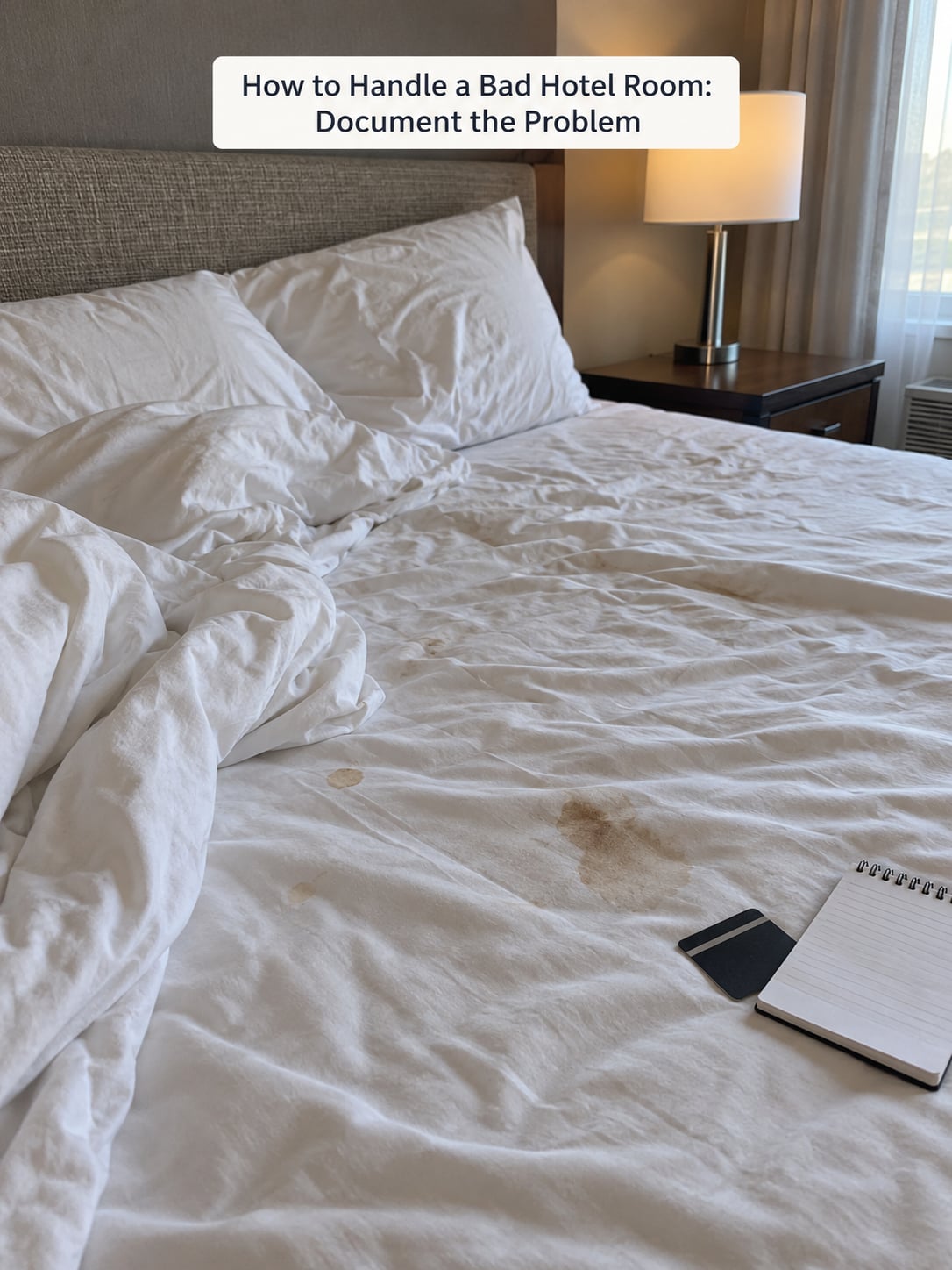
Shoot wide first, then close. A wide shot shows the stain in the room, the close one shows the detail. Take a short video walking through so the setting is obvious, and keep your own face out of frame unless you want a personal record.
Add time stamps. Most phones stamp photos with the date and time automatically, so turn that on and leave location data alone. A quick voice note describing what you see while you are still in the room is good evidence too, because your voice records the moment.
Write facts, not adjectives. “Dark hair on the pillow, three visible spots, room 412, 15:40” is useful. “Disgusting” is not. Never edit, enhance, or stage a photo, since a hotel can challenge an altered image and a clear unedited one is far harder to argue with.
Keep your booking confirmation, your cancellation terms, and every receipt for the room in one folder. If you paid for parking, breakfast, or a late checkout, those numbers are part of what you are asking to have adjusted.
Ask the Front Desk for a Solution
Go to the desk in person rather than calling from the room. In person you get a person, a name, and a written note on your folio if you ask for one.
Lead with the problem, then the impact, then the ask. Keep it to about thirty seconds.
Hi, I checked in to 412 about ten minutes ago. The air conditioning is not running and the room has not been cleaned since the previous guest. At that rate I cannot sleep tonight. I would like to move to a room with working cooling, and if that is not possible I would like a partial refund of the room rate for tonight. Could you let me know who is handling this?
Ask for one specific outcome. A room change is the most common resolution because it costs the hotel nothing extra. An upgrade is a reasonable second ask if the problem is minor. Compensation or a partial refund makes sense when the room is unusable, and a full refund of the room rate is fair when the property breached what you booked.
Note the name of the person who takes the request and when they expect to come back. If the answer is “we will get it fixed right away,” ask for a time and ask them to knock. Promised fixes that never arrive are one of the most common complaints people describe, and a specific time is harder to miss.
Take the new room and inspect it before you accept it. If the replacement has its own problem, raise it in the same conversation rather than after the desk has closed on the issue.
Escalate If the First Response Fails
Escalate one level at a time, and stay calm at each level. Aggression buys you nothing that specificity does not. Work down this order, and skip ahead only when a level genuinely cannot act.
- Level 1, front desk agent. Reach them in person at the desk. Expect a room change, extra amenities, towels, or a note on your folio.
- Level 2, manager on duty or front office manager. Ask the desk to page them, or call the hotel directly. Upgrades, partial refunds, food and beverage credit, late checkout, and property credit usually come from this level.
- Level 3, general manager. Phone the hotel and ask for the general manager by name. Larger compensation, waived fees, a formal written response, and release of a prepaid deposit are in scope here.
- Level 4, brand corporate office. Use the loyalty or “contact us” form on the brand’s site with your folio number. This is where escalations the property could not resolve end up, along with loyalty recovery and free night certificates.
- Level 5, booking platform. Go through their help center with your reservation number and your evidence. They can refund what you paid through them and help with rebooking.
- Level 6, card issuer or regulator. Your bank handles a credit card dispute; a local consumer protection agency or inspector handles an unfair charge or a health and safety failure.
A credit card dispute is the step most people regret, so treat it as level six. If you booked through a platform, file with the platform too. Guests frequently report platforms replying that they are only an intermediary and pushing you back to the hotel, which is useful information: it tells you the property is your only route. If the hotel will not act, send the platform your photos, the folio, and a short written timeline. They cannot compel the hotel, but a refund request sitting in their system has a way of getting answered.
A chargeback is the last resort. Call the number on the back of your card and ask for the disputes department, not general service. Under US rules a consumer generally has 60 days from the statement date to dispute a charge, though deadlines vary by card network and bank, so check yours before assuming you are late. Have your photos, folio, booking confirmation, and a written note of what you already asked the hotel for. Then stop contacting the hotel directly, because continuing to bill while your bank is investigating tends to weaken the case.
Regulators fit specific problems. Suspected bed bugs, unsanitary conditions, fire-code or electrical hazards, and repeated billing errors are matters for a local health or safety inspector rather than a hotel manager. Consumer protection agencies handle unfair charges and misrepresentation. Small claims court handles a single unrecovered bill, and it is rarely worth the filing fee unless the amount is meaningful.
Travel insurance is worth reading before you call the bank. Some policies cover supplier failure or relocation costs that a chargeback will not.
Common Mistakes That Cost Travelers Their Remedy
- Arguing instead of describing. “Your staff are incompetent” ends the conversation. “The air conditioning did not run at all and the room never cooled down” gives them something to fix.
- Leaving before the problem is logged. Walking out to a different hotel turns a fixable complaint into a chargeback dispute.
- Threatening things you will not do. A threat to sue everyone in the lobby costs you the calm tone that was working.
- Refusing a temporary solution. A different room for the night, breakfast credit, or a hold on your bags costs you nothing and keeps the hotel engaged while the real issue is resolved.
- Assuming a manager can reverse a processed charge. Once a payment has settled, refunds often need the property or the platform that holds the funds, not the desk.
- Saving everything for the review. A public review after checkout has less force than a documented conversation at the desk while the staff member who saw the problem is still on shift.
How to Avoid Repeating the Problem
Read the most recent reviews for your specific room type rather than the property average, since a wing of twin rooms tells you nothing about a king. Ask for anything you depend on, such as a quiet floor or a firm pillow, in writing before you arrive, and keep the confirmation.
Arrive as early as check-in allows. A room inspected ten minutes after check-in is a solvable complaint, and one discovered at midnight is not. When you walk in, check the bed, the bathroom, the air or heating, the window lock, the outlets, and the smell, and take sixty seconds doing it.
Save the hotel’s direct phone number and the corporate contact in your phone before you travel. Going through the booking app during an emergency adds an extra hop that can cost you twenty minutes.
Frequently Asked Questions
Can I refuse a replacement hotel room?
You can refuse a replacement room, and you can ask to see it before you accept. A new room only solves the problem if it is actually better: check the air, the bed, the window, and the noise level before agreeing. If the replacement is worse, say so calmly at the desk and state that you are refusing because the issue remains. What you cannot do is refuse every option and then leave; hotels generally treat that as walking away from the booking.
How much compensation should I request for a bad hotel room?
Match the request to the severity. A minor issue like a slow coffee maker rarely justifies money; ask for a replacement amenity or a small credit. A broken air conditioner or an unclean room in summer justifies a partial refund of the room rate. A room that is unusable, unsanitary, or not what you booked justifies a full refund of the night plus reasonable food or transport costs. Ask for one specific remedy rather than a vague amount.
Should I photograph every problem before speaking to the front desk?
Photograph anything you intend to ask about, yes, and add a short note with the date, time, and room number. Wide shots first, then close-ups, and use your phone’s automatic timestamp. Do not stage, edit, or exaggerate anything, because hotels challenge altered images easily. Taking the photos first takes five minutes and makes the front-desk conversation shorter and far harder for staff to deflect.
Can I get a full refund if I dislike the room but it is clean and safe?
Dislike is not a claim. If the room was clean, safe, and matched the description you booked, the hotel generally does not owe a refund, because the booking was performed as promised. Refunds become realistic when a specific term was broken: a booked room type you did not get, an advertised amenity that does not work, a rate misquoted at the desk, or a fee you were charged without disclosure. Name the broken term rather than the feeling.
What if the hotel says no other room is available?
Ask what they can offer instead, and write down the answer: a partial refund, food and beverage credit, a discount on a future stay, or a partner hotel nearby with transport covered. If their claim of being fully booked does not match what you can see from the lobby, ask in a neutral way who can confirm the occupancy status. Guests report that an empty parking lot is not proof, but a calm question in front of the desk often unlocks a room that was being held back.
Can I dispute the charge after leaving the hotel?
Yes, a card dispute can be filed after checkout, and it is the standard next step when the property refuses a remedy. Call the number on the back of your card, ask for the disputes department, and note the deadline on your statement, which under US rules is commonly 60 days though networks and banks differ. Send your photos, folio, booking confirmation, and a short note on what the hotel was asked to fix. Stop billing the hotel directly once the dispute is open.
What to Do First
Photograph the room and go to the front desk within fifteen minutes, while the problem is still visible and a manager can actually change your night. Say what you saw, say what you want, and ask for the name of the person handling it. Everything after that is escalation; almost nobody needs to go past the manager on duty.