The best time of year to visit Hawaii for good weather is April, May, September, and October. Those shoulder months give you warm ocean water, lighter rain, and noticeably smaller crowds than July or the Christmas and New Year stretch. The catch is that no month is perfect everywhere, so island and shoreline choice still matter more than most guidebooks admit.
What trips people up is the idea that Hawaii has four seasons. It really has two: a warm, dry season from May through October and a cooler, wetter season from November through April. Daytime temperatures at sea level sit in the low to mid 80s F (about 27 to 29 C) in the dry months and the mid to upper 70s F (about 25 to 26 C) in the wet months, so the spread across the whole year is narrower than the spread between one island and the next.
That is the real answer to the best time of year to visit Hawaii for good weather question. Pick a shoulder month, then pick the island and the side of the island that matches what you want to do. Here is how the year actually breaks down.
Table of Contents
- Best Time of Year to Visit Hawaii for Good Weather: Quick Answer
- Hawaii Weather by Month: What to Expect
- Which Hawaii Months Offer the Best Weather?
- January to March: cooler, calmer, and the whales
- April to June: warm, dry, and mostly calm
- July and August: warmest water, hardest crowds
- September and October: the best-kept window
- November and December: whale season meets holiday demand
- Whale watching season: January through March
- Hurricane season: June 1 to November 30
- How Rainfall and Trade Winds Change Your Hawaii Experience
- Best Time for Beaches, Snorkeling, and Hiking
- Weather Differences Between Oahu, Maui, Kauai, and Hawaii Island
- Crowds, Prices, and Booking Timing by Season
- How to Choose the Best Time for Your Hawaii Trip
- Frequently Asked Questions
- What is the best month to visit Hawaii for good weather?
- Is the rainy season in Hawaii bad?
- What month is worst for hurricanes in Hawaii?
- When is whale watching season in Hawaii?
- What is the cheapest time to visit Hawaii?
- Does weather differ a lot between the Hawaiian islands?
- Conclusion
Best Time of Year to Visit Hawaii for Good Weather: Quick Answer
April, May, September, and October are the strongest all-round choices. April and May keep the trade-wind pattern of the dry season while the summer school-break crowds have not fully arrived, and September and October keep the warmth after summer ends but before the holiday rush sets in.
If your priority is a specific goal rather than a specific month, the short version looks like this:
- Best overall weather and value: April, May, September, October
- Warmest and most predictable sun: May through August, hottest and busiest in July and August
- Best for warm water and thin crowds: September and early October
- Best humpback whale viewing: January through March, peaking in February
- Best for North Shore big-wave surf: November through March
- Best for hiking and volcano trails: April through June, and September through November
- Cheapest and quietest months: early February to mid-March, then late April and May
- Least risky overall: February, March, April, May, and October
One caveat worth repeating: most of the “worst” months are only worst for a particular island. A traveler sitting on the dry leeward side of the Big Island in July rarely gets a soaking, while someone on the windward side of Kauai in the same week might not see the sun at all.
Hawaii Weather by Month: What to Expect
The table below gives the broad pattern for a typical year at sea level. These are average patterns rather than daily guarantees, and every row can produce an off day. Use it to narrow your shortlist, then check a real forecast about a week before you fly.
| Month | Daytime high (sea level) | Night low | Rain pattern | Sea and surf | Crowds |
|---|---|---|---|---|---|
| January | 77-80 F (25-27 C) | 63-68 F (17-20 C) | Wettest stretch on windward shores; short showers, sun in between | Warmest water of the year, big North Shore swells | Low after the holidays |
| February | 78-81 F (26-27 C) | 63-68 F (17-20 C) | Showers continue, drier weeks increasingly common | Calm in south and west, large on the North Shore | Quietest month of the year |
| March | 79-82 F (26-28 C) | 65-69 F (18-21 C) | Rain tapering off, more stable days | Trades start to return, water still warm | Low, then spring break builds late in the month |
| April | 81-84 F (27-29 C) | 66-70 F (19-21 C) | Dry season pattern largely in place | Calm, clear, improving visibility | Moderate, easing after spring break |
| May | 82-85 F (28-29 C) | 68-72 F (20-22 C) | Dry, with trade wind clouds on the northeast | Excellent visibility, gentle trades | Low to moderate |
| June | 83-86 F (28-30 C) | 70-73 F (21-23 C) | Dry on leeward sides, Hilo and other northeast areas wetter | Trades strengthen, south shore active | Moderate, holiday week busy |
| July | 84-87 F (29-31 C) | 71-74 F (22-23 C) | Driest overall, humid and warm | Small summer south-shore waves, very calm north | High |
| August | 84-88 F (29-31 C) | 71-74 F (22-23 C) | Driest and hottest, still humid | Warmest water, trades steady | High |
| September | 84-87 F (29-31 C) | 70-73 F (21-23 C) | Still mostly dry, hurricane season peak risk | Trade wind days build near the end of the month | Low to moderate |
| October | 82-86 F (28-30 C) | 69-72 F (20-22 C) | Transition month, rain starting to return on windward coasts | Good visibility early, rougher late in the month | Low to moderate, event weekends fill up |
| November | 80-83 F (27-28 C) | 66-70 F (19-21 C) | Wet season starts in earnest, trade winds fade | North swell begins to arrive, water still warm | Low outside Thanksgiving week |
| December | 78-81 F (26-27 C) | 64-68 F (18-20 C) | Wet, though many dry days between systems | Full North Shore winter surf | Very high over the holidays |
Read the crowd column as a demand signal rather than a headcount. The most crowded windows are the Christmas and New Year stretch, the July week that covers the school holiday, and the two weeks around Memorial Day and Labor Day.
Which Hawaii Months Offer the Best Weather?
January to March: cooler, calmer, and the whales
Winter in Hawaii feels more like a mild mainland spring than anything cold. Mornings can be genuinely fresh in the uplands, and on a clear January night you might see Mauna Kea from a Kona beachfront, which is not a winter trip memory many places can match.
The trade-off is rain, concentrated on the northeast and windward coasts. Honolulu averages roughly 17 inches of rain a year spread across many small events, while Hilo on the Big Island receives more than 130 inches. The gap is more about how the rain arrives than how often.
What January through March buy you is whales and empty beaches. The humpback population that feeds in Hawaiian waters numbers around 10,000, and they are most reliably visible from Maui and the Big Island between January and March.
April to June: warm, dry, and mostly calm
April is the crossover month. The wet pattern loosens, the trades come back, and you get dry-season water clarity without the July heat. Most people who want warm beach weather with a manageable crowd land somewhere in this window.
May is the sweet spot of the first half of the year. It is dry, comfortably warm, and busy only around Memorial Day. June gets hotter and more humid, and it is also when the trade-wind convergence zone settles over areas like Hilo and the Kohala coast, which is why the northeast Big Island can see rain while the Kona side stays clear.
July and August: warmest water, hardest crowds
These months deliver the most reliable sun and the warmest ocean. Water sits around 80 F (about 27 C) or a little higher, so swimming and snorkeling are comfortable all day.
They are also the busiest and most expensive stretch of the year, with school-break calendars, flight schedules, and resort availability all lining up. If your dates are fixed, July and August are fine. If your dates are flexible, September gives you much of the same warmth with far fewer people.
September and October: the best-kept window
Travelers who have done this say September and October are the months to tell people about. You keep the dry-season sun and the warm water, and the summer crowds have thinned out.
September runs hotter, and later September into October brings the first significant trade wind days of the approaching season. October is drier early in the month and rainier later, and event calendars pick up on the Big Island, so book ahead if the Ironman World Championship or a major festival falls inside your dates. Hurricane season is technically active, but direct strikes on the main islands are rare, and the more common disruption is simply a rougher ocean and a few wet days.
November and December: whale season meets holiday demand
November is where the wet season takes hold. Earlier in the month, water is still warm and the trades have not fully returned, so mornings can be lovely. By the end of the month the North Pacific storms start arriving with real force, which is precisely what the big-wave surfers want.
December splits cleanly in two. The first half of the month runs during the holiday travel period with peak demand, narrow availability, and resort rates at their highest. The second half relaxes considerably, and the crowds thin out quickly.
Whale watching season: January through March
Humpback whales are present in Hawaii waters from roughly December through May, with the peak between January and March. Maui, Molokai, Lanai, and the Big Island are the best viewing areas, with the main body concentrated around the channel between Maui and Molokai.
If you want whales and quiet, the sweet spot is mid-to-late January or all of February. Morning excursions leave earlier and see less traffic than the mid-morning departures out of Kahului.
Hurricane season: June 1 to November 30
The Atlantic hurricane season is irrelevant here. In the central Pacific, the season runs June 1 through November 30, and the greatest number of systems tends to form between July and September.
What that means in practice is very different from the Atlantic. A direct hit on any of the main islands is unusual, with the last hurricane to cross Oahu doing so in 1992 and Kauai’s Iniki landing the same year. The realistic risk is indirect: higher surf, a couple of gray wet days, a boat excursion canceled, and a rougher ocean for snorkeling. If a storm is forecast, the National Weather Service and local civil defense issue evacuation guidance, and it is worth having a plan that does not depend on a single activity on a single day.
How Rainfall and Trade Winds Change Your Hawaii Experience
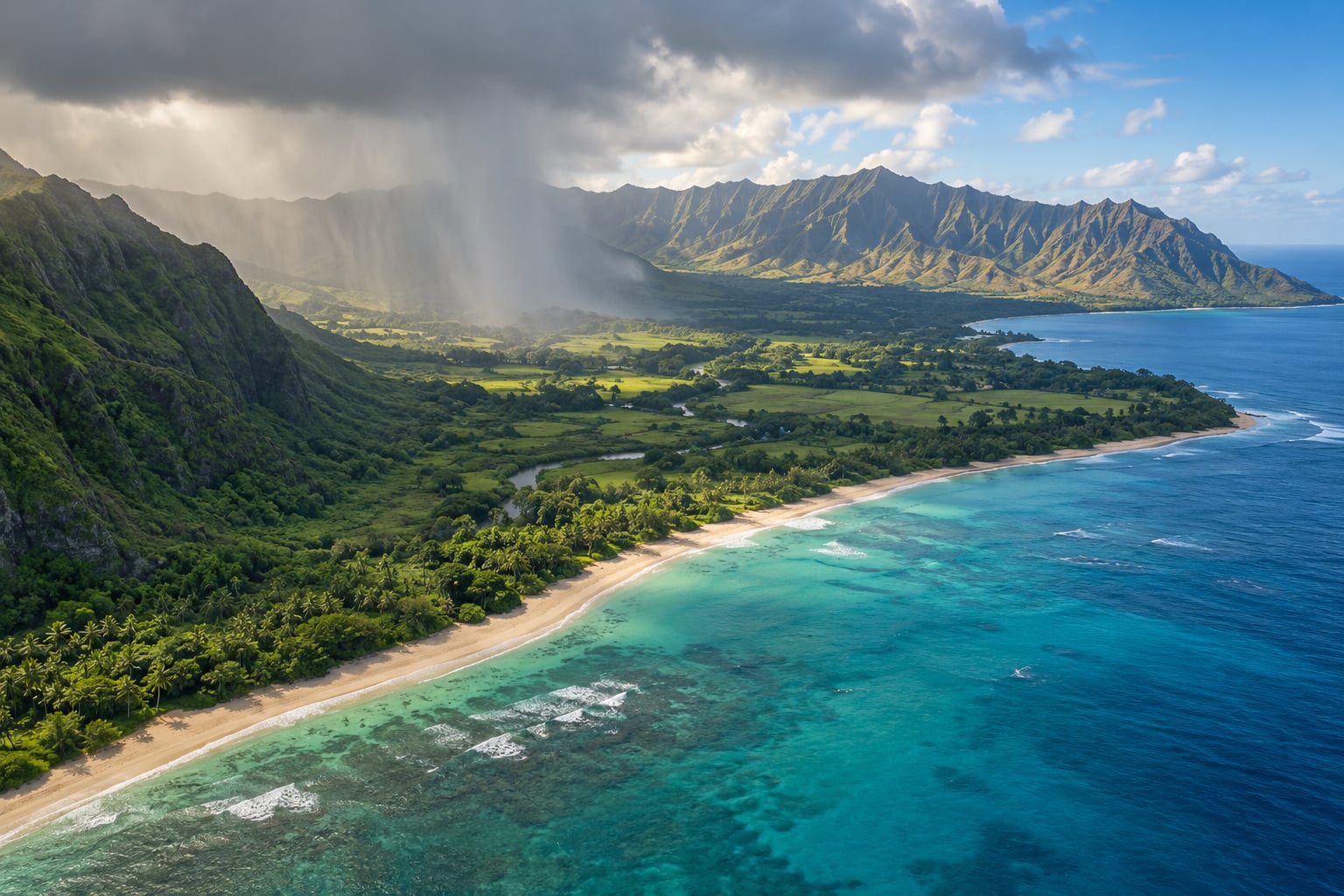
The single most useful thing to understand about Hawaii weather is that rain is localized. It is very common to stand on a west-facing beach in bright sun while watching a rain shaft cross a valley a few miles away, then pass a rain shower on the highway twenty minutes later.
Here is the mechanism, and it is short. Trade winds blow from the northeast. As that moist air hits the mountains it rises, cools, and drops rain on the northeast, or windward, side. The same air then crosses over the summit and descends on the southwest, or leeward, side, warming as it goes, which is why places like Waikiki, Kailua-Kona, and the leeward side of Maui are dry for most of the year even during the wet months.
Which means the resort you book, not the month, often determines your weather. Kauai has the wettest conditions of the main islands, and the Garden Isle’s north and east coasts can be rinsed daily while the south around Waimea Canyon stays dry. On the Big Island, the split between Hilo and Kona can be dramatic in the same afternoon.
A wet-season shower is also usually shorter and harder than people expect. In a lot of traveler accounts it arrives as a 15 to 30 minute downpour, often with a rainbow behind it, and is followed by sunshine. Pack a light packable rain shell rather than a heavy jacket, and plan beach and hiking hours for the morning on days when showers are likely.
You can also hedge across the weather. On the Big Island, staying on the Kona side keeps you in the sun through the wet season. On Kauai, staying on the south shore during winter trades gives you bigger surf to watch and drier days.
Best Time for Beaches, Snorkeling, and Hiking
For beach days and swimming, aim for May through October. The water is warm, the trades are usually steady enough to keep the sea surface clean, and north and west shores are calm. Watch the shore direction: during the winter swell months, north and east facing beaches on Oahu, Maui, and Kauai get conditions that are genuinely unsafe for swimming even on a sunny day, while south and west facing beaches stay glassy. If the forecast shows a large north swell, move your swim to the south shore and go watch the surfers instead.
For snorkeling, June through September gives the best underwater visibility, when the trades stir the water and the dry season keeps the runoff down. Visibility at Molokini, the Hanauma Bay preserves, and the Kona coast is noticeably better in a strong trade-wind week than in a calm glassy one. Always check the marine conditions and any harbor or bay alerts before booking an excursion, because a boat trip is the easiest thing in your itinerary to lose to a wind day.
For hiking, the choice is about heat and trail condition rather than rain. Slopes, ridgelines, and exposed trails like those in Waimea Canyon, Kalalau, or the summit routes on the Big Island heat up fast in May through August, so start at sunrise and carry more water than you think. April, May, September, and October give you drier trails, cooler mornings, and less punishing conditions. Winter adds a second variable: wet rock and muddy trail surfaces on popular routes.
Elevation does the rest. Summit areas on the Big Island run well below freezing at night, and Haleakala on Maui at just over 10,000 feet can feel like a different planet from the beach below. Bring a warm layer for sunrise regardless of the season.
Weather Differences Between Oahu, Maui, Kauai, and Hawaii Island
Hawaii’s islands sit in a 800-mile chain, and each one has its own shape, wind exposure, and rainfall profile. This is where the choice of month gets refined.
| Island | Character | Best months for weather | Watch for |
|---|---|---|---|
| Oahu | Most urban, moderate rainfall year-round, easy to split a trip between beaches and city | April, May, September, October | North shore swells November to March; summer crowds and higher rates |
| Maui | Warm year-round, drier than most islands, whale watching capital | April, May, September, October; January to March for whales | Haleakala summit cold any month; west side wetter in winter |
| Hawaii Island | Largest island, most varied conditions, driest leeward coast, coolest summit | April to June, September, October | Hilo and the Kohala coast rain in the summer months; volcano park is at altitude |
| Kauai | Wettest of the main islands, the Garden Isle, very green in winter | April to June, September; January to March for whales and surf | Na Pali Coast can be rough in winter; north and east sides much wetter |
| Molokai | Remote, lightly visited, leeward west side is dry and sunny | April, May, September, October | Limited services, long drives, some areas unreachable in heavy rain |
| Lanai | Small and quiet, dry, largely undeveloped outside one resort area | April, May, September, October | Book transport and any guided activity well ahead; whale watching nearby in winter |
One of the best single-island arguments for a shoulder trip is the Big Island. It is large enough that it rarely feels crowded, and its leeward side keeps you in the sun even during the summer convergence zone. Kauai is the opposite trade: wetter, but winter brings a green landscape and serious surf, which is its own draw.
Crowds, Prices, and Booking Timing by Season
Hawaii is consistently expensive, and the month you pick changes demand more than it changes cost per night. Think of it as a demand scale rather than a number.
| Month | Demand | What drives it |
|---|---|---|
| January (after the 5th) | Low | Post-holiday drop, whales still active |
| February | Low | Quietest window, whale peak, good availability |
| March | Low to moderate | Builds through the month with mainland spring break |
| April | Moderate | Spring break easing, then a genuinely quiet early-month window |
| May | Low to moderate | Quiet except the Memorial Day weekend and festival dates |
| June | Moderate | Summer build, plus graduation and holiday travel |
| July | High | School-break peak, limited hotel inventory |
| August | High | Continued summer peak, warmest guaranteed sun |
| September | Low to moderate | Summer ends, Labor Day weekend is the exception |
| October | Low to moderate | Event calendar fills specific weekends on the Big Island and Maui |
| November | Low | Quiet apart from Thanksgiving week |
| December | Very high | Holiday period, then a sharp drop after mid-month |
How far ahead to book depends entirely on which window you are shooting for. The booking side is more predictable than the weather side, and the lead times get long fast as you move into peak.
| Travel window | Flights | Hotels and vacation rentals | Rental car |
|---|---|---|---|
| Late December, July, major holidays | 6 to 9 months | 6 to 9 months, sooner for condos and multi-bedroom | 3 to 4 months |
| Shoulder months (April, May, September, October) | 3 to 5 months | 3 to 5 months | 4 to 8 weeks |
| Low season (mid-January to February, mid-November) | 2 to 4 months | 2 to 4 months | 2 to 4 weeks |
Two restrictions are worth booking first regardless of season. Haleakala sunrise requires an advance reservation for the popular early morning window, and the demand for it is high enough that a late booking simply rules the sunrise out. Na Pali Coast boat tours operate on a limited seasonal schedule, so if that is the reason you are going, check the operating months before you fix your dates.
Events also concentrate demand in otherwise quiet months. Merrie Monarch in late April, the Aloha Festivals in September, the Ironman World Championship in Kona in the fall, and the Honolulu Marathon in December each draw crowds and lift rates for a few days around them.
How to Choose the Best Time for Your Hawaii Trip
Work from your main priority, then work backwards. These are the seven situations that come up most often.
If you want reliable warm beach weather and can pick any month: choose May, June, September, or early October. All four deliver dry-season conditions, and September and October are the least crowded of them.
If you want the warmest water and the most predictable swimming: go July or August, and accept the crowds as the price. If the budget can absorb it, late August into September gives you nearly the same water temperature with thinner crowds.
If you want whales: go January, February, or March. Pick Maui, the Big Island, or Molokai. If you also care about quiet, take the second half of January or February, and avoid the last two weeks of March when spring break arrives.
If you are a surfer: the answer flips completely from the beach answer. North Shore Oahu and Maui are at their best from November through March, with the biggest surf in December, January, and February. Summer is a south-shore season, when smaller waves break at beaches like Waikiki, Makapu, and Sandy Beach instead.
If you are hiking: April, May, September, and October keep trails drier and mornings cooler. Winter is fine for lower-elevation forest trails, but wet rock on exposed ridges is a real consideration, and the Big Island’s volcano park and summit routes are cold at night all year.
If you are traveling with kids or on a school-break calendar: you are looking at June, July, and August, and that is fine. Build the trip around early morning beach and snorkel time, midday water play, and late afternoon rest, and book everything three to four months out.
If you are on a budget or booking at short notice: look at the second half of January, all of February, and early December. Demand is the lowest of the year in those windows, which is when rooms and cars are easiest to get.
If you have only a few days: pick one island. The Big Island and Maui hold the most variety per day, and Oahu packs the most attractions into a short trip. A four to five day visit is usually enough for one island; ten days or more is when adding a second island starts to make sense.
Whichever window you settle on, check the National Weather Service Honolulu forecast about a week out and again the day before, look up current marine conditions before booking any boat excursion, and pack a light rain shell even in the dry season.
Frequently Asked Questions
What is the best month to visit Hawaii for good weather?
April, May, September, and October offer the best balance of dry weather, warm ocean, and manageable crowds. May and early September are warmest and driest of the group, while April and October sit at the cooler edge of the range. July and August are warmer still but carry peak summer crowds and peak demand.
Is the rainy season in Hawaii bad?
Not in the way most people imagine. Wet-season rain usually arrives as a 15 to 30 minute tropical shower rather than all-day drizzle, and it falls mainly on the northeast windward side. The southwest leeward coasts, including Waikiki, Kailua-Kona, and parts of Maui, stay dry through the winter. Many travelers report plenty of sunshine between showers.
What month is worst for hurricanes in Hawaii?
September carries the highest risk, and the official season runs June 1 through November 30 with most systems forming between July and September. Direct strikes on the main islands are rare, the last one crossing Oahu happening in 1992. The realistic impact is higher surf, a few gray days, and canceled boat excursions rather than a landfall.
When is whale watching season in Hawaii?
Humpback whales are in Hawaiian waters roughly December through May, with the peak between January and March. Around 10,000 whales pass through, concentrated around the channel between Maui and Molokai, with viewing also good on the Big Island. Fewer boats run in January than in February, so morning trips often mean a better experience.
What is the cheapest time to visit Hawaii?
The quietest and least expensive stretch is from mid-January through February, followed by early December after the holiday travel period and early May outside the Memorial Day weekend. Demand peaks over Christmas and New Year and through July. Booking flights three to five months ahead for a shoulder month gives you far more room than a last-minute winter trip.
Does weather differ a lot between the Hawaiian islands?
It can, on the same day. Kauai is the wettest of the main islands, with the north and east sides much rainier than the south. The Big Island splits dramatically between Hilo and the Kohala coast and the dry Kona side. Oahu stays fairly moderate year-round. That is why choosing the island and the side of the island often matters more than the month.
Conclusion
April, May, September, and October remain the answer to when to visit Hawaii for the best weather, with the exact pick depending on whether you want the warmest water or the quietest beaches. Everything after that is a secondary decision: match the island to your weather preference, then match the coast.
Here is what to do first. Pick your month, pick the island and the side of the island, then book the pieces that are hard to replace, meaning the Haleakala sunrise reservation, a Na Pali or Molokini boat excursion, a rental car, and any dates near an event. Check the National Weather Service forecast a week out and marine conditions the day before the water.
Rain in the winter is a nuisance, not a disaster, and a bad forecast in Honolulu says very little about the morning after. Pack the light shell, keep the first and last days of your trip flexible, and the worst of the season turns out to be manageable more often than not.