A parked car heats up shockingly fast, so the way you keep food cold in the car all day comes down to four things: chill everything before you leave, pack it into an insulated cooler with more frozen coolant than you think you need, keep that cooler shaded and closed, and verify with a thermometer instead of guessing. Perishable food stays safe at 40°F (4°C) or below.
That is the whole method. The rest of this guide is the detail that decides whether it works on a 95°F afternoon — how fast the cabin climbs, how much ice a 12-hour drive actually takes, what order to stack things in, and when the USDA rules say you throw the leftovers out. It takes about 20 minutes of prep before departure, and the actual skill level is low.
Nothing here needs power or a plug. If you want the same answer in one glance, the steps below run in order and the mistakes section at the end catches the four things that ruin most coolers.
Table of Contents
- How fast does a parked car heat up?
- What You Need
- How to Keep Food Cold in the Car All Day, Step by Step
- Pre-chill the food and cooler before loading
- Choose a cooler that fits the whole outing
- Pack the cooler in the right order
- Keep the cooler shaded and rarely opened
- Check the temperature instead of guessing
- Know when perishable food must be discarded
- Common Mistakes
- Loading warm food
- Buying a cooler that is too small
- Putting ice only at the bottom
- Leaving it in direct sun
- Opening it every fifteen minutes
- Relying on the car battery or a running engine
- Keeping food visible during stops
- Trusting a cold-feeling cooler without a number
- Frequently Asked Questions
- How long can food stay cold in a car cooler?
- Should I use a trunk or passenger compartment for a food cooler?
- Is it safe to keep frozen food in the car if it still has ice crystals?
- Can I run the car to keep food cold while I am away?
- How often should I open the cooler during a hot day?
- Conclusion: Start With a Pre-Chilled Cooler
How fast does a parked car heat up?
This is the number people get wrong, so it is worth sitting with. A closed car in summer sun gains roughly 20°F in the first ten minutes and can pass 100°F within an hour. Windows and windshields block ultraviolet light but not infrared heat, which is why the cabin soaks up solar energy through every surface.
| Time parked in summer sun | Approximate cabin temperature | What it means for perishable food |
|---|---|---|
| 0 minutes | Outdoor temperature, roughly 80°F | Safe, if you start cold |
| 10 minutes | About 20°F higher than outdoors | Approaching 100°F, danger zone |
| 30 minutes | Around 115°F to 125°F | Danger zone for 30 minutes |
| 60 minutes | Often above 130°F | Danger zone for an hour |
| 2 hours or more | 130°F to 160°F | USDA limit reached, discard risk |
The USDA Food Safety and Inspection Service counts the range between 40°F and 140°F (4°C and 60°C) as the danger zone, where bacteria multiply fast. Above 90°F (32°C) outside, the clock drops from two hours to one. Shelves, seat pans and the cargo area all sit in that band, with dark surfaces and a closed cabin at the top of the range.
The practical takeaway: food you forget about in the car is already in trouble long before you get back. Cooling equipment only works if the cold source starts colder than the food and stays that way.
What You Need
A reliable setup is four items plus a plan. Anything less works until the sun climbs, which is exactly when you need it most.
- An insulated cooler sized for the trip. Rotomolded hard coolers with a gasket seal hold temperature far longer than soft-sided totes. Buy for the number of people and the hours, not for the car boot space you wish you had.
- Frozen coolant. Block ice for long trips, cube ice or frozen water bottles for a single day, reusable gel packs for drinks and lunch boxes. Dry ice for genuinely long or sub-freezing runs, handled with care.
- An independent food thermometer. A dial probe you can push into a thick item tells you what the air inside the cooler is not telling you. Cheap models work fine.
- Leakproof containers. Deli containers or screw-top tubs keep food out of meltwater, which is the number one complaint about soggy cooler food.
- An insulated tote or bag for the passenger cabin. Nesting one cooler inside another is the most-repeated trick among people who drive in summer heat, and it adds real hours.
- A shade plan. A cargo liner, a reflective sun cover, or simply the coolest and least sunlit spot in the vehicle. Pull the cooler out before you unload anything else.
How much coolant you need scales with time and heat. These are working figures for a typical insulated cooler holding a mixed load for two to four people.
| Trip length | Block or frozen bottles | Cube or bagged ice | Gel packs |
|---|---|---|---|
| Up to 12 hours, mild weather | 6 to 8 blocks | 10 to 12 lb | 4 to 6 packs |
| 12 to 24 hours | 10 to 14 blocks | 20 to 24 lb | 6 to 8 packs |
| 24 to 36 hours | 16 to 20 blocks | 35 to 40 lb | 8 to 10 packs |
| 36 to 48 hours | 24 blocks or more | 50 lb or more | 10 to 12 packs |
Add roughly half again as much coolant if the forecast is above 90°F (32°C), if the cooler sits in direct sun, or if you expect to open it often. Forum advice from long-distance drivers is blunt about this: a cooler advertised as a five-day cooler often manages two days once it becomes the family snack drawer.
How to Keep Food Cold in the Car All Day, Step by Step
Pre-chill the food and cooler before loading
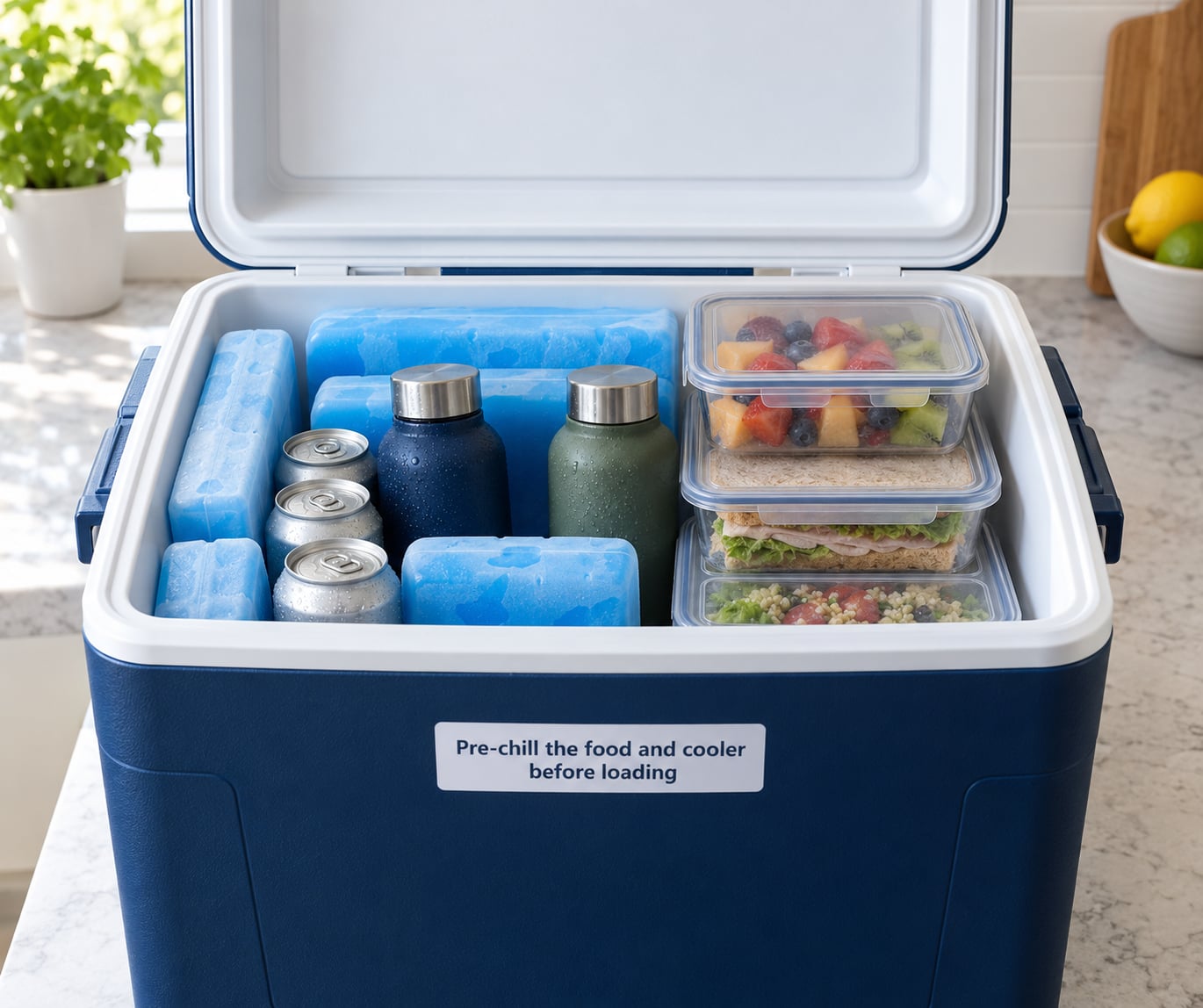
Pre-chilling is the single biggest win, and it takes one evening. Put the empty cooler in the coldest part of your house with a bag of ice or several gel packs inside, and let it sit overnight. Refrigerate everything that was in the fridge and chill drinks the night before rather than the morning of.
Here is why it matters: ice spends its energy bringing warm things down to temperature. Warm food entering a cold cooler absorbs that energy, so the coolant melts fast before it ever starts protecting anything. Cold food entering a cold cooler barely touches the coolant at all. A registered dietitian I read describing this put it plainly — loading a pre-chilled cooler is the difference between putting food in a fridge and putting it in a warm box.
You will know it worked if the food in the cooler still feels cold to the touch and the ice blocks are still solid in shape rather than slumped, several hours into the drive.
Choose a cooler that fits the whole outing
Pick the cooler from three numbers: how many people you feed, how many hours you are away, and how hot it will be. A 20-quart cooler packed full with ice and food will hold temperature well through a 12-hour summer day. The same cooler holding two sandwiches and six drinks will look half empty, and half empty is the enemy of ice retention, because air conducts heat far better than ice or food.
Insulation thickness matters more than brand. Thick-walled rotomolded bodies with a rubber gasket and over-centre latches seal properly, and a proper seal is the difference between a cold afternoon and a warm one. Check the closure early: fill it with water, close it, and see if anything seeps along the seam.
If you want cold all day without buying more ice, three routes exist. A hard cooler with block ice is the cheapest and most proven. An insulated tote inside a hard cooler doubles the insulation for the price of a tote. A 12-volt compressor fridge runs off the cigarette lighter socket or a portable battery pack and holds a set temperature indefinitely, which is why car-dwelling communities keep asking about them, but it costs more upfront and does nothing during a power cut.
Pack the cooler in the right order
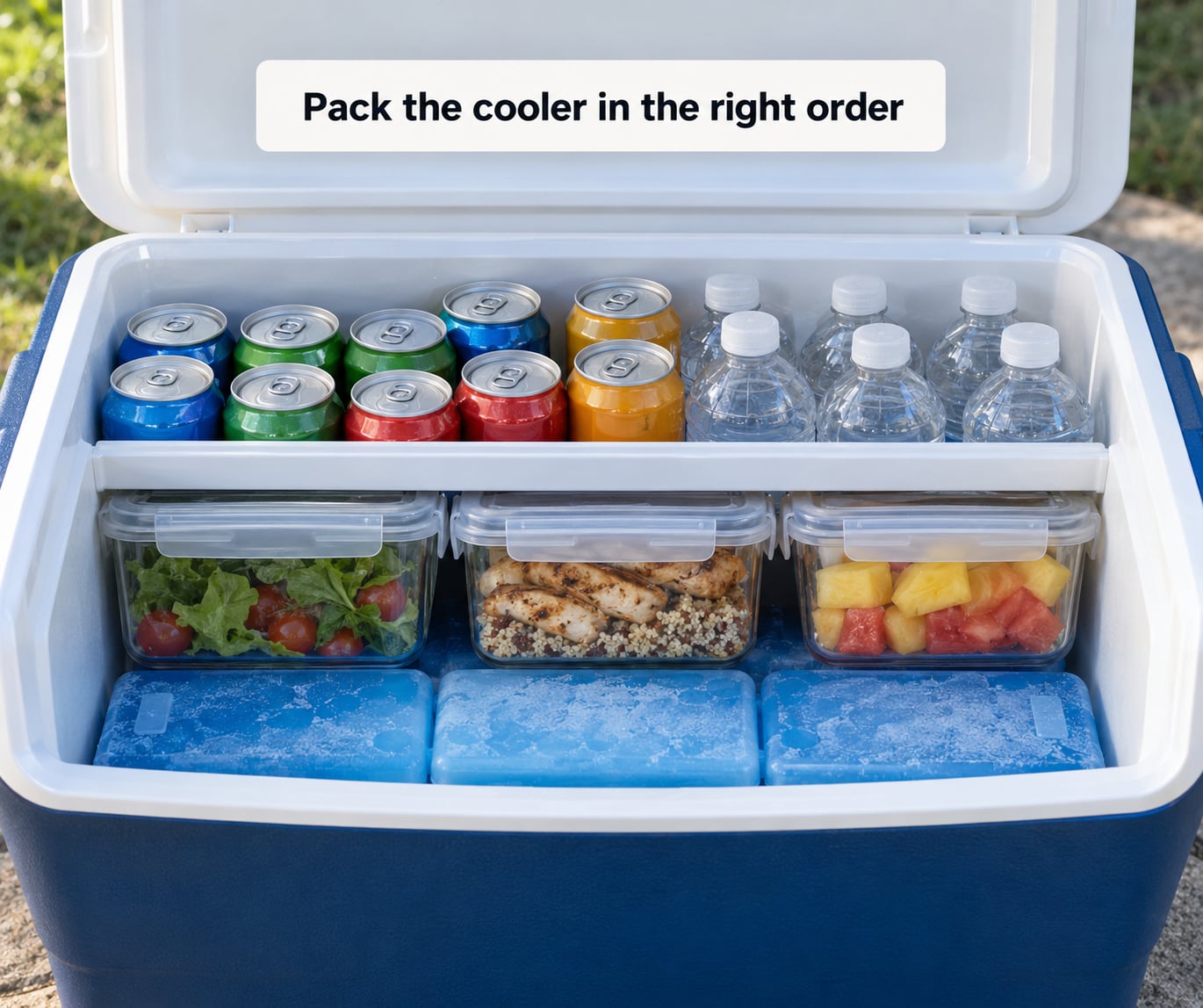
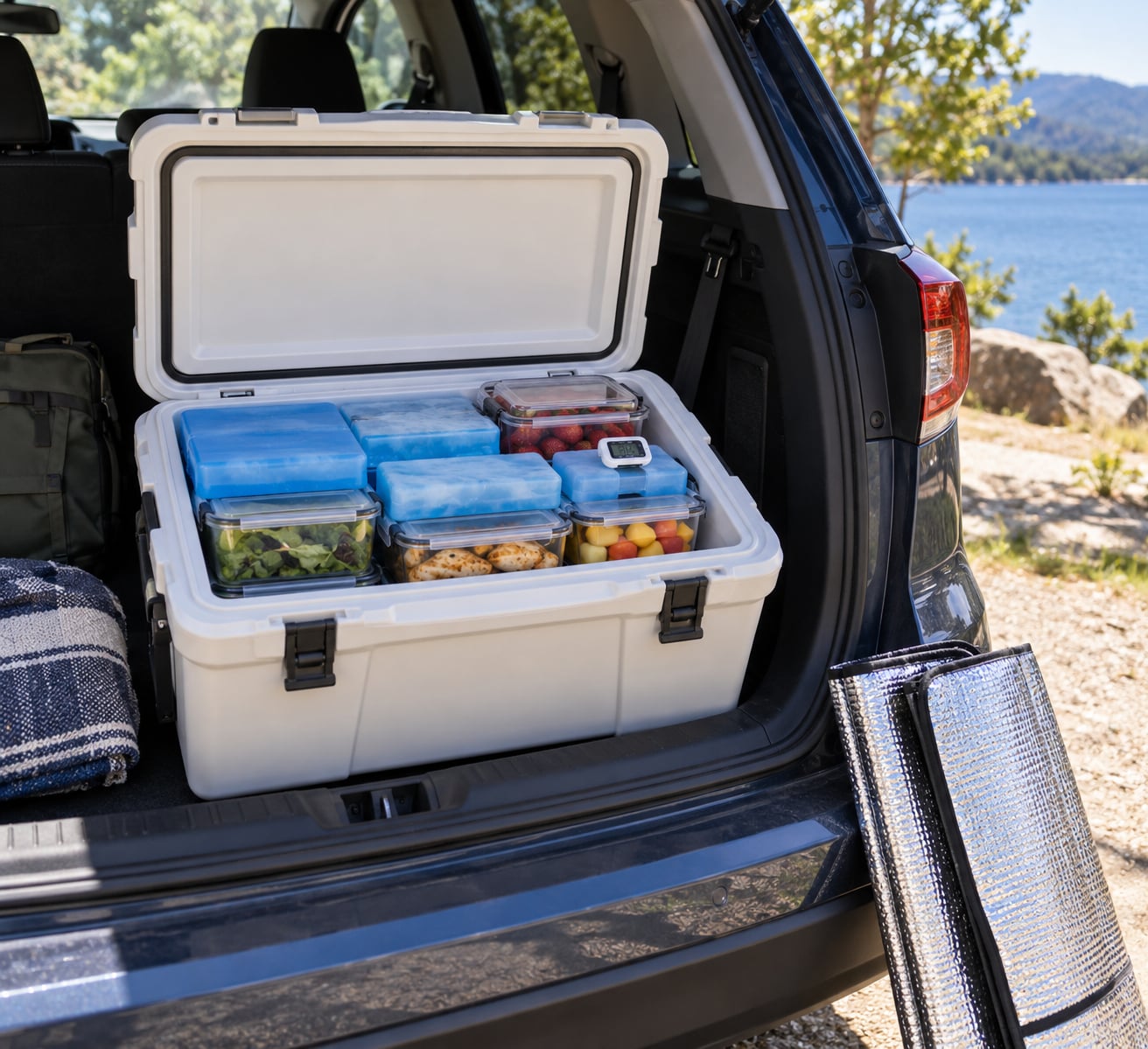
Coldest and least used at the bottom, most used at the top. Frozen blocks or bottles sit on the floor of the cooler, then frozen items such as meat and seafood go directly on top of that cold source. Raw meat always goes in a sealed tub or bag, separate from anything ready to eat, and below the food you plan to pull out often.
Put sandwiches, fruit, drinks and lunch boxes on top where you can grab them in one movement, rather than unpacking the whole stack for a juice box. The most repeated packing rule in camping forums fits neatly here: air is your enemy. Fill the voids. Nest small sealed tubs into the gaps between blocks, use empty sealed containers as spacers, and keep the cooler as full as you can manage.
A few small habits prevent the complaints that show up in every cooler thread. Keep ice inside its plastic bag or a sealed tub so meltwater never reaches loose food. Keep a towel or a shallow drain tray at the base, and drain only once you are back in air conditioning — cold meltwater still chills the food around it. Keep fragile items and bottles in an inner insulated tote so they do not freeze solid against the ice. Eat the delicate items early, while the coldest layer is still working.
Keep the cooler shaded and rarely opened
Heat comes in through the lid, the walls and direct sun, and out every time you lift the lid. Put the cooler in the passenger area or the cargo bay behind a liner, out of any patch where sunlight lands through the glass, and never on top of a warm suitcase or under a pile of hot gear.
On hot days, take the cooler out of the car during stops if you can, and put it in the shade before you unload anything else. Grabbing lunch should not mean sorting through six containers. Batch what you need into one tote, pull that tote out, close the lid, and go back for seconds if you must.
If you are parked for hours with nobody in the vehicle, treat the cooler as the priority item. The cargo area is usually less sun-exposed than the cabin, and a light-coloured or insulated liner over it does more than most people expect.
Check the temperature instead of guessing
The habit that separates people who keep food safe from people who hope they got lucky is a thermometer check. Push the probe into the thickest item, or into the centre of a container of meat, rather than reading the air at the lid. Record it when you pack and again a few hours in, then add or rotate frozen packs if the reading climbs.
Reading at or below 40°F (4°C) means you are on track. Between 40°F and 70°F for a short while is not an automatic failure, but it is a warning to add cold and eat the risky items first. There is no way to recover food that has spent hours in the danger zone and then been chilled again, so treat climbing numbers as a signal to eat, not to rearrange.
For people managing medication cold chains rather than lunch, a small battery data logger that records temperature is worth carrying. The same thinking applies to infant formula and breast milk, where people often assume any cool bag is enough and it is not.
Know when perishable food must be discarded
The USDA rule is short and worth memorising. Perishable food that has been above 40°F (4°C) for more than two hours must be thrown away, and above 90°F (32°C) the limit is one hour. Perishable means meat, poultry, seafood, eggs, dairy, cut fruit, cut vegetables, cooked rice and pasta, and anything else that spoils without refrigeration.
Two hours is cumulative, not per outing. If food warms past 40°F for 30 minutes at one stop and 90 minutes at another, that is two hours and it goes in the bin. Food sitting on a picnic table in full sun is in the same danger zone as food sitting in the car, so pull coolers before you spread out blankets.
When in doubt, discard it. There is no safe smell or appearance test for bacteria, and a cooler full of ice that you cannot vouch for is not permission to take chances. Leftovers from a car that spent hours above 40°F (4°C) are the ones people regret keeping.
Common Mistakes
Nearly every failed cooler I have heard about traces back to one of these. The fix for each is simple enough to do before you leave.
Loading warm food
The most common and most damaging. Warm food and warm drinks dump heat straight into the coolant. Chill everything overnight, and pre-chill the empty cooler too.
Buying a cooler that is too small
An undersized cooler runs out of ice hours early and leaves food sitting in meltwater. Size for the hours, then fill the remaining space with sealed containers so cold air has nowhere to move.
Putting ice only at the bottom
Cold sinks, but the food you open most sits at the top and stays warm. Split the coolant: some underneath, some on top and around the sides.
Leaving it in direct sun
Solar gain on a lid is fast work for a cooler. Use a cargo liner or a reflective cover, and choose the least sunlit place in the vehicle.
Opening it every fifteen minutes
Each opening lets warm cabin air in and cold air out. Batch your access, take out what the whole group needs in one go, and close the lid.
Relying on the car battery or a running engine
A parked, idling car does not cool a cabin reliably, wastes fuel, and raises carbon monoxide risk in enclosed or crowded places. Treat the AC as a bonus on arrival, not as part of the cold chain.
Keeping food visible during stops
A picnic table in full sun is not a safe serving surface, even on a mild day. Keep perishables inside the cooler and put out only what will be eaten within two hours.
Trusting a cold-feeling cooler without a number
Hands lie, especially at the start of a trip. A thermometer costs almost nothing and turns a guess into a decision.
The safest routine for a short outing is small: pre-chill, load in the right order, park in shade, check once. For anything longer than a day, add a second cooler for drinks so the food cooler is opened rarely, put the ice in blocks rather than cubes, and check the temperature every few hours. If you have no cooler at all, insulated grocery bags in a shaded footwell, a bag of ice from a rest stop, and small quantities of ready-to-eat food beat nothing, though they are not a substitute for a real cooler.
Frequently Asked Questions
How long can food stay cold in a car cooler?
A well-packed insulated cooler holding 40°F (4°C) or below will usually protect perishables for 24 to 36 hours, and roughly two days with block ice in mild weather. Open it less, keep it shaded, and you gain hours; leave it in the sun or open it constantly and you lose most of that. Verify with a thermometer rather than trusting the packaging claim.
Should I use a trunk or passenger compartment for a food cooler?
Either works, and the deciding factors are sun and space. A covered cargo area usually receives less direct sunlight than the cabin, which helps in summer, but it can be cramped for a large cooler. In the passenger area, an insulated tote or bag gives extra protection. Whichever you pick, put the cooler out of direct sun, and bring it inside before you unload anything else.
Is it safe to keep frozen food in the car if it still has ice crystals?
Yes. Ice crystals or a food temperature at 40°F (4°C) or below means the food is still safely frozen, which is the USDA position. Food that has fully thawed and is still cold enough to have ice crystals forming again is usually safe, but food that has thawed and warmed above 40°F (4°C) for over two hours, or one hour above 90°F (32°C), must be discarded.
Can I run the car to keep food cold while I am away?
It is not a good idea. A parked idling car does not cool the cabin evenly, so food near the windows can still climb quickly, and you burn fuel for little benefit. Sitting in a parked vehicle also raises carbon monoxide risk, especially in garages, drive-throughs and quiet residential streets. Use a cooler with frozen coolant instead, and treat the air conditioning as an extra once you are back in the car.
How often should I open the cooler during a hot day?
As rarely as you can manage. Every opening replaces cold air with warm cabin air and melts ice faster. A good rhythm on a long drive is two or three planned openings, each one taking out everything the group needs at once, then a quick temperature check. If you need constant access to drinks, put them in a second cooler or tote so the food cooler stays shut.
Conclusion: Start With a Pre-Chilled Cooler
If you only remember one thing, remember the first step. Put the cooler and the food in the coldest place you have the night before, then load frozen coolant on top and underneath, close the lid, and keep the whole thing out of the sun. Check the temperature once a few hours into the trip instead of assuming, and throw away anything that spent more than two hours above 40°F (4°C), or one hour when it is above 90°F (32°C) outside.
That routine is what actually lets you keep food cold in the car all day, whether the trip lasts six hours or three days.