
If an airline cancels your flight and you choose not to fly, you are entitled to a full cash refund to your original payment method under US Department of Transportation rules. The airline has to process it automatically: within 7 business days for a credit card charge, and within 20 calendar days for cash or any other payment method. This guide walks through how to get a refund for a canceled flight, starting with the one move most people skip, which is declining the travel voucher before anything else.
The tricky part is rarely the right itself. It is the portal that only offers you a credit, the phone agent reading a script, and the two weeks of silence that look exactly like a refusal. Most of that is avoidable, and the whole process usually takes an afternoon plus a few follow-ups.
Table of Contents
- What You Need
- How to Get a Refund for a Canceled Flight, Step by Step
- Confirm exactly what changed
- Check the fare rules and passenger rights
- Gather proof of the booking and cancellation
- Contact the party that issued the ticket
- Submit a specific refund request
- Follow up and escalate if necessary
- What to do about ancillary fees and partial itineraries
- How long the refund takes
- Common Mistakes
- Frequently Asked Questions
- Do I get a refund if my flight is canceled?
- How long does a canceled flight refund take?
- What if my flight was booked through Expedia or another travel agent?
- Can I still get cash if I already accepted a travel voucher?
- Will my credit card refund a canceled flight through a chargeback?
- What happens if the refund goes to a cancelled credit card?
- Conclusion
What You Need
Gather this before you contact anyone. Airlines verify bookings against a record locator, so a claim without one goes nowhere.
- Booking confirmation or record locator. The six-character code from the original email, plus the full confirmation email itself.
- Passenger names exactly as ticketed. Middle names and date of birth matter if the booking agent needs to match the reservation.
- The cancellation notice. Screenshot the app, the SMS, or the departure board. Note the time it arrived, since it sets the record.
- Payment record. The card statement line, the date, the last four digits, and the amount charged.
- Full itinerary. Every segment, including connections and any separate return legs, so you can claim a partial refund correctly.
- Receipts for extras. Seat selection, checked bag fees, lounge access, and any other ancillary fee you paid.
- Every message. Screenshots of texts, emails, app chats, and written requests. Not the call, unless you took notes.
One extra piece saves a lot of back-and-forth: note whether the ticket was issued by the airline or by a third-party booking site. That single fact decides who owes you the money.
How to Get a Refund for a Canceled Flight, Step by Step
Confirm exactly what changed
Cancellation, schedule change, delay, missed connection, denied boarding, and voluntary cancellation all produce different options. Read the notification twice before you assume anything.
An involuntary cancellation is the airline canceling a flight it had booked and sold. That is the clean case, and it triggers an automatic cash refund if you do not fly.
A schedule change means the flight still operates but at a different time, and sometimes a different airport. If the new schedule is a significant change, the DOT rule gives you a choice of refund or the revised itinerary. Significant changes include a departure or arrival shift large enough to make the original trip useless, a change in airport, or a downgrade in cabin on a fare that included premium seating.
A delay is not a cancellation, and the thresholds are higher. For flights leaving the United States, a domestic delay of 3 hours or more, or an international delay of 6 hours or more, can count as a significant delay. Missed connections and denied boarding sit on their own rules.
If you canceled the trip, fare rules take over completely. Non-refundable and basic economy fares generally give you nothing back.
Check the fare rules and passenger rights
Rights live in two places: the fare rules you agreed to when booking, and passenger-protection law where you live or where you are flying. For most US departures the second one is the DOT refund rule under 14 CFR Part 259.
Under that rule, if the airline cancels your flight and you do not accept a replacement, you get a full refund of the fare and any taxes and fees, back to the original payment method. You do not have to justify it, and you do not have to explain the reason for the cancellation.
Here is the part people misunderstand. Whether the cancellation was caused by weather, a mechanical fault, an air traffic control hold, or a staffing shortage makes no difference to the refund right. Those reasons matter for compensation claims, not for getting your money back. Forum consensus on travel legal advice threads is consistent on this point: a frontline agent telling you the cause was weather is describing the airline’s problem, not yours.
Outside the US, the same basic idea applies through EU261 and UK261, with two differences. First, you can claim compensation on top of the refund, because those are two separate claims. Second, arrival delay at your final destination is what gets measured, not departure delay.
| Where your flight departs | Refund if you do not fly | Extra compensation available |
|---|---|---|
| United States | Full refund to original payment method, automatic | None for weather or controllable causes; only for denied boarding or extreme delay cases under DOT rules |
| EU member state under EU261 | Refund of the unused part of the journey | EUR 250 to EUR 600 by flight distance, plus meals, hotel, and transport |
| UK departure under UK261 | Refund of the unused part of the journey | GBP 220 to GBP 520 by flight distance, plus care and assistance |
EU261 and UK261 both exclude extraordinary circumstances such as extreme weather and air traffic control strikes, though care obligations still apply in many of those cases. Check the rules that apply to your departure point rather than assuming the US timeline.
Gather proof of the booking and cancellation
Screenshot everything before you touch the booking. Once you accept a rebooking or a voucher, the original itinerary can disappear from the app and your evidence gets harder to rebuild.
Take three specific screenshots: the cancellation message with its timestamp, the original itinerary page showing the canceled segment, and the refund or credit offer as it was presented to you. That last one matters later if you need to show you were offered a voucher and declined it.
Write down the amounts you paid separately. A line-item note of base fare, taxes, seat, and bag means you can spot a short refund the moment it lands, instead of discovering months later that the bag fee never came back.
Contact the party that issued the ticket
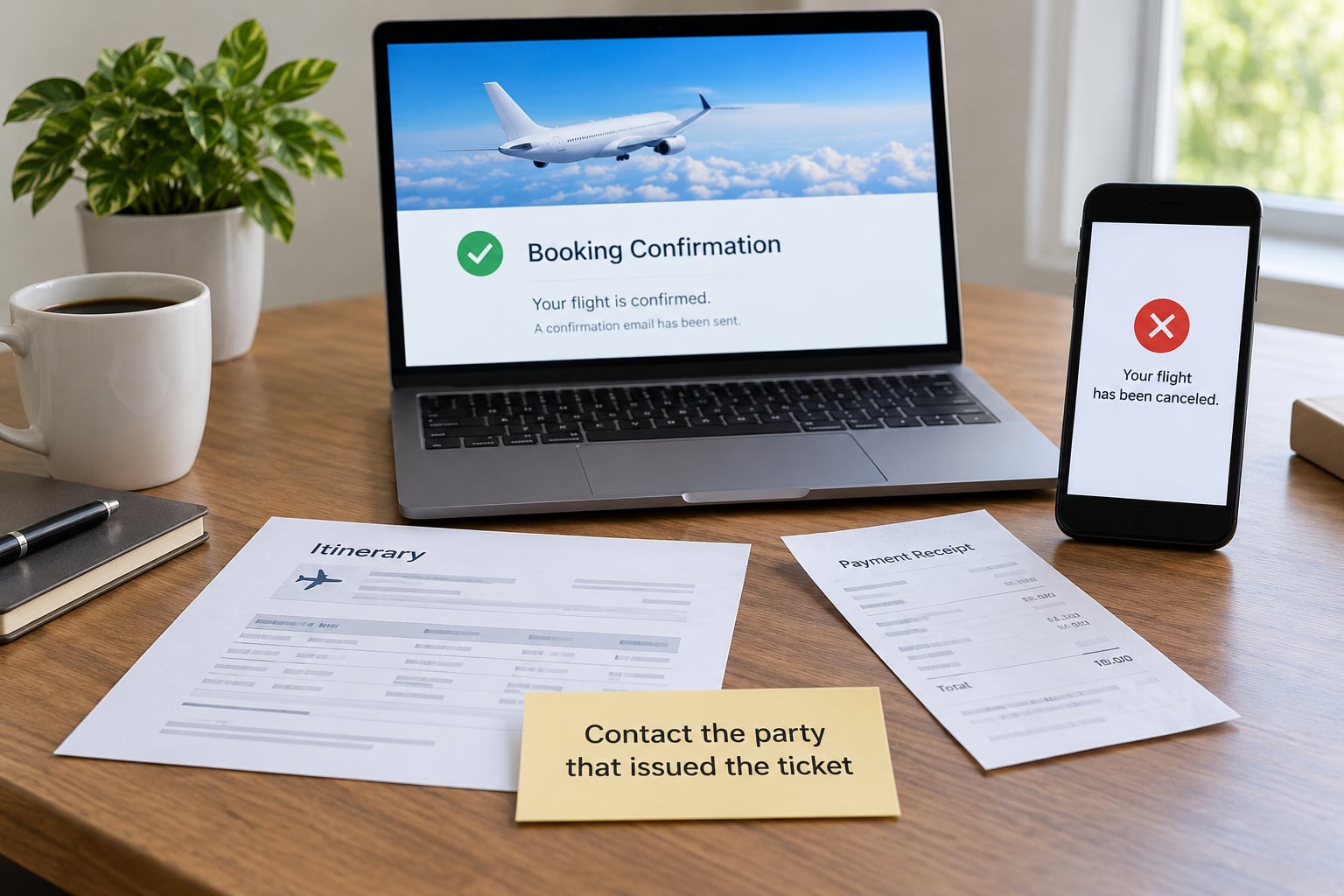
The payer is the party that owes you the refund. If you paid the airline directly, contact the airline. If you paid Expedia, eDreams, Opodo, Booking.com, or a phone agent, contact them first, because they hold the money.
The circular deflection is the most common complaint in travel forums. The airline says contact your booking agent. The agent says we are waiting on the airline. Neither moves.
Break the loop this way: contact the party that took your payment, quote the record locator, and state that the flight was canceled and you are declining the offered rebooking or travel credit. Then give a deadline. If that party points back at the airline, tell them in writing that you are requesting the refund from them as the merchant of record and that you expect either the refund or a written explanation within 14 days.
If you booked direct, use the airline’s own refund channel rather than social media or a third-party claims vendor. Delta, United, and American all publish a refund request form and a Manage Trips or My Trips section where a canceled segment can be claimed. Southwest handles refunds through its own site and customer service. The portals often default to offering a travel credit, so look for the cash option or file the written request instead.
Submit a specific refund request
A vague message gets a vague answer. Put these nine things in the request, in writing:
- Record locator and booking confirmation number
- Passenger names exactly as ticketed
- The canceled flight number and scheduled date
- Date and reason for cancellation as stated
- Confirmation that you are declining rebooking and travel credit
- Request for a full refund to the original form of payment
- The original payment method, including last four digits of the card
- Itemised list of ancillary fees to include, such as seat and checked bag
- A reasonable deadline for a written response, such as 14 days
Say the decline explicitly. The single highest-value sentence in this whole process is a written one: I decline the travel credit and rebooking offer, and I am requesting a full refund to my original form of payment.
If you want the words to say at a gate or phone, they are short. Say: I understand you are offering a travel credit, and I am declining it. My flight was canceled by the airline and I did not travel, so I am requesting a refund to my original payment method. Then ask for a case number before you hang up. A refusal at the counter is a script, not a ruling.
Follow up and escalate if necessary
Silence is the most common answer and it is not the same as a no. Send a short follow-up after 14 days referencing the original request and its date, and ask for a case number if you do not have one.
If the airline still refuses, work up this ladder in order.
- Airline customer care or complaint team. Escalate above the agent who refused you, using the written trail you built.
- US DOT complaint. File online through the Aviation Consumer Protection complaint channel. Airlines are required to respond, and the complaint record supports every later step.
- Credit card chargeback. Dispute the transaction with your card issuer as services not rendered. Most issuers give you 60 days from the transaction date to open a dispute. Attach the cancellation notice, the written claim, and the refusal.
- Consumer Financial Protection Bureau complaint. Useful for the pattern of airline response, not for the money itself.
- Small claims court. The last stop for a single disputed amount, and often worth it once you have a written refusal from the airline.
For flights departing the EU or UK, the national enforcement body or the European Consumer Centre handles the complaint instead of the DOT. For a UK departure, the Civil Aviation Authority is the equivalent route.
Keep a separate track going for anything the airline will not reimburse. Travel insurance and credit card travel protection are parallel claims, not alternatives, and they cover categories the refund never touched: a hotel on an overnight delay, meals, ground transport, and sometimes a lost or delayed bag.
What to do about ancillary fees and partial itineraries
The base fare is only part of what you paid. A checked bag that never flew, a seat assignment you never used, and an onboard service you never received are all refundable, and airlines rarely volunteer them. Ask for them by name in the original request, with the amounts.
On a multi-leg trip, the refund follows what you actually used. If you flew outbound and the return was canceled, expect a refund of the unused portion rather than the full total. If a long layover was swallowed by the disruption and the airline put you on a different routing, that gap can sometimes be added back as unrewarded mileage or a partial refund.
How long the refund takes
Two different clocks are running, and confusing them is what makes refunds feel lost.
| Clock | Deadline | What it covers |
|---|---|---|
| Airline must submit the refund | 7 business days for credit card; 20 calendar days for cash or other methods | The deadline to process and submit the refund to your payment provider |
| Your bank or card issuer posts it | 3 to 10 business days after the airline submits, depending on the issuer | Bank posting speed, outside airline control |
| Airline’s own stated processing | Often 2 to 4 weeks, longer when volumes spike after a mass cancellation | What carriers quote on their own refund pages |
If the credit card that paid is closed or cancelled, the refund still goes to that account, not to a new card you provide. Issuers typically reissue it as a check or credit to the underlying account, which can take extra weeks. Travelers on flight forums describe this outcome as consistent: no airline will redirect a refund to a different card.
If you took a travel credit instead and now regret it, you have limited options. Some carriers will convert an unused credit back to cash on request, others treat the credit as accepted and final. Ask in writing once, keep the answer, and if the answer is no, that credit is usually the end of it. That is the reason to decline it in the first place.
Common Mistakes
Nearly every difficult refund traces back to one of these.
Contacting the wrong party. You paid a booking agent, so the agent owes you the refund, not the airline. Start with whoever took your money.
Treating a social post as a rule. Airline policy pages change and differ by fare type. Quote the written terms on the airline’s own site and the DOT refund rule, not a forum answer from three years ago.
Not documenting the cancellation. Once the segment disappears from the app, rebuilding the evidence takes days. Screenshot the moment you know.
Asking twice for the same thing. A duplicate refund request can pause a claim while the airline checks whether it already paid. Note what you asked for and when.
Missing the dispute window. Credit card chargebacks usually have to be opened within 60 days of the transaction. Start the escalation before that window closes even if the airline is still “processing.”
Accepting the voucher first. This is the expensive one. Accepting a rebooking or travel credit, including by tapping yes on a gate kiosk, can be treated as a voluntary choice, and that weakens or removes your cash right entirely.
Assuming the reason matters. Weather, mechanical, and ATC holds are all the airline’s problem. The refund right does not change with the cause.
Frequently Asked Questions
Do I get a refund if my flight is canceled?
Yes, if the airline canceled the flight and you chose not to fly, you get a full refund to your original payment method. US Department of Transportation rules make the refund automatic, and the airline must submit it within 7 business days for a credit card or 20 calendar days for other payment methods. The reason for the cancellation does not affect your right to the money.
How long does a canceled flight refund take?
The airline must process and submit the refund within 7 business days for credit card charges and 20 calendar days for cash or other methods. After submission, your bank usually takes 3 to 10 business days to post it. Airlines also quote their own processing times of 2 to 4 weeks, which often overlap with the legal deadline. If nothing appears after 20 calendar days, escalate.
What if my flight was booked through Expedia or another travel agent?
The party that took your payment owes you the refund, so contact the booking site first, not the airline. Give them your record locator, state that the flight was canceled and you are declining the credit, and set a 14-day deadline. If they redirect you to the airline, reply in writing that you are claiming from them as the merchant of record and expect a refund or written explanation.
Can I still get cash if I already accepted a travel voucher?
Sometimes, but it is harder. Some airlines convert an unused travel credit back to cash on written request, especially if the original flight was canceled and never flown. Others treat the accepted credit as final. Ask once in writing, keep the answer, and treat a no as the end of that avenue. Declining the credit at the outset is the only reliable way to protect the cash right.
Will my credit card refund a canceled flight through a chargeback?
Yes, most issuers let you dispute the charge as services not rendered, and you usually have 60 days from the transaction date to open the dispute. Attach the cancellation notice, your written refund claim, and the airline’s written refusal. A chargeback is stronger after a complaint, so file the airline or DOT complaint first and keep that record with your dispute.
What happens if the refund goes to a cancelled credit card?
The refund still goes to the original account, not to a new card you offer. Most banks reissue it as a check or as credit to the underlying account, which can take several extra weeks and sometimes requires you to contact the issuer to collect it. No airline will redirect a refund to a different card, so keep the closed account active until the money arrives.
Conclusion
Start with three things: confirm what exactly changed, screenshot the cancellation before the booking updates itself, and decline the travel credit in writing before anything else. Then send one specific refund request to whoever took your payment, with a 14-day deadline.
If the answer is silence or a no, that is a script, not a ruling. Move up the ladder: airline complaint team, then the DOT or your national enforcement body, then a chargeback inside 60 days, then small claims. How to get a refund for a canceled flight is mostly about the paper trail you build in the first afternoon.