Most of the transit etiquette rules tourists get wrong come down to one habit: treating a foreign transport system exactly like the one at home. The rules below are the ones visitors break most often, and each has a fix you can apply in about five seconds.
Table of Contents
- Transit Etiquette Rules Tourists Get Wrong at a Glance
- The transit etiquette rules tourists get wrong, and the five-second fix
- 1. Boarding Through the Wrong Door
- 2. Blocking the Door or Aisle
- 3. Taking a Priority Seat Without Needing It
- 4. Speaking Too Loudly on a Phone
- 5. Playing Audio Without Headphones
- 6. Ignoring Local Queueing Customs
- 7. Treating a Stop or Station as a Place to Loiter
- 8. Carrying Oversized Luggage Without Checking Rules
- 9. Forgetting to Secure Loose Belongings
- 10. Not Letting Others Exit First
- 11. Treating Transit Stops as Public Restrooms or Lounges
- 12. Assuming Every Transit System Works the Same Way
- How transit etiquette changes by city
- Frequently Asked Questions
- Is it disrespectful to talk on trains in Japan?
- What must you not do in a bus?
- What are the most common transit etiquette mistakes?
- Is it better to sit at the front or back of a bus?
- Should I thank the bus driver?
- What happens if I break a transit rule?
- Conclusion: Start With Observe, Board and Adjust
Transit Etiquette Rules Tourists Get Wrong at a Glance
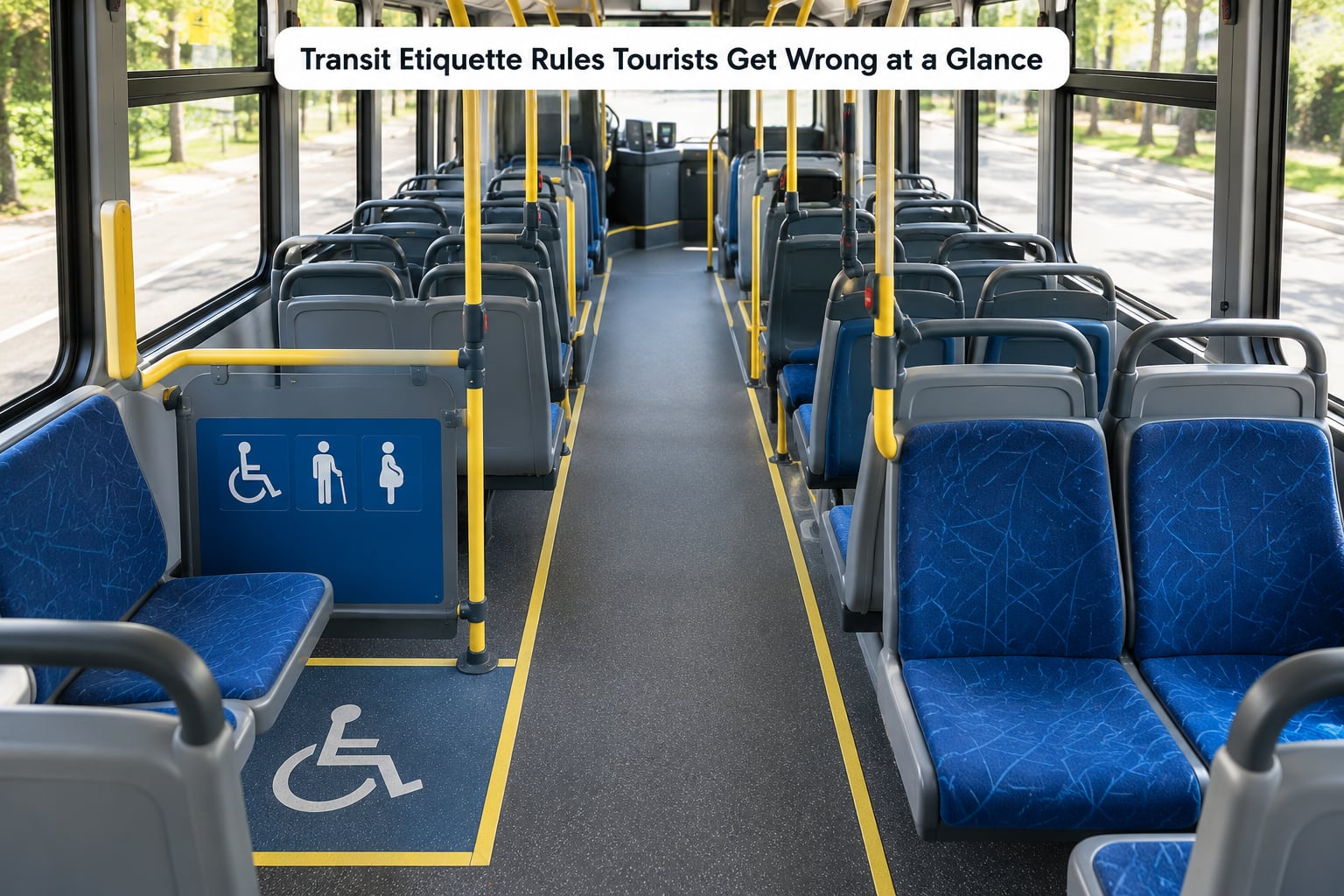
The quick version: board through the door marked for entry, let people out before you go in, keep the aisle and doorways clear, silence your phone, and give up a priority seat when someone who needs it steps on. Add oversized luggage rules and bus driver greetings, and most awkward moments disappear.
The transit etiquette rules tourists get wrong, and the five-second fix
| Mistake | Why locals object | The fix |
|---|---|---|
| Boarding through the wrong door | It collides with the flow of people getting off | Use the door marked for entry and let alighting passengers off first |
| Standing in the doorway or aisle | It blocks boarding and slows everyone | Move inward, keep bags at your feet or on the rack |
| Keeping a priority seat | Those seats are reserved for people who need them | Check the floor markings and offer the seat when asked or when someone is standing |
| Voice calls on board | A call is a speakerphone call with extra steps | Take the call after you get off, or use a headset at whisper level |
| Speaker audio without headphones | Music becomes everyone else’s music | Use headphones, or one earbud if the volume stays low |
| Ignoring local queue customs | Platforms have a designed boarding order | Read the floor markings and follow whoever is already forming a line |
| Loitering on the platform | Waiting space gets swallowed by standing crowds | Stand behind the tactile paving or floor line, off the doors |
| Oversized luggage unchecked | It blocks doors and takes rack space from others | Check size limits, use the luggage area, reserve a seat if the rule requires it |
| Unsecured bags | An open zipper at head height invites theft and snagging | Zip bags closed, keep them in front of you on your lap |
| Pushing past people getting off | Exit flow is the tightest part of the journey | Stay seated until they reach the door, then offer space |
| Treating the vehicle as a lounge | Food, litter and long waits cost other riders space | Carry your trash off and keep eating on commuter trains rare |
| Assuming every system works the same | Fares, doors and stopping norms change at every border | Check signs and instructions before you board |
1. Boarding Through the Wrong Door
On most buses and trams the doors are one-way: you get on at the front and off at the back, or in the reverse on some city systems. Tourists often drift toward the nearest door, which is the one everybody is stepping out of.
The fix is simple. Look for the floor arrows, the door labels, or the queue that has formed. On a double decker in London, board at the downstairs door on most routes and let people off upstairs first. No fine is involved; it just makes the boarding slower for everyone, and someone always ends up with an elbow in a doorway.
2. Blocking the Door or Aisle
The single most common irritation on a crowded carriage is a person standing directly in front of the doors. Doors need to open and close on schedule, and riders behind you need to move past when they get off.
Move inward as soon as you are on board, even if it means standing shoulder to shoulder. Keep your bag between your feet rather than across the aisle. If a stop comes and you are nowhere near the door, move along early rather than waiting for the crowd to surge. On Japanese trains the alighting passengers walk down the length of the car and everyone shuffles to one side, which looks chaotic from outside and works perfectly well as long as nobody is planted in the middle.
3. Taking a Priority Seat Without Needing It
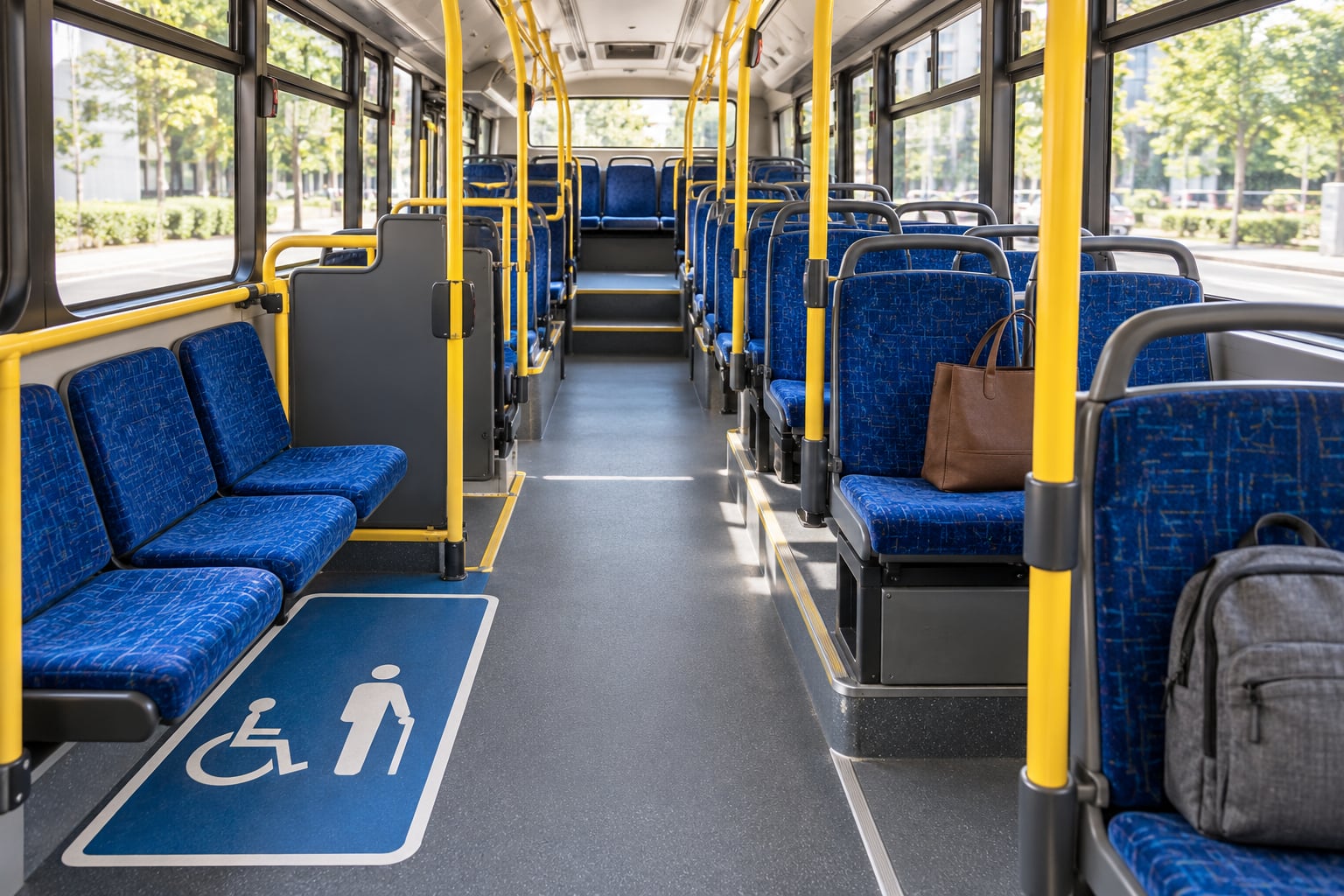
Priority seats are marked with signs, different colored upholstery or pictograms, and they usually sit nearest the doors. They are for older passengers, people with disabilities, pregnant passengers and anyone travelling with a small child. In Tokyo they are marked with an elderly and disabled pictogram, and locals give them up automatically when someone stands nearby.
Check the markings before you sit rather than after. If you are unsure whether you qualify, sitting elsewhere costs nothing. If someone with a cane, a stroller or a child gets on while you are in a priority seat, stand up and offer it without waiting to be asked, and do not take it personally if they say no.
4. Speaking Too Loudly on a Phone
Taking a voice call on a crowded carriage is one of the few etiquette breaches that draws comments from other passengers, and in Japan it can draw more than that. Long train rides are long precisely because the carriage is quiet enough to sleep in.
The fix is to take the call after your stop. If you need to stay on the line, use a headset at a volume you would be comfortable with if the whole carriage were listening, and step into the space near the inter-carriage door where the noise floor is higher. Travelers on forums also point out that a quiet carriage sign means no calls at all, so check the door sticker before you dial.
5. Playing Audio Without Headphones
Quiet headphone use is normal and expected. Audio out loud is the version people resent, because it turns a private playlist into a shared one.
Wearing one earbud at a time is a reasonable middle ground if the volume stays at a level where you could hold a conversation with the person beside you. If a video needs sound, that is a headphones or mute-the-video situation. One person on a Japan travel forum described the rule more bluntly than any published guide: what counts is whether a stranger can hear what you are listening to.
6. Ignoring Local Queueing Customs
Boarding queues differ more than people expect. Japanese platforms often have painted lines that split into an alighting path and a waiting position, and boarding order can depend on how far back you were standing, not on which line you joined.
Elsewhere there is no line at all, just a mass of people who surge forward, and trying to form a neat queue just puts you at the front of nothing. Watch before you step forward: if there are floor markings, use them; if there is no marking and people are simply standing, stand behind the last person. On some systems boarding starts by pressing a button at each door, so nothing moves until you do.
7. Treating a Stop or Station as a Place to Loiter
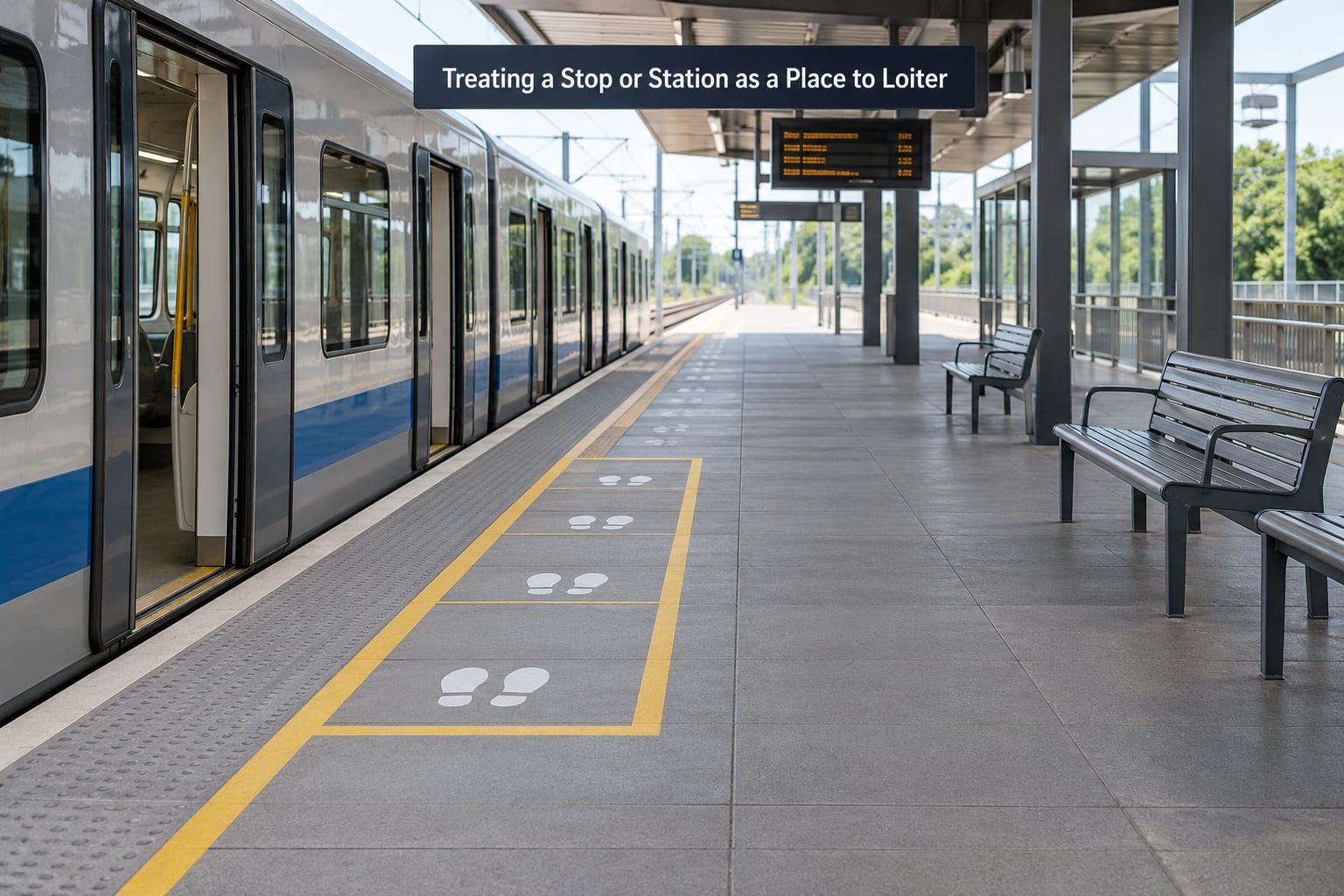
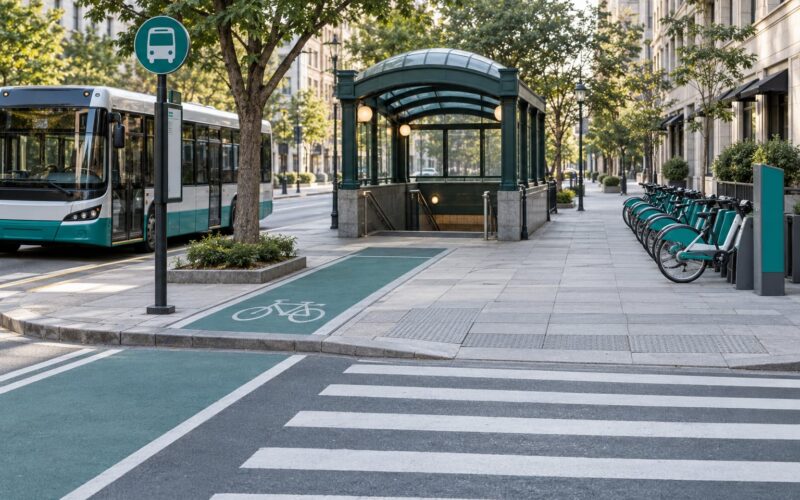
Most city platforms have an alighting area and a waiting area marked on the floor, often by tactile yellow paving. Standing in the alighting path is a hard block for everyone getting off, and the annoyed looks start immediately.
Wait behind the marking, and step forward only as the train stops. If a platform has doors that open along the carriage, stand at the gap you want, not in the middle of the leaf. The one genuinely difficult platform condition is a stop where more passengers are waiting than fit in the waiting zone, which is where losing patience turns into a surge. Step to one side, let the front carriage board first, and move along rather than pushing forward.
8. Carrying Oversized Luggage Without Checking Rules
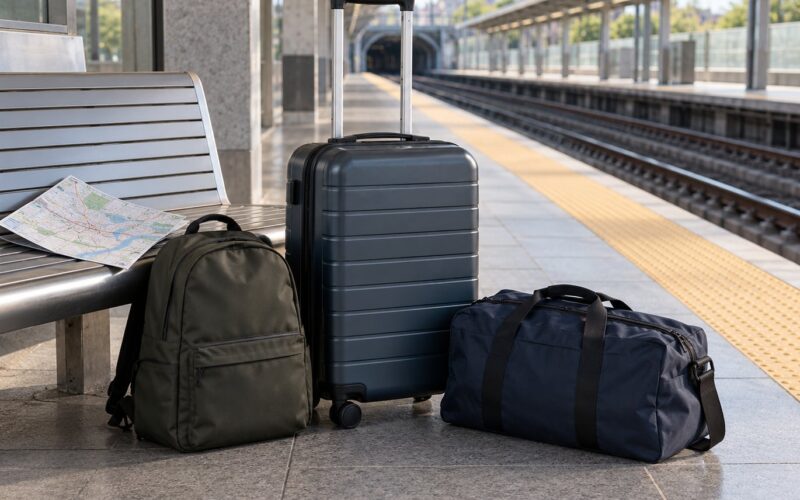
Every operator has a size threshold where a bag stops being a bag and becomes an obstacle. In Japan, a suitcase whose total dimensions exceed 160 cm, counting wheels and handles, needs an oversized baggage seat on the Tokaido, Sanyo and Kyushu Shinkansen, and the reservation is free if you book it when you buy your ticket.
On metros and subways there is no reservation, just racks at the ends of the carriage and a firm expectation that you use them. Local commuters take those racks first, and some trains run with them reserved for passengers who have tickets, so an unreserved bag there can cost someone else a seat. If your case will not fit, station staff can often store it or send it to your hotel for a fee. Booking that service in advance is the cleanest etiquette move available, because the case never enters the carriage at all.
9. Forgetting to Secure Loose Belongings
A backpack worn on your back at rush hour is a moving door for someone behind you, and an unzipped bag at seat height is an open invitation. On trains, keeping your bag on your lap or closed in front of you protects the bag and the passenger behind it.
The same applies to smaller items. A bag under a seat in the aisle gets sat on, a phone on a tray table ends up on the floor at the next brake, and headphones dangling from a pocket snag on doorways. Belongings that go missing on transit are almost always unattended belongings, so a closed bag you can feel against your body is the cheapest insurance there is.
10. Not Letting Others Exit First
Boarding is a negotiation; alighting is not. Stay seated until the people around you have started standing, then move toward the door without shoving, and step out first so the next wave can flow in behind you.
On a train that is stopping at a large interchange station, the mistake gets expensive. Thousands of people push toward a handful of doors while the ones already off walk back against the flow. The fix is to check your exit number before the train arrives and let yourself be carried by the flow rather than fighting it. Riders on forums describe the useful habit plainly: when you are standing, tuck yourself against the wall and let people pass, then move when the gap opens.
11. Treating Transit Stops as Public Restrooms or Lounges
Spreading out across a bench to sleep for two hours, eating a full meal on a commuter metro, or leaving a coffee cup in the priority seating area are the behaviours locals single out. They are not illegal, but they cost other people the space they need.
Eating works as a rough dividing line: on a high speed or long distance train, buying an ekiben at the station and eating it at your seat is normal and expected. On a commuter metro at rush hour it reads as antisocial. The same goes for trash, where the rule is simple and universal: whatever came in with you leaves with you, and if you cannot find a bin at the platform, keep it until you find one.
Wet umbrellas deserve their own line. Dripping water down the aisle or into a priority seat creates exactly the mess that gets a seat skipped, so a folded umbrella in a plastic cover is the standard solution on trains and buses. If you are getting off in the rain, shake it outside the doors before you step back into the carriage.
12. Assuming Every Transit System Works the Same Way
Transferring from a metro to a bus in a country you have not used before is where the small mistakes accumulate. Doors that open only with a button, a bus that will not move until everyone has paid, a train that does not stop unless you signal, and a platform where you have to press the departure button yourself all look like rudeness until you know the rule.
Spend thirty seconds at the stop reading the signs before you step on: the fare type, whether a ticket or a card is required, what the platform number means, and whether luggage has a restriction. The accessibility rules are worth checking too, since ramps and level boarding vary enormously and drivers often expect you to signal for the ramp rather than assume it deploys. Local transit operators publish their own rules on their own websites, and those beat anything a travel blog or an AI answer can tell you.
How transit etiquette changes by city
No two systems run the same way, and the differences that surprise visitors most are about noise, food and how drivers are treated.
| City | Noise and calls | Food on board | Driver and staff |
|---|---|---|---|
| Tokyo and most Japanese cities | Silent carriage standard, phone on manner mode or silent | No food on commuter metro, normal on the Shinkansen | Bow or a quiet thank you on buses, no tipping |
| London | Quiet by convention, louder than most visitors expect | Allowed, keep it small and tidy | Queue for the bus, no tipping, thank the driver on request |
| Paris | Conversations normal, phone calls quietly tolerated | Allowed but discreet | Validate your ticket, no tipping |
| Singapore | Very quiet, announcements only | Allowed, rarely seen | Queue on the platform and for the bus, no tipping |
| New York | Unmanaged, volume is whatever the rider brings | Allowed | Minimal interaction, tipping not expected |
Bus etiquette deserves its own note because it is where trains and buses get mixed up. Buses are smaller, the driver is right in front of you, and a small acknowledgement matters more than it would in a train carriage. Locals board at the front door and often sit at the back, leaving the front rows for priority use and folding seats. On many routes people move to the back of the bus and queue down the centre before boarding, which looks strange until you understand the layout. On Japanese town buses, boarding through the middle rear door and alighting at the front is common, and a bow or a spoken thank you to the driver is standard. It is a courtesy, not a rule, and one traveler on a forum put the objection to expecting visitors to know it plainly: it is an unwritten norm that nobody would seriously hold against a first-time visitor.
Frequently Asked Questions
Is it disrespectful to talk on trains in Japan?
Talking at a normal conversational volume between two people sitting together is fine. A voice call is not, because the speaker forces everyone else to listen. On commuter trains keep calls off the train entirely, or use a headset quietly. Some carriages are labelled quiet, and on those conversation is not expected at all.
What must you not do in a bus?
Do not board through a door that is only for getting off, do not stand in the doorway or aisle, and do not talk on the phone loudly near the driver. Keep bags off the seat in front if someone needs it, let alighting passengers off first, and take your trash with you. On many systems the bus will not move until every passenger has paid or tapped a card.
What are the most common transit etiquette mistakes?
Boarding through the wrong door, blocking the aisle, keeping a priority seat, taking voice calls, playing audio out loud, standing in the alighting area, and ignoring local queue and ticket rules. Each one has a five second fix: use the entry door, move inward, check the seat markings, silence the phone, use headphones, and read the signs at the stop before you step on.
Is it better to sit at the front or back of a bus?
Sit at the back. The front rows are usually where priority seats sit, and buses often have folding or wheelchair spaces there. On routes where passengers board at the rear and queue down the centre, moving to the back early also gives you a seat without fighting for one. If you have a stroller, a cane or a large bag, the front is the more practical spot.
Should I thank the bus driver?
A quiet thank you costs nothing and is normal in Japan, where a small bow is also common. In London and Paris a nod is plenty and nothing is expected. It is a courtesy rather than a rule, so nobody will be offended if you miss it, and the habit reads as thoughtful to anyone who sees it.
What happens if I break a transit rule?
In most systems the penalty is social rather than legal: silence, stares, or a passenger asking you to move. Drivers in some systems will refuse boarding or hold the doors if the carriage is unsafe, and a handful of cities attach fines to specific offences such as smoking or fare evasion. Check the operator’s own published rules for what actually carries a penalty where you are.
Conclusion: Start With Observe, Board and Adjust
The most useful habit is not memorising a rulebook. It is standing at the stop for thirty seconds and watching what people actually do, because the floor markings, the queues and the door flow tell you everything.
Use the entry door, let people out first, move inward, keep bags out of the aisle, silence the phone, and offer a priority seat when someone needs it. Adjust as you go, and if a local custom looks strange, follow it and ask later. Nobody expects a visitor to read every unwritten rule on day one, and standing in a doorway is the one mistake that gets noticed every time.