So, how many days do you need in Hawaii? If you have never been, plan on 7 to 10 days for a first trip. That range buys you one island done properly or two islands at an unhurried pace, once you subtract the arrival and departure days that flying swallows up.
The catch is that trip length and usable days are not the same number. An 8-day trip from the US East Coast gives you roughly five and a half full days in Hawaii, because each flight runs nine to eleven hours door to door. That math is where most disappointment starts, and it is worth doing before you pick dates.
Below is how to size a Hawaii trip: the tiered trip lengths, the minimum nights each island actually needs, ready-made plans for five, seven, ten and fourteen days, and the details that quietly change the answer.
Table of Contents
- How Many Days Do You Need in Hawaii?
- Why nights matter more than days
- Where you fly from changes the answer more than the island count
- How Many Days for Each Hawaii Island?
- A Recommended Hawaii Itinerary by Trip Length
- Should You Stay on One Island or Visit Several?
- How to Choose the Right Length for Your Hawaii Trip
- What Changes the Ideal Hawaii Stay?
- Common Hawaii Trip-Length Mistakes
- Planning the Best Hawaii Route
- Frequently Asked Questions
- Is 5 full days in Hawaii enough?
- Is going to Hawaii for 3 days worth it?
- How many days do you really need in Hawaii?
- How many days should I spend in Hawaii for the first time?
- How many days in Hawaii are enough for families?
- Is it better to stay longer or visit multiple islands?
- Conclusion
How Many Days Do You Need in Hawaii?

Here is the short version, tier by tier:
- 3 to 4 days — one island only, one or two highlights per day, and a lot of time in the air. Worth it from the West Coast, rarely worth the long-haul fare from further out.
- 5 to 6 days — the bare minimum for a real look at one island. Four full days on the ground, plus a travel day at each end.
- 7 to 9 days — the sweet spot for a first visit. Five to six full days on one island, with room for a weather day or a slow morning.
- 10 to 14 days — two islands at a real pace, or one island taken slowly with a beach stretch and a hike in the same week.
Destination experts on the Tripadvisor Hawaii forums put the floor at five nights for Oahu, Maui or Kauai, and seven nights for the Big Island. Those are consensus minimums, not marketing lines, and they are the numbers most first-timers break.
Why nights matter more than days
Hotels sell nights, and island-hopping costs nights, so nights are the honest unit. Five nights on Maui means six calendar days on the island, but the first and last of those are arrival and departure days: you land, collect a car, check in late, and you are running on fumes.
Count usable days like this: total trip length, minus one day for getting there, minus one day for getting home. An 8-day trip lands you about 6 days in Hawaii, of which the first and last are half-days. That is 5 usable days.
Where you fly from changes the answer more than the island count
| Trip length | Flying from the US West Coast | Flying from the US East Coast | Flying from Europe or Asia |
|---|---|---|---|
| 5 days | 3 usable days, tight | Not viable | Not viable |
| 7 days | 5 usable days, workable | 4 usable days, minimum case | 3 usable days, poor |
| 10 days | 8 usable days | 7 usable days, comfortable | 6 usable days, workable |
| 14 days | 12 usable days | 11 usable days | 10 usable days, easy pace |
Hawaii is five hours behind the US East Coast in winter and six hours behind in summer, and the swing between daylight hours catches a lot of people out. Travellers from Europe and South Asia also land groggy, which is why international arrivals get told flatly that four nights is not enough.
How Many Days for Each Hawaii Island?
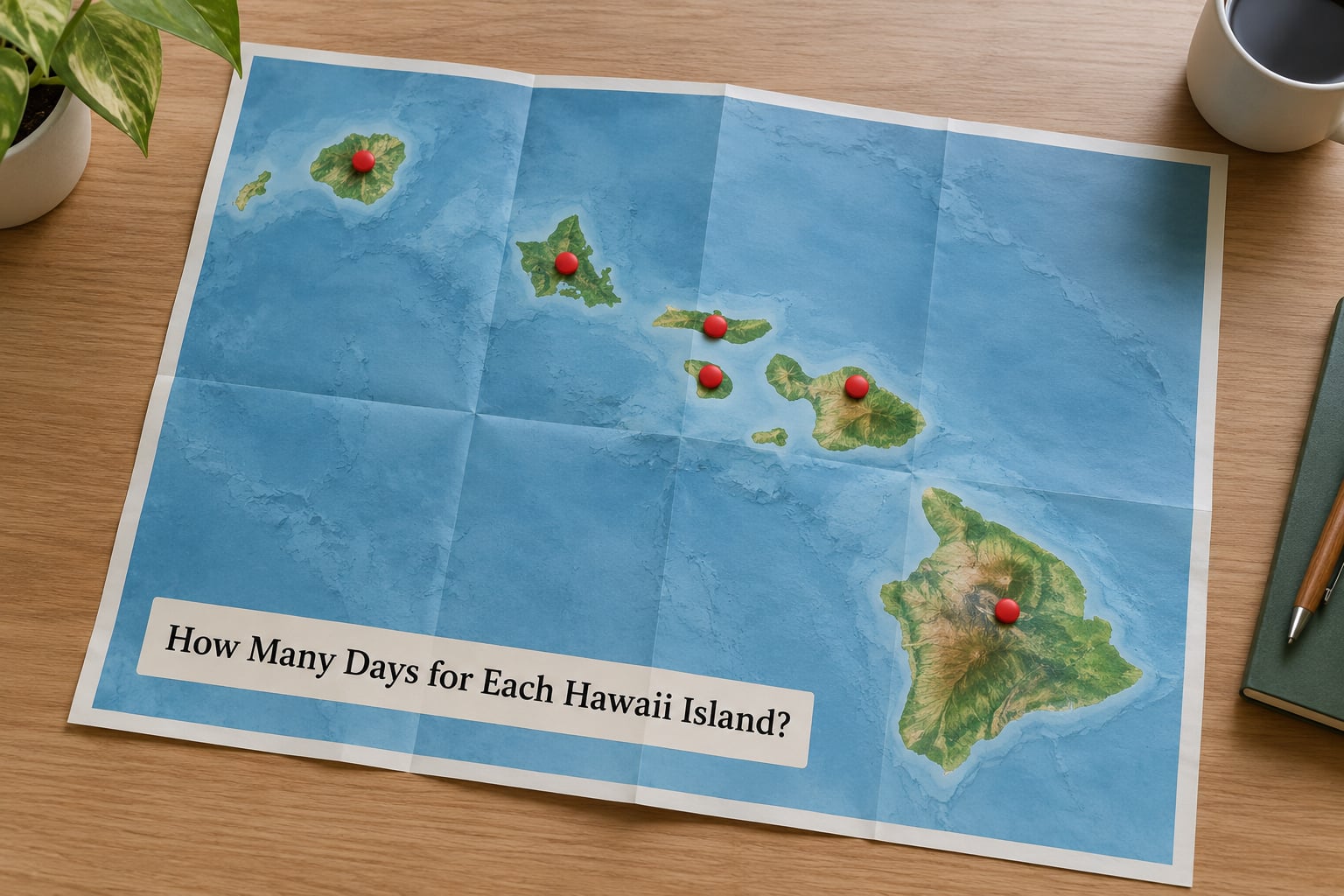
Each island has its own minimum. The Big Island needs more time because the places people travel to see are spread across 80 miles of highway, and everything on Maui except the beach loop takes a full day each way.
| Island | Minimum practical stay | Comfortable stay | Best for |
|---|---|---|---|
| Oahu | 4 nights | 6 to 7 nights | First timers, food, surf, history, easy logistics |
| Maui | 5 nights | 7 nights | Scenic drives, whale watching, snorkelling |
| Kauai | 5 nights | 7 to 8 nights | Nature, hiking, quiet, one base for the whole trip |
| Hawaii Island (Big Island) | 7 nights | 9 to 10 nights | Volcanoes, Mauna Kea stargazing, varied scenery |
| Molokai | 5 nights | 7 nights | Silence, remote beaches, very little planning |
| Lanai | 4 nights | 5 to 6 nights | A short, deliberate stop between larger islands |
| Two islands | 10 nights total | 12 to 14 nights total | A first trip with room for a change of pace |
A thread in the r/VisitingHawaii subreddit shows the trap clearly: someone planned 9 full days and three islands and was told plainly that it was too many islands for the time, because each hop costs at least half a day.
A Recommended Hawaii Itinerary by Trip Length
These plans are built around usable days rather than calendar days, and each one keeps you on a single island until it is time to move.
5-day trip (Oahu). Day 1 lands in Honolulu, Waikiki beach that afternoon. Day 2 Diamond Head at sunrise, then Kapiolani Park and the Ala Moana centre. Day 3 Hanauma Bay in the morning, Lanikai and Kailua along the east shore. Day 4 Pearl Harbor in the morning, the Polynesian Cultural Center or the Bishop Museum in the afternoon. Day 5 North Shore drive, Haleiwa town and Sunset Beach if the surf is clean, then the flight home.
7-day trip (Oahu, 6 nights). Same as above, then two days you get to shape. One for Waikiki surf lessons, Ala Moana and the Saturday Farmers Market at KCC. One for either the North Shore or a Circle of Fire state park hike near the south shore. That spare day is the one that turns a checklist into a trip.
10-day trip (Oahu and Maui, 5 nights each). Five nights on Oahu as above, then a 40-minute flight to Kahului. Day 6 up the Haleakala crater for sunrise, which means a 3am start and a 45-minute drive uphill from Kahului. Day 7 the Road to Hana in full. Day 8 snorkelling at Molokini or along the south shore. Day 9 Iao Valley or Wailea beach, then a short afternoon flight home.
14-day trip (three islands or two plus real downtime). Oahu 5 nights, Big Island 5 nights, Maui 4 nights. On the Big Island, spend one day at Hawaii Volcanoes National Park watching Kilauea, one on the Kona coast for manta ray night snorkelling, and one driving the short but stark Waipio Valley lookout road. Build in a blank day at the end. Holidays go wrong, and a spare afternoon saves the trip.
Should You Stay on One Island or Visit Several?
One island wins for a first trip of 7 days or fewer, and for anyone who plans to spend half the week underwater or on a trail. You unpack once, you learn the bus routes, and you stop losing mornings to airports.
Two islands make sense from 10 nights upward. Inter-island flights run about 40 minutes from Honolulu to Maui or Kauai and roughly 50 minutes to Kona, but the real cost is the day around them: travel to the airport, checked luggage, security, boarding, the flight, the rental car on the other end, and an evening re-settling. Budget half a day per hop, which is the rule forum regulars repeat constantly.
Island hopping also splits your car problem. On Kauai most visitors rent a car for the whole stay. On Maui a rental makes sense for the first few days and then becomes an expensive liability sitting outside your resort. That is manageable, but it is another reason to keep the island count low.
Three islands needs 14 days or more. A r/travel poster weighing a two-week holiday against a shorter trip framed the trade-off better than any guide: the same airfare buys either a rushed two-island tour or a proper week on one island with a flight home.
Weather can also break a multi-island plan. A tropical storm that grounds flights on the day you were meant to move is far more damaging when you have a second island to reach. If you have exactly the minimum time, one island with a rent-a-car is the resilient choice.
How to Choose the Right Length for Your Hawaii Trip
Four questions settle it. Where are you flying from, how many islands genuinely interest you, how much time do you want on a beach versus on a trail, and who else is travelling.
First visit or fifth visit. First-timers should not go shorter than 5 full days on one island. Repeat visitors often get more from 7 nights on a single island than from a week split in two.
Couples and honeymooners. Five nights is genuinely fine if you are staying put and the resort does the work. Add a night for a second island if a coastal helicopter or surf lesson is on the bucket list.
Families with kids. Count 5 usable days as a minimum and 7 as comfortable. Children tolerate slow days well and long transfers badly, so keep each island to one hotel base and put nothing on the itinerary before 9am.
Seniors or anyone with limited mobility. Oahu wins, because distances are short and taxis are everywhere. Add a day: the pace question matters more than the length question.
Solo travellers. Six days is a comfortable week. Day trips by ferry or small-plane to Lanai work well from Maui without an overnight.
Budget. The long-haul airfare is a fixed cost whether you stay four nights or ten, so the cost per day falls sharply as the trip gets longer. That is the honest argument for staying put, and it is the argument forum users make most often when deciding whether a short trip is worth taking at all.
What Changes the Ideal Hawaii Stay?
Arrival and departure timing. Landing at 2pm on day 1 and flying out at 11am on the last day costs you most of a day at each end. Red-eye arrivals are worse than useless; you arrive at 7am with no sleep bank.
Reservation windows. Haleakala sunrise requires advance booking and a very early alarm. Pearl Harbor sells tickets by timed entry. Both are easy to lose a day to when you plan in the moment.
Long drives. The Road to Hana takes 10 to 12 hours door to door with stops and eats a full day. Waipio Valley, Kilauea Caldera and the Kohala coast roads do the same. On the Big Island, give each major attraction its own day rather than trying to chain two.
Surf and snorkelling conditions. Winter brings bigger North Shore surf and humpback whale season off Maui. That is an argument for Oahu and Maui in January rather than a reason to change trip length, though it does mean packing for the right season.
Festivals and crowds. The Merrie Monarch hula competition in April on Oahu, plus heavy mainland holiday weeks in late December and early July, all raise the bar for advance booking. Shoulder months of April, May, September and October usually give you the calmest conditions to fit a shorter itinerary into.
Accommodation location. Staying in Waikiki puts you within a 20-minute drive of most Oahu sights. Staying in Kihei or Kula on Maui halves some drives and doubles others. Count the daily transfer time before you add nights, not after.
Activities already booked. If you have a booked helicopter tour, cooking class or snorkelling trip, work backwards from it. A 3am Haleakala sunrise wake-up on your fourth morning is fine; on your ninth it is the thing you remember. Long trips absorb activities badly unless they are spread out.
How many things you already want to do. Hawaii supports a surprisingly long list. Forum regulars say it plainly: you cannot see and do everything in two weeks, let alone two months. That is a useful permission slip. It means seven days is not a compromise; it is the length where the main things get done.
Common Hawaii Trip-Length Mistakes
Treating three nights on an island as two days. Three nights means two partial days and one full one. Forum answers about four-night trips are consistent on this point: the trip is enjoyable and you will see very little of it.
Confusing Honolulu with Oahu. Honolulu is the city on the island of Oahu, not a second destination. Plenty of first-timers build a day for Honolulu and a day for Oahu and end up driving the same highway twice.
Packing two islands into seven days. This is the most common planning error. It produces four nights, two airports, two rental cars and a lot of driving between the good parts.
Booking the last day as a full day. A 2pm international flight from Honolulu is really a half day, and a morning flight is barely a quarter. Plan something small for that day.
Scheduling nothing for the first evening. After nine hours in the air, the first evening goes to food and sleep. Do not put a luau, a show or a booking against it.
Underestimating Kauai and Molokai. These are smaller in area but not faster to cross. Allow a full day each for the Waimea Canyon and Koke’e area, and expect limited evening options if you choose the quiet route.
Planning the Best Hawaii Route
Start where the flights arrive. Most itineraries that include Oahu work because nearly all inter-island flights connect through Honolulu, and an early or late arrival there is easier to absorb.
Pair neighbours rather than zig-zagging. Oahu and Kauai see the least weather disruption, Kauai and Maui give you two very different island scenes with one short hop, and Maui to the Big Island is the smoothest jump because the airports are close.
Put the Big Island last. It is the biggest place to cover, it offers night snorkelling and summit stargazing that cannot be scheduled at 9am, and ending the trip there keeps you within easy reach of the mainland connections.
Leave at least three hours between an inter-island flight and an international departure, and build the last night near the airport rather than on the other side of an island. Rental returns, bag drop and the drive to the terminal are not as quick as they look on paper.
Frequently Asked Questions
Is 5 full days in Hawaii enough?
Yes, for one island, as long as you fly from the US West Coast and stay in one place. Five full days covers Oahu or Kauai at a comfortable pace. From the US East Coast or overseas, subtract a day and consider seven nights instead.
Is going to Hawaii for 3 days worth it?
Only if you are close to the mainland and you want one thing. A long weekend from California works for Waikiki, a resort stay or a surf trip. The same trip from further east costs you a full day in each direction and leaves no usable time at all.
How many days do you really need in Hawaii?
Seven to nine days for a first trip, which leaves five to six usable days once arrival and departure are subtracted. Ten to fourteen days if you plan to cover two islands, because each inter-island hop costs about half a day.
How many days should I spend in Hawaii for the first time?
Plan at least five full days on a single island, and seven if you want a relaxed pace with a spare day. First visits often feel too short at four nights and about right at six, according to destination experts on the Hawaii forum threads.
How many days in Hawaii are enough for families?
Seven to nine days works best, with one hotel base per island and nothing scheduled before mid-morning. Children handle slow days well and long transfers badly, so keep islands to four or five nights each rather than three.
Is it better to stay longer or visit multiple islands?
Stay longer on one island when you have seven days or fewer. Split the trip across two islands only when you have ten nights or more, since every hop costs roughly half a day in transfers, luggage and settling in.
Conclusion
Start with your usable days, not the calendar. Take your trip length, subtract the arrival day and the departure day, then check whether what remains covers the island minimums: five nights on Oahu, Maui or Kauai, seven on the Big Island.
If the arithmetic leaves five full days, book one island and put a spare day in the calendar for weather. If it leaves eight or more, start looking at a second one.