A seven-night Hawaii trip for a family of four typically costs $8,000 to $15,000 total, with most families landing between $10,000 and $12,500 — roughly $360 to $450 per person per day once flights, a hotel, food, a rental car and activities are all counted. That is a real Hawaii trip cost breakdown for a family of four, and the range is wide because island choice and travel dates move the total more than almost anything else.
The number that surprises people most is how little of the headline price survives contact with the final bill. Flights and the nightly room rate look reasonable in a search, then resort fees, parking, the lodging tax, checked bags and per-person activity pricing push a $6,000 idea toward $12,000. This guide walks through every line item so you can see where the money goes before you book, not after.
Table of Contents
- Hawaii Trip Cost Breakdown for a Family of Four at a Glance
- What Affects the Price
- How to Estimate Flights, Hotels, and Car Costs
- How to Estimate Food, Activities, and Local Transportation
- Ways to Save
- Costs families forget to budget for
- Frequently Asked Questions
- Is Hawaii cheaper than the mainland for a family vacation?
- Do we need a rental car for four people in Hawaii?
- How much should a family of four budget for food each day?
- Are hotel resort fees included in the price of a Hawaii trip?
- Which Hawaii island is best for a lower-cost family trip?
- When should we book flights and hotels for Hawaii?
- Conclusion
Hawaii Trip Cost Breakdown for a Family of Four at a Glance
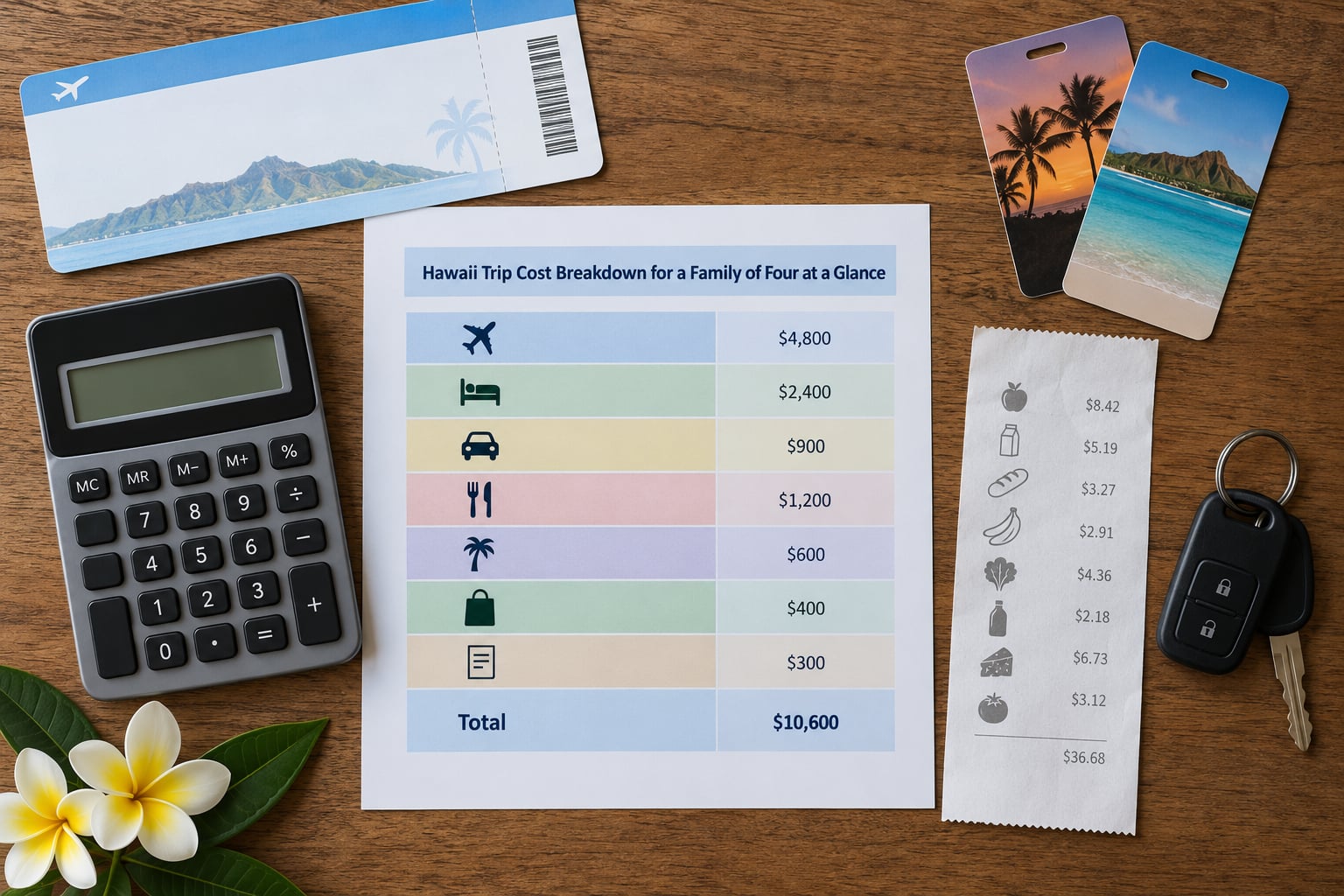
The table below models a seven-night stay for two adults and two children on one island. The midrange column is the useful planning number; the budget and higher-cost columns bracket it so you can see which choices actually move your total.
| Category | Budget tier | Midrange tier | Higher-cost tier |
|---|---|---|---|
| Flights (4 travelers, round trip) | $1,600 | $2,800 | $4,400 |
| Lodging (7 nights, before tax and fees) | $1,750 | $3,150 | $5,600 |
| Resort or destination fees | $0 | $280 | $385 |
| Lodging tax at 18.712% | $328 | $589 | $1,048 |
| Rental car (5-7 days, with taxes) | $280 | $560 | $1,050 |
| Gas and parking | $190 | $330 | $490 |
| Food and groceries | $1,050 | $1,750 | $2,800 |
| Activities and parking fees | $450 | $1,100 | $2,200 |
| Miscellaneous, tips, travel insurance | $300 | $450 | $700 |
| Contingency (7%) | $410 | $850 | $1,700 |
| Total for the family of four | $6,358 | $11,859 | $20,373 |
| Per person | $1,590 | $2,965 | $5,093 |
| Per person, per day | $227 | $424 | $728 |
Two caveats on these figures. First, they are typical U.S. planning ranges rather than quotes, and they shift with region, island and season — a family flying from Buffalo pays a very different airfare than one driving to Portland. Second, lodging is shown before tax and fees deliberately, because the posted nightly rate is the number most families budget from and it is not the number they pay.
For a reference point, one widely used calculator model puts a midrange family of four on seven nights of Maui with an East Coast departure at roughly $15,800 total, or about $3,950 per person. That is the high end of midrange, and it is the clearest illustration of how origin and island choice interact: the same family flying from Seattle would land at a totally different number.
What Affects the Price
Most of the swing in a Hawaii trip cost breakdown comes down to seven variables: how long you stay, which island you pick, when you go, where you fly from, where you sleep, whether you rent a car and how old your kids are. Here is how each one moves the bill.
Trip length. Flights, car rental and per-day food are fixed costs. They get amortized across more nights when you stay longer. Seven nights is the sweet spot for most families because two travel days eat a meaningful chunk of a short trip.
Island. This is the single biggest lever after airfare. Average daily hotel rates published by the Hawaii Tourism Authority and DBEDT put Oahu well below the other islands, with Maui at the top. Vacation rental rates follow a similar pattern but Kauai runs high for rentals specifically.
Travel dates. Late December through early January, the July Fourth week, and the last two weeks of August are the peak windows. September and October, and the January to mid-February stretch after the holidays, are the softest.
Flight origin. A family flying from the West Coast sees roughly half the airfare of a family flying from the East Coast for the same week. One connection versus a nonstop rarely changes the price much, but it adds six hours of travel with small children.
Hotel location and style. Oceanfront Waikiki and beachfront Maui condos cost several times what a two-bedroom unit a few blocks inland runs per night. Resort fees and self-parking can add $45 to $72 per night on top of the rate at beachfront properties.
Rental car. Not every island or every hotel demands one, which is covered in detail below.
Children’s ages. Under two usually flies as a lap infant, which changes both the airfare math and the car seat line. Under 12 needs a car seat in Hawaii even if your home state does not require one.
| Island | Hotel average daily rate | Vacation rental average daily rate | 7-night family of four, midrange |
|---|---|---|---|
| Oahu | $264 | $419 | $8,500 to $12,500 |
| Big Island | $427 | $382 | $9,500 to $14,000 |
| Kauai | $409 | $559 | $10,000 to $15,500 |
| Maui | $494 | $596 | $11,000 to $17,000 |
Those midrange island totals come from destination-expert ranges and assume a midrange hotel or rental, a rental car, food and a couple of paid activities. Oahu comes in lowest on almost every line because it has the widest range of hotels, the best bus and rideshare coverage, and the most competition. Maui runs highest because its rental inventory is smaller and its beachfront inventory is concentrated in fewer buildings.
How to Estimate Flights, Hotels, and Car Costs
Airfare is where most families should start, because it anchors the budget. Multiply a per-person fare by four travelers, and note that children usually fly at a percentage of the adult fare rather than full price. Rough per-traveler ranges by origin: West Coast around $575, Mountain region around $650, Midwest around $825, East Coast around $1,000. International origins run considerably higher. A California family of four on economy fares has been quoted in the $1,200 to $2,000 range, while the same party flying cross-country can double that.
Add checked bag fees at roughly $35 to $50 per bag each way, and count seats you might pay for separately. Four people with two checked bags each is 16 bags across the round trip, which is rarely included in the fare estimate people quote themselves.
For lodging, work out the average daily rate for your dates and multiply by seven, then add resort or destination fees, then add the lodging tax. Hawaii’s combined lodging tax stack reaches 18.712%: an 11% state transient accommodations tax, a 3% county TAT on Oahu, Maui, Kauai and the Big Island, and up to a 4.712% general excise tax pass-through. The state TAT already includes the 0.75% green fee, so do not add it twice. A $450 room becomes about $560 before parking.
For the car, build the daily rate plus taxes, then add insurance, fuel and parking. Weekday and weekend rates are not the same, and an extra driver is often a separate daily charge. Gas on the islands runs well above mainland averages, commonly around $5 a gallon. Hotel parking is the line item people miss most: $45 to $65 a night is common, and $72.50 a night is not unusual at a large Waikiki property. On a seven-night stay that is roughly $500 that never appeared in the nightly rate.
Count seven nights of lodging but two travel days. Many calculators get this wrong by charging an eighth night or by including rental car days you never use.
How to Estimate Food, Activities, and Local Transportation
Food is the line item families consistently describe as the one that breaks the budget. A practical approach is to set a daily allowance per person and adjust for how often you eat out. Budget travelers who buy groceries for breakfasts and lunches and eat out once a day can hold roughly $45 to $60 per person per day. Midrange families eating breakfast in and lunching casual run $80 to $110 per person per day. Resort and sit-down dinners push toward $150 or more per person per day.
Weight the children rather than counting them as adults. A common model puts school-age kids at about 65% of an adult’s daily food budget and lap infants at 25%. Grocery prices run roughly three times mainland levels, so a Costco run for breakfast items, snacks and water is a genuine line item worth budgeting, not a rounding error.
Activities are priced per person, and the per-person number is what stings on a family of four. Budget $100 per person per activity as a realistic planning figure, and pick two or three anchor experiences rather than five or six. A snorkel cruise, a luau and a half-day tour can run $800 to $1,300 for the family. Helicopter tours and private guided days run several times that.
Local transportation has three modes. TheBus and island bus systems cost a few dollars a ride and work well on Oahu and Maui, though they take longer than a car and stop running early in the evening. Rideshare and taxis are convenient on Oahu and pricier on Maui and Kauai. A rental car removes waiting and makes the North Shore, Hana Highway and volcano sites genuinely reachable.
Also budget for park entry and reservations. Nonresident day-use reservations at Diamond Head and in Hana, and out-of-state vehicle passes at Hawaii Volcanoes National Park, apply to almost any family itinerary that touches a state park, and they are not included in any of the totals above.
Ways to Save
Savings on Hawaii come from a handful of decisions, and they are not equally easy. Here they are roughly in order of impact.
Travel in a shoulder window. January through mid-February after the holidays, and September, are the two softest periods. The trade-off is weather: January can mean a wet week, and late summer brings higher surf and more hurricane-season risk.
Choose Oahu, or the Big Island. Both run meaningfully below Maui and Kauai on lodging, and Oahu’s bus and rideshare network lets you skip the rental car entirely. What you give up is Maui’s back-road beaches and Kauai’s seclusion.
Stay a few blocks back from the ocean. A two-bedroom unit with a kitchen and pool, three or four blocks inland, often costs less than one oceanfront hotel room and gives four people separate sleeping spaces. The trade-off is a longer walk in the heat and no ocean view.
Rent the car for the days it earns its cost. Many hotels offer parking rates that cost as much as a rental. If you are staying on Waikiki for five of seven nights, skip the car for those days and pick it up for the two you want the North Shore or a hike. Do not book a seven-day rental as a default.
Buy groceries for two or three meals a day. A kitchen in a vacation rental or a hotel with a kitchenette changes the food number more than any other single choice. Grocery prices are high, so shop at a warehouse club once and eat in twice daily.
Pick two anchor activities. Free beach and park days are genuinely free. A snorkel trip booked through a discount operator instead of a resort outfitter can be half the price for the same boat and gear.
Set a daily spending limit before you land. Families who agree on a ceiling for cash, snacks and impulse purchases tend to come home closer to budget. Give kids a spending envelope and let it be their problem.
Use points where you already hold them. Families on the Hawaii budget boards have run nine nights across two islands with 12 flights and two cars for a few hundred dollars out of pocket using hotel points, airline transfer bonuses and companion fares. That result depends entirely on card history you already have, so treat it as upside, not a plan.
Book a package only after pricing it separately. Bundles sometimes undercut the sum of the parts, sometimes do not, and the difference is usually small enough that the child-friendly perks decide it. Price flights, the room and the car separately before you accept any bundle.
Carry a planning cushion. Five to ten percent of your total covers the things that reliably go wrong: a delayed flight that forces a late hotel night, a sick kid, a car that will not start on a Sunday, an activity you want to add.
Costs families forget to budget for
These are the lines that convert a $6,000 plan into a $12,000 reality, and every one of them is easy to miss.
- The 18.712% lodging tax stack, applied to the room rate before any resort fee
- Resort and destination fees, typically $40 to $55 a night at full-service properties
- Self-parking at $45 to $72 a night, sometimes charged even when you do not drive
- Checked bag fees in both directions, 16 bags for a family of four with two each
- Interisland flights and their bag fees, if you visit more than one island
- Park reservations and nonresident entry fees
- Gratuities, which run 18% to 20% at many sit-down restaurants and are not optional the way tax is not optional
- Car seats, which are required in Hawaii for children under 12 and add a daily fee
Adding those eight lines to a midrange seven-night plan typically adds 25% to 35% on top of the naive total. That is the single most useful thing to know before booking.
Frequently Asked Questions
Is Hawaii cheaper than the mainland for a family vacation?
Not usually. Food, parking and resort fees all run above mainland levels, and lodging tax adds 18.712% on top of the room rate. Hawaii can still come out ahead of destinations like Disney World when you factor in admission costs and multi-day car rental, but the hotel and dining lines here are consistently higher than most families expect.
Do we need a rental car for four people in Hawaii?
On Oahu you can manage with TheBus and rideshare alone, and renting one for the full week often costs more than hotel parking would have. On Maui, Kauai and the Big Island, a car is close to essential because the best beaches and sites are spread out. Many families rent for three to four days rather than seven.
How much should a family of four budget for food each day?
Plan on $45 to $60 per person per day if you buy groceries for breakfasts and lunches and eat out once, $80 to $110 for a midrange pattern of one casual meal out per day, and $150 or more for resort and sit-down dining every evening. Weight children at roughly 65% of an adult daily budget and lap infants at about 25%.
Are hotel resort fees included in the price of a Hawaii trip?
Rarely. Resort and destination fees of $40 to $55 a night are usually charged separately at check-in, on top of the 18.712% lodging tax. Some booking sites show a total rate with taxes included, so compare like for like and check whether the quoted figure includes the resort fee and parking before you call it a deal.
Which Hawaii island is best for a lower-cost family trip?
Oahu is the least expensive overall. Average daily hotel rates are the lowest of the four islands, the vacation rental inventory is wide, and the bus and rideshare network lets you skip the rental car. The Big Island is the runner-up option, often with lower rental rates. Maui and Kauai carry the highest lodging costs.
When should we book flights and hotels for Hawaii?
Book flights four to seven months out for most dates, and earlier for holiday weeks, late August and any period where your family cannot flex. Hotels with free-cancellation rates are worth locking in eight to ten months ahead for peak weeks, then re-checking prices monthly. Island details and rates change constantly, so confirm current numbers before you pay anything.
Conclusion
Start with three decisions: how many nights you are staying, which island, and where you are flying from. Those three fix roughly two-thirds of your budget before you look at a single hotel. Everything after that is adjustment.
Build two budgets rather than one — a floor and a realistic middle — and reserve the large items first, since flights and lodging are where flexibility disappears. Then layer on the rental car with its full daily cost including gas and parking, a per-person daily food allowance, and two anchor activities for the family. Add the 18.712% lodging tax, resort fees, bags and park reservations before you think you are done, and keep a 5% to 10% cushion.
The ranges in this guide are typical U.S. planning figures that vary by island, season and trip length, and they change over time. Check current prices for your exact dates before booking anything.