
A long weekend getaway works when you plan it in seven stages: fix the dates, set a spending limit, pick a destination you can reach in a few hours, book the time-sensitive items first, build one anchor per day, confirm entry and transit rules, then pack light. That sequence takes most people one focused evening, and it is the whole difference between a relaxing break and three days of rushing.
Here is the part nobody tells you. A Friday evening to Sunday evening getaway gives you roughly 60 waking hours, minus travel. Some of those hours are for getting there. Some are for eating slowly. Almost none of them should be spent queueing for something you booked at the last minute.
So the real job of learning how to plan a long weekend getaway is not to fit the most in. It is to protect the few hours that make the trip worth taking. Everything below is built around that.
Table of Contents
- What You Need Before You Start Booking
- 1. Fixed dates and the actual travel window
- 2. A total budget, expressed as a number you refuse to exceed
- 3. Documents and identity requirements
- 4. One planning document
- 5. A rough idea of the experience
- 6. Booking and research tools
- Step-by-Step: How to Plan a Long Weekend Getaway
- 1. Define the Trip Window and Non-Negotiables
- 2. Compare Destinations by Practicality
- 3. Build a Budget and Set Spending Limits
- 4. Book the Fixed Items First
- 5. Create a Day-by-Day Itinerary
- 6. Check Local Transport, Entry Rules, and Connectivity
- 7. Pack Light and Run a Final Check
- Common Mistakes to Avoid
- Overpacking the schedule
- Choosing a far destination without counting transit
- Ignoring transfer buffers
- Spending the whole budget on the room
- Booking activities before transport and lodging
- Relying on unverified rules or old advice
- Tips for a Smoother Long Weekend
- Frequently Asked Questions
- How many days are enough for a long weekend getaway?
- What is a realistic budget for a long weekend getaway?
- Is it better to book a rental car or use public transportation?
- How do I choose a destination that is close enough for a short trip?
- What should I pack for a long weekend getaway?
- Conclusion
What You Need Before You Start Booking
Most failed weekend trips fail in the setup phase, not the destination phase. Gather these five things before you look at any hotel listing.
1. Fixed dates and the actual travel window
Write down your earliest possible departure time and your hard return time. A Friday night flight out and a Monday evening flight back gives you a full Saturday and Sunday. A Saturday morning departure gives you Saturday afternoon and all of Sunday, which is half the trip.
Add your commute time to each end. If it takes you 40 minutes to reach the airport, a 7:15 a.m. flight is really a 6:00 a.m. departure from home.
2. A total budget, expressed as a number you refuse to exceed
Pick a ceiling for the whole trip, everything included, before you pick a destination. This works far better than picking a destination and then discovering what it costs.
3. Documents and identity requirements
Check that your passport or ID is valid for the whole trip, including your return. If you are crossing a border, verify the current entry rules on the official government site rather than a blog or an old forum post. Rules change quietly.
4. One planning document
A shared note, a spreadsheet, or a free workspace page works. The point is that everyone, including anyone traveling with you, can see the same dates, budget, and booked items in one place. Argument time drops off fast.
5. A rough idea of the experience
Not a destination. An experience. Hiking, a food-focused city break, a beach, a small town with good walking, or genuine rest with no plans at all. This drives every later decision.
6. Booking and research tools
Use one comparison tool for transport, one for accommodation, and one mapping app for local distances. Add a shared calendar. An AI assistant can help you draft a first-pass outline, but it cannot check live schedules, entry rules, or opening hours, so verify anything time-sensitive yourself.

Step-by-Step: How to Plan a Long Weekend Getaway
1. Define the Trip Window and Non-Negotiables
Calculate your usable days honestly: window length minus travel time in each direction. Three days is the practical minimum for a long weekend. Two days becomes a rushed stopover, and four days is where the trip starts to feel like a real holiday.
Then choose one must-do. One. Everything else is negotiable. Travelers who agree on a single anchor before booking get far fewer disagreements in the moment, because nobody is fighting for a second headline activity.
Done when: dates, budget ceiling, and one priority experience are written down and shared.
2. Compare Destinations by Practicality
Judge a candidate on five things: door-to-door travel time, whether direct transport exists, seasonal conditions, cost per night, and how long it takes to reach the main activity from your accommodation. Door-to-door matters most, and it includes your commute plus transfers.
A useful rule: if travel eats up more than a quarter of your usable time, pick somewhere closer. There is a version of this trade people make wrongly. They choose an ambitious destination because it looks interesting, then spend a third of the trip in transit or in an airport lounge.
| Travel time each way | What you keep | Best fit |
|---|---|---|
| Under 2 hours | Nearly the whole weekend | Rest, food, one big day out |
| 2 to 4 hours | Roughly half the weekend | One destination, one or two anchors |
| 4 to 7 hours | Most of one day | Only if the place is the reason you are going |
| Over 7 hours | A full day gone | Consider a longer holiday instead |
Also check season, not just temperature. Two hours of rain can ruin a hiking weekend; the same weather barely registers in a city with indoor museums. Check that your dates avoid the worst local crowds where that is possible.
Done when: two or three candidates survive on travel time, and you know the seasonal risk for each.
3. Build a Budget and Set Spending Limits
Split the total into categories, then set a limit per category. Percentage shares are a good starting point because they work whatever the currency.
| Category | Share of total | Notes |
|---|---|---|
| Transport to and from | 30 to 40 percent | Usually the largest single line, and the one that sets your destination ceiling |
| Lodging, 2 or 3 nights | 25 to 35 percent | Check the total stay price, not the nightly headline rate |
| Food and drink | 20 to 25 percent | Higher if the trip is food-focused |
| Activities and entries | 10 to 15 percent | One anchor, then mostly free |
| Local transit | 5 to 10 percent | Trains, metro, taxis, fuel and parking |
| Insurance | 1 to 3 percent | Worth it for borders, gear, or cancelable bookings |
| Contingency | Around 10 percent | Not optional. A missed train counts as a real cost |
These are typical shares for US weekend trips, and they move with region, season, and how far you travel. Fares and rates change constantly, so treat every number here as a shape rather than a quote. Lodging is where people most often overspend: a beautiful room 45 minutes from the center can quietly cost you two extra hours of transit across the weekend.
Done when: each category has a limit and the total matches your ceiling.
4. Book the Fixed Items First
Order matters. Book in this sequence: transport to the destination, accommodation, then hard reservations. Activities that can be swapped come last.
A hard reservation is anything time-sensitive or limited: a popular restaurant, a guided tour with a fixed start, a popular attraction entry slot. These dictate the shape of the day, so lock them before you plan around them.
Before you pay, check the cancellation terms in both directions. A booking you cannot change is fine for the flight that anchors the trip, and a poor choice for a Saturday dinner you might want to move.
Then test the plan in reverse. Start from your return time and work backward to the last activity, adding a buffer of 15 to 20 minutes between every transition. If the schedule only works when everything runs perfectly, it does not work.
Done when: transport and lodging are confirmed, hard reservations are locked, and the itinerary survives a one-hour delay.
5. Create a Day-by-Day Itinerary
Give each day one anchor and one rhythm, then stop. The standard shape is simple: a morning activity, a long lunch, an afternoon anchor, an easy evening nearby.
Day one is travel day. Keep it light, because arrival time is never guaranteed. Day two carries the main anchor and should feel unhurried. Day three is checkout day and needs its own treatment, since it is the half people waste on packing and waiting.
| Day 3 checkout timeline | What happens |
|---|---|
| Morning | Slow start. Check out and leave bags with the front desk |
| Late morning | One nearby activity, within 20 minutes of the hotel |
| Midday | Early lunch, then collect bags |
| Afternoon | Free time near the station or airport |
| Departure buffer | Arrive at least 2 hours before a flight, 45 minutes before a train |
Leave white space on purpose. Unscheduled hours are what turn a trip into a memory instead of a checklist, and on a short trip they are the first thing people delete. Travelers on forums describe the same pattern again and again: the unplanned afternoon was the part they talk about afterwards.
Done when: every day has a location, one anchor, a meal plan, and a route home, with gaps left in the middle.
6. Check Local Transport, Entry Rules, and Connectivity
Work out how you will get around once you arrive: which station is nearest, whether you need a day pass, whether the anchor is walkable or needs a bus, and how long the transfer really takes at the local pace. Local transit is usually the least glamorous and most useful line in a budget.
Verify entry and health requirements on official government or embassy pages. Avoid archived versions of those pages and old advice threads. Requirements for visas, vaccines, and declarations change on a schedule that has nothing to do with your plans.
Decide how you will stay online. Downloading a map for offline use, saving your bookings and documents locally, and checking whether your phone plan covers the country saves a lot of stress at an airport gate. If you are driving, check whether roaming or a local device is cheaper.
Done when: you know the airport or station route, the local transit option, and where your documents live offline.
7. Pack Light and Run a Final Check
Build the list from the weather forecast and the activities, not from a generic list. Then use a packing rule to keep the volume manageable. Three systems are widely used.
| Rule | What it limits | Best for |
|---|---|---|
| 5-4-3-2-1 | 5 tops, 4 bottoms, 3 pairs of underwear and socks, 2 shoes or pairs of shoes, 1 extra layer | Easy first system to remember |
| 3-3-3 | 3 tops, 3 bottoms, 3 pairs of underwear and socks | Carry-on only trips |
| 3-5-7 | 3 tops or dresses, 5 bottoms, 7 pairs of underwear and socks | Trips with more walking or laundry |
On top of the rule, always carry documents, one change of clothes, medication, chargers, a power bank, and a refillable bottle. Assign shared items explicitly so nobody packs three phone chargers and no one packs the first aid kit.
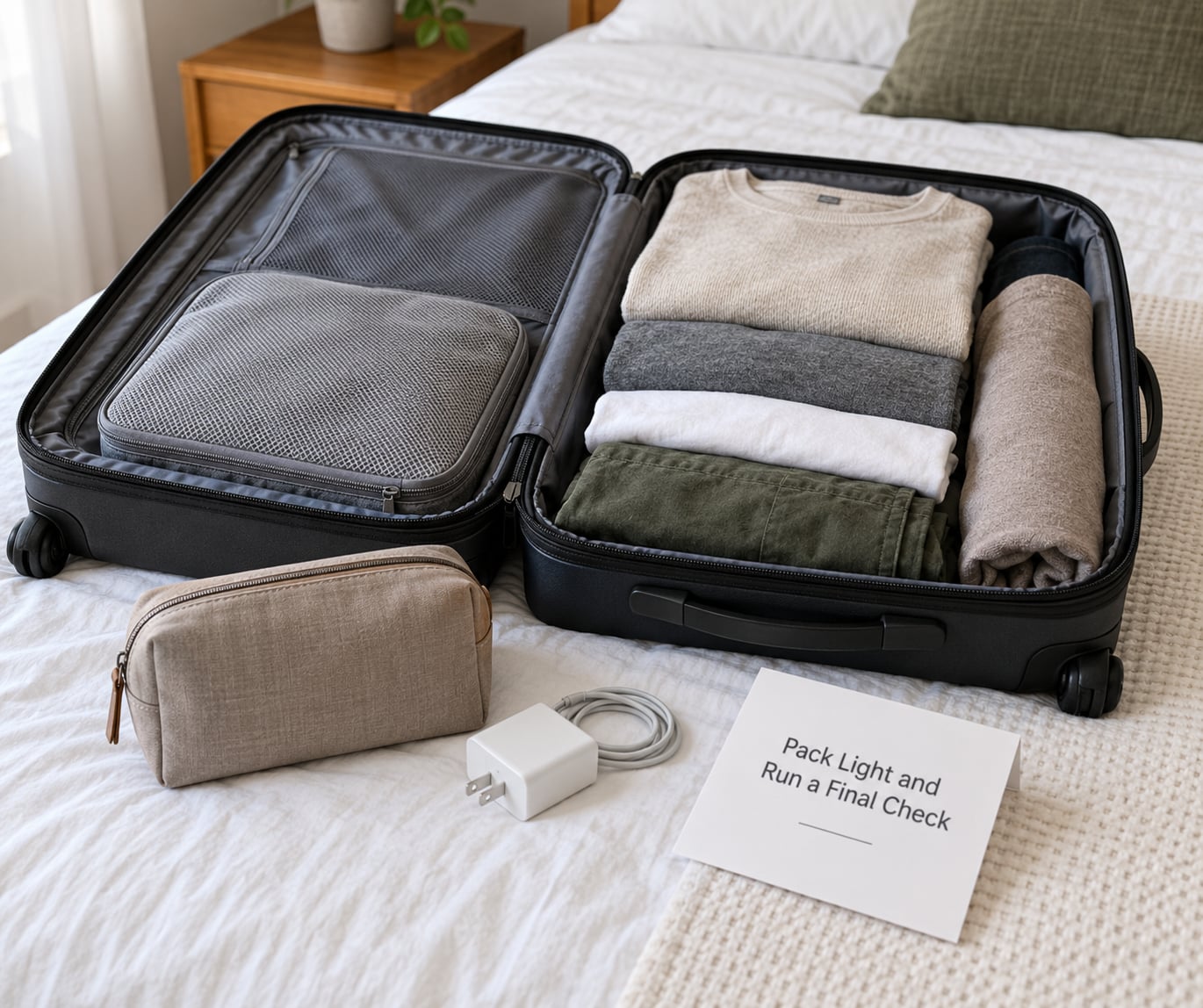
Then run a check 24 hours out. Confirm your documents, your bookings, your check-in time, your transfer times, and who is carrying what. Set two alarms for departure day rather than one.
Done when: you know what you are carrying, when you leave, and where the documents and reservation confirmations are stored.
Common Mistakes to Avoid
Overpacking the schedule
Three or four booked activities a day leaves no room for a slow lunch, a wrong turn, or a good recommendation from a local. Pick fewer and trust the gaps. One anchor per day is plenty for most weekend trips.
Choosing a far destination without counting transit
Measure door-to-door time in both directions before falling in love with a place. A beautiful destination six hours away is a different trip from one three hours away, and not always a better one.
Ignoring transfer buffers
Add 15 to 20 minutes between every planned transition, and more on the return day. Missed connections and station-to-hotel transfers are where tight itineraries collapse.
Spending the whole budget on the room
A premium room eats the transport share, which then forces a cheap destination choice. Set the accommodation limit first, then pick the destination that fits inside it.
Booking activities before transport and lodging
Once transport moves, everything else moves with it. Lock the fixed items, then fill the days.
Relying on unverified rules or old advice
Entry requirements, opening hours, and transit details change. Check official sources and the operator’s own site in the week before you travel, and save a screenshot in case connectivity fails.
Tips for a Smoother Long Weekend
Choose one anchor neighborhood and stay in it. Every extra hotel change costs you an evening.
Favor somewhere walkable or on one transit line. Ten minutes of walking is cheaper and calmer than two rides.
Leave a real gap in the middle of day two. It is where unplanned things happen.
Keep a small emergency reserve for a reroute, a taxi after a late dinner, or a ticket change.
Save every confirmation offline, in one folder, before you leave home.
With a group, put the shared plan in one document with a deadline for input. Late additions are what break the schedule.
And depart Friday night when you can. It buys back several hours of Saturday, which is the single cheapest upgrade available to a weekend trip.
Frequently Asked Questions
How many days are enough for a long weekend getaway?
Three days is the practical minimum: one travel day, one full day for the main anchor, and a checkout day with a short morning activity. Two days works for a nearby destination you have visited before, but a first visit usually feels rushed. Four days is where the trip stops feeling like a squeeze and starts feeling like a holiday.
What is a realistic budget for a long weekend getaway?
Work from shares rather than fixed figures: roughly 30 to 40 percent for transport, 25 to 35 percent for lodging, 20 to 25 percent for food, 10 to 15 percent for activities, 5 to 10 percent for local transit, and about 10 percent held back as contingency. Costs vary by region and season, so build your own ceiling before choosing a destination.
Is it better to book a rental car or use public transportation?
Public transport wins in cities with frequent service, since you avoid parking, fuel, and city driving fees. A rental car makes sense for rural areas, national parks, or groups splitting the cost across several people. Decide after checking the local transit route between your accommodation and your anchor, because that distance decides it more often than the price does.
How do I choose a destination that is close enough for a short trip?
Measure door-to-door travel time in both directions, including your commute and every transfer. If travel takes more than a quarter of your usable time, choose something closer. To plan a long weekend getaway properly, also check seasonal conditions, direct transport options, and how long it takes to reach the main activity once you arrive.
What should I pack for a long weekend getaway?
Start from the weather forecast and your activities, then apply a packing rule such as 5-4-3-2-1 or 3-3-3. Add documents, medication, one change of clothes, chargers, a power bank, and a refillable bottle. Choose clothing that mixes well so fewer pieces create more outfits, and assign shared items so nothing gets carried twice.
Conclusion
Long weekend getaway planning comes down to three things done in the right order: confirm the date window, set the total budget, and pick the one experience that has to happen. After that, choose a destination you can reach quickly, book transport and lodging before anything else, and give each day a single anchor with real gaps around it.
Do those three things tonight, before any searching. Everything after them gets easier.