Yes, you can check fragile souvenirs, but pack for a drop rather than for a smooth ride. Knowing how to pack fragile souvenirs in checked luggage comes down to one idea: stop the item from moving. Bags get tossed onto conveyors, stacked under heavier luggage and vibrated for hours, so a piece rattling around inside a wrapper breaks long before a piece locked in place does.
Budget 30 to 45 minutes for a batch of souvenirs. The materials are cheap — bubble wrap, a shoebox, socks you were going to pack anyway — and the rest is technique.
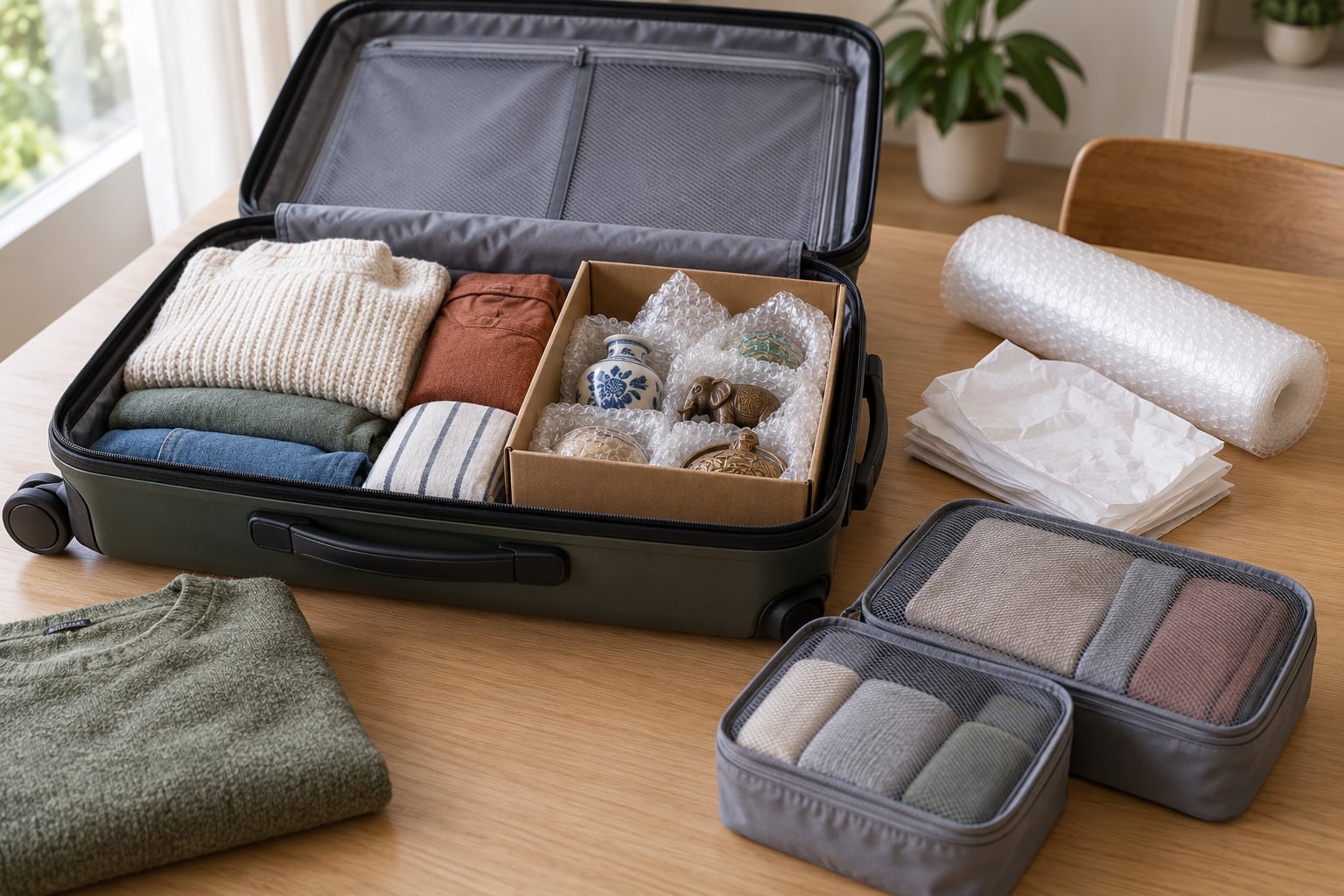
The short version: wrap every item on its own, immobilize it inside a rigid container, bury it in the middle of the suitcase with at least 5 cm of soft padding on all sides, fill every gap, and shake the case before you zip it.
Table of Contents
- What You Need
- Step-by-Step: How to Pack Fragile Souvenirs in Checked Luggage
- 1. Check Airline Rules and Separate Especially Valuable Items
- 2. Choose a Container That Limits Movement
- 3. Wrap Each Souvenir Separately
- 4. Build a Layer of Cushioning
- 5. Fill the Suitcase From the Bottom Up
- 6. Add a Final Top Layer and Prevent Shifting
- 7. Weigh, Seal, and Inspect the Bag
- Common Mistakes
- Frequently Asked Questions
- Can I bring fragile items in my checked luggage?
- Does a fragile sticker actually protect my bag?
- What is the best way to pack glass or ceramic souvenirs?
- Can I pack wine, spirits, or olive oil in checked luggage?
- What should you never pack in checked luggage?
- My souvenir broke in checked luggage. What do I do?
- Conclusion
What You Need
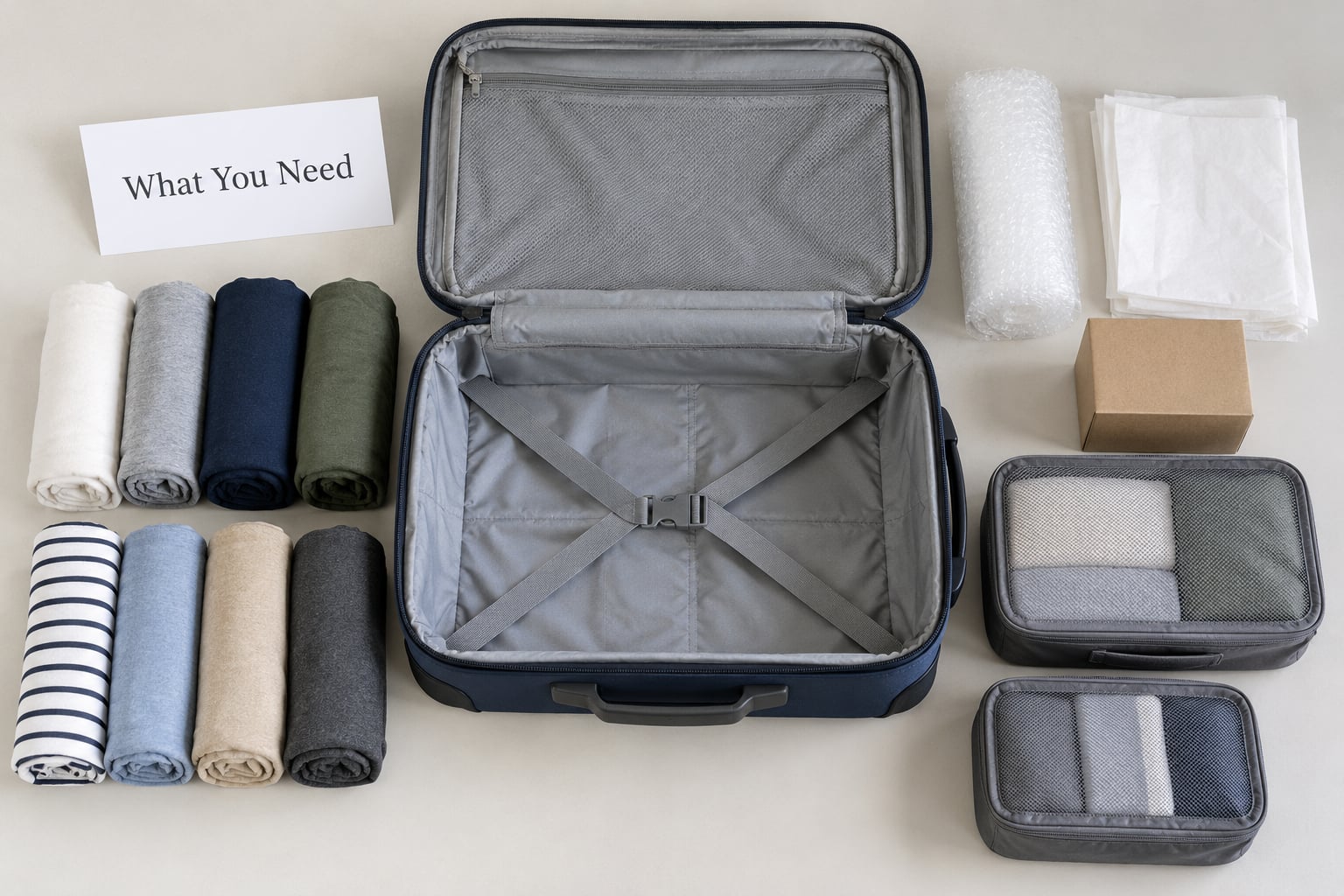
Gather these before you start wrapping, because improvised materials are the usual reason souvenirs arrive broken.
- A rigid container per item. A shoebox, a small cardboard box, a plastic tub, or a padded camera-style bag. The container has to be a little larger than the souvenir on every side.
- Bubble wrap or foam wrap. Small rolls are enough for a few pieces. The bubbles face the object, never the outside.
- Packing tape and markers. Tape closes the box and holds the wrap in place. A marker lets you write the room number on containers so nothing gets opened at the wrong hotel.
- Soft clothing for padding. Socks for small items, T-shirts as a mid layer, sweaters and towels for the heavy cushioning. Thick knits absorb impact better than thin cotton.
- Sealable plastic bags. Zip-lock or freezer bags protect bottles, keep moisture off your clothes and double as the outer layer for anything leakable.
- Receipts or phone photos. Photograph each souvenir with its price tag before it is wrapped. If it breaks, that photo is your only proof of what it was worth.
A hard-shell case resists crushing and moisture, and a soft-sided bag absorbs shocks and gives you more room to squish padding into corners. Either works once the item is immobilised, and neither one protects a souvenir that is free to move.
You may also hear about the 5-4-3-2-1 packing rule, which is about general luggage organisation: five days of clothing, four shoes, three books, two accessories and one toiletry bag. It is a decent weight guide, but it does nothing for breakables.
Step-by-Step: How to Pack Fragile Souvenirs in Checked Luggage
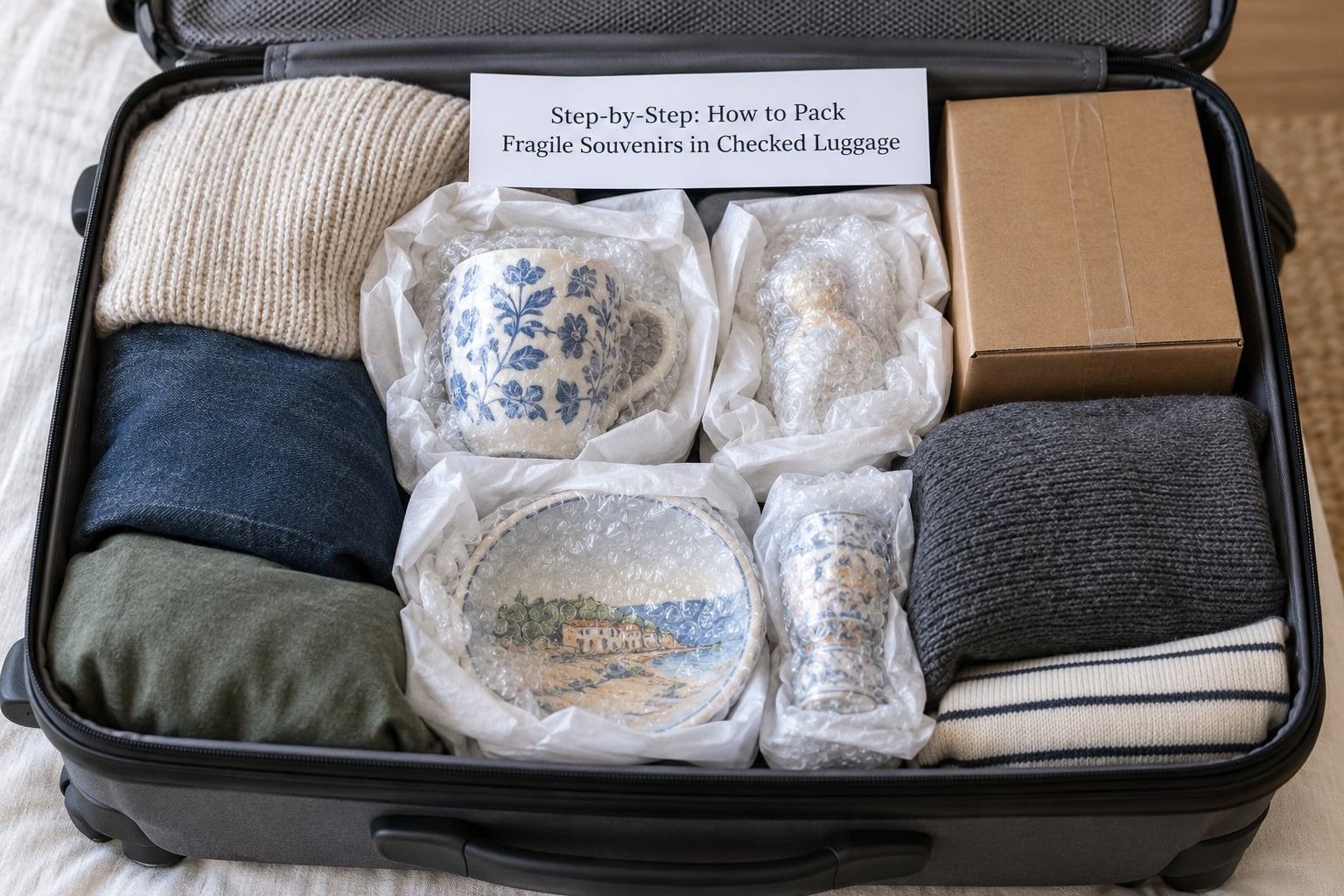
1. Check Airline Rules and Separate Especially Valuable Items
Read the carrier’s baggage page and the destination’s import rules before you pack, not at the counter. Size limits, weight caps and security rules differ by airline and by country, and an item that is fine at one airport can be confiscated at the next.
Passports, medication, keys, electronics and anything irreplaceable stay in your cabin bag. Musical instruments and large or valuable pieces often travel better in the cabin, and some carriers offer priority or special-handling tags for them.
2. Choose a Container That Limits Movement
Match the souvenir to a box, rigid tub or padded bag that keeps it from sliding in any direction. A rigid container spreads pressure across several sides, so a crushing stack in the hold gets absorbed by cardboard and clothing rather than concentrated on the object.
Leave roughly 5 cm of space between the item and the walls of the box. A box fitted too tightly is almost as bad as an empty one, because there is no room for the padding that does the work.
3. Wrap Each Souvenir Separately
Wrap pieces individually, even small ones that look sturdy. Two or three layers of bubble wrap with the bubble side against the object handles the sharp blow; a layer of tissue, soft fabric or a clean sock over the top stops the bubble pattern printing itself into glaze, glass or polished wood.
Tape the edges closed rather than tucking them in, cover handles, spouts and any projections that stick out, and fill hollow shapes such as vases and bowls with rolled socks so nothing presses on the inside wall. Use a sock instead of bubble wrap for spice jars, small bottles and jewellery boxes.
4. Build a Layer of Cushioning
Place the wrapped souvenir inside its box and surround it on all four sides and the top with soft material. Aim for at least 5 cm of padding, which is about two inches, with nothing touching a hard surface.
Close the lid and tape it shut. A container that is snug enough not to rattle when you shake it will take a fall far better than one with loose corners that absorb the impact instead of passing it along.
5. Fill the Suitcase From the Bottom Up
Build the case in layers. Put flat, unbreakable items at the bottom, then the most protected souvenir in the centre of the suitcase, where a drop hits it on several sides at once. Add your padded boxes around it, then fill every remaining gap with rolled clothing.
Voids are the enemy. An empty corner lets a wrapped box swing into its neighbour and crack it, so use socks and T-shirts to wedge things tight. Aim for a case that is full rather than loosely arranged.
6. Add a Final Top Layer and Prevent Shifting
Finish with a top layer of soft items, and keep hard objects such as shoes, books and electronics away from the souvenirs. Never put packing peanuts loose in the case; they shift under pressure and get crushed into anything they touch. Bag them first, or use clothing instead.
Then run the shake test. Lift the case by one handle, tilt it, and give it a firm shake over a hard floor. If you hear a thud, hear paper rattle or feel anything slide, add padding or reposition the item until the case is silent.
7. Weigh, Seal, and Inspect the Bag
Padding is light but not weightless, and many carriers charge for bags over a set limit, often around 23 kg or 50 lb depending on the ticket. Weigh the case at home, before check-in, and know your remaining allowance before adding another box.
Check that the suitcase closes fully and evenly, distribute heavy items near the wheel end so the bag does not tip, and re-open it once at home before you unpack for good. Keeping your photos and receipts of each souvenir matters more than most travellers expect.
Common Mistakes
Most broken souvenirs come down to a short list of avoidable errors.
- Using newspaper. Ink transfers to light surfaces and stays there. Tissue, kraft paper or plain wrapping paper works better, and acid-free paper is worth using for paper items, prints and textiles.
- Leaning souvenirs against the suitcase wall. The shell is the hardest surface in the bag and the first thing a drop touches. Keep every fragile item at least 5 cm away from it.
- Leaving empty space. Voids let wrapped items swing and collide. Fill gaps with clothing, not with more air.
- Trusting the hard shell. A hard case prevents crushing and rain, not movement or vibration. It changes nothing on its own.
- Packing irreplaceable items with no record. Photograph the souvenir, keep the receipt, and note the purchase date before it goes into the case.
- Relying on a fragile sticker. Handlers do sometimes put tagged bags on top of the pile, but the practice is inconsistent and nothing in your ticket guarantees it.
- Bottles in a single bag. One leak ruins the souvenir and everything next to it. Double-bag every bottle and cap in a sealed bag.
When the item is heavy, larger than a shoe, or impossible to cushion properly, shipping it home from the destination usually beats fighting with a suitcase. Travellers on travel forums recommend setting a decision rule before the trip rather than deciding at check-in.
Frequently Asked Questions
Can I bring fragile items in my checked luggage?
Yes, airlines accept fragile souvenirs in checked baggage, but most will not pay a claim for breakage caused by rough handling. Assume the item is uninsured once it is checked. Pack it so it cannot move: wrap it, immobilize it in a rigid box, and bury it in the middle of the suitcase with about 5 cm of padding on every side.
Does a fragile sticker actually protect my bag?
Not as a guarantee. Most carriers hand the sticker out free at check-in, and some handlers do place fragile-tagged bags on top of the stack, but it is inconsistent and nothing in your ticket promises it. Ask about a priority tag where the airline offers one, then put your real protection into the packing method itself.
What is the best way to pack glass or ceramic souvenirs?
Wrap each piece on its own in two or three layers of bubble wrap with the bubble side facing the object, then add tissue or soft fabric so nothing shifts inside the wrap. Tape it closed, set it in a box about 5 cm larger on every side, and pad all around it. Socks work well for small jars and jewellery boxes.
Can I pack wine, spirits, or olive oil in checked luggage?
Yes, and checked is the right place for them, since carry-on liquids are limited to 100 ml containers. Double-bag each bottle in a sealed plastic bag, wrap it, and stand it in the middle of the case surrounded by about 5 cm of clothing. Inexpensive wine sleeves or bottle protectors are worth buying before the flight home.
What should you never pack in checked luggage?
Passports, medication, keys, electronics and irreplaceable heirlooms belong in your cabin bag. For souvenirs, leave untreated wood, seeds, soil and fresh produce at home, since customs and biosecurity rules seize them at the border. Items made from endangered species, such as some coral, shell and reptile products, need a CITES permit before you travel.
My souvenir broke in checked luggage. What do I do?
Report it to the airline before you leave the baggage-claim hall and ask for a Property Irregularity Report, or PIR. Photograph the damage, keep the case and all wrapping, and hold on to receipts. Liability for fragile items is limited and rough handling is usually excluded, so file the claim quickly and expect modest compensation at best.
Conclusion
Before you check the bag, run through this short list: every souvenir wrapped on its own, every wrapped item immobilised in a rigid container with at least 5 cm of padding, every gap filled with clothing, irreplaceable pieces staying in your cabin bag, and the case silent when you shake it. Photograph anything you would hate to replace before it goes in.