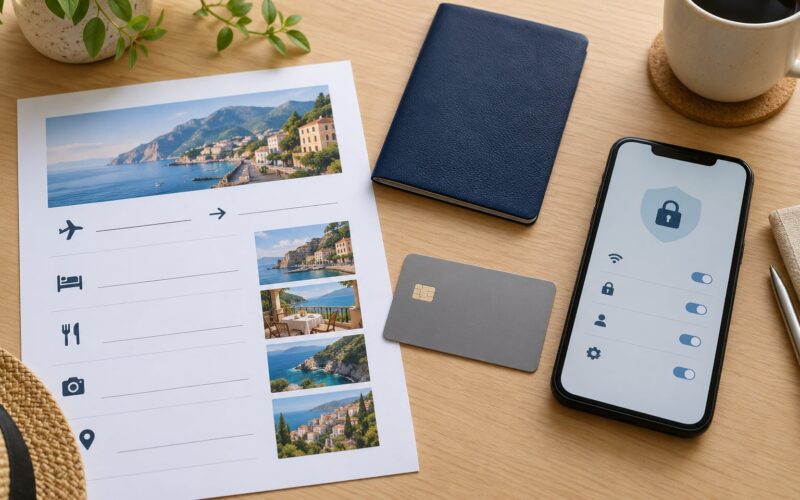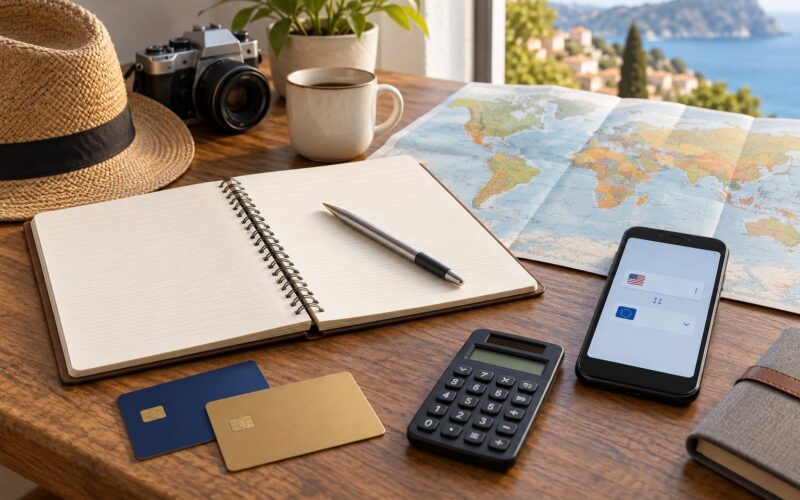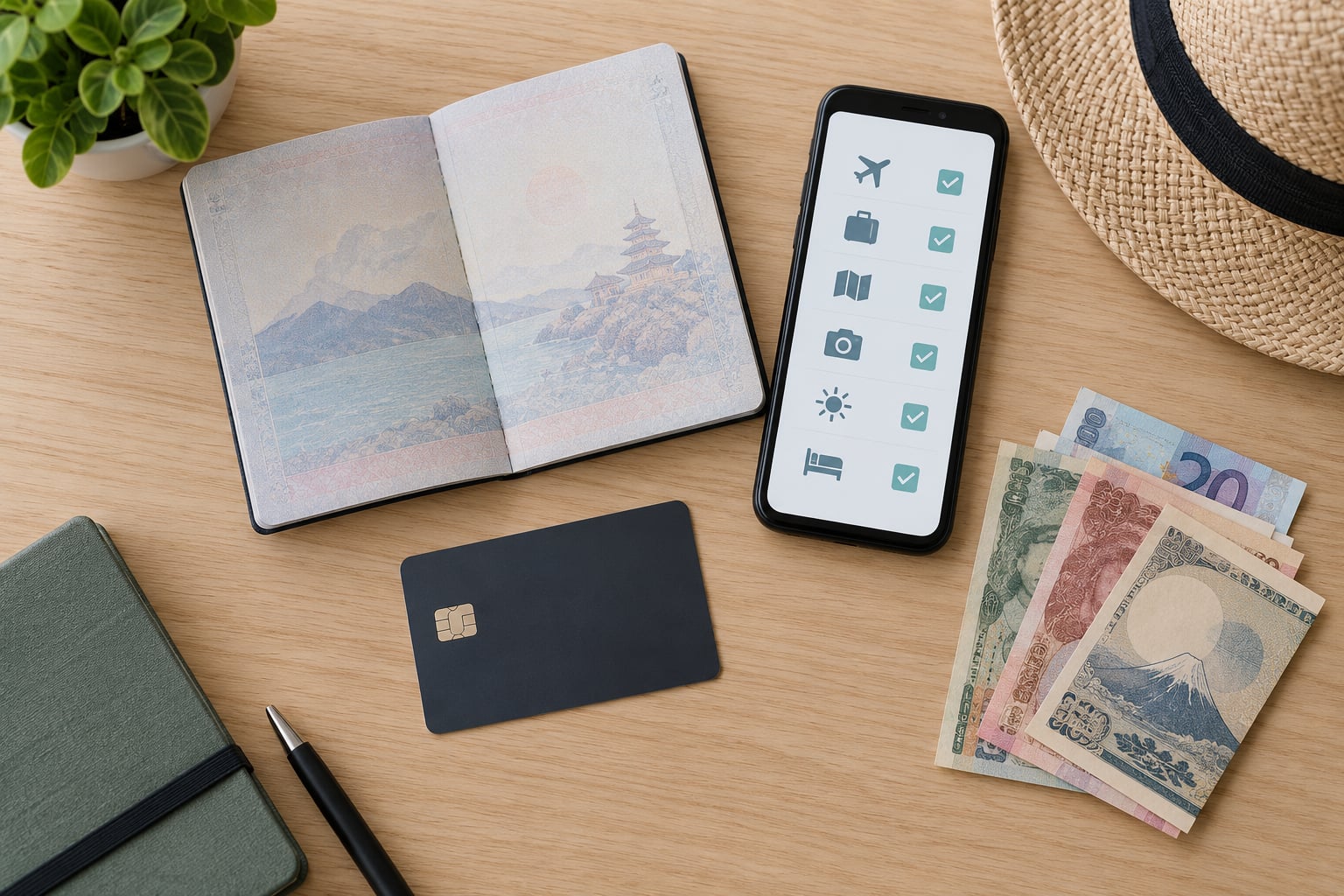
You can use a debit card overseas without problems if you tell your bank before you fly, always choose the local currency at the terminal, and keep a second card from a different bank as backup. Most of the trouble travelers hit comes from a fraud system that freezes a card it has never seen used abroad, not from the card itself. Set up the account properly a week ahead, and the whole trip runs on plastic and a phone.
The five things that prevent nearly every problem are simple enough to do tonight, before you pack anything. Add them to a note and the rest of this guide explains each one in detail.
- Add a travel notice for every destination and date range in your bank app or online banking.
- Confirm the card has no foreign transaction fee, and find out what your bank charges per ATM withdrawal.
- Carry two cards issued by different banks, stored in two different places.
- Always decline the offer to pay in your home currency and pay in local currency instead.
- Turn on real-time transaction alerts and save the bank’s international support number in your phone.
One more habit matters more than any other: check your account the evening after you arrive, while you still have time to fix a block. A frozen card discovered on day four of a five-day trip is a different problem from the same freeze discovered on day one.
Table of Contents
- What You Need
- Step-by-Step
- Step 1: Check That Your Card Works Abroad
- Step 2: Notify Your Bank and Set Travel Alerts
- Step 3: Choose When to Use a Card or Cash
- Step 4: Pay and Withdraw Safely
- Step 5: Monitor Spending and Handle Problems
- Common Mistakes
- Frequently Asked Questions
- Can I use a debit card overseas without telling my bank?
- Why was my debit card declined even though I had enough money?
- Should I choose the local currency or my home currency at an ATM?
- Are debit cards safer than credit cards for international travel?
- What should I do if my debit card is lost or stolen abroad?
- How do I avoid foreign transaction fees on a debit card?
What You Need
Most of this takes about fifteen minutes in a banking app. You need four things lined up before departure.
Two cards from two different banks. One goes in your wallet, one stays somewhere separate in your luggage. Cards from the same bank share the same fraud system, so two cards from one bank is really one card with a backup PIN pad.
Your PIN, written somewhere you can reach without your wallet. International ATMs take four digits, numbers only. A five-digit app PIN or a birthday with two extra digits will fail at the machine, and a failed PIN attempt is exactly the kind of pattern that makes an account get locked for security.
A way to prove who you are. That means the card itself plus whatever identification your bank requires for international support. Some banks ask for your card number, your date of birth and the first three digits of your PIN. Some ask for the last four of your card number and a travel notice you set up in advance. Store that information somewhere you can read offline.
A photo of your card front and back. Not the full number, just enough to identify the card if you need to describe it, and the last four digits written down somewhere. If your bag goes missing, you can rebuild the details without a phone call that itself needs the card in hand.
Also worth carrying: a small emergency amount in the local currency or in widely accepted US dollars, split across two bags, and the number to reach your bank’s support line from outside the country. Support lines for many large banks route through a toll-free number that simply does not connect from certain countries, so check whether your bank publishes a direct international number and a local one for the country you are visiting.
Step-by-Step
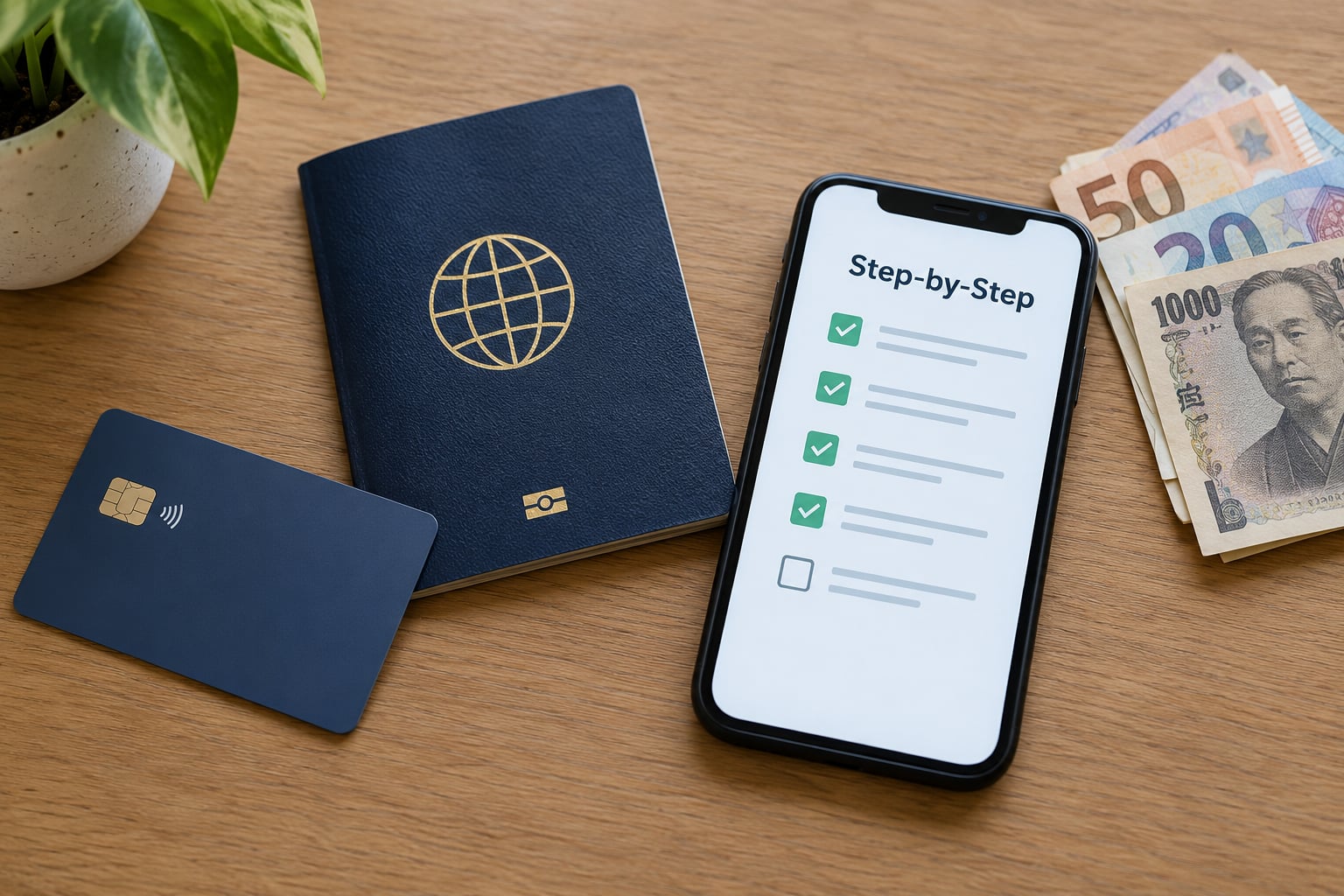
Step 1: Check That Your Card Works Abroad
Start by reading what your bank already tells you, before you ask. Most banks publish a travel page in the help section listing foreign transaction fees, ATM fees, whether the card works at all outside the country, and any countries they restrict.
Four things to confirm, each in a different place. The fee schedule tells you the foreign transaction markup and the per-withdrawal ATM charge. The card terms tell you whether international use is even included, which matters for premium and travel cards that quietly opt out. The help centre tells you which countries are unsupported or restricted. And the app tells you your daily ATM withdrawal limit, because that number is often low enough to surprise you at a ticket counter.
If your card carries a foreign transaction fee and you travel more than once a year, this is the moment to weigh a multi-currency account or a bank with no such fee. The comparison is easy to make in your bank’s app and worth an evening, because the fee is charged on every purchase, not just on withdrawals.
Step 2: Notify Your Bank and Set Travel Alerts
Adding a travel notice takes about two minutes and prevents what travelers describe as weeks of hassle. In the app or online banking, look for a travel notice, travel plan or card settings section, then enter each destination country and the date range you will be there.
Three details people get wrong. Use the countries you are actually entering, including transit stops, because a card used during a layover in an unlisted country can still be flagged. Return the notice to the date you get home, since an open-ended notice can keep the card under closer monitoring afterwards. And set the notice before you make any purchases abroad, which sounds obvious but is where the gap usually appears.
Large US banks have all been discussed on travel forums for cards being blocked despite a notice in place, with Bank of America and Wells Fargo coming up most often, followed by Chase. The usual trigger is not the purchase itself but something in the pattern: a country you added but did not visit, a purchase while roaming, or a small online transaction from a new merchant category. If that happens to you, the fix is in Step 5.
Then turn on transaction alerts. Push alerts or text alerts for every purchase, and make sure they work over data roaming. Some banks let you set an amount threshold and others only send above a minimum, so check what yours actually does before you rely on it. Keep one small balance in the account rather than a large one, so a fraudster who clones the card hits a wall quickly.
Step 3: Choose When to Use a Card or Cash
Decide where you are before you need it, because the decision is much harder at a station platform with a queue behind you. Card wins in hotels, restaurants, supermarkets, pharmacies and anywhere a reader takes a chip or a contactless tap. Cash wins in cash-heavy places: local markets, small family-run shops, taxis that lack terminals, tips, public transport in much of Asia, and anywhere a reader is out of service.
Cost drives the same split. Card purchases pass through the card network and your bank, and the network rate is close to the mid-market rate, with your bank’s markup on top if there is one. Cash bought at an airport exchange booth carries a commission that often runs into the mid single digits. Card is normally cheaper for anything above the cost of a small withdrawal fee.
Cash-heavy regions deserve a larger starting stack. Carry enough for the first three or four days plus the arrival transit fare, and refill from a bank-owned ATM rather than from a change booth.
Step 4: Pay and Withdraw Safely
At a terminal or an ATM, you will be offered a choice: pay in the local currency or pay in your home currency. Choose local currency, every time. That second option is dynamic currency conversion, where the terminal or the machine does the conversion instead of the network, and the rate it offers is routinely worse than the rate your card network would have given you. The conversion looks free and the cost is buried in the exchange rate.
At a card terminal, tap or insert your card yourself and keep it in your hand if the machine has a contactless reader. Watch the amount on the screen before you approve, and check that the total matches what the receipt says. Where the terminal is out of sight, such as a restaurant table or a hotel reception desk, take the terminal to the counter or ask the server to bring it over.
Online and in-app payments follow the same currency rule. When a booking site offers to charge you in dollars, decline it and let the merchant bill the local currency. Ride-hailing apps and transport tickets are frequent sources of home-currency charges, and they are worth checking each time.
For PINs, cover the keypad with your other hand. If a person offers to help you at a machine, say no and use a machine that is physically attached to a bank or inside a bank lobby. Those are the machines travelers call the safest option, and they also tend to be the ones that do not add an operator surcharge on top of your bank’s fee.
Check that the card machine accepts your network before you insert anything, and check that the ATM is one you recognise from the network logos on the screen. If a machine retains your card, stop pressing buttons. Call the number printed on the machine itself using your own phone, or contact your bank’s support line, and ask them to block the card before anything else. Travelers in Southeast Asia describe this happening regularly, and a retained card is recoverable within days if you report it the same day.
Keep receipts for anything above the amount you would think twice about, and note which ATMs you used. A receipt with a time and an ATM identifier makes a disputed withdrawal far easier to sort out.
Step 5: Monitor Spending and Handle Problems
Check your account daily rather than weekly. You are looking for a transaction you did not make, an unfamiliar merchant name, or a currency you were never in. Finding a fraud block while you still have other payment methods is a nuisance. Finding one on the last day of a trip is a crisis.
A decline is not always a block, and telling them apart saves time. A decline with a message about insufficient funds or a limit means the bank processed the transaction and said no, so check your balance, your daily withdrawal cap and the merchant’s own limits. A decline at a terminal that behaves oddly, followed by the same card failing everywhere within minutes, points to a fraud block or a security lock instead. If the card suddenly stops working abroad without any action from you, that is the more likely cause.
Contact the bank through a channel you trust rather than a number on the terminal screen or on a text message. Use the number in your app or on the back of the card, or the one on your bank statement. Banks can usually unblock a card over the phone once they confirm your identity, and often that call is faster than anything inside the app.
Ask about replacement timing in the same conversation. A physical card mailed abroad can take a week or more, but most banks now provide instant virtual card numbers for online purchases and can transfer money to a second account. If you travel with two cards from two banks, you already have that fallback and you can wait for the replacement at a sensible pace instead of arranging one in an airport at midnight.
If money is the emergency rather than the card, check whether your bank offers emergency cash delivery to a hotel or embassy, and whether your travel insurance covers a cash advance. Keep the policy number with your documents.
Common Mistakes
Forgetting the travel notice. The single most reported problem. The fix takes two minutes in the app, and it should be done before you buy anything that touches a foreign merchant.
Accepting dynamic currency conversion. It looks like the kind option, and it is the expensive one. Fix the habit by deciding before you travel that you decline any offer to charge you in dollars, then looking for the local currency line on the screen.
Using an independent ATM in a quiet place. Independent machines can charge several times what your bank charges and are more exposed to card-trapping devices. Use machines attached to a bank or inside a bank lobby, and check the network logos first.
Retrying a declined PIN too many times. Three failures can lock the card for security, and a lock abroad is a much bigger problem than a lock at home. After one failed attempt, cancel the transaction, step aside, and check what you typed before trying again.
Carrying one card from one bank. Two cards from the same bank share one fraud system, so a block hits both. Two banks means two independent decisions.
Ignoring the foreign transaction fee. It applies to every purchase, not just cash, and on a long trip it adds up to more than the cost of a flight change. Check the fee before the trip, not after.
Leaving the emergency cash in one bag. Split it, and split the backup card too. The most common emergency is not theft of money, it is a bag that never reaches the hotel.
Disabling alerts to save battery. Alerts are the early warning that a card is being used by someone else. Turn roaming data on for your banking app, or keep the SMS alerts running.
Frequently Asked Questions
Can I use a debit card overseas without telling my bank?
Usually, but not reliably. A card with international use enabled often works abroad without a travel notice, and plenty of travelers get through a whole trip that way. The problem is that fraud systems flag card activity from an unexpected country, and a flag usually means the whole account freezes rather than just one transaction. That can lock you out of online banking too, which is how you pay for a replacement. Adding the notice costs two minutes in your app and removes the most common cause of a card being blocked abroad.
Why was my debit card declined even though I had enough money?
The balance is rarely the real reason abroad. Common causes are a daily ATM withdrawal limit, a per-transaction cap set by the terminal, a card security block triggered by an unusual country, a PIN entry error that happened too many times, or an online merchant declining a prepaid or bank-issued card category. Check the decline message in your app, because most banks record the reason. If the same card fails everywhere within a few minutes, treat it as a block and call your bank rather than trying the card again.
Should I choose the local currency or my home currency at an ATM?
Always choose local currency. When you accept your home currency, the machine or the terminal performs the conversion through dynamic currency conversion, and the rate it uses is usually worse than the card network rate. Paying in local currency lets the network convert the amount, and your bank then applies only its own foreign transaction markup, if it charges one. At a terminal, decline the home-currency option and wait for the local-currency prompt. At an ATM, decline any question about converting the withdrawal amount.
Are debit cards safer than credit cards for international travel?
It depends on what you are doing. For purchases, a credit card usually gives you stronger dispute rights because the money has not left your account yet, while a debit card moves the funds immediately and recovery can be slower. For cash, a debit card is more practical, since credit card cash advances usually carry a fee and an immediate interest charge. Many travelers therefore keep both: a credit card for spending and a debit card for ATM withdrawals and as the backup if the credit card is blocked.
What should I do if my debit card is lost or stolen abroad?
Block it in your banking app or call your bank’s international support number straight away, then tell the bank you are abroad so they can note the location. Ask whether a replacement can be sent to your accommodation or branch and how long it takes, and request an instant virtual card number for online bookings. Meanwhile, use your second card and your emergency cash. Report the loss to local police if you need an official report for your insurer, and keep the reference number, because claims processes usually ask for it.
How do I avoid foreign transaction fees on a debit card?
You cannot remove the fee with a single setting, so there are three practical options. First, use a bank whose card has no foreign transaction fee for your destination market. Second, keep most spending on a card or wallet that already uses the mid-market rate, such as a multi-currency account, and hold the fee-paying card as backup. Third, withdraw cash in the local currency at a bank-operated ATM and use that for small purchases, since one withdrawal fee beats many small conversions. Check your fee schedule before each trip, because banks change these terms.
Fees and card rules differ between banks and change over time, so treat the details above as a framework and check your own bank’s current terms before you leave.
Do one thing tonight: open your banking app, add the travel notice for every country on your itinerary, turn on transaction alerts, and check what your card charges for foreign use and ATM withdrawals. That is fifteen minutes of work, and it removes the reason most debit card problems happen abroad. Then pack two cards from two banks, keep your PIN reachable but hidden, and pay in the local currency every single time.