A foreign transaction fee is a surcharge, usually 1 to 3 percent, that your card issuer charges when you spend or withdraw money in a currency other than the one your account settles in. To avoid it, use a card with no foreign transaction fee, always choose the local currency when a terminal asks, and keep cash withdrawals to the few places where you actually need notes. Set aside twenty minutes before you leave to check your card’s fee schedule and tell your bank you are travelling.
Most of the surprise costs I see come from one of three things: a card that quietly carries a 3 percent fee, a terminal that offers to charge you in dollars, or an ATM with a surcharge nobody mentioned. Each one is avoidable, and each one takes about a minute to avoid once you know it exists.
This guide covers how to avoid foreign transaction fees on cards, in cash, and in online bookings, plus what to do when a fee has already landed on your statement. Figures here are typical ranges drawn from published card and network fee schedules; your own issuer’s terms are what count.
Last reviewed in October 2026.
Table of Contents
- What You Need Before You Go
- Step-by-Step: How to Avoid Foreign Transaction Fees
- 1. Choose a Card With No Foreign Transaction Fee
- 2. Set the Account to the Right Currency
- 3. Use Local Currency and Avoid Dynamic Currency Conversion
- 4. Limit Cash Withdrawals and Check ATM Fees
- 5. Apply a No-Foreign-Fee Card to Hotel, Food, and Transit Purchases
- 6. Track the Real Cost Before and During the Trip
- 7. Verify Fees, Notify Your Bank, and Dispute Anything Wrong
- The Fee Types You Are Actually Avoiding
- Common Mistakes That Cost Travelers Money
- Frequently Asked Questions
- How do I avoid a 3 percent foreign transaction fee?
- What does a foreign transaction fee actually mean?
- Is a credit card or debit card better for avoiding foreign transaction fees?
- Should I pay in dollars or the local currency when a terminal asks?
- Do foreign transaction fees apply when I shop on an overseas website from home?
- Can a foreign transaction fee be refunded or disputed?
- Conclusion: Do This First
What You Need Before You Go
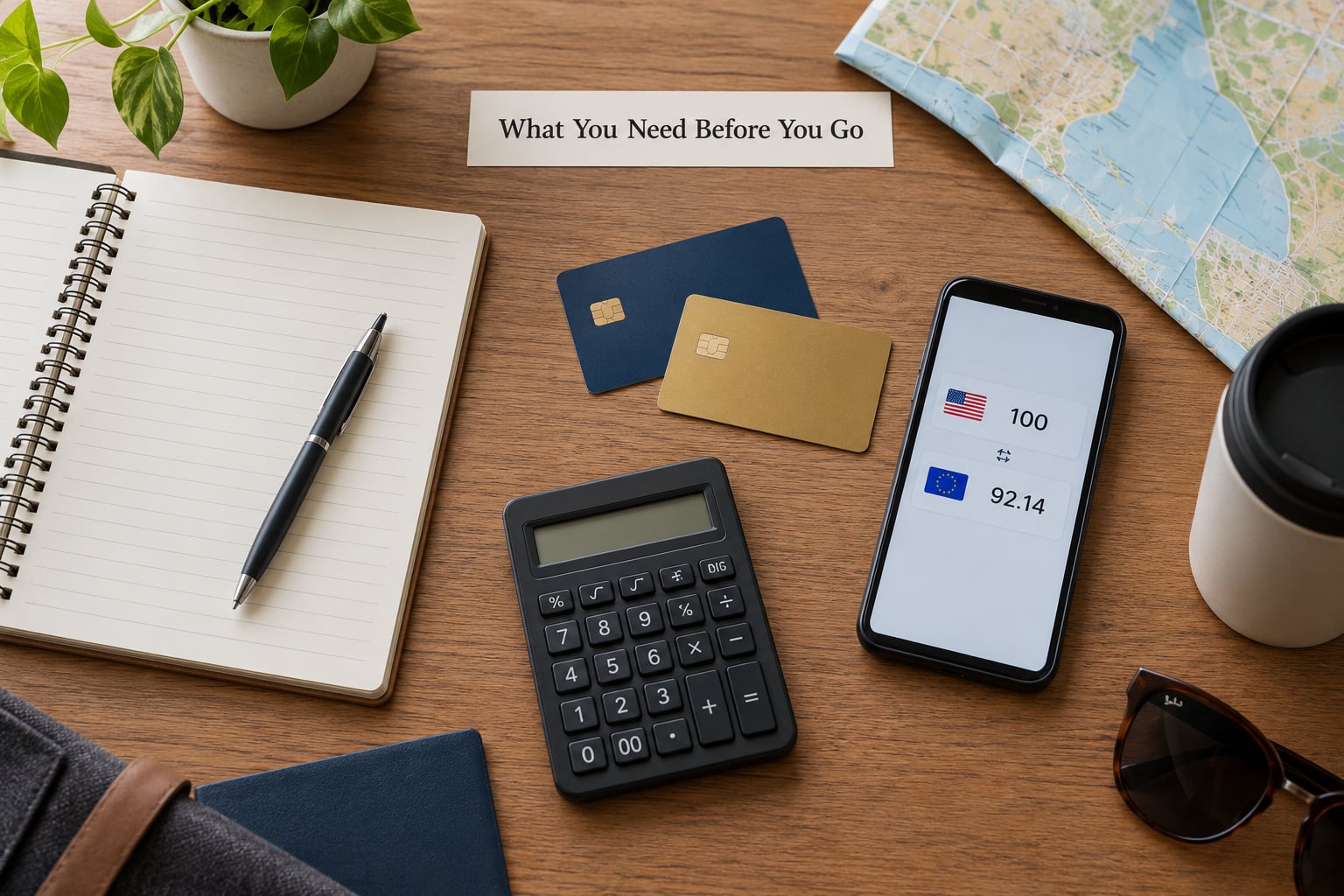
Gather four things before you compare payment methods, and the rest of the trip gets easier. The first is your card’s fee schedule, which most issuer websites bury under a pricing or terms page rather than putting on the card itself.
- The fee schedule for every card you plan to take. Search your issuer’s site for foreign transaction fee, and note the percentage, whether it applies to credit and debit, and any annual fee attached.
- The currency your account settles in. Most US cards settle in dollars, which matters when you are buying something priced in yen from home.
- Your destination and the cash-versus-card balance. Countries differ enormously in how card-friendly they are, so write down how many days you expect to need physical notes.
- Bank-run ATM access. A credit union, a bank you already hold an account with, or a supermarket ATM usually charges a different operator fee than a machine on a tourist strip.
- A backup card on a different network. If one network has a terminal problem, a Visa card will not help if your backup is also Visa.
- Your bank’s phone number and secure messaging channel. You want both offline, because a frozen card abroad is a bad time to search a website.
Download your banking app too. Doing it before departure means you can check rates, freeze and unfreeze the card, and raise a withdrawal limit without hunting for a store’s connection.
Step-by-Step: How to Avoid Foreign Transaction Fees
1. Choose a Card With No Foreign Transaction Fee
Pick the card whose schedule says foreign transaction fee 0 percent, and treat that as the primary card for the whole trip. Capital One and Discover cards carry no foreign transaction fee across their ranges, and several cards from Chase, Bank of America and American Express also advertise 0 percent, so the option is widely available rather than exotic.
Read the wording carefully, because two different fees hide behind the same phrase. Your issuer may waive its own fee while the card network still adds a currency conversion charge, which is why a card described as fee-free can still cost you about 1 percent. Card networks publish their conversion rates, and the exact schedule on your account is the version that applies to you.
How to tell this worked: search the issuer’s site for the fee schedule, find the line item, and write the percentage on a card in your phone. If the number is 0 percent, that card becomes the default for every purchase you can make by card.
2. Set the Account to the Right Currency
Your account settles in one currency, usually dollars, and that choice is not something you change per trip. What you can change is which currency the merchant or ATM charges you in, and that is where the savings live.
Converting money in advance through a separate product adds a second margin to the same trade. Holding a balance in the destination currency through a multi-currency account can work for long stays or repeated trips, where the spread is charged once rather than on every card purchase, but for a two-week holiday the card rate is usually cleaner.
How to tell this worked: check your account settings and confirm your settlement currency matches what you expect. If your bank offers a travel multi-currency balance and you expect more than a few weeks abroad, read its spread and monthly fee before deciding.
3. Use Local Currency and Avoid Dynamic Currency Conversion
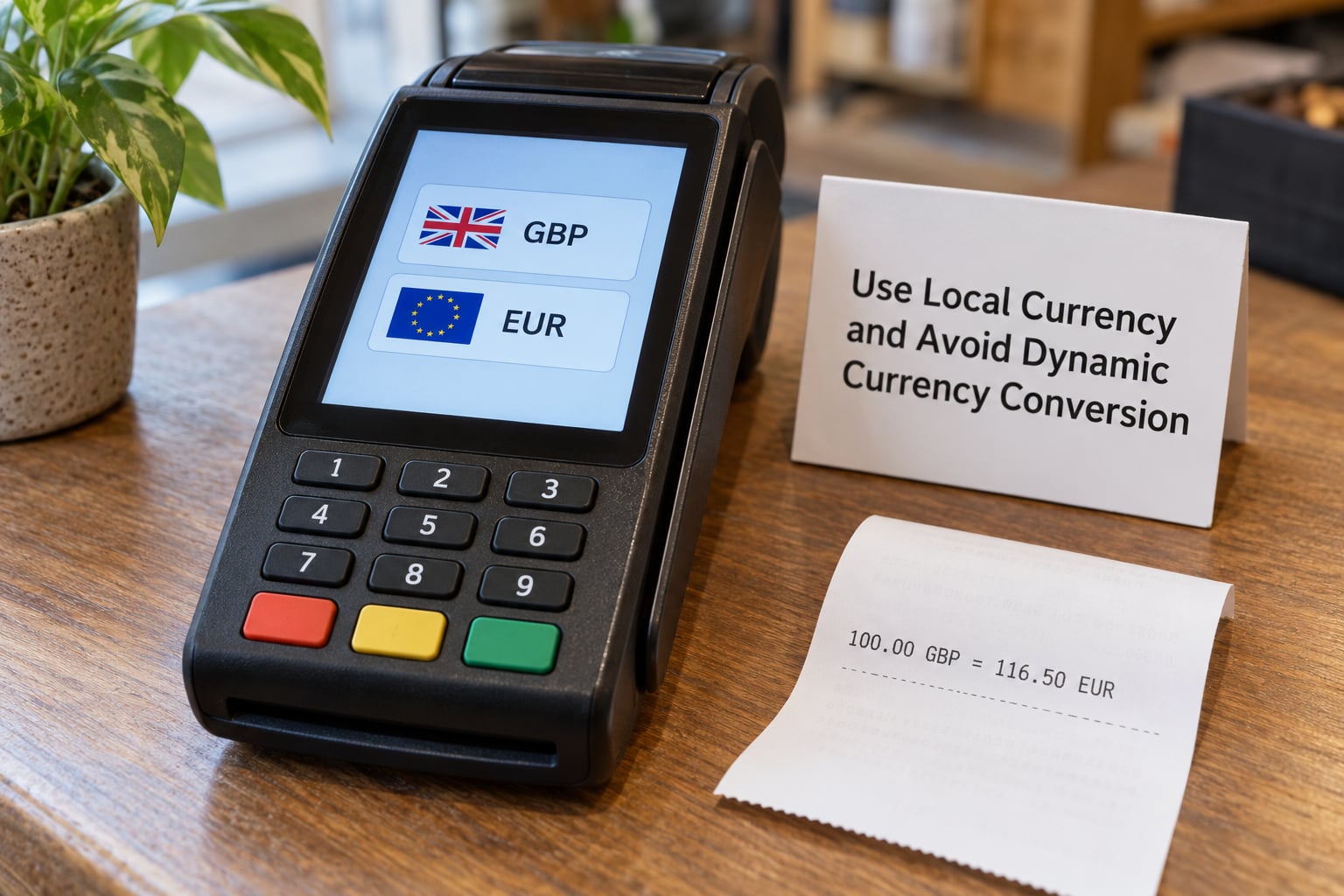
When a terminal, an ATM or a hotel asks whether you want to pay in your home currency or the local one, choose the local currency, every time. This is dynamic currency conversion, and the home-currency option exists so you see a familiar number while quietly handing the conversion to the terminal operator with a markup. Community consensus on travel forums is blunt about this one: travellers who picked dollars to avoid a surprise almost always lost more than they saved.
The markup on a converted terminal rate commonly lands in the range of 4 to 7 percent over the mid-market rate. Paying in local currency on a no-foreign-fee card puts the conversion with the card network at roughly 1 percent, so the gap is real money rather than a rounding difference.
There is one trap worth naming: some terminals present the dollars option as your fee-free option. It is not. If a terminal tells you that choosing your home currency means no foreign transaction fee, that is a sales pitch, and the safe move is still to pick the local currency and complete the transaction.
How to tell this worked: on your statement, the transaction should post in the local amount with a conversion line. If it posts in dollars only, you accepted dynamic currency conversion.
4. Limit Cash Withdrawals and Check ATM Fees
Cash abroad is the most expensive payment method, and the cost rarely sits in one place. The ATM operator charges a fee, your bank may charge its own fee for the withdrawal, and the exchange rate on that withdrawal can carry its own markup. Bank-run machines commonly charge a small flat fee while a machine in a tourist area or at an airport can add a percentage surcharge on top.
You can cut most of that in three ways. Withdraw from your own bank or credit union’s network, decline the ATM’s offer to convert to your home currency, and take out enough for several days rather than a daily trickle, since the flat operator fee applies per withdrawal.
Debit cards from online banks are popular for this reason, with reimbursement of out-of-network ATM fees built into some accounts, and multi-currency services such as Wise and Revolut are often recommended by travellers for repeated ATM use. Check the reimbursement terms, because some credit the fee after the fact rather than waiving it at the machine.
Two things you cannot avoid: the operator fee at many foreign ATMs, and the fact that a no-foreign-fee card still pays a network conversion charge on a cash withdrawal. Avoid credit card cash advances entirely, since they typically carry a 3 to 5 percent fee, a minimum charge, and interest that starts the same day.
How to tell this worked: your banking app shows the withdrawal settled with a clear operator fee and one conversion line, rather than several adjustments over the following days.
5. Apply a No-Foreign-Fee Card to Hotel, Food, and Transit Purchases
Card payments should cover most of a trip, and that is what keeps the total cost low. Use the no-foreign-fee card for hotels, restaurants, trains, metro fares, tickets and car rentals, since each of those carries a conversion charge that your cash cannot avoid.
Two categories behave differently. Hotel and car rental desks place a pre-authorisation hold, often a few hundred currency units, which reduces your available credit or balance while the stay is running. If you are also paying with a second card, tell the desk which card the hold goes on, or ask whether they can reduce it. Online bookings priced in a foreign currency work the same as any other purchase, so book with the no-foreign-fee card too.
How to tell this worked: at checkout, your pre-travel balance already includes enough headroom that the hold does not push the card past its limit and decline a real purchase later.
6. Track the Real Cost Before and During the Trip
Write down four numbers for anything large: the amount you paid in local currency, the rate on your statement, the fee charged, and the final total in your account currency. A simple note in your phone is enough, and a spreadsheet works if the trip is longer than two weeks.
Worked example. A seven-day trip with roughly 1,500 USD of card spending: at 3 percent, the fee adds about 45 USD. The same spending at 0 percent adds nothing from your issuer, leaving only the network conversion charge of about 15 USD. Two cash withdrawals of 200 USD each at a machine charging a flat operator fee and an exchange-rate markup add a further amount that would disappear entirely if those notes were replaced by card payments.
Checking the rate on the statement is the part most people skip. Divide the amount charged in your account currency by the amount on the receipt, then compare that rate to the mid-market rate for the day. A gap of roughly 1 percent is normal network conversion. A gap of several percent means the conversion happened somewhere other than the network, which is worth flagging to your bank.
7. Verify Fees, Notify Your Bank, and Dispute Anything Wrong
Tell your bank about the trip if your card has a travel notice setting, since some issuers freeze cards that suddenly appear in another country. Check your withdrawal limit before leaving and raise it if you expect to take out meaningful amounts, because daily limits apply per day and a mid-trip increase is harder than a pre-trip one.
After the trip, read the statement line by line. Look for a foreign transaction fee line, a currency conversion line, and any pair of entries for one purchase, since a dynamic currency conversion usually shows as the original charge plus an adjustment days later.
If a fee was charged in error, contact the issuer through the number on the back of the card or a secure message from the app, and state the date, the amount, the merchant and the fee. Ask them to identify which fee it was, whether it came from the network or from their own schedule, and whether a statement credit is available. Credit card purchase protections generally cover goods and services, while a pure fee line is often handled as a billing error, so describe it accurately and let the bank route it.
Keep screenshots of the terminal screen and the receipt. If the merchant ran a conversion you declined, that evidence is the strongest thing you can hand an agent.
The Fee Types You Are Actually Avoiding
These four charges get confused constantly, and each one behaves differently.
- Issuer foreign transaction fee. Charged by your bank on any transaction in a foreign currency, commonly 1 to 3 percent. Avoided entirely by a card with a 0 percent schedule.
- Network conversion charge. Added by the card network when it converts the amount, often around 1 percent. Many cards waive the issuer fee but not this layer, which is why a fee-free card is rarely truly free.
- Dynamic currency conversion. Not a fee at all, a merchant-side conversion with a 4 to 7 percent markup. Avoided by declining the home-currency option.
- ATM and cash advance fees. Flat operator fees at the machine, a possible issuer fee on top, and for credit card cash advances a separate fee plus interest from day one. Avoided by using bank-run ATMs with a debit card, and not avoided at all by borrowing cash on a credit card.
Common Mistakes That Cost Travelers Money
Choosing dollars at the terminal. It feels safer because the amount matches your budget. Fix: pick the local currency, always, even when the terminal says dollars avoid a foreign transaction fee.
Treating no foreign transaction fee as no cost. The network conversion layer still applies. Fix: budget roughly 1 percent of card spending as the realistic floor, and treat anything above that as a signal something went wrong.
Using the ATM as a default payment method. Withdrawing daily for small amounts pays the flat operator fee over and over. Fix: withdraw in larger amounts less often, from your own bank’s network.
Skipping the fee schedule before departure. People assume every card behaves the same. Fix: check each card, note the percentage, and pick the card with the lowest figure.
Forgetting the travel workflow. A card blocked abroad or a limit that is too low causes bigger problems than a 3 percent fee. Fix: set the travel notice, confirm limits, download the app, and carry a backup card on a different network.
Not reading the statement when you get home. A fee you never check is a fee you keep paying on the next trip. Fix: spend ten minutes comparing posted amounts against receipts and mid-market rates.
Three habits hold up better than the rest. One no-foreign-fee card as your default, local currency chosen without exception, and cash used only for the places that genuinely need it, such as markets, small cafés and tips. Everything else is a detail on top of that plan.
Frequently Asked Questions
How do I avoid a 3 percent foreign transaction fee?
Use a card whose fee schedule lists a 0 percent foreign transaction fee, and run it as your default for the whole trip. Declining the home-currency option at terminals and ATMs prevents the separate 4 to 7 percent conversion markup. Expect roughly 1 percent of card spending anyway from the card network’s conversion charge, which no issuer waives.
What does a foreign transaction fee actually mean?
It is a surcharge your card issuer adds when you spend or withdraw money in a currency other than the one your account settles in, usually 1 to 3 percent of the amount. It applies to purchases, ATM withdrawals and online payments priced in a foreign currency, and it posts as its own line on your statement.
Is a credit card or debit card better for avoiding foreign transaction fees?
Either works if its schedule says 0 percent, and plenty of credit cards and debit cards qualify. Debit cards have one advantage for cash: some online bank accounts reimburse out-of-network ATM fees. Credit cards have one clear disadvantage, since a cash advance adds a fee and same-day interest on top of everything else.
Should I pay in dollars or the local currency when a terminal asks?
Always choose the local currency. Paying in dollars accepts dynamic currency conversion, where the terminal operator sets the rate and adds a markup commonly in the range of 4 to 7 percent. On a no-foreign-fee card, paying in local currency keeps the conversion with the card network at roughly 1 percent.
Do foreign transaction fees apply when I shop on an overseas website from home?
Yes. Buying from a merchant that prices in another currency is a foreign-currency transaction, so your issuer’s fee applies even though you never left the country. The same applies to foreign subscriptions and travel bookings priced in another currency. Pay with a 0 percent card and the fee disappears.
Can a foreign transaction fee be refunded or disputed?
Sometimes. Contact your issuer through the number on your card or the secure message channel in your app, giving the date, amount, merchant and fee, and ask whether the fee came from the network or the issuer schedule. Fees that were charged because you accepted a conversion you did not realise are the most likely to be credited back.
Conclusion: Do This First
Find one card with a 0 percent foreign transaction fee, make it your default, and choose the local currency at every terminal and ATM without exception. Use cash only where a combined ATM fee and conversion rate is genuinely lower than the card rate, which is usually limited to markets, small cafés and tips.
Rates, card terms and bank policies vary by issuer and by country, so check your own card’s fee schedule rather than working from a general rule. Budget about 1 percent of your card spending as the realistic floor for network conversion, and read the statement when you get home so any surprise shows up on the next trip rather than the last one.