How ATM fees abroad work comes down to three separate charges, and travelers usually only ever see one of them on the receipt. The machine’s owner adds an operator surcharge, your own bank adds a foreign ATM fee, and the currency conversion adds a percentage on top. Decline the conversion prompt, use a bank-owned machine instead of a street kiosk, and withdraw in fewer, larger amounts, and most of that stack disappears.
Fee schedules differ by country and change whenever issuers feel like rewriting them, so the figures below are realistic ranges rather than quotes. The mechanics, though, are stable, and once you can name the three layers you can predict what a withdrawal will cost before you confirm it.
Table of Contents
- How ATM Fees Abroad Work
- Layer one: the ATM operator surcharge
- Layer two: your bank’s foreign ATM fee
- Layer three: the conversion charge
- Dynamic currency conversion is the expensive choice at the screen
- What the Final Withdrawal Cost Can Look Like
- Why the size of the withdrawal matters so much
- Why Banks and ATM Operators Charge Fees
- Why a card with no foreign transaction fee is still not free
- How to Lower ATM Fees Abroad
- How ATM Fees Abroad Work and How to Lower Them Step by Step
- Before departure
- Choosing the machine
- How ATM fees abroad work at the screen
- After the withdrawal
- Low-Fee Versus No-Fee ATM Options
- What to Do If You See an Unexpected ATM Fee
- When the ATM declines or keeps your card
- Frequently Asked Questions
- How do I know the total fee for an ATM withdrawal abroad?
- Should I choose the local currency or let the ATM convert the amount into dollars?
- Are credit cards better than debit cards for getting cash abroad?
- Why can an ATM charge a fee even when my bank says the ATM is fee-free?
- Can I avoid foreign transaction fees by using a travel card?
- How often should I withdraw cash while traveling abroad?
- What to Do First Before You Fly
How ATM Fees Abroad Work
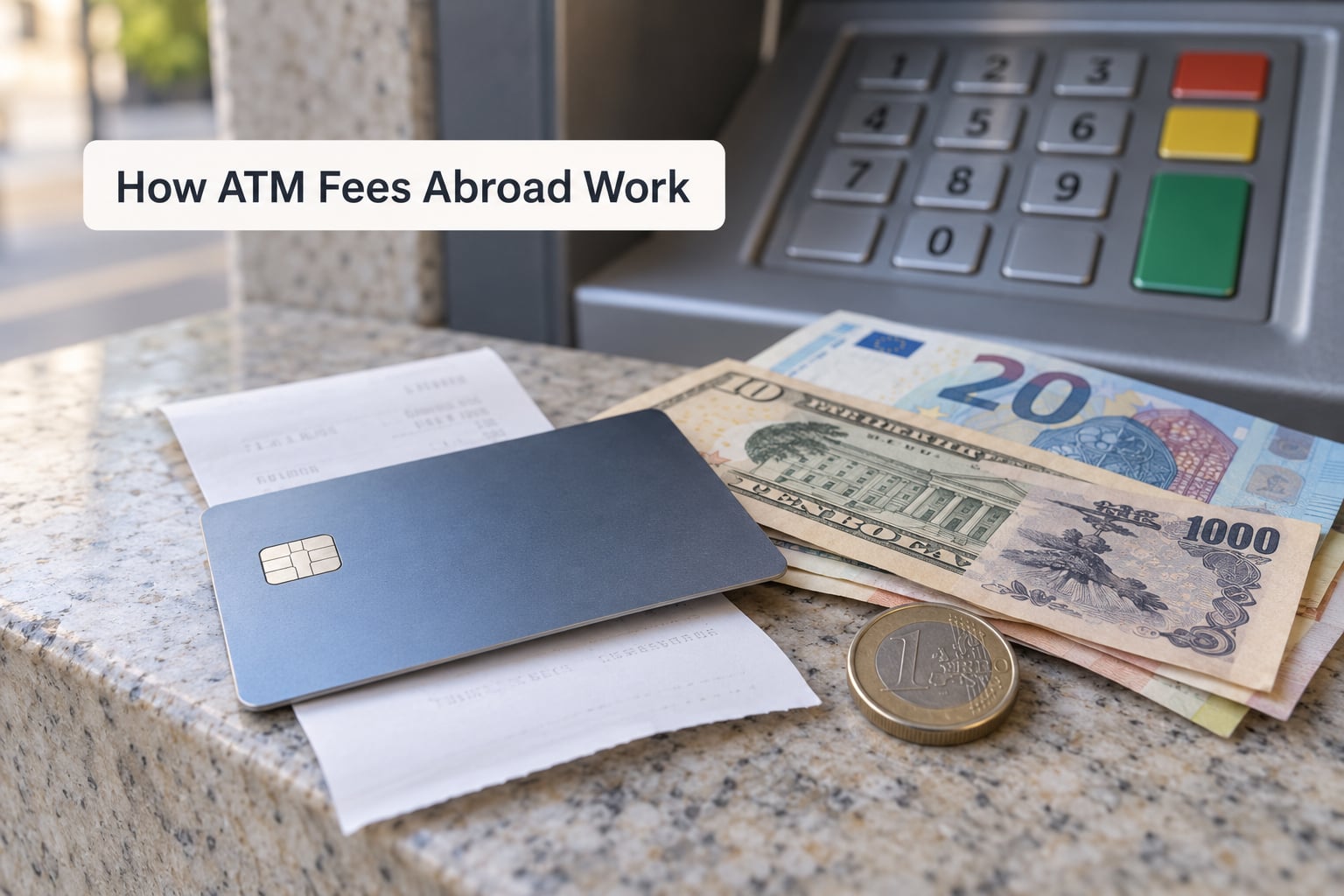
A foreign ATM fee is any charge added to a cash withdrawal taken out in a currency other than the one your account is held in. In practice that means up to three layers stacked on a single transaction: the ATM operator’s surcharge, the fee your own bank adds for using a foreign machine, and a foreign transaction fee or exchange markup applied to the amount being converted.
The layers are set by different companies and arrive at different times, which is exactly why the total surprises people. One is quoted on the terminal before you approve. One posts to your account days later. The third one never appears as a line item at all, because it is buried in the exchange rate.
Layer one: the ATM operator surcharge
This is the fee the owner of the machine charges, and it is the only one you can see before you commit. In most of Europe it shows as a fixed amount on the screen, often between 0 and 6 units of the local currency or its equivalent, or it appears as a percentage of the withdrawal. Independent machines, airport terminals and hotel lobby units usually sit at the expensive end.
Layer two: your bank’s foreign ATM fee
Your issuer charges for letting you use a machine that is not in its own network. The common structure is a flat fee per withdrawal, frequently in the 1 to 5 range, though plenty of banks charge a percentage instead, and a few charge both. On travel forums, small banks and credit unions come up often precisely because some of them apply a flat 1% on international ATM transactions with no additional fixed fee attached.
Layer three: the conversion charge
When the machine hands out pesos, reais or baht, somebody has to turn your home currency into local currency and settle it across borders. Your bank may add an explicit foreign transaction fee, typically 0% to 3% of the amount, or it may build a smaller markup into the rate. Either way, the rate you receive is never the mid-market rate you see on a currency website.
| Layer | Who sets it | Typical range | When you find out |
|---|---|---|---|
| Operator surcharge | ATM owner or network | 0 to 6 per withdrawal, or a percentage in some countries | On screen, before you confirm |
| Foreign ATM fee | Your bank | 1 to 5 per withdrawal, or 1% of the amount | Days later, on your statement |
| Foreign transaction fee | Your bank | 0% to 3% of the converted amount | Same statement line |
| Rate spread | Built into the rate | About 0.5% to 2%, never advertised as a fee | Hidden inside the rate itself |
Dynamic currency conversion is the expensive choice at the screen
Dynamic currency conversion, usually shortened to DCC, is the terminal’s offer to charge you in your home currency instead of the local one. The screen will show an amount that already looks converted, at a rate the ATM operator picked, and it will often look reassuring because the number is familiar.
It is the worst deal on the menu. Because the operator sets the rate and keeps the difference, the converted figure commonly runs several percent worse than letting your own bank do the conversion at the wholesale rate. The consensus across travel forums is blunt: always decline, always take the local currency, and if the machine insists on converting or offers no local-currency option, walk away and find another machine.
What the Final Withdrawal Cost Can Look Like
Here is an illustrative example, not a quote. A traveler withdraws the equivalent of 300 units of their home currency from a bank-owned machine in a country where the operator does not surcharge. The bank’s foreign ATM fee is 3 and the foreign transaction fee is 2% of the amount.
Operator surcharge: 0. Bank fee: 3. Conversion fee: 6. Total cost: 9, which works out to 3% of the withdrawal. The same trip with a street kiosk charging a 5 operator surcharge and a 3% card fee costs 5 plus 3 plus 9, or 17 in total, roughly 5.7% of the money taken out. All figures are illustrative and will not match any specific card.
Why the size of the withdrawal matters so much
Because the fixed parts do not scale. Pulling 100 out with a 5 operator surcharge and a 3 bank fee plus 2% costs 10, or 10% of the withdrawal. The same 8 in fixed charges on a 400 withdrawal, plus 8 in conversion, comes to 16, or 4%.
| Withdrawal size | Operator surcharge | Bank fee | Conversion at 2% | Total cost | Effective cost |
|---|---|---|---|---|---|
| 40 | 5 | 3 | 0.80 | 8.80 | 22.0% |
| 100 | 5 | 3 | 2.00 | 10.00 | 10.0% |
| 300 | 5 | 3 | 6.00 | 14.00 | 4.7% |
| 500 | 5 | 3 | 10.00 | 18.00 | 3.6% |
Per-transaction pricing quietly rewards a habit most travelers have never thought about, which is withdrawing a little from a machine every other day. Five small withdrawals of 40 cost the same 44 in fees that a single withdrawal of 200 would cost in one trip.
Why Banks and ATM Operators Charge Fees
None of these charges are arbitrary. Cash is expensive to move around, and each layer covers a real cost that somebody passes along.
Card networks charge the issuing bank an interchange fee, sometimes called the IIN fee, for handling the transaction. Cash has to be collected, counted, transported, insured and refilled, and an owner of a machine on a Greek island or in rural Mexico carries that whole operation on a small number of transactions. Compliance adds another layer, since machines that dispense euros or dollars to visitors sit under anti-money-laundering rules, and the owner passes some of that cost on through a surcharge.
Local pricing explains the rest. In a country where cash is normal, bank-owned machines often charge nothing and expect you to spend the money in local shops. Where cash is a visitor product, the pricing is set for visitors, and an airport or hotel unit is priced accordingly.
Why a card with no foreign transaction fee is still not free
This is the part most fee guides skip. A card advertised as charging 0% foreign transaction fee has removed one layer, not all of them. The conversion still happens through a chain: your bank, the card network, and the national or regional central bank that supplies the local currency. Every hand-off takes a cut.
What remains is the rate spread, the gap between the mid-market rate and the rate your bank actually credits. In practice that spread runs from well under 1% on a good multi-currency account to a couple of percent on a traditional card. Add an ATM operator surcharge and a fixed foreign ATM fee on top, and a no-foreign-transaction-fee card is cheaper, sometimes dramatically so, but it is not the same as free.
How to Lower ATM Fees Abroad
Eight moves, roughly in the order they pay off.
- Decline dynamic currency conversion every single time, and always choose the local currency. Why it works: the terminal rate is the most expensive rate available to you, and the choice takes two seconds.
- Use ATMs inside bank branches. Why it works: bank-owned machines are the ones most likely to charge no operator surcharge, and they tend to sit in busy, lit, staffed places.
- Use a card that charges no foreign transaction fee. Why it works: it deletes the largest percentage layer, and percentage layers hurt most on small transactions.
- Look for an account that reimburses foreign ATM fees. Why it works: reimbursement offsets the bank layer, though read the terms, because many programs cap the amount per statement cycle and treat a bank fee as an out-of-network claim.
- Withdraw in fewer, larger amounts. Why it works: the operator surcharge and your bank’s fee are per transaction, so the same cash costs far less in one go.
- Decide your cash budget before you land. Why it works: a plan means one withdrawal at the airport or central station and then cards for everything else.
- Pay by card wherever cards are accepted, and use peer-to-peer payments to split bills with people whose cards do not work. Why it works: a card purchase with no foreign transaction fee beats any cash withdrawal for the same amount.
- Carry a second card from a different network, stored separately from the first. Why it works: it protects you against a declined withdrawal, a retained card or a card that simply gets frozen.
Readers on r/travel and r/TravelHacks repeat the same order of operations: withdraw once on arrival, then pay by card. Members on r/Schwab and r/SoFi point to reimbursement accounts, with the honest caveat that the best-known of those require you to open a brokerage account first and hold a balance.
How ATM Fees Abroad Work and How to Lower Them Step by Step
Before departure
Set a travel notice on every card you are taking, including any you are not using, so a decline in a small town does not get mistaken for fraud. Check the fee schedule for your specific cards, not the marketing summary, and pick one withdrawal card to handle all cash for the trip.
Choosing the machine
Look for a machine inside a bank, a supermarket or a large transit station. Independent and tourist-area units, including the Euronet-style kiosks that appear in airports, ferry terminals and hotel lobbies across Europe, add an operator surcharge and are widely reported on travel forums as the expensive option for foreign cards.
How ATM fees abroad work at the screen
The terminal shows the amount, sometimes the operator surcharge, and a question about which currency to charge you in. Select the local currency, decline the conversion, confirm the amount. If the machine will not let you proceed in the local currency, that surcharge is already built in and you should cancel.
After the withdrawal
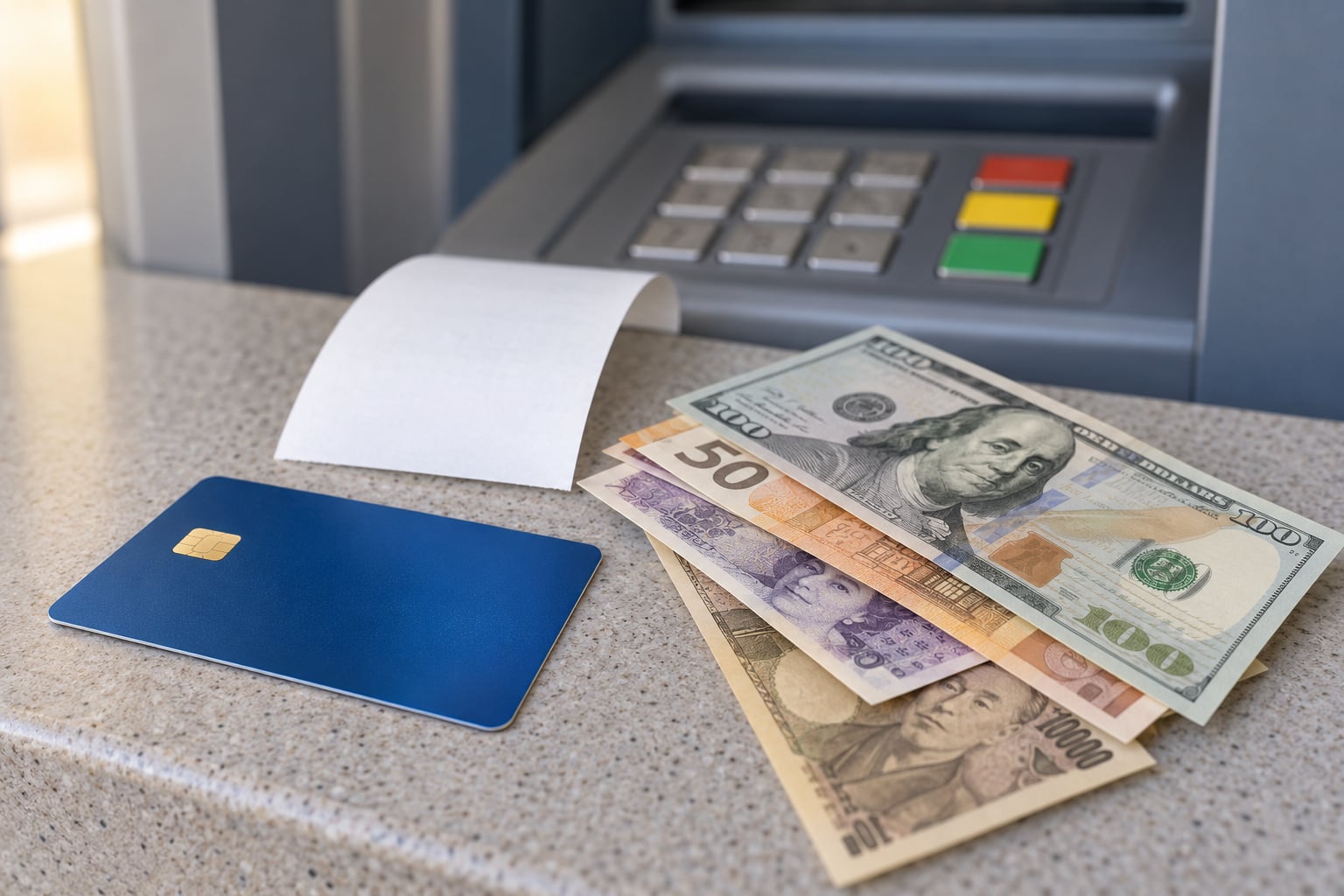
Take the receipt and check it before you walk away. It should show the amount dispensed, the local currency and the operator surcharge if there was one. Photograph anything odd, then check your account a few days later once your bank has posted its own fee, so you can match two lines against one withdrawal.
Low-Fee Versus No-Fee ATM Options
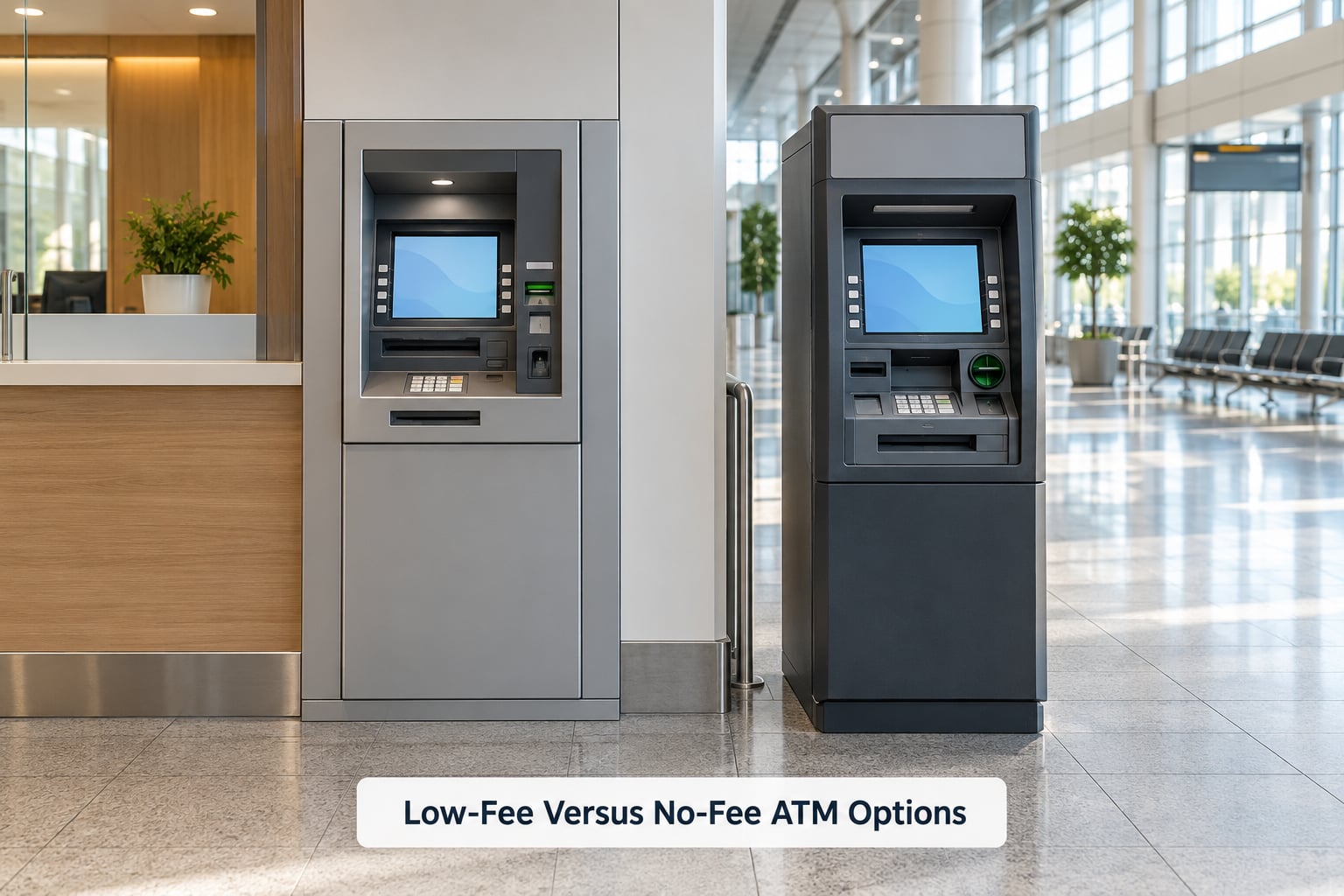
Options differ less by what they charge than by who sets the price. Bank-owned machines are the closest thing to a no-fee withdrawal, because your own network is not an outside operator. Everything else adds a layer somewhere between you and the cash.
| Option | Typical extra cost | Best for | Watch out for |
|---|---|---|---|
| Bank-branch ATM | Often none; your bank fee may still apply | Anyone with a day or two to spare | Closed on weekends and holidays in some countries |
| Bank-network surcharge-free access | Free at participating institutions | Everyday banking alongside a fee-free account | Access is limited to in-network machines |
| Independent or street kiosk | Operator surcharge, often percentage based | Convenience when nothing else is open | The most expensive common option for a foreign card |
| Airport and hotel ATM | Operator surcharge, often the highest on the street | Emergency cash on arrival | Dynamic currency conversion may be the default choice |
| Bank-issued debit card | Bank fee plus spread unless the card waives FX | Everyday spending and low-risk cash | Balances are exposed if the card is lost |
| Travel prepaid or multi-currency account | Often a small fixed conversion spread | Longer trips and repeat withdrawals | Loading, holding and card-order conditions |
| Credit card cash advance | Cash advance fee and immediate interest, on top of everything above | Genuine emergencies only | The most expensive way to get cash abroad |
Multi-currency accounts and prepaid travel cards trade a flat, disclosed cost for a variable one. Because their spread is visible and stable, they tend to win on a trip with many withdrawals. A plain debit card wins on a short trip where you only need cash once. A credit card cash advance rarely wins at all, since it stacks a fee, an interest charge from the day of withdrawal, and a separate rate on the conversion.
Some travelers also split the difference by paying for most things on a no-foreign-transaction-fee credit card, keeping only tips, market vendors and small cafés on a debit card, and holding a modest amount of cash in a money belt or hotel safe as a fallback.
What to Do If You See an Unexpected ATM Fee
Most fee disputes are settled with a phone call, not a complaint letter. Work through this order.
First, read the receipt. It separates the operator surcharge, which is agreed at the machine, from anything your bank added afterwards. Charges that duplicate the same withdrawal on two consecutive days are often a posting error, and banks reverse those routinely once you point them out.
Second, contact your issuer using the number on the back of the card and ask what each line represents, and whether the ATM was in their network. If you used a fee-reimbursement account, this is the moment to file the claim, and you will need the receipt, the date, the amount and the location.
Third, keep the paperwork. A photograph of the receipt, the card transaction screen and your statement line is usually enough. Write the dispute in one short message with those three facts, and reference the charge date.
Remedies vary widely by bank and by country. Some issuers credit an operator surcharge as a courtesy, some will not, and consumer protection rules that apply at home rarely travel with you. Ask for the outcome in writing, and check whether your card issuer or your home regulator has a formal process for charges you did not authorise.
When the ATM declines or keeps your card
A decline is usually a limit or a block rather than a fault. Daily withdrawal limits, per-transaction caps and country blocks all trigger it, and a card that failed abroad may be blocked for the rest of the day.
If the machine retains the card, call your issuer before doing anything else and follow their instructions, since the branch that owns the machine will usually need written authorization before releasing it. Do not keep retrying at other machines; repeated declines can extend a block and make you look like a fraud case.
Frequently Asked Questions
How do I know the total fee for an ATM withdrawal abroad?
Only part of it. The ATM operator’s surcharge appears on the terminal screen and on the receipt, so you can see that part before you confirm. Your bank’s foreign ATM fee and any foreign transaction fee post days later, after the card network has settled the conversion. To estimate the total in advance, add a typical operator surcharge to your bank’s published foreign ATM fee, then add the foreign transaction percentage to the amount you want to withdraw.
Should I choose the local currency or let the ATM convert the amount into dollars?
Always choose the local currency and decline the conversion. That option is called dynamic currency conversion, and the operator sets the rate, keeping the difference, which commonly runs several percent worse than your bank’s wholesale rate. Declining costs nothing, takes two seconds, and is the single highest-return habit in this whole guide. If a machine will not proceed without converting, cancel and find another one.
Are credit cards better than debit cards for getting cash abroad?
For spending, usually yes, provided the card charges no foreign transaction fee. For cash, no. A credit card cash advance adds a cash advance fee, interest that starts accruing on the day of withdrawal, and often a higher conversion rate, on top of the ATM operator and bank fees. Debit and prepaid travel cards also limit how much of your balance is exposed if a card is lost. Credit card cash is for genuine emergencies only.
Why can an ATM charge a fee even when my bank says the ATM is fee-free?
Because two different companies charge two different fees. A fee-free network promise means the ATM owner does not add a surcharge and your bank does not add its foreign ATM fee. An exchange rate booth that also dispenses cash, or an independent kiosk, is a different operator outside that network, so the operator surcharge still applies. Check the screen before confirming: the terminal will show the operator’s charge even when your bank’s side is zero.
Can I avoid foreign transaction fees by using a travel card?
It removes the explicit percentage fee, but not every layer. The conversion still passes through your bank, the card network and the central bank supplying the local currency, and the gap between the mid-market rate and the rate you receive is the rate spread, often from well under 1% to a couple of percent. A good travel card is still much cheaper than a card charging 3%. Compare the disclosed spread, not just the headline 0%.
How often should I withdraw cash while traveling abroad?
As rarely as practical. Operator surcharges and bank fees are charged per transaction, so the same total cash costs far less in one large withdrawal than in five small ones. A common pattern is one withdrawal on arrival to cover the first day or two, then cards for everything, topped up once more only if a later destination is genuinely cash-heavy such as a market, a tip-heavy country or a rural area.
What to Do First Before You Fly
Pick one card with no foreign transaction fee, set a travel notice on everything, and decide your total cash budget for the whole trip before you land. Then follow three rules at the machine: bank branch, local currency, largest sensible amount.
Those three choices remove most of the three-layer stack, and they work with any bank. Check your own issuer’s current fee schedule before you go, since that is the one part of this picture only your bank can confirm.