Learning how to travel solo for the first time is mostly preparation rather than bravery. Pick a city with good public transit, book the first night before you book anything else, leave room in the plan for a missed train, and tell one person at home where you are staying. That is genuinely most of the work, and it takes a few evenings, not months.
The part nobody tells you is how the nerves actually behave. They usually peak in the days before departure, when everything is still hypothetical and your imagination fills in the gaps. Once you land, get through the airport, and sit down with a coffee somewhere that looks right, most of that tension drains away faster than expected.
This guide covers the whole sequence, from choosing a destination to handling the first evening alone. It suits anyone who has never travelled without a partner, whether the worry is safety, dining solo, meeting people, or handling a disruption by yourself.
People who travel alone regularly tend to describe the first trip in the same terms: over-planned at the start, looser by the end. Treat the itinerary below as a starting structure rather than a script, and adjust it as you go.
Table of Contents
- What You Need Before You Book
- Documents and identity
- Travel insurance
- Money and two payment methods
- A communication plan
- First-night accommodation
- Health information
- Safety gear that is actually useful
- Step-by-Step
- 1. Choose a first solo destination that suits your comfort level
- 2. Build a flexible itinerary instead of overplanning
- 3. Set up money, documents, and communications before leaving
- 4. Pack for comfort, safety, and one unexpected problem
- 5. Get through arrival and your first few hours
- 6. Adjust the plan as the trip unfolds
- Common Mistakes
- Booking too much for the first two days
- Relying on a single payment method
- Announcing where you are staying
- Ignoring local norms
- Staying isolated on purpose
- Walking home through empty streets late
- Fixing every detail in advance
- Having no plan when you get sick
- Frequently Asked Questions
- Is it safe to travel alone for the first time?
- How do I deal with anxiety when traveling alone for the first time?
- How do I eat alone at a restaurant without feeling awkward?
- What do I do if I miss a flight or train while traveling solo?
- What should I do in an emergency while traveling alone?
- How do I keep family updated without posting my location publicly?
- Conclusion
What You Need Before You Book
Most of the anxiety around a first solo trip comes from loose ends, not from the destination itself. Work through this list before you pay for anything, and most of the stress has nowhere to attach itself.
Documents and identity
- Passport with validity beyond your trip dates, plus the blank pages some countries require.
- Any visa or entry permission, checked against your actual passport, not an assumption.
- Digital copies of passport, visa, insurance policy and bookings, stored in two places.
- A note of your country’s embassy or consulate contact for where you are going.
Travel insurance
Buy cover that covers you travelling alone, and read the exclusions rather than the headline. Some policies limit cover for specific activities, and single travellers should check the medical and repatriation terms carefully. Coverage rules vary by country and provider, so treat this as a place to check details rather than a blanket recommendation.
Money and two payment methods
Forum discussions on r/solotravel and r/femaletravelers converge on one point: split everything. Carry a main card, a second card from a different network, and a small amount of cash hidden somewhere other than your wallet. Travelling with a single card and a full stash of cash is the single most common thing experienced solo travellers tell beginners to avoid.
A communication plan
Agree a check-in rhythm with one person at home before you go. A daily short message works better than nothing at all, and it gives someone a reason to notice if you go quiet. Write down the address of your first-night accommodation and keep it on that person’s phone too.
First-night accommodation
- Booked and confirmed before departure, never figured out on arrival.
- Within walking distance of a train or metro station, or on a route with late buses.
- A place with a staffed reception and a recent review mentioning safety.
Health information
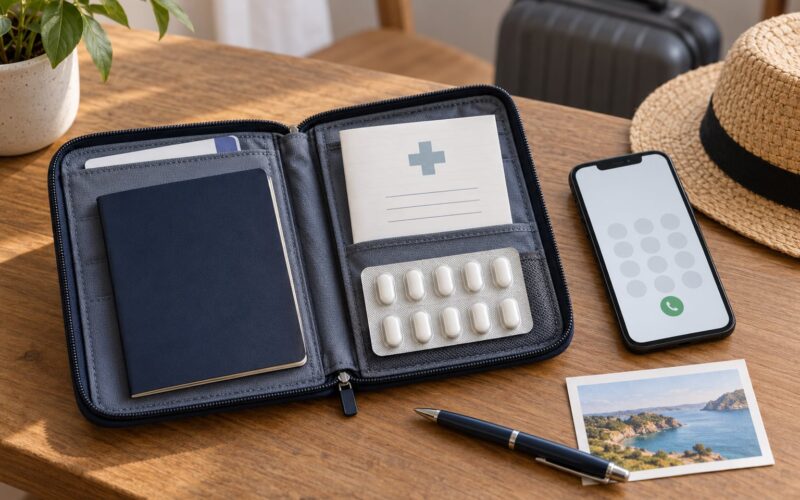
Note your allergies, medications, blood type and your insurer’s assistance number, and keep them on your phone plus a paper copy. Travelling alone means there is nobody to remember the details for you when you are groggy, so write them down instead of trusting your memory.
Safety gear that is actually useful
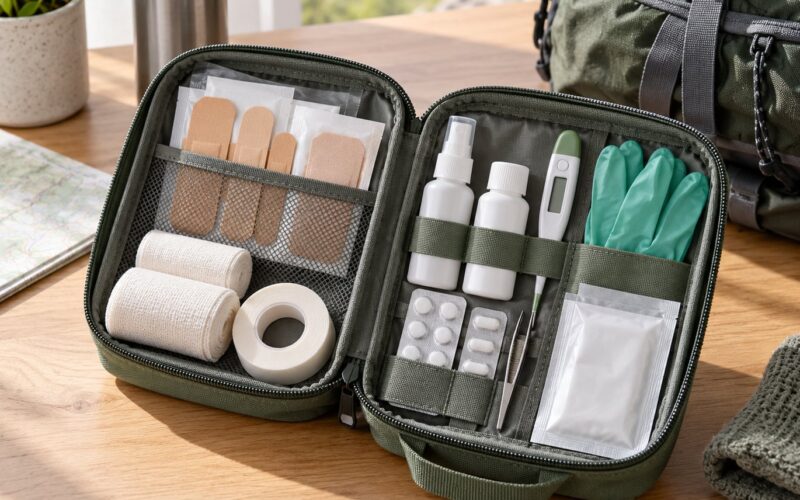
A small door wedge or travel door lock, a portable charger, a power bank for long transit days, a basic first aid kit and a scarf or light layer that works in both heat and air conditioning. That is enough gear. You are not preparing for an expedition, you are removing small frictions from an ordinary week away.
Step-by-Step
1. Choose a first solo destination that suits your comfort level
Beginner-friendly destinations for a first trip share four traits: they are easy to get around, English is widely understood, accommodation and transport are reliable, and there is enough to do that you are never stranded with nothing to do. Choose how much challenge you want on purpose rather than drifting into a long-haul flight to a place you have never seen.
How to travel solo for the first time is decided here more than anywhere else. These five options come up constantly in beginner threads, and each one removes a different worry:
- Lisbon or Porto, Portugal — English widely spoken, metro and trams, walkable hills. Compact and affordable, and easy to leave if plans change.
- Dublin or Galway, Ireland — English throughout, buses, trams and walking. No language barrier at all on a nervous first trip.
- Tokyo or Osaka, Japan — English uneven but signs are clear, plus a rail network and IC cards. Very safe, and easy to disappear into when you need a rest day.
- Wellington or Auckland, New Zealand — English throughout, short distances, buses and trains. A low-stress pace with plenty of outdoor day trips.
- Amsterdam or Rotterdam, Netherlands — English widely spoken, cycling, trams and trains. Cyclists everywhere make a lone rider look normal.
Check the practicalities before you commit: whether the trip sits in the shoulder season rather than peak, whether your dates avoid a large event that fills every room, and how long the journey actually takes. A weekend trip within your own country works well as a warm-up before a bigger international one. Whatever you pick, confirm the return journey before the outbound one so you are never stranded.
2. Build a flexible itinerary instead of overplanning
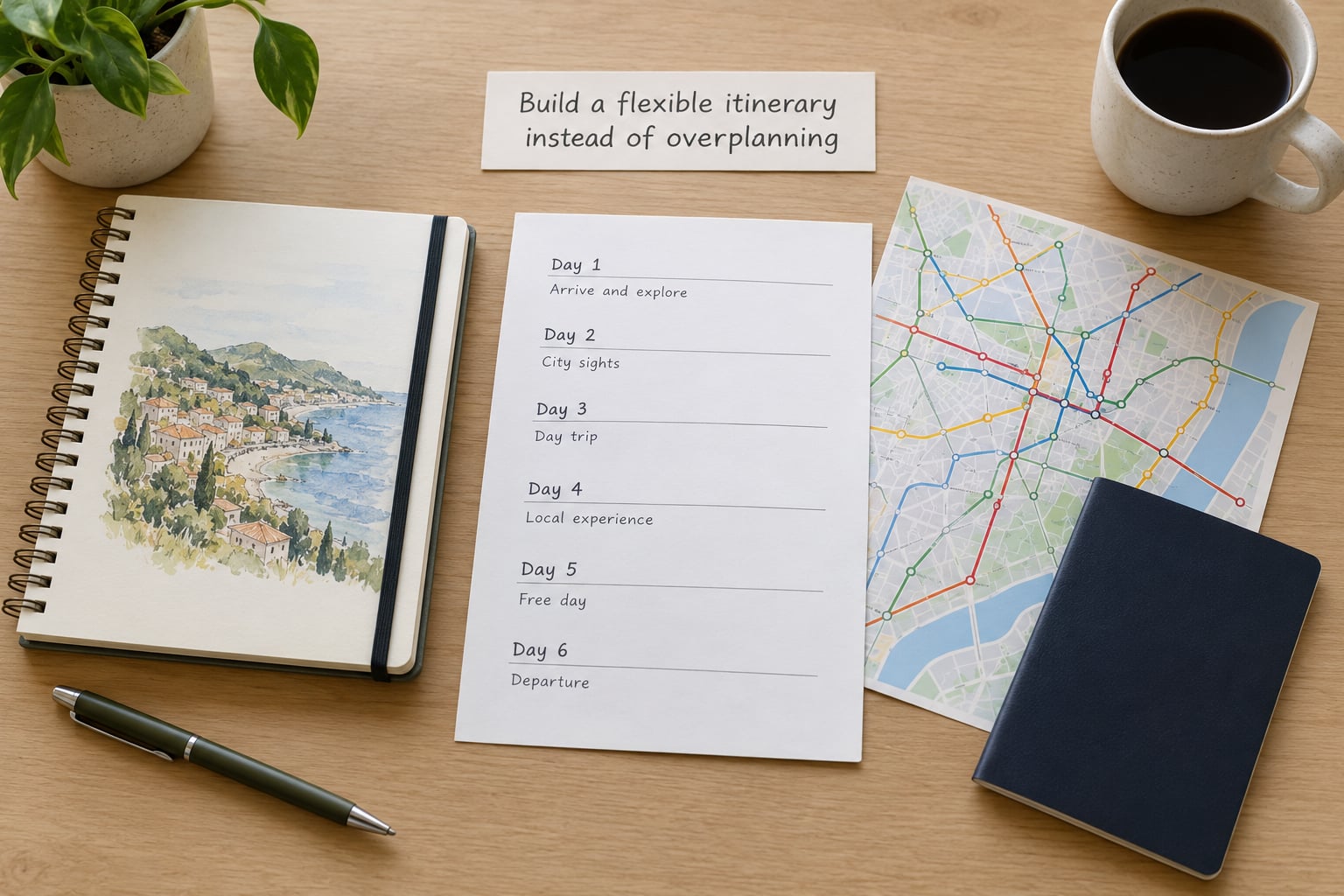
A loose itinerary beats a packed one for a first solo trip, because the whole point is that you have room to change your mind. Build it around anchors rather than a full schedule: where you are sleeping each night, how you will get from there to the station, and one main thing to do per day.
Everything between those anchors stays open. That single rule removes most of the pressure, because a free afternoon can become a museum, a long lunch, or an hour in a park when you cannot face another church.
Write the plan somewhere you can actually carry, a paper notebook or a note on your phone, with the confirmation numbers for accommodation and the first day’s transport. Download the maps you will need before you fly, because searching for a street connection on roaming data with a dead battery is a bad first-night experience.
A good test before departure is whether someone else could follow your plan from what you wrote down. If a stranger would ask you a question it does not answer, add the answer.
3. Set up money, documents, and communications before leaving
Handle the admin in one sitting rather than in ten rushed evenings. Photographs of your passport, visa, insurance details and bookings go into a folder that works offline, plus one cloud backup you can reach from any device.
Then set up the practical bits:
- Two payment methods, from different networks, stored in different places.
- A small emergency amount of cash kept apart from your daily supply.
- Offline maps downloaded for the area you will actually be in.
- Translation app, a ride-hailing app and your insurer’s number saved locally.
- A portable charger packed, not sitting in a drawer at home.
- Your check-in contact given the first-night address and your flight details.
Turn on two-factor authentication on your email before you travel, since that is where your password resets live. Tell your contact what the trip looks like, which days you are moving between cities, and when you expect to be back home.
Check that it worked by switching your phone to airplane mode a day before departure. Anything you cannot open offline, you download now.
4. Pack for comfort, safety, and one unexpected problem
Solo travel rewards a small bag. You carry it up stairs yourself, you can put it in a taxi without a second pair of hands, and you never lose it in an airport carousel.
Build the list around three ideas: comfortable enough for a long day of walking, light enough to carry, and able to handle one thing going wrong.
- Broken-in shoes, plus a second pair that can handle distance if the first pair hurts.
- Layers, because transport systems and restaurants disagree wildly on temperature.
- One outfit that works for something nicer than you feel like doing.
- Refillable water bottle and a small bag for rubbish.
- Basic first aid, any regular medication, and sunscreen and insect repellent.
- A travel adapter, a short charging cable, and headphones for the loud parts.
- One small lock for a locker or a hostel safe, so you are not carrying valuables on your body.
Skip anything you would only use once at a specific hour, and skip the second pair of jeans. You can buy almost anything you forgot within a day’s walk of most city centres.
5. Get through arrival and your first few hours
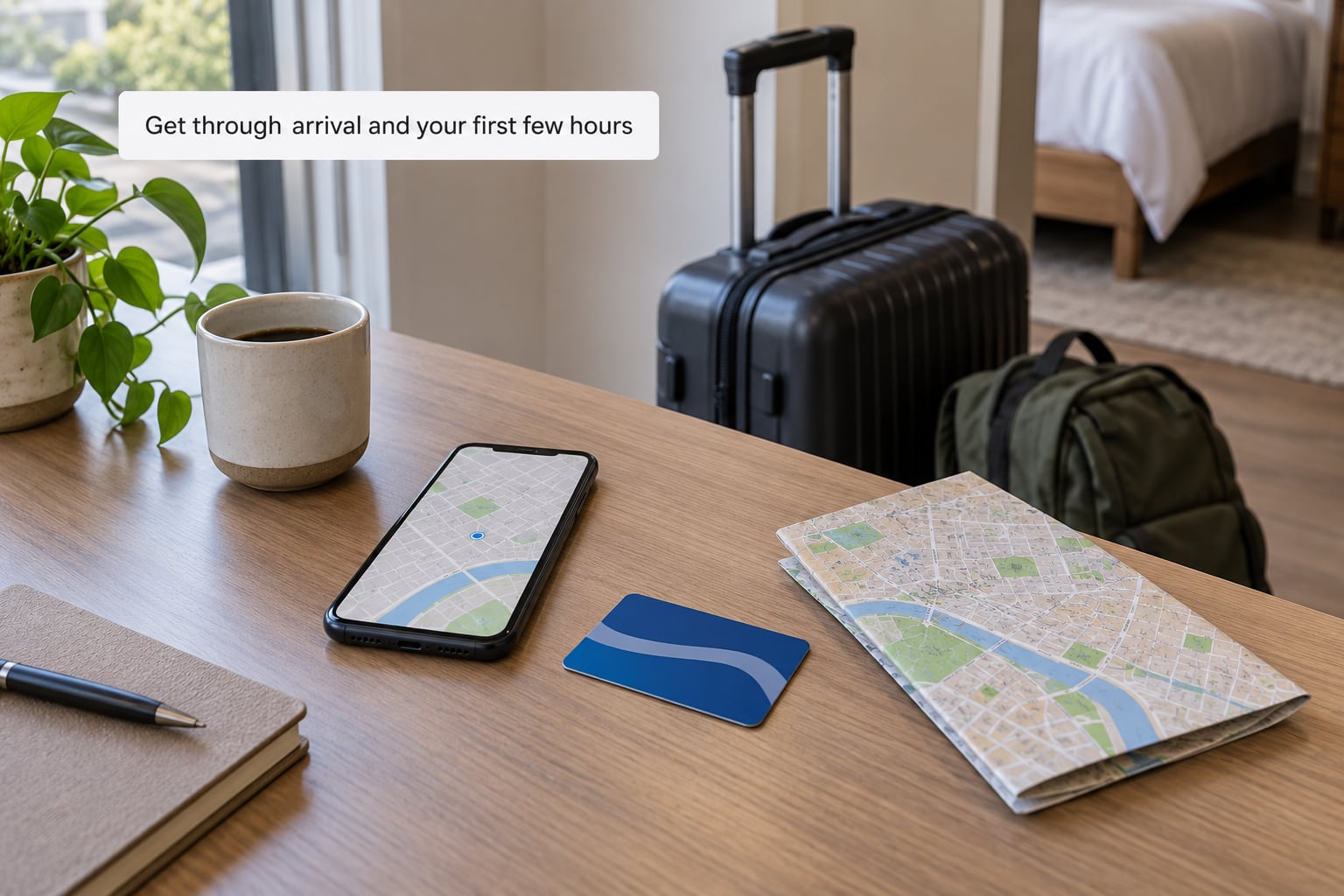
Arrival is the stretch most first-timers find hardest, because everything is new at once. Break it into small tasks and it becomes ordinary.
- Get through the airport or station before you look at your phone for anything else.
- Confirm the transport route to your accommodation before you leave the building.
- Buy or activate a local transport card and check the last service back.
- Message your contact that you have landed, with the address of your accommodation.
- Find the route to your lodging with an offline map, saved before you go.
- Check in, lock the door properly, and look at where the exits and fire stairs are.
Spend the first evening doing something low-effort. A supermarket, a short walk around the block, a simple meal nearby. The aim is to learn the shape of the neighbourhood, not to see anything.
Set your phone up with local data or a SIM before you need it, then turn on location sharing only for the people you choose. Once you know which street you are staying on and where the nearest station is, the unfamiliarity shrinks quickly.
6. Adjust the plan as the trip unfolds
Solo travel almost always includes a delay, a weather change, a missed booking or a day where you simply do not want to leave the room. That is a normal Tuesday, not a failed trip.
Reassess with a short list of questions:
- What was the main thing I wanted from this trip?
- What is worth rearranging to protect it?
- What can simply be dropped?
If a train is cancelled, take the next one and shorten the next stop rather than rebuilding the whole week. If you are tired, move something easy to tomorrow. If the weather turns, swap the outdoor anchor for an indoor one and put the original back in the reserve pile.
Keep a little money unspent by design. A buffer means a change of plan costs you an afternoon rather than the trip.
People who travel alone repeatedly say the loosening happens naturally, and that the second trip needs a fraction of the preparation the first one did. Build that into your expectations rather than treating trip one as a test you could fail.
Common Mistakes
Almost every avoidable problem on a first solo trip comes from overcommitting or carrying everything in one place. Knowing how to travel solo for the first time means spotting these before they cost you an evening. These are the ones worth naming.
Booking too much for the first two days
Piling three attractions onto day one means one late train ruins all of them. Book the first night, the arrival transport and one activity per day, then leave the rest open. You can always add more once you know how the place moves.
Relying on a single payment method
One card means one problem, one decline and a bad afternoon. Carry a backup card on a different network and a small amount of cash stored away from your wallet, so a lost bag is not a lost trip.
Announcing where you are staying
Posting your accommodation publicly tells anyone scrolling exactly where you sleep. Share your plans with your check-in contact privately, and keep public updates about places, food and views instead. Waiting until you leave before posting also leaves you in the past rather than the present.
Ignoring local norms
Where to sit, when to eat, whether to tip and how loudly to speak all shift from country to country, and guessing wrong reads as rude. Ask your accommodation host for two or three local habits on your first evening. Hosts are usually glad to explain, and it buys you a lot of goodwill.
Staying isolated on purpose
Telling yourself you will sort everything out alone is how a small problem becomes a big one. Group walking tours, a hostel common room, a language exchange or a scheduled class all give you a reason to be around people. Solitude is a choice you make, not a condition you have to accept.
Walking home through empty streets late
Awareness rather than avoidance is the advice experienced travellers repeat. Stay on lit, busy routes, keep your phone in your hand rather than a pocket, and accept the taxi when it is offered rather than walking a route you would not choose in daylight. Most hostels and guesthouses will call you a car without judgement.
Fixing every detail in advance
Reservations for every meal and every ticket feel safe and end up restrictive. Book the things that are hard to replace, like the first night and any long-distance transport, and leave meals and small sights spontaneous.
Having no plan when you get sick
Falling ill alone is one of the quieter fears people carry. Research the nearest clinic to your accommodation, know how to call your insurer’s assistance line, and keep medication labels in the original packaging. If you are unwell, ask your host to help you book a taxi. That is what hostels are good at.
Frequently Asked Questions
Is it safe to travel alone for the first time?
Yes, for most travellers in most destinations, and the preparation matters more than the destination does. Choose a city with reliable transit, book the first night, split your money and cards, keep offline maps and your insurer number on your phone, and share your itinerary with one person at home. Awareness beats avoidance: stay on lit routes, accept rides when they are offered, and trust your gut about a street or a person.
How do I deal with anxiety when traveling alone for the first time?
Expect the worst part to arrive before departure and shrink once you land. Name the specific fear rather than a vague dread, then build one action that handles it: research the route from the airport, message your check-in contact, or book the first dinner. On the trip, keep the first day deliberately small and give yourself permission to skip anything. Travellers on r/Anxiety and r/solotravel describe the same arc.
How do I eat alone at a restaurant without feeling awkward?
Eating alone becomes unremarkable faster than most people expect. Go where you actually want to eat rather than somewhere impressive, choose a counter or bar seat where a solo diner is normal, and bring a book or your phone. Sit with your back to the room only if you want to watch it. Crowded places with quick service make the first meal far easier than an empty dining room.
What do I do if I miss a flight or train while traveling solo?
Nobody is relying on you, so treat a missed connection as a logistics problem rather than a disaster. Speak to airline or station staff immediately, check the next departure, and ask about standby options before buying anything yourself. Most carriers will rebook on the same day at no charge. Tell your check-in contact, then get somewhere with a charger and food while you wait, and protect the rest of your plan by cutting one anchor.
What should I do in an emergency while traveling alone?
Start with your insurer’s assistance number, kept in your phone and written in your notes, because they arrange care and repatriation more smoothly than booking it yourself. In immediate danger, go to a staffed public place such as a hotel reception, pharmacy or police station, and use your bank’s international line to freeze your cards if they are lost. Tell your check-in contact what happened and where you are.
How do I keep family updated without posting my location publicly?
Use private messages for anything that reveals where you are sleeping or where you are walking tonight, and keep public posts about places, meals and views instead. Agree a daily check-in time so silence is meaningful rather than random, and give one person your flight details and first-night address before you leave. Waiting a day before posting also means your location history is behind you rather than live.
Conclusion
Start with one destination you could describe in a single sentence: close to home or a short flight, plenty of public transit, English widely understood. That is enough for a first trip, and the ease of it is the point.
Before you book anything, put the essentials in place. Confirm your passport and entry requirements, buy insurance that covers travelling alone, arrange two payment methods, get your first night confirmed, and give one person at home your dates and address. That single evening of admin removes most of the stress that beginners expect on the road.
Then plan loosely and travel slowly. Over the days, the trip stops being something you are managing and starts being something that is yours, which is the whole reason people go alone in the first place.