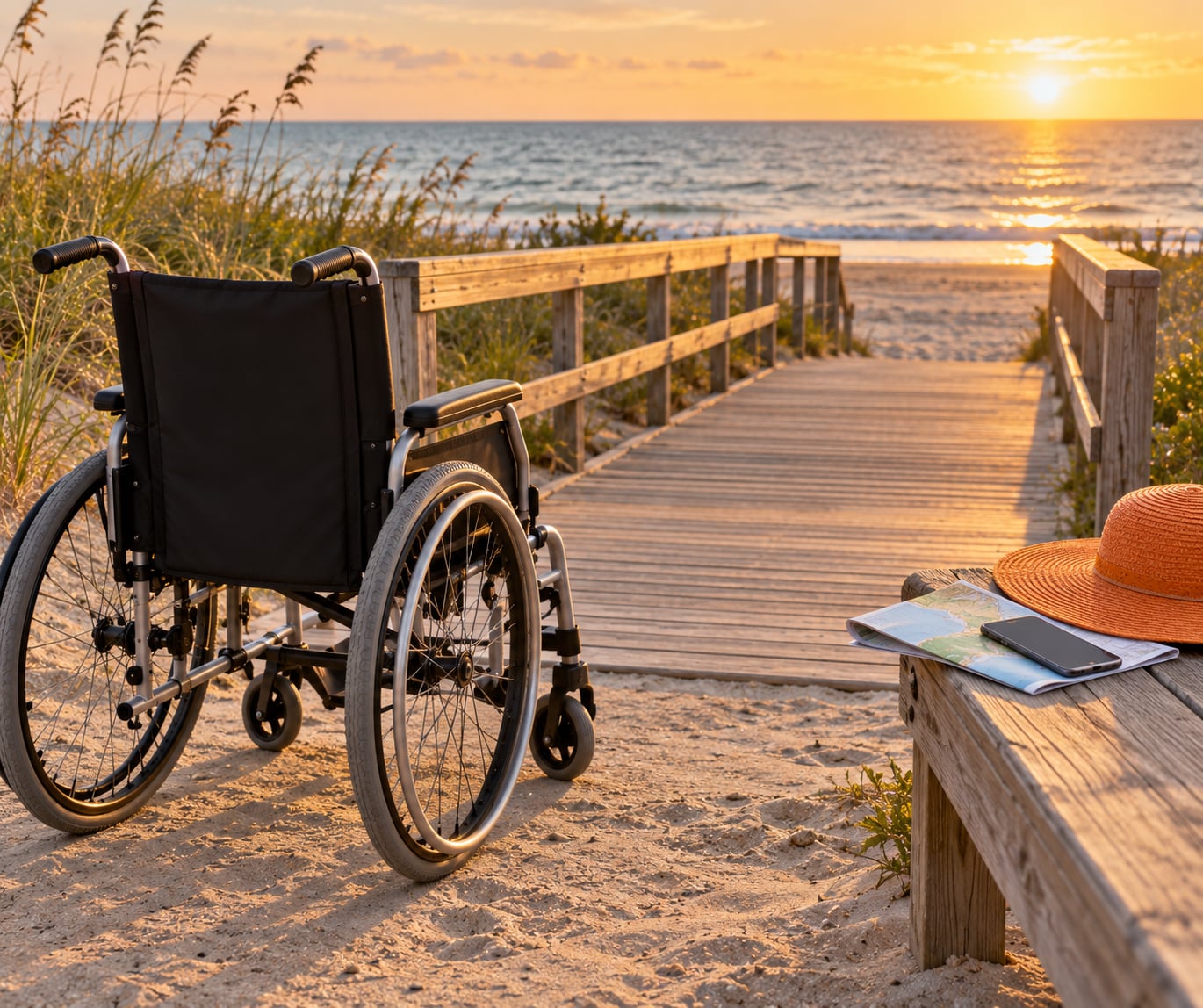
A beach counts as wheelchair accessible only if the whole path works, not just the last ten feet. That means getting from a parking space or transit stop to the waterline without stairs, loose sand, or a locked gate, and it means a toilet, a safe surface and a way back out are all part of the same trip.
Most beach websites describe a ramp, then go quiet. So the real answer to how to check if a beach is wheelchair accessible comes down to three things: find the official accessibility page, ask someone who works there with specific questions, and confirm conditions again on the morning you go. Here is exactly how to do each of those, in the order that saves the most wasted phone calls.
Tides, storms and maintenance change a beach’s accessibility faster than almost anything else in travel planning. A mat that reached the water last summer may end 40 feet short of it now, and a chair that was loanable at 9am can be out by noon on a weekend. Treat every description, including the official one, as a snapshot of a specific week.
Table of Contents
- What You Need
- The beach’s official accessibility page
- Recent visitor photos and reports
- Tide, surf and weather information for your date
- Facility details, not just access details
- Digital tools worth ten minutes of your time
- Know the legal frame, briefly
- Your chair’s real measurements
- Step-by-Step: Check the Route From the Parking Area to the Sand
- 1. Get from your vehicle to the path
- 2. Cross the curb and the first stretch of ground
- 3. Check the gate, entrance or crossover
- 4. Follow the ramp, boardwalk or mat to the water
- 5. Decide how you will get back
- How to Check the Surface and Entry Conditions
- How to check the surface when you cannot be there
- Which access type suits which situation
- Confirm Accessible Facilities and Services
- Equipment and loan programs
- Facilities that decide the day
- Weight limits and dimensions
- Verify Weather, Tide, and Water Access
- Ask the Right Questions When Information Is Missing
- A call script that works
- If you would rather email
- Who to ask when nobody answers
- A script for the day before and the day of
- What to bring, and what to leave behind
- Common Mistakes
- Frequently Asked Questions
- Can a wheelchair reach the sand at most beaches?
- What should I ask about a beach’s accessible entrance?
- Are beach wheelchairs available without a reservation?
- How do tides and rough surf affect beach accessibility?
- What if a beach says it is accessible but has loose sand?
- How can I verify an old accessibility report before visiting?
- Conclusion
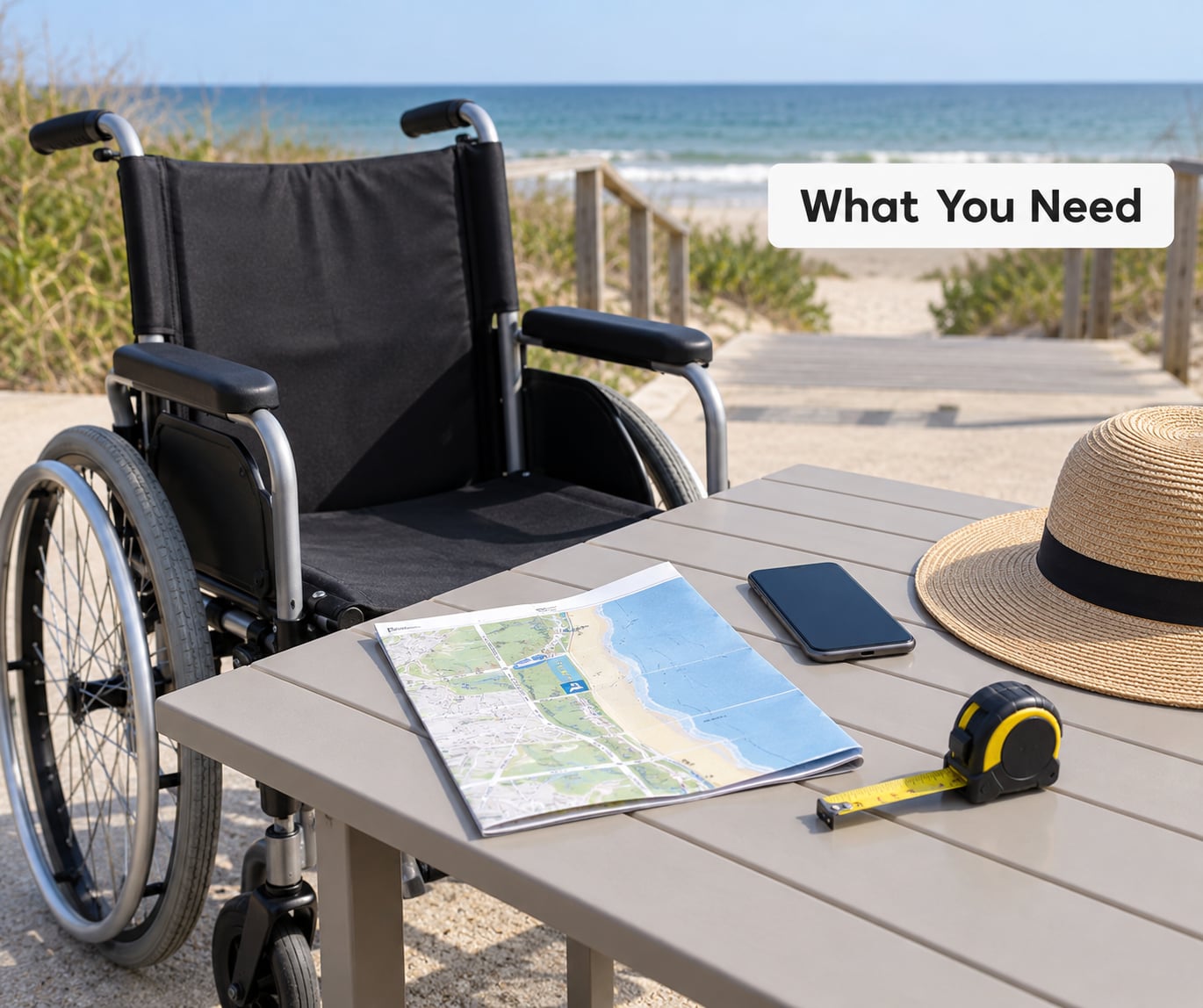
What You Need
Gather what follows before you contact anyone. Without it, calls go in circles and you end up with vague answers like “we have accessibility”.
The beach’s official accessibility page
Search the beach’s name with “accessibility”, “accessible”, “ADA” or “beach wheelchair”. County parks departments, state park systems and city beach pages usually hold the equipment details. If the page has no update date, treat it as a starting point rather than a fact.
Recent visitor photos and reports
Look for photos taken in the last six months, not the photo that has been sitting at the top of the page for years. You are looking for three specific things in each image: what the surface looks like under the wheels, how wide the path is, and whether there are people or bins narrowing it.
Tide, surf and weather information for your date
Note the high and low tide times and the surf rating. A mat that works at low tide can be swamped or under water at high tide, and a beach with a steep drop-off at the shoreline is a different problem from one with a gradual slope.
Facility details, not just access details
Ask specifically about accessible parking bays and how many there are, an accessible restroom that stays unlocked all day, an outdoor shower with a grab bar, drinking water, and shade. A beach with great access and a locked restroom is a poor day out.
Digital tools worth ten minutes of your time
A general map app will show you a parking lot and a beach icon, which is not much help. Access-specific layers are better: look for map tools that plot accessible parking, restrooms and beach access points as separate attributes rather than a single pin. Search the beach operator’s own site for an accessibility map or a beach access plan, since those usually carry the access point names you need when you call.
Two more filters are worth using. Search by access type rather than by beach name, because “wheelchair accessible beach” returns a beach with a ramp while “beach wheelchair loan” returns a beach with equipment. And sort reviews or photos by most recent, then look specifically at pictures shot from a seated height rather than standing, because a standing photo of a boardwalk flatters it.
Know the legal frame, briefly
In the United States, state and local rules cover how public beaches provide access, and the ADA applies to the facilities and services at a beach such as parking, restrooms and rental counters. What that framework generally does not do is guarantee a firm path across open sand to the waterline, which is why beaches provide equipment and matting under their own policies instead. Knowing this stops you from expecting a beach to provide something it has never been required to, and it tells you what to raise in a complaint if a parking bay or a restroom is blocked.
Your chair’s real measurements
Write down the overall width and length, the width at the widest point including footplates or a guard, the total weight with you in it, whether it reclines, and whether it can be dismantled. Beach wheelchairs have weight limits and narrow seats, and knowing your numbers before you call turns a vague yes into a workable plan.
Add three more numbers that cause surprises. Measure your turning circle, which on firm ground needs roughly five feet for a standard chair and more if you use a large front-drive base. Note your best transfer method, whether that is standing, sliding, or needing two people, because it decides whether a beach wheelchair seat matters at all. And check whether your chair has push rims that a companion can grip from behind, since most balloon-tired beach chairs are pushed, not self-propelled.
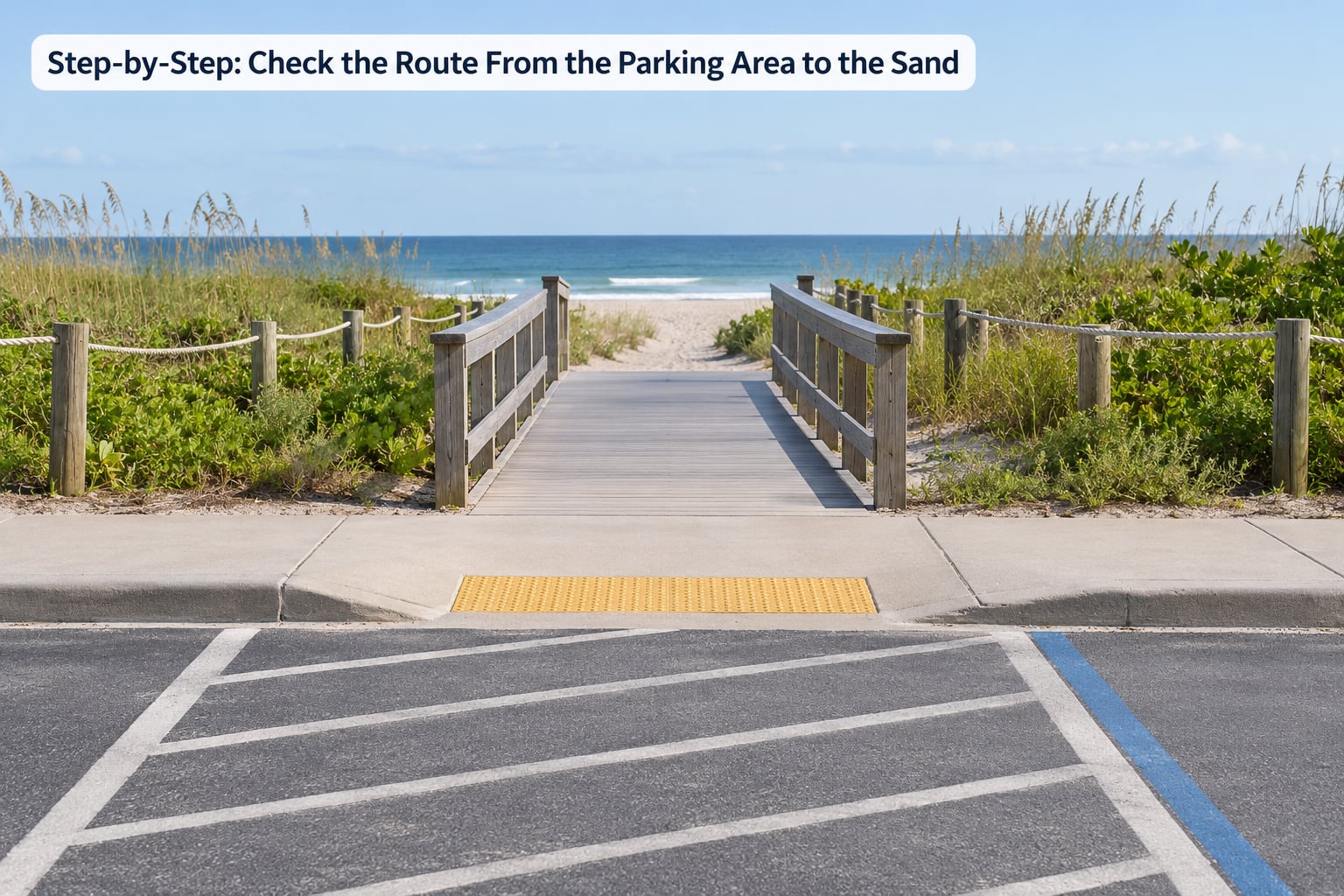
Step-by-Step: Check the Route From the Parking Area to the Sand
Assess the route in order, because each stage can end the trip. If any stage fails, the beach is not accessible for you, no matter how good the sand looks beyond it. Work down this list and mark a pass or fail for each stage.
1. Get from your vehicle to the path
Check that an accessible parking bay exists, that it is on a firm surface rather than gravel, and that the bay is near an entrance. A bay six minutes and 200 feet from the beach is technically compliant and practically exhausting. Ask how many bays there are, because a beach with two bays fills before the shoreline does.
You passed this stage if a person who cannot walk more than about 30 feet comfortably reaches the beach entrance without assistance.
2. Cross the curb and the first stretch of ground
Look for a curb cut with a firm landing at each end, not a ramp that drops straight onto gravel. Some beach entrances have a lift or a raised platform with a removable section. If the only route crosses a drainage swale or a stretch of coarse shell, ask for an alternative rather than hoping to power through.
You passed this stage if the surface from the parking bay to the entrance is paved, level or gently sloped, with no loose material.
3. Check the gate, entrance or crossover
Beach access points are often controlled by a gate, a fence line or a locked dune crossover. Confirm in advance whether it is unlocked during beach hours, who holds the key if it is not, and whether the opening width clears your widest measurement. A 32-inch chair plus a footplate is a real problem at a 30-inch gate.
You passed this stage if you know who opens it, at what time, and how wide the clear opening is.
4. Follow the ramp, boardwalk or mat to the water
Ask how far the structure runs and what happens at the far end. Boardwalks are common and frequently stop well short of the waterline. Mats, sold under names like Mobi-Mat, are synthetic sand-colored surfaces laid over a beach for the same purpose, and they shift with erosion and sand movement.
You passed this stage if you have a distance in feet or yards from the end of the structure to the water, at a stated tide.
5. Decide how you will get back
The return trip is uphill on a ramp and often harder in loose sand with tired arms. Ask whether a second exit exists, whether staff will assist with the return, and how far you must travel over sand after leaving the firm surface.
You passed this stage if the return route is the same distance and grade as the route in, with a stated plan for assistance.
How to Check the Surface and Entry Conditions
A firm, stable, slip-resistant surface is the thing you are really shopping for. Wheels need continuous support, and packed damp sand near the waterline holds far better than dry sand further up the beach. Any surface that moves under the wheels or that tips the chair is a stop.
Watch for these specific failure points.
- Deep dry sand. Push forward, not back, and if the wheels sink more than an inch, the chair will need much more force than you have at the end of a day. This is the single most common reason a beach that looks accessible is not.
- Loose gravel and shell. Shell beaches and coarse crushed stone are effectively no-go for standard small front casters.
- Stairs. Any set of steps without a parallel ramp ends access for many manual chairs, no matter how short it is.
- Narrow gates and pinch points. Ropes, bins, signage and lifeguard towers often narrow a path at the one place you need width.
- Steep ramps. Above roughly 8 to 10 percent without a level landing, many people cannot manage a manual chair unassisted. Ask for the slope or the number of landings.
- Wet decking. Timber boardwalks get slippery with salt spray, algae or sand tracked onto them. Handrails or rope guides matter more here than width.
- Uneven transitions. The lip where a mat meets sand, or where pavement meets a boardwalk, is where a front caster catches.
How to check the surface when you cannot be there
Phone photographs rarely show a surface honestly, because a firm mat looks exactly like loose sand in a wide shot. What helps is asking a pointed question and reading the answer for precision: “Is the mat continuous the whole way, or does it stop partway?” If the person cannot say, treat it as stopping partway.
Look for one specific clue in any recent visitor photo: whether a manual wheelchair on the surface has tracks behind it. Tracks mean firm material. A photo showing a chair parked at the top of a ramp with open sand in front of it tells you the ramp exists and nothing more.
Which access type suits which situation
| Access type | Strength | Weakness | Best for |
|---|---|---|---|
| Boardwalk | Firm, wide, predictable surface; usually reaches the dune line | Often stops short of the water; can be wet and slick | Rollers, walkers and adaptive strollers reaching a viewing point |
| Synthetic sand mat | Rolls over sand, reaches closer to the water, quieter than wheels on boardwalk | Shifts with erosion and storms; narrower than a boardwalk; ends loose | Manual wheelchair users going to the waterline |
| Ramp onto open sand | Lowest cost, shortest firm section | Loose sand begins immediately at the bottom | Short visits and shorter distances |
| Dune crossover | Direct route through the dune without a long walk | Foot traffic only in many places; often unpaved approach | Ambulatory visitors with limited stamina |
Wheelchair users consistently report that a boardwalk which stops 80 feet from the water feels worse than no boardwalk at all, because it creates the work without finishing it. Ask for the end point in writing before you go.
Confirm Accessible Facilities and Services
Separate what is written down from what a visitor reports, because the two can be years apart. Official pages tell you what equipment exists. Current visitor reports tell you whether it is out, broken or out of service. You need both, and you need to know which one you are quoting.
Equipment and loan programs
Beach wheelchairs come in three broad types. Manual beach wheelchairs with wide balloon-style tires are pushed by a companion and reach the waterline. Electric beach wheelchairs let the user travel independently and are heavier to transfer into. Floating or swimming wheelchairs are designed to be taken into shallow water. Ask which types are on site, how many of each exist, and whether a companion is required.
Counts matter enormously. A beach with two chairs in a pilot program is not a beach with two chairs in general. Reservation policy matters just as much: first-come first-served equipment means you should arrive early on a weekend, while advance reservation usually means a phone call days ahead. Some programs also require a deposit, a signed waiver or proof of disability documentation, and staff may want a return time built into the loan.
Facilities that decide the day
- Accessible parking. How many bays, what surface, how close to the entrance.
- Accessible restrooms. Confirm one exists, that it is open during beach hours, and whether it is seasonal. Many are closed on the shoulder season even when the beach is open.
- Changing space or restroom with grab bars and a bench. Changing in a chair is a different question from using the toilet.
- Outdoor showers. Useful for rinsing sand off a chair, which matters more than most visitors expect.
- Shade and seating. Boardwalks and mats absorb heat, and heat sensitivity is a real limit for many users.
- Lifeguard coverage. Ask whether a lifeguard will work with a beach wheelchair during swimming, and whether the swimming area is in front of a specific tower or mat.
- Concession stand access. Water, food and an indoor break are part of a realistic day at the beach.
Weight limits and dimensions
Get the weight limit of the beach wheelchair in pounds and the seat width and depth. If your own chair plus your body weight is close to the limit, you will want a chair that lets you transfer independently, which usually means a specific reclining or transfer-friendly model. If transfers are hard for you, ask whether two staff members are available to help, and whether the operator requires you to have a trained companion present.
Verify Weather, Tide, and Water Access
Everything above can be true on paper and wrong on the day. This is the section that protects you.
Tide changes the endpoint. A mat or boardwalk that ends 30 feet from the water at low tide may end in the water at high tide, which sounds fine until you realize the surf is now against the structure. Ask for the mat length and the distance to the water at both high and low tide, and check which tide times fall inside your planned visit.
Surf and rip currents change who can swim. On-duty lifeguards will tell you whether the water is safe that day. If there is no lifeguard coverage, the water access plan needs to be conservative, and a floating chair in a rip current is a hazard rather than an aid.
Wind and heat are harder to judge from a website. Wind across open sand removes the ability to push a manual chair steadily, and exposed mats with no shade get hot. If you are heat sensitive, ask whether there is a shaded structure on the route and how far it is from the water.
Storms and closures. A named storm can take out a crossover, bury a mat or close a beach for days afterward with no announcement on the accessibility page. Nesting bird closures on sections of beach are common in spring and summer and can close the exact crossover you needed. Check the beach’s alerts page or social feed the day before and the morning of.
Maintenance. Ramps break, mats get washed away and restroom doors get left locked. A quick same-day call, even on a beach you have visited before, catches more problems than any website.
Ask the Right Questions When Information Is Missing
When the website is thin, a two-minute call resolves most gaps. Call the beach operator, concession stand or lifeguard station directly rather than a general tourism number, and try mid-morning on a weekday, when staff have time.
A call script that works
Opening with the specific question gets a specific answer. Here is the version I would use:
“Hi, I’m planning to visit with my manual wheelchair and want to make sure I can get down to the water. Can you tell me how the access works from the parking area, whether there’s a mat or boardwalk, and where it ends? And do you have beach wheelchairs on site, how many, and do they need to be reserved?”
Then follow up on the four things people most often forget:
- Is there an accessible restroom open during beach hours today, and out of season?
- How many accessible parking bays are there, and how wide is the beach access gate?
- What is the weight limit on the beach wheelchair, and do you require a companion or a trained person to push?
- Are there any current closures, water conditions or weather rules that would change the route?
Write down the name of the person you spoke to and the date. If the answer is “I think so, but let me check”, ask for a call back rather than accepting a maybe. Staff turnover is high in seasonal work, so a name helps you reach someone with real knowledge.
If you would rather email
Email is better when you need a specific number in writing or when the beach is far away. Keep it short: the beach name and access point, your visit date and time, your chair’s width and total weight, then your questions about route, gate width, mat length and distance to water, equipment availability and reservation policy, and restroom hours. Ask them to reply with the access point name rather than a general answer, because many beaches have several entrances with different levels of access.
Who to ask when nobody answers
Try the county parks or recreation department that manages the beach, then the ADA center covering your state, which can tell you what the beach is obligated to provide and whether a complaint is appropriate. If a beach looks inaccessible and staff will not confirm otherwise, documenting the barrier is the first step to getting it fixed.
A script for the day before and the day of
A short message the evening before catches equipment loans, restroom hours and weather closures, and takes under a minute: “Quick check for tomorrow morning: are the beach wheelchairs in service, is the mat accessible at the main crossover, and are there any closures?” Staff reply faster to this than to a full itinerary, and a “yes, all good” from someone who unloads the chairs that morning is worth more than any website page.
If the answer changes anything, adjust while you can rather than at the entrance. Two entries is usually enough: the evening-before check and a same-morning check before you leave.
What to bring, and what to leave behind
Wheelchair users who do this well tend to carry the same short list: a pump for your own tires, since a beach chair loan does not fix a flat on your everyday chair, a small hand tool kit, a water bottle you can reach from your seat, a wide-brimmed hat or neck shade because boardwalks and mats are hot surfaces, and a change of seat cover or a light blanket. Add a plastic bag or mat for wheel removal if your rear wheels come off at the waterline, plus a towel you can drape over your lap rather than needing to reach behind.
Leave behind the assumption that the trip works without a plan. The most common bad day at an accessible beach is not a broken ramp, it is a chair 200 feet from the water with loose sand in between and no way to fix it.
Common Mistakes
Assuming a ramp means accessible. The ramp is the easiest part to photograph. Check the gate, the gate width, the surface after the ramp and the distance to the water.
Relying on a single old review. A three-year-old trip report tells you about a configuration that has probably since shifted. Look for reports from the last few months and treat anything older as background.
Ignoring the distance from parking. Two accessible bays at the far end of a 400-foot lot changes the day completely, especially with heat. Ask for the bay count and the distance.
Confusing seasonal access with year-round access. Beach restrooms, mat positions and even the lifeguard program often operate on a summer schedule while the beach itself stays open. Confirm the facility is running on your date, not just in general.
Assuming a beach wheelchair will be there. Equipment is limited, loaned first-come or reserved, and frequently all in use on a sunny weekend. Reserve it if reservation is offered, and treat first-come as a reason to arrive early.
Not planning the return. Uphill on a ramp after two hours in a chair is a different proposition from the trip in. Know your exit plan before you commit to the far access point.
One tip that fixes most of this at once: pick a second beach as a backup within a short drive, and re-confirm your first choice on the morning you go. Weather cancellations and equipment failures happen, and a backup you already verified turns a ruined day into a slightly different beach.
Frequently Asked Questions
Can a wheelchair reach the sand at most beaches?
No. Dry loose sand stops most standard chairs within a few feet, because small front casters dig in and the chair pitches forward. Reaching sand usually needs a mat, a boardwalk, or a beach wheelchair with wide balloon tires. Some beaches have all three. The deciding detail is where the firm surface ends and how far that leaves you from the water.
What should I ask about a beach’s accessible entrance?
Ask who opens the gate during beach hours, how wide the clear opening is, whether the approach from accessible parking is paved, and how far the mat or boardwalk runs before it ends. Then ask the distance from that endpoint to the water at high and low tide. Those five answers tell you more than any accessibility statement on the website.
Are beach wheelchairs available without a reservation?
At many beaches they are first-come first-served, which means arriving early on a busy day. Some larger beaches and state park systems take advance reservations by phone, and a few run pilot programs with only two or three chairs in total. Ask which policy applies, how many chairs exist, and whether a deposit, waiver or companion is required before you travel.
How do tides and rough surf affect beach accessibility?
Tide decides where the water sits relative to the end of a mat or boardwalk, so a route that works at low tide can be swamped or dry at high tide. Rough surf and rip currents change who can safely enter the water and whether lifeguards will assist. Check tide times for your visit window and ask whether surf conditions affect access to the mat.
What if a beach says it is accessible but has loose sand?
Treat the claim as covering the route to the beach, not the last stretch of sand. Ask directly how far the firm surface runs and whether a mat reaches the water. If loose sand starts 80 feet out, you may be able to enjoy the beach from a fixed spot but not reach the waterline, and that is a different trip. Decide which one you need before you go.
How can I verify an old accessibility report before visiting?
Date everything. Call the beach operator and ask what has changed since your last visit: mat position, gate width, equipment count, restroom hours and closures. Add a same-morning check before you travel, since storms, nesting closures and maintenance can alter a route within days. Write down who you spoke to and when, so you can compare notes if conditions shift.
Conclusion
Start with one action: confirm the complete route and the current conditions with an official or recently updated source, then phone the beach operator if any part of it is uncertain. Work from the parking bay to the water, check the surface and gate, confirm the facilities and equipment policy, and re-check on the morning you go. If the answer stays vague on any of those, pick the backup beach you already verified and enjoy that instead.