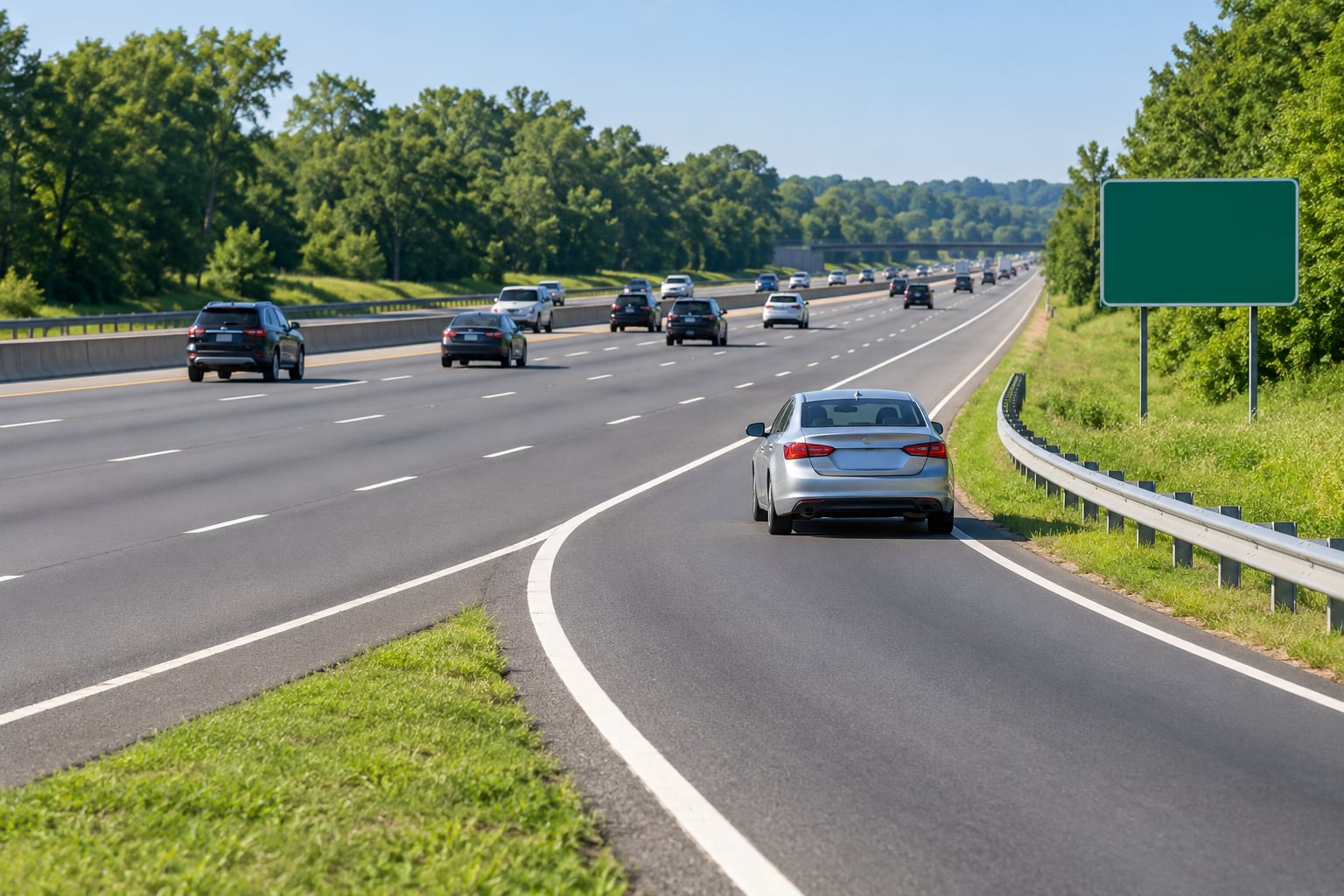
To merge onto a highway safely, accelerate along the on-ramp until you are travelling at roughly the same speed as the traffic in the lane you want, pick a gap several car lengths long, signal early, check your mirrors and blind spot one last time, then steer smoothly across and keep going until you are at or above highway speed.
The whole maneuver takes about ten seconds, and the part people get wrong is rarely the steering. It is the speed. Crawling up the ramp at half the speed of the lane you want is what forces a last-second, tires-screaming merge and annoys everyone behind you.
A working truck driver put the whole routine into one line, and it has not been improved on since: get up to highway speed, see a gap, match the gap, signal intent, merge. Below is that routine unpacked, followed by the awkward cases nobody covers, including no gap at all, short ramps, rain, and the drivers who will not move over.
Last reviewed in 2026. Rules and ramp designs vary by state and by interchange, so treat the sequence below as the standard your own driver’s manual describes.
Table of Contents
- What You Need
- Step-by-Step
- How to merge onto a highway safely by reading the traffic
- Match highway speed before choosing the gap
- Signal, check again, and merge smoothly
- Complete the merge and hold a steady lane position
- Common Mistakes
- Tips for difficult merges and next steps
- Frequently Asked Questions
- What speed should I be driving when merging onto a highway?
- How much of a gap do I need to merge safely?
- Should I keep signaling throughout the entire merge?
- What should I do if no gap appears when I reach the highway?
- Is it safer to merge at the same speed as highway traffic or accelerate faster?
- Can I merge onto a highway from a short or steep entrance ramp?
What You Need
No special gear, but three things have to line up before you commit to a merge: a vehicle that can reach highway speed in the length of the ramp, a clear view of the lane you are entering, and enough road ahead of you to stop if something goes wrong.
- A working signal and brake lights. Check them before you roll out of the parking lot, not from the driver’s seat at the ramp signal. You will want the brake lights on the moment you settle in.
- Mirrors you can actually see out of. Clean, adjusted, and free of anything stuck to the glass. A dirty side mirror is a blind spot you paid for.
- Acceleration room. Long enough to get from a stop to highway speed without reaching redline. If you are towing, overloaded, or driving a vehicle that struggles at highway speed, the ramp is the worst place to find out.
- The posted speed limit for the lane you are entering, not the ramp advisory. That number is your target.
- Patience about the law. Traffic already on the highway does not have to move over for you. The onus of responsibility sits with the driver on the ramp, and believing otherwise is the single biggest source of merge panic.
If the ramp ends before you reach traffic speed, that is a design problem, not a failure. Take the merge at the lower speed or take the next exit. A slow merge is a recoverable event; a forced one is a crash.
Step-by-Step
How to merge onto a highway safely comes down to one ordered sequence: read the traffic, match speed, signal, check, commit. Doing those in that order is what separates a merge that nobody notices from one that makes three drivers brake.
How to merge onto a highway safely by reading the traffic
Start with the mirrors, then put your eyes back through the windshield and over the hood. A gap you spotted two seconds ago in a mirror has already filled with traffic, so every gap has to be confirmed with your own eyes before you decide anything.
Look further down the highway than feels natural, six to ten car lengths and beyond. The car that looks slow in the near lane is often about to accelerate, and a driver in the lane beside you flashing a left turn signal usually means a gap you were eyeing is about to close.
On a quiet ramp, decide early. On a busy one, watch a full cycle of traffic from back to front and count how many gaps pass before one is comfortable. Watching the whole stream instead of hunting gap by gap is much less tiring than it sounds.
Match highway speed before choosing the gap
Aim to be within about five miles an hour of the lane you are entering. Well above it and you arrive with nowhere to go; well below it and the traffic you are joining has to brake for you.
Pick your merge point as far up the ramp as the layout allows and treat the solid line at the end as a deadline, not a suggestion. A steady throttle does most of the work here. Flooring it burns fuel, sprays water and grit on a wet ramp, and can leave a heavy vehicle bogged down at the exact moment it picks back up.
Some drivers count the short dashed lines before the merge point as a rough timer. It is crude, but it converts the vague dread of the ramp running out into a number, and numbers are easier to drive against.
Signal, check again, and merge smoothly
Signal once you are settled at traffic speed and still on the ramp, and leave it on until your wheels are fully across the line. In dense traffic, signal a little earlier so the gap you want has time to open up.
Then the check, in this order: mirrors, over-the-shoulder glance into the blind spot, and a final look out the window at whatever is beside you. If a car appears in your mirror at highway speed and keeps growing, it is in your blind spot. Stay where you are and let it pass.
Cross with a smooth, small steering input rather than a sharp flick. A shallow arc keeps momentum carrying you forward and reads as far less threatening to the driver beside you than a sudden swerve across two feet of paint.
One more piece of line vocabulary worth knowing: the solid white line marks the edge of the ramp, and the broken continuity line is the boundary where lane changes become legal. Stay on the ramp side until you have committed.
Complete the merge and hold a steady lane position
Once you are across, keep accelerating to at least highway speed and then hold a steady line. Do not stamp on the brakes, do not drift toward the lane line, and do not immediately signal for another lane. Two merges in a row is one of the fastest ways to run out of gaps.
Settle about four seconds behind the car ahead in dry daylight, more in rain or darkness, then keep rechecking your mirrors every few seconds. The merge is not over when you reach the lane. It is over when you are stable in it.
Common Mistakes
Most entrance collisions trace back to a short list of repeatable errors, and the fix for each is a single small change made earlier in the sequence than feels natural.
- Forcing a gap that is not really there. The gap closes at highway speed and someone has to brake hard or swerve around you. The fix: ease off the accelerator and open a gap one lane over, or stay on the ramp.
- Crawling up the ramp. Every driver in the lane has to brake for a car doing half their speed. The fix: build speed along the ramp so you arrive near traffic speed.
- Merging without a shoulder check. A car in the blind spot is invisible in the mirror and never appears in it. The fix: mirrors, then shoulder, then window, before any steering input.
- Stopping at the ramp end or on the shoulder. A stationary vehicle at highway speed is a rear-end collision waiting to happen. The fix: slow down, keep the signal on, continue to the next exit.
- Using high beams when nobody is oncoming. The beam bounces off the pavement and washes out the lane markings you are aiming at. The fix: low beams for the merge unless oncoming traffic is genuinely absent.
- Settling into a gap beside a truck. Large vehicles have blind spots on both sides and may not know you are there. The fix: leave about a car length of space beside any truck until you are past it.
- Braking hard right after the merge. You are still travelling faster than the car behind you. The fix: match lane speed first, then brake gradually when needed.
The error missing from that list is indecision: steering across the line, pulling back, then going again. It unsettles everyone around you more than a bad merge, because nobody can tell what you are going to do. Pick a gap, check it, and go.
Tips for difficult merges and next steps
In heavy traffic, stop waiting to be handed a gap and make one. Slightly slowing on the ramp causes the drivers behind you to close up, which opens the space you wanted two seconds earlier. On long multi-lane on-ramps where traffic is dense and roughly even, the accepted technique is a zipper merge: use all the lanes, keep a safe gap, and alternate turns at the merge point rather than queueing and merging early.
Short or steep ramps change the arithmetic. A downhill ramp accelerates you without your help, so back off the throttle before the merge point to avoid arriving well over the speed of the lane. A short uphill ramp may simply not be long enough, and a heavy vehicle may never reach traffic speed. Merge slower or exit. Speed limits are advisory on ramps for exactly this reason.
Construction zones are their own case. Temporary lines and arrow boards replace the normal markings, lanes split and rejoin without warning, and the gaps you were counting disappear into a barrier taper. Choose a lane early, follow the arrows rather than your old habit, signal before the split, and treat every gap as smaller than it looks.
In rain, at night, or with glare from oncoming headlights, add margin everywhere. Use low beams, keep the gap to four seconds or more, look further ahead because reaction time is longer, and never drive the merge by staring at the light streaming across the windshield. On a wet ramp, ease the throttle so the tires do not throw a wall of spray that blinds the drivers you are trying to join.
Around trucks, give yourself room and stop lingering. A truck beside you cannot see much of either side, may need a long merge of its own, and will drift right before it enters the lane. Leave a full lane width when you can and check your mirrors before settling alongside.
If no gap appears as the ramp runs out, this is the order to work in. Ease off the accelerator to let traffic catch up and re-open a gap, keep the signal on so the first helpful driver knows, and re-check every few seconds. If the ramp genuinely ends with nothing safe, merge at the lowest speed you can manage at the last possible moment, or take the next exit. Taking the exit is a good decision, not a lost one.
If merging makes you anxious, that is common, and it is not a sign of a bad driver. It usually means the task is running faster than your processing. Slow the task down: name the gap you are aiming for out loud, count the dashed lines as a timer, keep your hands light at the wheel, and practice at quiet times of day when traffic is thin. If fear turns into panic, leave the highway and rejoin later. Every driver on that road did the first merge badly.
Frequently Asked Questions
What speed should I be driving when merging onto a highway?
Get as close as you can to the speed of the lane you are entering, ideally within five miles an hour, before you cross the line. Much slower and you force traffic to brake for you. Much faster and you arrive with no room to adjust if the gap changes. Accelerate along the ramp, not once you are already on the highway.
How much of a gap do I need to merge safely?
Pick a gap you could comfortably fit into with a full car length spare at both ends, not the tight gap between two cars that are already close. As a rough check, the vehicle ahead of you should pass a fixed object, like a sign or a bridge, about four seconds before the vehicle behind it does. In rain or darkness, double that.
Should I keep signaling throughout the entire merge?
Yes, from the ramp until your wheels are fully across the line. Leaving it on until you are settled tells drivers behind you that the merge is still happening, which often creates the opening you need. Once you are in the lane, hold your speed for a second before signalling anything else, and give a quick mirror check in case you have drifted.
What should I do if no gap appears when I reach the highway?
Ease off the accelerator so the drivers behind you close up and the gap reopens, keep the turn signal on, and check again every few seconds. If the ramp is ending and nothing safe exists, merge at the lowest speed you can manage in the last moment, or continue to the next exit. Never stop on the shoulder or in a live lane to wait.
Is it safer to merge at the same speed as highway traffic or accelerate faster?
Matching traffic speed is the safer choice. Entering well above highway speed leaves you no room to react and can frighten the driver beside you, and it does not shorten the merge. The only time more speed helps is on a short, downhill ramp, where it is the only way to avoid dropping into the lane far below traffic speed.
Can I merge onto a highway from a short or steep entrance ramp?
You can, but the gap may not be ideal. On a downhill ramp, ease off the gas before the merge point so you do not arrive far above traffic speed. On a short or uphill ramp, accept entering a little slower than the lane, or take the next exit and try again. A slower merge is far safer than forcing one.
The first thing to change is speed, not steering. Build speed along the ramp until you are near the posted limit of the lane you want, and only then start choosing a gap. Get that order right and learning how to merge onto a highway safely stops being something you brace for and becomes something you simply drive.