If you are searching for how to sleep in your car safely at a rest stop, the answer is mostly yes. You can sleep in your car at most rest stops in the US, as long as you obey the posted time limit and stay in the passenger-car area. Safety comes down to four things: a lawful spot, fresh air, hidden valuables, and a way out of the car in seconds. This guide walks through all of it, plus what to pack and what to do if someone knocks on the window.
A drowsy driver is a dangerous driver, and rest areas were built for exactly this problem. A full night in a bad rest stop can leave you worse off than a two-hour nap with the engine off and the windows cracked. Most state departments of transportation publish their rest-area rules online, and five minutes of checking beats an unwelcome visit at 2 a.m.
Table of Contents
- What You Need
- Step-by-Step: How to Sleep in Your Car Safely at a Rest Stop
- 1. Check Whether Overnight Car Sleeping Is Allowed
- 2. Choose a Well-Lit, Predictable Overnight Location
- 3. Prepare the Vehicle for Ventilation and Temperature
- 4. Make the Cabin Comfortable Without Blocking Escape
- 5. Secure the Car, Belongings, and Personal Safety
- 6. Sleep in Short, Controlled Blocks
- 7. Pack and Leave the Rest Stop in the Morning
- Common Mistakes
- Sleeping Where Camping Is Banned
- Leaving Valuables Visible After You Arrive
- Running the Engine in a Garage or Enclosed Space
- Closing Every Window
- Parking Beside an Active Road or in a Fire Lane
- Using Alcohol as a Sleep Aid
- Assuming an Open Rest Area Is a Safe One
- Ignoring Summer Heat
- Overlooking Cold Nights
- Frequently Asked Questions
- Is it legal to sleep in your car at a rest stop?
- Is it safe to sleep in a car with the engine off?
- What if police or security wake me at a rest stop?
- Can you sleep overnight in a car at a Walmart or truck stop?
- How do I keep my car safe while I sleep overnight?
- Conclusion
What You Need
You do not need much, but you do need all of it. Missing one item is usually what turns a rest stop night into a bad night.
- A lawful overnight location. A state rest area, a truck stop with a car-parking area, or private property that permits it. Check the posted time limit before you settle in.
- Ventilation. Two or three inches of open window on one side, plus something to hold it there. A cracked window alone lets in enough air; a wedge or a rolled-up bag of socks keeps it there without a door ajar.
- Privacy covers. Black fabric or cardboard panels for the side windows, or a reflective sun shade. Fabric blocks light better than cardboard and does not rattle.
- Security basics. All doors locked, valuables packed before you arrive, phone charged to full, and your location shared with one person.
- Temperature control. A sleeping bag rated for roughly 10 degrees colder than the forecast low, and a battery fan for hot nights.
- Emergency supplies. Water, snacks, a small first-aid kit, a flashlight, and any medication you need within reach rather than buried in a case.
- A comfort setup. A flat sleeping surface or inflatable mattress, a travel pillow, an eye mask, and ear plugs. Metal hips and a cold seat make an otherwise good night miserable.
Step-by-Step: How to Sleep in Your Car Safely at a Rest Stop
1. Check Whether Overnight Car Sleeping Is Allowed
Start with the sign at the entrance, then confirm it on the state DOT website. Most rest areas post a maximum stay, often 24 hours, with shorter limits in a handful of states. Commercial drivers on a mandated break are treated differently from car sleepers, so truck-stop rules are not a guide. For anyone working out how to sleep in your car safely at a rest stop, that sign and that state page are the two checks that actually decide the night.
Watch for the wording that matters. Parking is often permitted while camping, which includes tents and sleeping outside the vehicle, is banned outright. Signs reading no camping, no sleeping in vehicles, or maximum stay 2 hours are unambiguous. If the sign is missing, ask staff rather than guessing, because fines and towing both happen.
Private property works differently. A shopping center or restaurant lot is private, and the owner can move you on at any hour. A national park or Bureau of Land Management dispersed camp area is public land with its own stay limits and vehicle rules. When in doubt, a designated campground costs less than a tow.
2. Choose a Well-Lit, Predictable Overnight Location
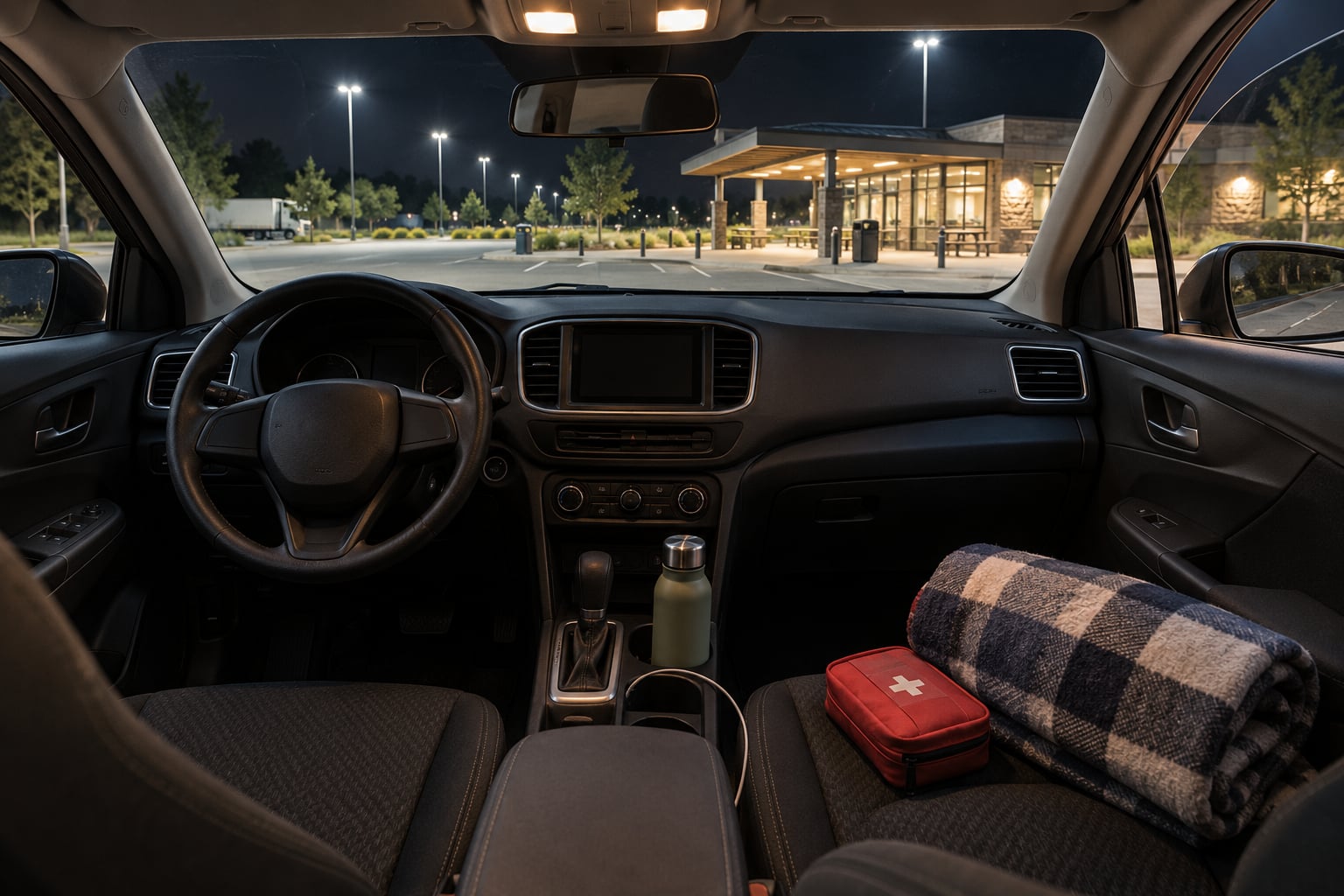
Pick a spot near an overhead light, close to the building entrance, with several other cars or RVs already parked. Other vehicles are the cheapest security system there is. An empty lot at the far end of a dark exit ramp is the worst option available, even if it is more private.
Stay out of fire lanes, emergency routes, loading zones, areas marked no parking, and any stretch where you would be within a few feet of moving traffic. Truck parking and car parking are usually separated for a reason, and car campers are frequently unwelcome in the truck rows.
Check two practical things before you commit. Look for cell reception by calling a number rather than trusting the bars, and note where the restroom is so you are not walking across an unlit lot at 3 a.m. If a rest area has regular security patrols or an attendant on site, that is the one you want.
3. Prepare the Vehicle for Ventilation and Temperature
With the engine off, ventilation is simple. Open a window on one side by two or three inches and the opposite side by an inch. That cross-flow is enough to keep carbon dioxide down in a closed cabin, and it is the reason most car sleepers feel fine on a mild night.
Carbon monoxide is the risk people worry about, and the fix is not a detector, it is location. Never run an engine in a garage, an enclosed structure, a wash bay, a low-lying spot where exhaust collects, or anywhere with a tailpipe pointed at a wall. A parking deck is also out. Outdoors, with the tailpipe clear and pointed away from openings, running an engine for heat is a different calculation, and it burns fuel you would rather keep.
For cold nights, park in the open rather than under trees or a building overhang where nothing warms up, and insulate yourself rather than the car. Engines and heaters warm the air but cool you down once you stop. For hot nights, a battery fan and cracked windows beat climate control, and they do not idle the car all night.
4. Make the Cabin Comfortable Without Blocking Escape
Recline the front seat or fold the rear seat flat, then lay your sleeping surface over the gap between them so you are not bent at the waist. Check that a door handle, a window switch, and the seat-belt release are all reachable from your sleeping position.
A simple sedan setup: front seats pushed forward and reclined, rear seat folded down, a flat mattress bridging the two, pillow under your neck rather than under your lower back. For a hatchback or small SUV, sleeping lengthwise behind the front seats keeps you clear of the rear glass and much less visible from outside. Leave no escape route blocked, and never wedge yourself somewhere you cannot roll out of quickly.
Darkness and noise do more for sleep than comfort gear does. Cover the windows, use an eye mask anyway for gaps, and foam ear plugs will handle steady highway hum that a fan cannot.
5. Secure the Car, Belongings, and Personal Safety
Pack valuables into the trunk before you arrive at the rest area, not after. An open suitcase or a bag on the passenger seat is what draws attention, and thieves check rest areas for exactly that. Keep your laptop out of sight even for ten minutes at the restroom, and take the key with you rather than leaving it in the ignition.
Keep passports, cash, and medication where you can reach them without sitting up fully, because those are the items you need fast. Lock every door when you settle. A seat belt across your lap is a useful reminder against rolling during deep sleep, but do not buckle yourself in a way that slows your exit.
Share your location with someone, keep your phone on loud enough to wake you, and decide in advance what you do if the situation changes. If someone approaches the car, keep doors locked until you can identify them clearly, have your phone ready, and leave calmly rather than arguing. If you are travelling alone, park in the middle of a well-lit area rather than at its edge, and let someone know your arrival time.
6. Sleep in Short, Controlled Blocks
Set two alarms before you settle, one phone and one backup, and keep ventilation in place for the whole night. A first night in a car rarely produces eight good hours, and expecting it sets you up for a bad morning. Two or three blocks with a short break between them beat one attempt at full darkness.
Skip anything that heavily sedates you in an unfamiliar place. Do not combine sleep medication with alcohol, and check anything you take for warnings about drowsiness, because you will not notice it until you are already too deep to react. Keep water near you and eat something before you lie down; an empty stomach wakes you early.
Check conditions a couple of times, briefly, without turning the night into a test of your vigilance. Notice whether the car has fogged, whether the temperature has moved, whether anything has changed outside. Then close your eyes again.
7. Pack and Leave the Rest Stop in the Morning
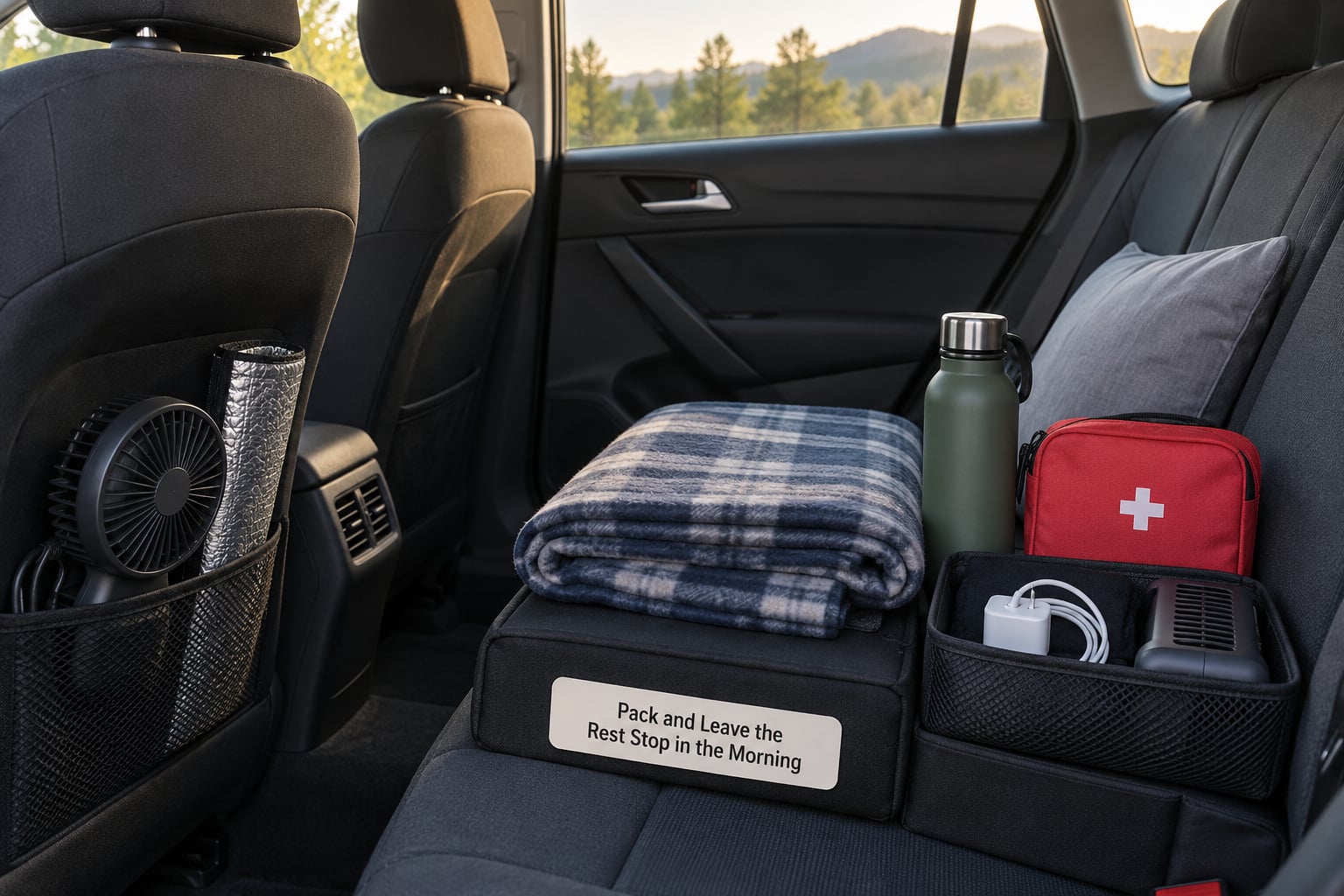
Before you drive, walk around the car and check for damage, then note anything new while you were asleep. If something is damaged, photograph it immediately while the other vehicles around you are still present, because that is when an officer will most want the photos.
Restore seats and windows, then check under the seat, in the door pockets, and around the pedals for the small things you always lose. Reset the vent so you do not drive into the rain with the window still open, and wipe the condensation off the glass before you get in.
Drink water, eat something with protein in it, and get into the sun for a minute. Drowsy driving kills, and a night of poor sleep can leave you more impaired than you expect. If you are still foggy, take a 20-minute nap or buy a coffee and drive 30 minutes before resuming. A rest stop exists so you arrive alive; use it that way.
Common Mistakes
Almost every bad night traces back to one of these. The fix is usually simple and takes under a minute.
Sleeping Where Camping Is Banned
Tents and car sleepers are treated the same in many states, and the fine is usually issued by an officer who does not care that you never left the driver’s seat. Read the sign at the entrance, then confirm the wording on your state DOT website before you settle for the night.
Leaving Valuables Visible After You Arrive
Thieves work rest-area lots methodically, and an open case or a bag on the passenger seat is the signal they are looking for. Pack everything into the trunk at your last fuel stop, so the cabin is already clear when you pull in.
Running the Engine in a Garage or Enclosed Space
Carbon monoxide is colourless and odourless and can incapacitate you within minutes. Never idle in a garage, parking structure, enclosed wash bay, or any low spot where exhaust collects; keep the tailpipe clear of walls and doorways.
Closing Every Window
A sealed cabin goes stale and headache-prone by morning, and the fix takes ten seconds. Two to three inches of cross-flow on two opposite sides keeps the air moving all night.
Parking Beside an Active Road or in a Fire Lane
Night traffic is unforgiving, and a fire lane is a tow no matter how tired you are. Use the passenger-car area furthest from the travel lanes, away from emergency access routes.
Using Alcohol as a Sleep Aid
It suppresses your breathing, wrecks sleep quality, and removes the judgement you would need if something went wrong. Set two alarms instead and sleep in controlled blocks.
Assuming an Open Rest Area Is a Safe One
Being open all night says nothing about lighting, cameras, or who else is parked there. Judge the location on what you can see: overhead lights, visible cameras, other families and RVs, regular patrols.
Ignoring Summer Heat
A closed car heats up faster than most people expect, and heat illness is a medical emergency rather than something to sleep off. Run a battery fan, crack the windows on opposite sides, and lay an insulated shade across the windshield before you lie down.
Overlooking Cold Nights
Insulate yourself rather than the vehicle, keep the fuel tank above a quarter, and remember that a cold morning start is far harder on you than a cold night. A remote lot with no shelter and no engine to run is the combination to avoid.
If the rest area turns out to be closed, restricted, or genuinely uncomfortable, move. A 24-hour truck stop with a separate car area, a designated campground, or a motel is a better night than a rest-area parking spot where you feel unsafe. Apps such as iOverlander, FreeRoam, and AllStays list legal overnight options with user notes, and state park sites list campgrounds that take reservations.
Frequently Asked Questions
Is it legal to sleep in your car at a rest stop?
Usually yes. Most states permit parking at highway rest areas, often with a posted limit of 24 hours, but they frequently ban camping, which includes sleeping inside a vehicle. Check the sign at the entrance and your state DOT website for the current rule. California, Colorado, and South Dakota restrict overnight parking more tightly than most states, and truck-stop rules are different from car-parking rules.
Is it safe to sleep in a car with the engine off?
Yes, with the cabin ventilated. Open a window two or three inches on each side for cross-flow air, and park outdoors where the tailpipe is clear of walls, doors, and low spots. Never idle an engine in a garage, parking structure, or enclosed wash bay, because carbon monoxide is odourless and can incapacitate you within minutes. Most car sleepers run nothing at all.
What if police or security wake me at a rest stop?
Stay calm and keep your doors locked until you can see who is outside and what they want. If it is law enforcement, roll the window down a few inches, keep your hands visible, and answer questions plainly. Stay in the passenger-car area and be ready to move on without argument. A calm, polite person is rarely treated badly, and a confrontational one is.
Can you sleep overnight in a car at a Walmart or truck stop?
Often yes, since these are private properties with generous parking, but not as a right. Managers can ask you to move at any time, and signage, lighting, and local ordinances all apply. Truck stops are popular with road travellers for showers and food, though car parking is often separated from truck rows. Ask a staff member where to park rather than assuming.
How do I keep my car safe while I sleep overnight?
Hide everything before you arrive, not after. Pack bags into the trunk at your last fuel stop, keep the cabin clear, lock all doors and take the key with you. Park under lights among other cars rather than at the edge of a lot, share your location with someone, keep your phone charged, and take valuables to the restroom in a zipped pocket rather than a visible bag.
Conclusion
Start by verifying local permission, then choose a well-lit legal spot among other cars, ventilate the cabin, hide your valuables before you arrive, and keep water, a first-aid kit, and your medication within reach. That sequence is how to sleep in your car safely at a rest stop, and it takes about ten minutes and covers nearly every overnight stop. When the sign is unclear, the weather is severe, or the lot does not feel safe, move to a designated campground, truck stop, or motel. Sleeping in your car is a good second-best option, never a good reason to push through exhaustion.