The fix is a rotation, not one big idea: a talking game for the first twenty minutes, a scavenger hunt when the scenery changes, then an audio story once the talking runs out. Learning how to entertain kids in the car without screens comes down to matching the activity to the child’s age, how far you still have to go, and whether the car is moving. Most of it needs nothing more than a passenger, a window and a voice.
Parents on Reddit’s r/toddlers and r/Parenting describe the same arc in almost every thread. It works for about ten minutes, then it doesn’t. The fix that comes up again and again is rotating two or three activities instead of hunting for one perfect toy, and keeping the kit in the car permanently so it never gets used at home.
Table of Contents
- How to Entertain Kids in the Car Without Screens: At a Glance
- 1. Play a Car Scavenger Hunt
- How to entertain kids in the car without screens when the car is moving
- 2. Tell Stories With a Twist
- 3. Use Audio Challenges and Improv Games
- 4. Play I Spy or Find the Difference
- 5. Make a Travel Bingo Card
- 6. Draw a Road-Trip Picture Together
- 7. Sing Rhymes, Make Up Songs, and Play Word Games
- 8. Create a Road-Trip Bingo Bag
- 9. Invent Characters From Roadside Objects
- 10. Use Travel-Specific Knowledge Games
- Frequently Asked Questions
- What are good screen-free car activities for a 3-year-old?
- How do you keep kids entertained on a long car ride without talking constantly?
- What can children play in the car with no paper or toys?
- Are scavenger hunts safe while the car is moving?
- How can I stop car sickness with a screen-free activity?
- Conclusion
How to Entertain Kids in the Car Without Screens: At a Glance
Every activity below is tagged with the age it suits, whether the car may be moving, what it needs, and how long it takes to start. Scan this first when you have two minutes before departure.
| Activity | Best age | Car moving? | Needs | Setup |
|---|---|---|---|---|
| Car scavenger hunt | 4-10 | Yes, passengers only | Paper and pen, or nothing | 2 min |
| Story with a twist | 5-12 | Yes | Nothing | 1 min |
| Audio and improv games | 6-12 | Yes | Nothing | 1 min |
| I Spy and find the difference | 3-12 | Yes | Nothing | 1 min |
| Travel bingo card | 5-12 | Yes | Index card and pen | 5 min |
| Collaborative drawing | 3-10 | Parked is better | Paper, washable crayons | 3 min |
| Rhymes and word games | 4-12 | Yes | Nothing | 1 min |
| Road-trip bingo bag | 18 months and up | Parked is better | Small packed kit | 5 min, once |
| Roadside characters | 4-10 | Yes | Paper for sketching | 3 min |
| Route knowledge games | 7-12 | Yes | A map, or nothing | 2 min |
1. Play a Car Scavenger Hunt
A scavenger hunt turns a car window into a game board, and it works on any road because the list is whatever you see out the glass. Pick one category before you leave so nobody spends the trip arguing about what counts.
How to entertain kids in the car without screens when the car is moving
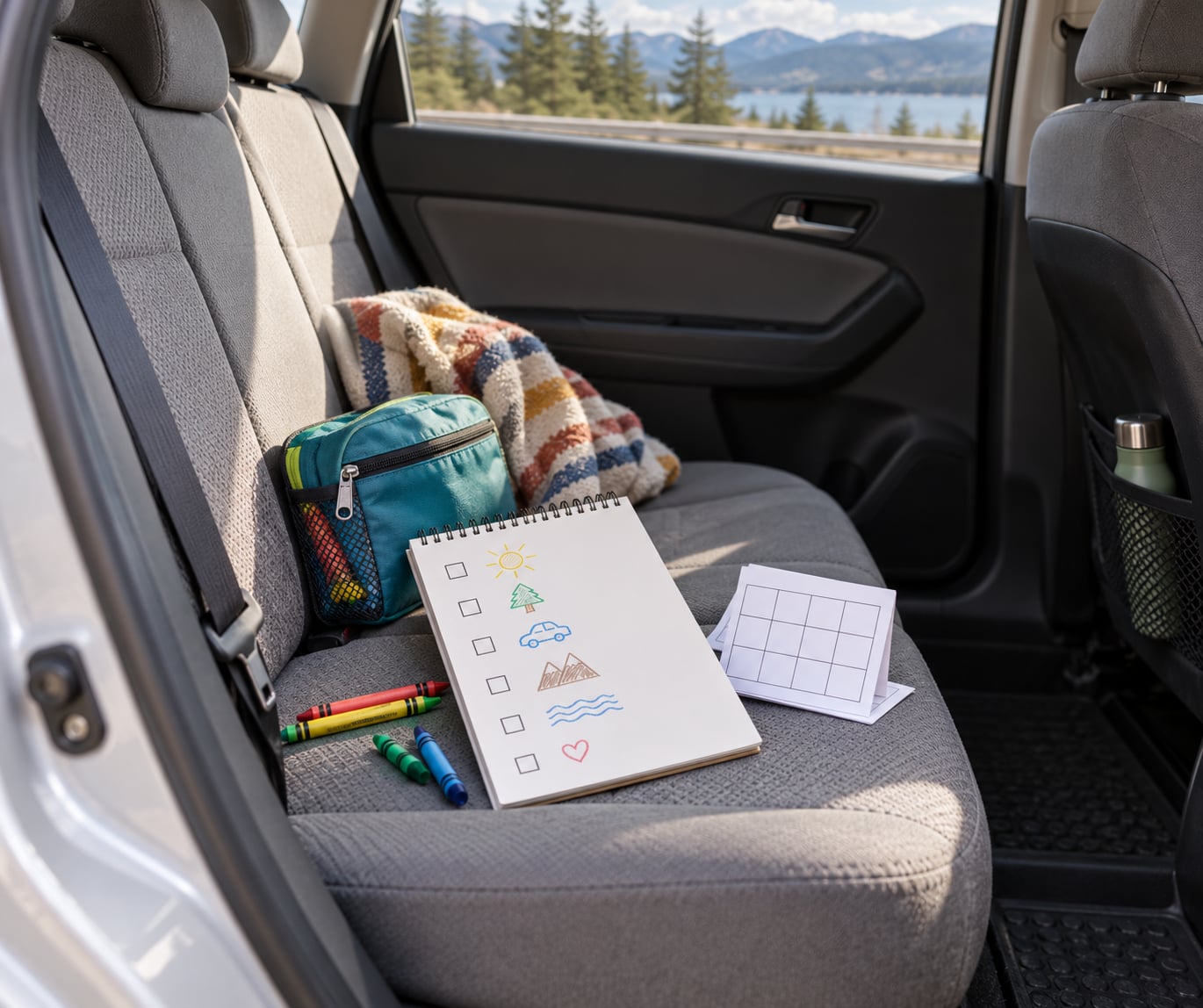
Keep the list in a child’s handwriting or on an index card, and let the passenger be the only player. The moving-car version works like this: name a target, wait in silence for ten seconds, then the passenger calls out when they’ve spotted it.
Four list styles that hold up:
- Colour hunt: find something red, something yellow, something round, something that isn’t a car.
- Shape hunt: triangles, squares, arches, bridges, roundabouts.
- Letter hunt: any sign starting with B, any word containing an R, any plate with three numbers.
- Object hunt: fire trucks, camper vans, motorcycles, dogs in cars, water towers, wind turbines.
A parent on r/Parenting reported that a letter-and-truck hunt on signs absorbed her four-year-old through a seven-hour drive with no screen time at all, which is the result most families are hoping for.
For a parked car, write ten items on paper and hand it over at a rest stop. It becomes a proper searching game rather than a window glance, and you get ten quiet minutes back.
2. Tell Stories With a Twist
This is a story-building game where nobody gets to plan ahead. One person opens with a sentence, the next adds one that must follow logically, and every tenth sentence a passenger gets to twist it.
You need prompt cards for the twists, and index cards in the glove box work fine. Write them in advance: a rabbit appears, somebody tells a lie, it’s suddenly night, the character finds a map, everybody has to switch places. Twenty cards will cover a long drive.
With no cards at all, pick three unrelated nouns before you leave out loud, such as teapot, ladder, ocean, and the story has to use all three. For one child, you run it back and forth with them. For siblings, each takes a turn adding a sentence and the other fills in the twist. For a road trip with adults and kids, let a child start so they own it.
3. Use Audio Challenges and Improv Games
Audio games cost nothing and work at highway speeds where scenery blurs. The rule for all of them is simple: only passengers play, and nothing in the game requires the driver to answer.
- Sound guessing: someone hums or makes a noise, everyone else guesses. A doorbell made with a throat is harder than it sounds.
- Silly questions: take turns asking absurd questions. Would a fish pay rent? Which is wetter, a cloud or a thought? No wrong answers, so pre-readers can lead.
- Story relay: each person adds one word to a shared sentence, alternating until the sentence collapses, usually inside a minute.
- Describe and draw: the person who can’t see picks an object from their pocket and describes it without naming it. Everyone else draws it. The descriptions get absurd and loud, which is the point.
Keep it to about twenty minutes per round. Parents report the volume of these games is what actually wears everyone out, not the games themselves.
4. Play I Spy or Find the Difference
I Spy works in a car because it needs no materials and no fixed answer. The classic version is “I spy something red, round, and it is not a stop sign”, with the guesser narrowing down until they can point at the window.
For younger children, drop the rules to a single attribute: something blue, something that is a building, something with four wheels and a ladder. Pre-readers can play this perfectly well because they are searching, not reading.
The find-the-difference variant keeps long highway stretches alive. Pick one category at the start, such as billboards, and everyone counts how many of a kind pass by. Blue Chevrolets. Trailers with more than one axle. Signs in a language they cannot read. When a long straight stretch gives you nothing to look at, switch to counting backwards from three hundred in fives, which occupies an older child for a surprising amount of time.
5. Make a Travel Bingo Card
Car bingo is a nine-square grid where each square holds something that can actually be seen from a seat. It works best when every square is a thing you’ll almost certainly pass, otherwise the card stalls.
A grid that works on most highways: a truck, a bridge, a gas station, water, a big yellow sign, a motorcycle, a church steeple, a rest stop, a state line sign. The first person to complete a row calls bingo, then you can trade squares or start a fresh card.
Making one takes five minutes with an index card, a pen and a folded grid. Fold it into quarters so it fits a cup holder or a shirt pocket. Crayons work better than pens for a three-year-old, and the point is the crossing off, not the neatness.
For younger children, cut it down to four squares and use pictures rather than words. A row of four is finishable in twenty minutes, which is roughly the attention span of a three-year-old on a good day.
6. Draw a Road-Trip Picture Together
One sheet of paper, one pen each, and a rule: each person adds exactly one thing to the picture before passing it on. No talking about what you’re drawing. Whatever gets added next has to work with what’s already there.
Keep the paper flat on a clipboard or a hard book so the car doesn’t fold it, and use washable crayons or markers if you’re worried about the seat. When it comes back to the first person, the result is usually a strange drawing involving whatever object was nearest the child’s knee, and it works better than it sounds.
With no materials, run the same game as narration instead. Each person describes one addition out loud while everyone else draws nothing, and the illustrator at the end has to build the scene from the descriptions alone. It’s messier and louder and often funnier.
7. Sing Rhymes, Make Up Songs, and Play Word Games
Rhymes and word games need no equipment at all and fill the worst stretch of the trip, which is the long middle where the novelty has worn off and the destination still feels far away.
- Call and response: you sing a line, a passenger sings the next. Familiar songs work best, and everyone in the car knows them.
- License plate word invention: read a plate out loud and add a vowel until it becomes a real word. Older kids get competitive about this fast.
- Rhyming pairs: you say a word, they say a rhyme. Then reverse it. Very young children can only manage rhyming pairs, so keep the round short.
- Category rounds: transport things, things in a kitchen, animals that live somewhere cold. Whoever repeats a previous answer sits out the next round.
- Quiet humming: a hummable song with everyone singing at half volume works when the cabin is dark or a younger sibling is asleep.
Music at full volume for the entire drive is worth avoiding, though. It adds to the restlessness rather than settling it, and adults come out of a four-hour drive more tired than they went in.
8. Create a Road-Trip Bingo Bag
A small zip bag holding five or six activities covers most of a two-hour drive. The best version is assembled once and stays in the car, because parents consistently say the same thing about these kits: they only work if the toys are never used anywhere else.
A five-minute bag could hold index-card bingo grids, a crayon or two, a small notebook, a pack of stickers, a card of pipe cleaners for threading through a shoebox lid with holes cut in it, and two or three small board books. Nothing loose, nothing with pieces small enough to swallow in a moving car.
Look for the properties that matter rather than the brand: nothing that dries or stains, nothing with detachable parts, and nothing that makes noise loud enough to cover the adults’ conversation. Reusable sticker books and water-fill colouring mats are popular for exactly that reason.
If a bag gets used up early, don’t hand over the whole thing at once. Two activities in the bag, switched halfway through the drive, lasts longer than the full bag handed over at departure.
9. Invent Characters From Roadside Objects
Anything seen out the window can become a character with a name and a problem. A water tower with a dent is a lighthouse keeper. A rusted truck is a mechanic. A billboard face belongs to someone who owes money.
Three prompts work well. First, name it with an adjective and a noun, so “Sleepy Ranger” rather than a name alone. Second, give it one problem. Third, give it one thing it carries, which is where the funniest details come from.
Once a character exists, the story keeps itself going. The next trip over the same stretch of road, kids look for their character and check whether anything has changed. It’s the cheapest memory you can make, and it works for pre-readers who can hold a whole plot in their head.
Keep the characters to ones the children invent. Recurring franchise characters travel badly here because there’s no surprise in them, and it also keeps the game free of anything licensed.
10. Use Travel-Specific Knowledge Games
The route itself is material, and older kids will happily spend an hour on geography they wouldn’t sit through in a classroom. Guess the destination from the road itself, the signage, the vegetation or the weather, and keep the answer to themselves until the last twenty minutes.
Other rounds that fit the format: name every state you pass a sign for, spot landmarks and rank them by how old you think they are, count something specific like mile markers or exits, trace the route on a paper map with a finger while an adult narrates the geography.
Counting games are the easiest filler for a stretch with no scenery. Count the exits, count the red cars for five minutes, or count backwards from a big number. Predicting what comes next works too, particularly in unfamiliar terrain: everyone guesses what the next sign will say and checks whether the guess beats the guess before.
Frequently Asked Questions
What are good screen-free car activities for a 3-year-old?
Name games, object hunts and simple rhymes work best, because a three-year-old holds attention for roughly five minutes. Travel bingo with four picture squares, spotting a yellow truck, and a sing-along the child already knows all travel well. Avoid anything needing fine motor skills or reading. Pair the activity with a snack or a stop, because rotation is what holds the attention, not any single game.
How do you keep kids entertained on a long car ride without talking constantly?
Alternate quiet and loud stretches rather than running games back to back. A scavenger hunt for ten minutes, then an audiobook or music for twenty, then a word game. Pre-readers can hunt window clings or the seat belt in silence, which gives adults a genuine break. Swap activities every thirty to forty-five minutes and let the child choose between two options so you are not negotiating.
What can children play in the car with no paper or toys?
I Spy, the colour and shape scavenger hunts, story building with three random nouns, silly questions, rhyming pairs, category rounds and counting games all need nothing but voices. These are also the safest options in a moving car because there is nothing loose in the backseat. Older kids can invent characters from billboards or license plates and add one line to the story each time a new one appears.
Are scavenger hunts safe while the car is moving?
Yes, if everyone stays belted and the driver never plays. Passengers do the searching, the driver drives, and nothing gets handed forward or thrown. Keep the list where a child can read it from their seat so nobody climbs around. A parked-car version works better for younger children because they can move. Follow the car seat manual and current local guidance for the restraint itself.
How can I stop car sickness with a screen-free activity?
Skip reading, drawing and anything involving spinning objects, since looking down at a page is the usual trigger. Look out of the window instead, so scenery games, counting mile markers and I Spy all help. Fresh air from a slightly open window and a snack before departure usually matter more than the game choice. If sickness keeps happening, talk to your pediatrician before the next long drive.
Conclusion
Pick the free option that matches your child, the time left, and whether the car is moving, then swap in a second one before the first goes stale. A two-minute scavenger hunt and a story with a twist cover most of a two-hour drive without anything packed at all, and that is how to entertain kids in the car without screens on the days you forgot the bag. Stop every hour and a half to two hours, keep the driver out of every game, and nothing needs passing forward.