The short answer: aim for about 240 ml (8 oz) of water for every hour you are in the air, sipped steadily rather than gulped, with an empty reusable bottle filled after you clear security. That is the whole idea behind how to stay hydrated on a long flight, and it takes maybe ten minutes of planning. On a 12-hour flight you are looking at roughly 2.8 litres spread across the day, which sounds like a lot until you break it into small sips every 10 to 20 minutes.
Cabin air is the reason. Cruising aircraft are pressurised to the equivalent of roughly 6,000 to 8,000 feet, and the relative humidity inside usually sits somewhere between 10 and 20 percent. That is drier than most deserts at night, and it is drier than your office. Every breath pulls moisture out of your airways and skin, and the low pressure also nudges your body into producing more urine, so fluid leaves faster than you would expect.
The payoff is bigger than avoiding thirst. A lot of what people call jet lag on arrival is mild dehydration: the headache behind the eyes, the puffy ankles, the dry nose that turns into a nosebleed, the shirt that suddenly feels tight. Drink steadily and you have a much better chance of landing feeling like yourself.
Table of Contents
- What You Need
- How to Stay Hydrated on a Long Flight: A Step-by-Step Plan
- 1. Start Hydrating Before You Leave Home
- 2. Carry an Empty Bottle Through the Airport
- 3. Take Small Sips After Boarding
- 4. Build a Timed Drinking Schedule That Scales With Your Route
- 5. Choose Drinks That Help Without Adding Discomfort
- 6. Rehydrate After Landing
- Common Mistakes
- Frequently Asked Questions
- How much water should I drink on a 7 hour flight?
- Why am I so dehydrated when I fly?
- How do I drink water constantly if I have a window seat?
- Should I drink electrolytes while flying?
- How do I stay hydrated on an overnight flight while sleeping?
- Is the water on the plane safe to drink?
- Conclusion
What You Need
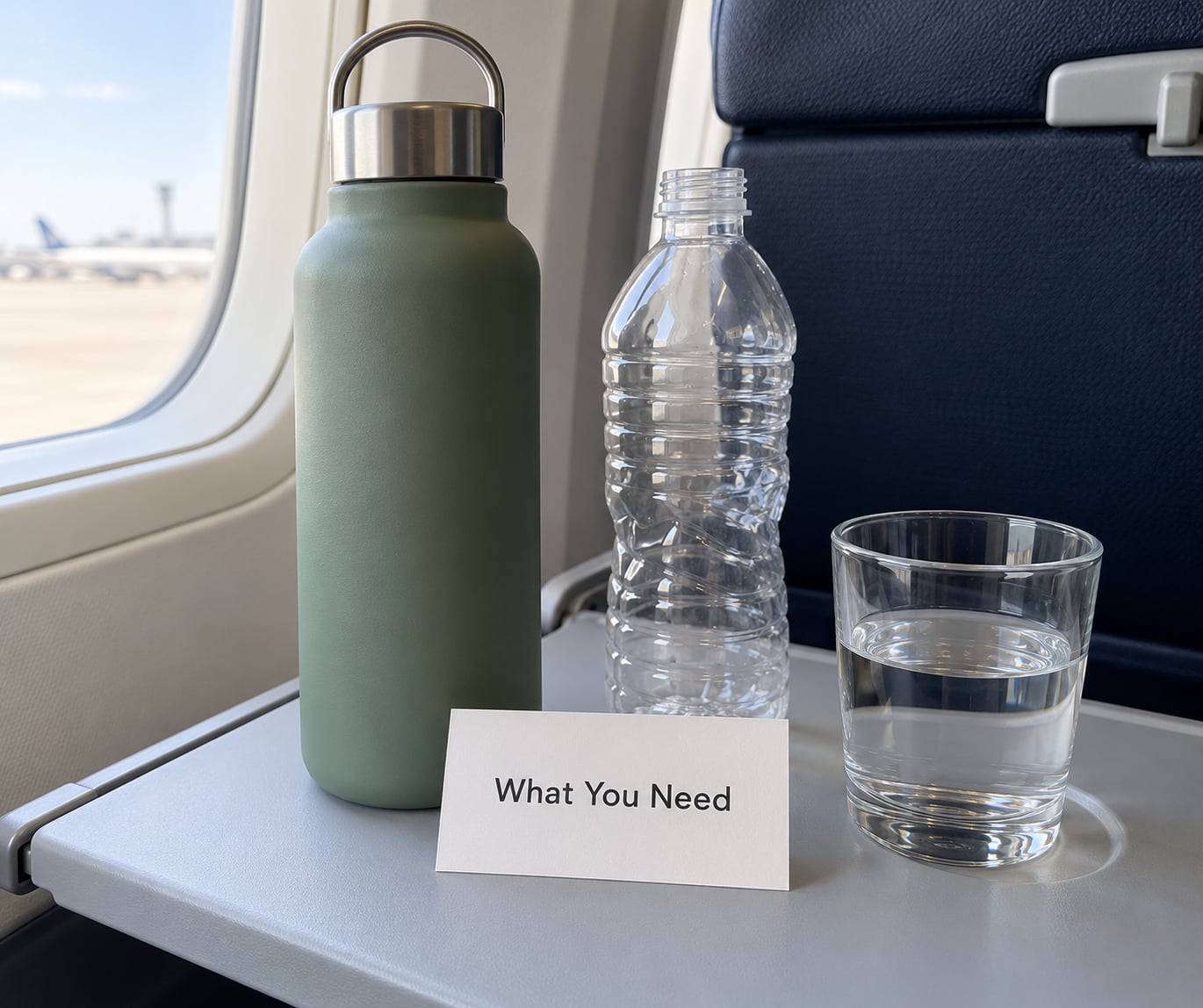
You do not need much. Most of the kit for a long-haul hydration plan fits in the seat pocket in front of you, which is a good test.
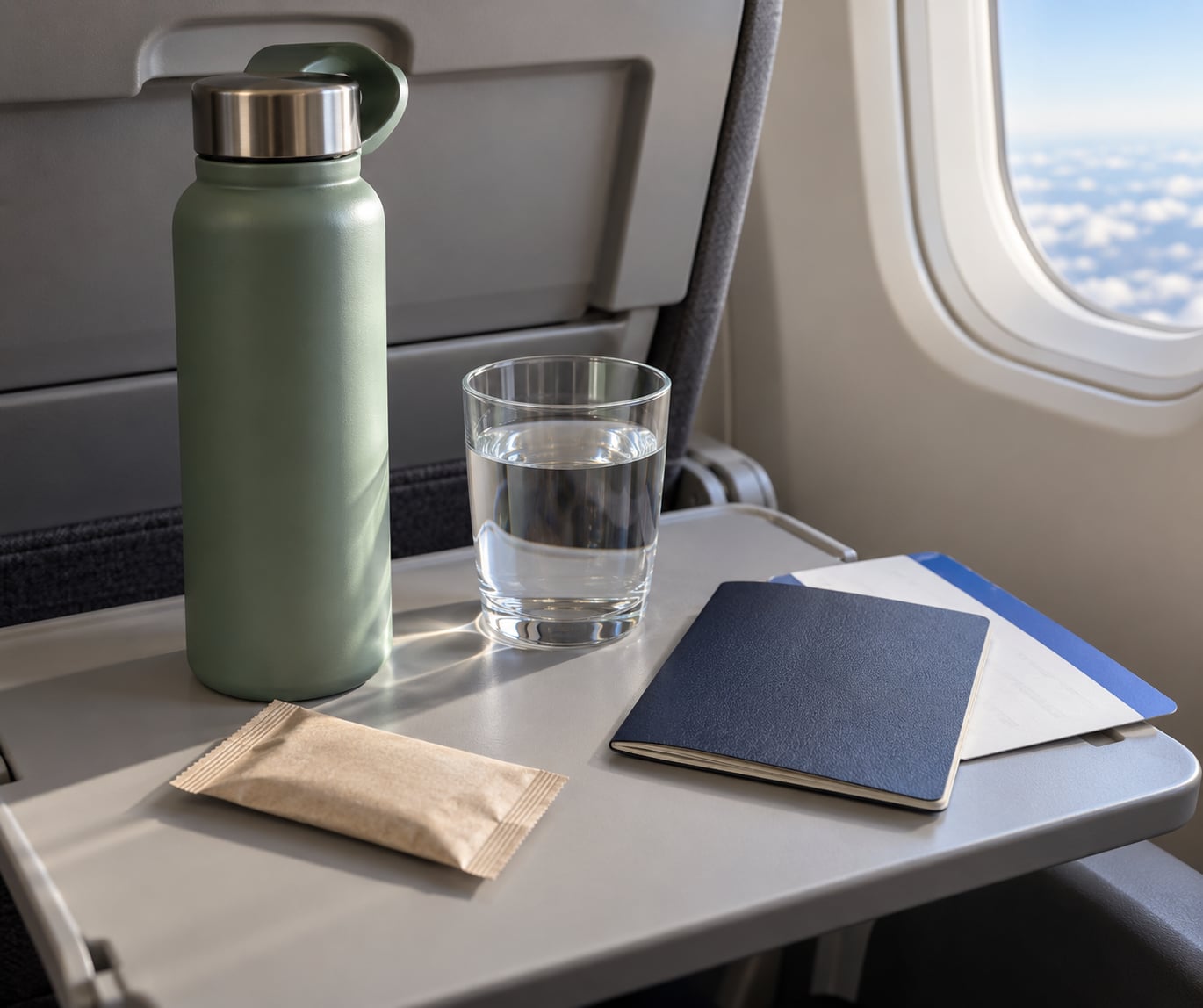
- A refillable bottle you can hold with one hand. A wide mouth matters more than insulation. You want to drink without twisting, unscrewing or fishing around, because the moment it becomes awkward you stop.
- An empty personal bottle for the airport. Liquids over 100 ml are not allowed through security, so the bottle travels empty and gets filled afterwards. This is the single most skipped step and the reason so many people board with nothing.
- Electrolyte sachets or tablets, if you want them. Optional, useful on hot routes, long red-eyes or heavy sweating, and unnecessary for most people on a routine daytime flight.
- Anything a clinician has told you to take. If you are on a prescribed fluid schedule, or a medication that affects fluid balance, follow that instead of any generic article, including this one.
- For the dry-air side: preservative-free eye drops, a saline nasal spray, and a thick lip balm. Travellers report these matter more to them than thirst does.
A bottle size worth thinking about: 750 ml to 1 litre. Anything much larger becomes dead weight in a seat pocket, and anything under 500 ml means refilling a lot in a cramped space.
How to Stay Hydrated on a Long Flight: A Step-by-Step Plan
1. Start Hydrating Before You Leave Home
Begin the day before if you can. People who fly on POTS, dysautonomia or other conditions that affect blood pressure are often told by their clinician to load up with fluid for two or three days ahead, and those of you without a medical reason can still borrow the habit: normal drinking, nothing heroic, starting the evening before.
On departure day, keep drinking at your normal pace through the morning. Chugging a litre in the hour before leaving the house does not help, because you will simply need the lavatory twice before takeoff. Eat something light and lower in sodium than a fast-food stop; salt makes you retain fluid, and retention works against you in a seat that is already swelling your ankles.
One caveat worth stating plainly: if you have been told to limit fluids for heart, kidney or other medical reasons, none of the volumes in this article apply to you. Follow your clinician’s number, not this page.
2. Carry an Empty Bottle Through the Airport
Empty in your bag, full by the time you sit down. Find a bottle-filler station after security rather than buying a plastic bottle from a shop, both for the cost and because a bottle you can keep topping up all flight is the one that will still be with you at hour ten.
Top it up again at the gate, and know where the next one is. Larger airports often have bottle fillers near the gates or inside the lavatories, and a lavatory tap works perfectly well if you have an empty bottle. If you get moved to a different gate, take the bottle with you. Finding a bottle that has been abandoned in a seat pocket is far more common than it should be.
3. Take Small Sips After Boarding
Once seated, take a few sips while the doors are still open and the cabin is settling. It sets the pattern: water in hand, small swallows, every 10 to 20 minutes, roughly whenever you glance at the time.
Small and steady beats a large glass every two hours. Your body absorbs fluid better in small frequent amounts, and the practical reason matters just as much: a 1-litre bottle emptied in one go means you are standing in the lavatory queue while the meal service goes past your row. Aiming to finish your target at about a sip every 10 to 20 minutes spreads the same volume across the whole flight and mostly keeps you out of that queue.
Airlines do serve water, but it is not something to plan around. Cabin service on a long flight can be episodic, cups are small, and there may be stretches with no service at all. Your own bottle is the plan; the drink cart is a bonus.
4. Build a Timed Drinking Schedule That Scales With Your Route
Here is the calculation nobody gives you, and it is the reason generic advice feels useless. Take your flight time, multiply by 240 ml, and treat that as a target rather than a quota.
| Flight length | Water target in the air | How it divides in practice |
|---|---|---|
| 4 hours | About 1 litre | A small glass roughly every 30 to 40 minutes |
| 7 hours | About 1.7 litres | A sip every 10 to 15 minutes, with a 200 ml top-up around every hour |
| 8 hours | About 1.9 litres | One 750 ml bottle plus one refill |
| 12 hours | About 2.8 litres | Two 1-litre bottles, or three 750 ml refills |
| 16 hours | About 3.8 litres | Spread across a full day of drinking, not concentrated into the first four hours |
A worked example for a 12-hour overnight flight leaving at 7pm. Drink normally through the day. Empty the bottle before boarding, refill it at the gate, and have about 200 ml between boarding and takeoff. Then aim for roughly 250 ml in the first hour, 300 ml in the second, and 250 ml in each hour after that, which lands close to the 2.8 litre target. Set a phone or watch alarm every 20 minutes and you do not have to think about it, which is the entire trick on a red-eye.
Adjust the schedule, not the principle, for your route. A daytime flight gives you natural anchors: drink during the meal service, drink when the film changes, drink when the service comes round. A short flight needs far less planning. If you are in a window seat and the service rarely reaches you, the alarm matters even more because nobody else is going to prompt you.
5. Choose Drinks That Help Without Adding Discomfort
Water is the default, and everything else is a modification of it. Here is the honest ranking for a long flight.
| Drink | On a long flight | Why |
|---|---|---|
| Plain water | Default choice | Hydrates without adding sugar, caffeine or irritation |
| Electrolyte drink or sachets | Useful on long, hot or sweating flights | Sodium and potassium replace some of what you lose in perspiration |
| Tea | Fine in moderation | Contains less caffeine than coffee; some people find it gentler on the stomach |
| Coffee | One is fine, two is usually a mistake | Mild diuretic effect, plus it disrupts sleep on a long route |
| Alcohol | Skip it | Worsens dehydration, worsens sleep quality, and inflates you the next morning |
| Sweet drinks and juice | Occasionally, small amounts | Hydrating, but sugar load means more fluid to process |
On caffeine, the honest version is that one coffee at the gate is not going to hurt anyone. Two or three across a twelve-hour flight, plus poor sleep from the caffeine itself, is a different situation, and the flyers who say they feel best on long routes tend to be the ones on tea and water. Forum regulars on FlyerTalk and r/travel describe the same pattern repeatedly: a few sips every half hour, no coffee, very little tea.
On alcohol, skip it for the flight. It works against you on three fronts at once: it dries you out, it fragments sleep, and it is hard to undo for several hours after landing.
On electrolytes, they are genuinely optional. A sachet in your bag costs you nothing to carry and covers the cases where they earn their place: a hot route, a long run of sweating, an older traveller, or anyone who has been unwell and is eating or drinking poorly. If you use them, mix them into your own water rather than treating them as a replacement for it, and follow the packet directions rather than making them stronger. If you have kidney, heart or blood-pressure conditions, ask a pharmacist before adding regular sodium supplements.
6. Rehydrate After Landing
The work is not finished at the gate. Within the first hour on the ground, have a proper drink and a balanced meal with some salt and protein, because a long flight leaves you under-fuel as well as under-hydrated. Keep sipping through the rest of the day.
Watch for the symptoms that outlast the flight and mean you should stop guessing. Persistent dizziness when you stand, confusion, a headache that does not shift with fluids, very dark urine for more than a day, or a dry mouth with no thirst at all are all reasons to see a doctor rather than a reason to drink more water. The same goes before any flight if you have heart, kidney or fluid-restriction conditions, or if you are pregnant, on dialysis, or caring for someone with a catheter or feeding tube. Those cases need a plan written by a clinician, not a general guideline.
Common Mistakes
Waiting until you are thirsty. Thirst lags behind fluid loss, and in dry cabin air the signal arrives late. The correction is the alarm, not willpower: set it every 20 minutes and let the reminder do the work.
Drinking a large amount at once. A 750 ml bottle emptied in five minutes gives you a bathroom trip twenty minutes later and a wide swing in fluid balance. Small, spaced sips are absorbed better and cause far less disruption.
Drinking almost nothing to avoid the lavatory queue. This is a real temptation for anyone who has sat in that queue, and it is how people arrive wrecked. The fix is to start the routine early in the flight and use the natural gap during meal service, when the queue usually empties.
Filling up on coffee and alcohol. Both make hydration harder rather than easier, and the alcohol also wrecks the sleep you need to recover from the time zone change. One coffee is a choice; three is a habit you will pay for at the destination.
Forgetting to refill, or losing the bottle. Keep it in the seat pocket or the bag, not in the overhead bin where nobody can reach it. Refill at the gate, and again whenever you spot a bottle filler during a walk down the aisle.
Ignoring your own medical situation. The 240 ml per hour figure is a benchmark for a healthy adult on a normal flight. Anyone on a fluid restriction, or managing a condition that affects fluid balance, should follow their clinician’s plan instead and skip the rest of this guide’s volumes.
Going too far in the other direction. This is the mistake nobody mentions. Drinking several litres of plain water in a short window, with no electrolytes and no food, can dilute your sodium levels, which is a genuine medical emergency. Spread the volume across the flight, eat something, and if you have a condition that affects fluid balance, ask your doctor what your ceiling should be before you fly.
Frequently Asked Questions
How much water should I drink on a 7 hour flight?
About 1.7 litres, which is roughly 240 ml for each hour in the air. Spread that over the flight rather than saving it up, aiming for a sip every 10 to 15 minutes and a noticeable top-up around every hour. Eat something along the way and add an electrolyte sachet if the route is hot or you have been sweating.
Why am I so dehydrated when I fly?
Cabins are pressurised to the equivalent of about 6,000 to 8,000 feet and hold relative humidity of only 10 to 20 percent, which is drier than most deserts at night. You lose moisture with every breath, and the low pressure increases urine output as well. The result is dry skin, dry nose and eyes, and thirst that arrives later than the fluid loss did.
How do I drink water constantly if I have a window seat?
Your bottle is the whole answer, because the drink cart cannot reach you reliably. Fill it at the gate, keep it in the cup holder or the seat pocket armrest, and set a phone alarm every 10 to 20 minutes. A soft-sided bottle with a drinking hose is a common trick among window-seat flyers who want to drink without moving at all.
Should I drink electrolytes while flying?
They are optional, not essential. They earn their place on long, hot flights, on overnight routes, and for anyone who has been unwell or sweating a lot, because they replace some of the sodium and potassium lost in perspiration. Mix them into your own water rather than using them instead of it, follow the packet directions, and check with a pharmacist first if you have kidney, heart or blood-pressure conditions.
How do I stay hydrated on an overnight flight while sleeping?
Drink your target in the two or three hours before you sleep, then set an alarm about two hours before landing to get a few hundred millilitres down before you land. Fill the bottle before you settle in and keep it inside the seat rather than overhead, where it will wake you every time someone opens the bin. A sip when the service comes round is a useful bonus.
Is the water on the plane safe to drink?
It is treated water and it is fine for most people, but the tanks are small, rarely fully cleaned and the fill quality varies by airport, which is why some travellers notice a chlorine or plastic taste. Filling your own bottle after security gives you more control and removes you from the question entirely. If you have a medical condition that makes you vulnerable, play it safe and use your own water.
Conclusion
Knowing how to stay hydrated on a long flight comes down to one habit: fill an empty bottle after security, then take small sips every 10 to 20 minutes until you reach about 240 ml per hour of flight time. Keep the bottle within reach, use the meal service and the drink cart as bonuses rather than the plan, and skip the alcohol.
Then adjust the numbers to your own body. If you have been given a fluid limit, or you have a heart, kidney or blood-pressure condition, take your figure from a doctor instead of a table. Everything else here is general travel information, and it should not replace advice from a clinician who knows your history.